Skip to content

First Gasp for a New Geezer

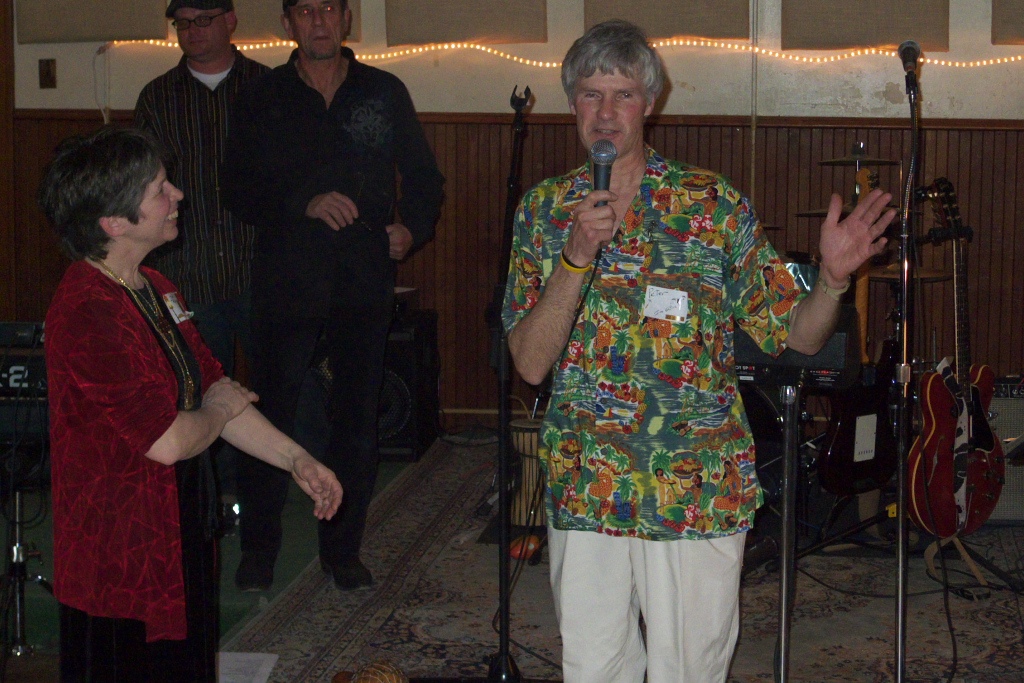
I have to pay tribute to a friend of ours, who celebrated his 60th birthday last night with a big bash at the German club in Mystic. Peter and his wife, depicted below, are good Democrats both. He and I were both committed Lamont delegates at the 2006 state convention.

Music was provided by the Rock and Soul Revue, performing some of the best of the music from the sixties. They were great. Some cynics might say that the dance floor was full of nascent geriatrics, desperately trying to re-live their youths. Those cynics would probably be right, but we all had a good time anyway. Besides, we can still lay claim to having been around when the best music ever was being made, and, as the poet said, “to be young was very heaven” (so long as you kept your ass stateside).


Nationally known

Atul Shah, who wrote a guest post for this blog recently, has made our chapter of Drinking Liberally nationally famous.

Listen here

The show was in New York, which explains the seemingly gratuitous statement about New York.

Friday Night Music for Hard Times

This week, rather than searching for a song by a specific artist, I decided to search for the best version(s) of a song. I first heard this song on an album of Stephen Foster’s music sung by Thomas Hampson, a classical music singer. The album is called American Dreamer, and if you think Stephen Foster is just Oh Susanna, you should give the album a listen, though rock and roll it definitely is not. Hampson’s version is on youtube, but with no video.

The song is Hard Times Come Again No More, which seems timely. The prevailing wisdom on youtube is that it is a Civil War era song, but that’s not the case. It dates to 1854, and it clearly references a time of economic hardship in which even our often inadequate social “safety net” didn’t exist.

The song lends itself to all kinds of arrangements. Sticking to my criteria of no lip synching, I’ve chosen two that I think lead the pack. The first is Bob Dylan, singing a hard scrabble version at a Willie Nelson tribute concert.

The second is in an entirely different style, by James Taylor and Yo-Yo Ma, from Ma’s Appalachian Journey album.

Honorable mention to Mavis Staples, who loses out because of the lip synching ban.

UPDATE: In response to popular demand (see comments), I’m putting Mavis Staples up. I’m still not convinced about the lip synching.


Unintended consequences

Chris Hayes of the Nation, who many of us know from his frequent appearances on Countdown, has uncovered a truly marvelous example of corporate perversion of the tax laws:

Thanks to an obscure tax provision, the United States government stands to pay out as much as $8 billion this year to the ten largest paper companies. And get this: even though the money comes from a transportation bill whose manifest intent was to reduce dependence on fossil fuel, paper mills are adding diesel fuel to a process that requires none in order to qualify for the tax credit. In other words, we are paying the industry–handsomely–to use more fossil fuel. “Which is,” as a Goldman Sachs report archly noted, the “opposite of what lawmakers likely had in mind when the tax credit was established.”

The massive tax subsidy has barely been reported in the press, but it’s caused a stir in the paper industry, which is struggling to stay profitable in the teeth of the recession. “Everybody’s talking about it,” paper industry analyst Brian McClay told me. “In the US and elsewhere in the world–in Canada and Brazil and Chile and Europe.”

Previously, the paper companies got all the energy they needed purely as a by product of the process by which they turned paper into wood. Adding diesel fuel to the process amounts to a gratuitious use of the fuel. As a hedge fund manager (of all things) quoted by Hayes, remarked, “You use the toilet every day, Imagine if you could start pouring a little gasoline into the bowl and get fifty cents a gallon every time you flushed.”

Congress clearly did not intend this. Stay tuned to see if it will be corrected, or whether the paper industry’s lobbyists will convince our representatives that this subsidy and waste is in the national interest. After all, Congress has still not seen its way clear to taxing that hedge fund manager at the same rate as his secretary.


Courtney does good, Himes not so much

You would think that Congress would be wary of sanctioning more bonuses at bailed out institutions, particularly at AIG, but of course you’d only be partly right. Congress is more than happy to help those bankers, so long as it can do so in a way that, at least at the moment, is totally opaque (that being the opposite of transparent). The House recently considered a bill, co-sponsored among others, by Jim Himes, former Wall Streeter, to restrict bonuses at these government funded institutions.

In its original form, it required all TARP recipients to make all bonuses performance based, and sought to put an end to the $1 billion in retention bonuses still to be paid out in July and September this year by AIG per an agreement they reached with Treasury Secretary Timothy Geithner. In other words, AIG could only pay out bonuses if the company actually did well, and couldn’t be doling them out while the company was losing money and on taxpayer life support.

Quite a hardship, isn’t it? Requiring bonuses to be performance based. Too much of a hardship, apparently, for all but 8 Republicans and 63 (that’s right, 63) Democrats, including, as it turned out, Himes himself.

What to do? How to preserve those bonuses while avoiding political heat?

Well, you amend the bill to exempt any TARP recipient that has started to repay the loans. So, all the bonus deprived crooks that caused this mess have to do to cash in is return a few of our dollars and they are home free. The repayment plan must be approved by the Treasury, but given Geithner’s performance on this, as on so many other issues, don’t expect that he’ll impose onerous terms. In any event, what’s the justification for paying bonuses to people just for remaining on a job that plenty of ex-Wall Streeters would be happy to fill.

The other four Connecticut Congressfolks, including our Joe Courtney, voted against the amendment. Here’s hoping that there’s a political price to pay next year for those who figured they could ignore the public’s feeling about this issue so long as they could do so in a backdoor manner. And here’s hoping beyond hope that Treasury will impose significant payback requirements as a condition of getting the waiver.


Tit for tat, not for the Democrats

26 Democrats have gone on record opposed to using the reconciliation process to pass climate change legislation, thus handing the Republicans a victory without cost to them. Most of those Democrats will most likely take the same position on health care, thus dooming the American people to a broken health care system, and thus a broken social system and economy, for the foreseeable future. All this because the Democrats don’t want to be seen as being unfair to the Republicans by using a parliamentary tactic that was used against them, time and again, by the Republicans.

There is an oft misunderstood Biblical injunction that prescribes “an eye for an eye and a tooth for a tooth”. In the days when it was written punishments were often meted out that were disproportionate, as they so often are even today. The Biblical injunction was a limitation on the severity of a punishment, a ceiling and not a floor. That formula of equivalent penalty is one the Democrats should keep in mind.

Years ago I read an article in the Scientific American, the burden of which was that the best way to prevent bad behavior, including bad political behavior, is to engage in a tit for tat. That is, if your opponent does something to you, you should do something equivalent to them. No more, but no less. An overreaction causes a spiraling series of provocations; overreaction is therefore “too hot”. Underreaction, or (as the Democrats prefer) no reaction is “too cold”. Equivalent reaction is “just right”. This is the reaction most likely to prevent future tits, so to speak. The Democrats were subjected to numerous tits, and their reluctance to deliver any tats will surely come back to haunt them, when their inability to deliver on their promises puts them back in the minority, as it most surely will, and sooner than you might think. When the Republicans are back in the saddle they will revert to their own ways, all their talk about respect for the rights of the minority forgotten. The Democrats can delay their return to minority status, and prevent those future tits, if they engage in a few tats now. Don’t hold your breath.


Larry Summers’ past at Harvard

It’s been only about 70 days, but already Bush is beginning to seem like a bad memory. Obama has been a breath of fresh air in many ways, but there’s some notable exceptions, made all the more depressing for the very reason that they are so few.

The most notable exception is the quality of his economic team, which is top-heavy with the folks, or the enablers of the folks, who gave us the economic crash. Chief among them is Larry Summers, about whom there is more news today. It seems while he was at Harvard (as its president, not as a student) he was involved in firing a woman who had the temerity to warn him that the Harvard endowment was being invested in derivatives that were not understood by the folks who were doing the investing. The story (via TPM Muckraker) was broken by the Harvard Crimson:

A former quantitative analyst at Harvard Management Company, the university’s once-vaunted endowment manager, tells the Harvard Crimson she was fired for voicing concern to then-university president Larry Summers’ chief of staff about the money manager’s risky use of derivatives the traders didn’t understand.

From the Crimson:

“The group I was working for had no background whatsoever to be working on [derivatives],” Mack says, adding that, to her knowledge, several of her colleagues were not licensed securities traders. “Sometimes the ways they handled even basic Black-Scholes models [widely used to price stock options] were puzzling.”

Back to TPM:

So Mack took inventory of the abuses — high employee turnover, lax risk management practices and a “low level of productivity in the workplace” were among others, and detailed them in an email to Marne Levine, Summers’ chief of staff and a Treasury staffer on the Obama Transition Team. (Summers was the only person to whom Meyers reported, and according to a recent Forbes story he personally ordered the university’s biggest derivatives trade, a purchase of interest rate swaps that cost the university billions this year.)

She was fired quite explicitly for raising these issues, even though she was told that the communications would be kept confidential. Of course, what’s important for us is the fact that this is just another example of Summer’s faith in these financial instruments, which thanks to his genius have caused such losses at Harvard. This is not a man who is capable of perceiving that the economic system needs fundamental restructuring, because for him to perceive that, he would have to admit that he has been consistently wrong for a very long period of time. People with outsize egos can’t do that sort of thing, and from all accounts, Summers has an outsize ego. Rather than creating a new economic order, Summers is invested in re-establishing one in which he believes and with which he is comfortable. That’s very bad news for the rest of us.


Guest Post-Al Gore in Boston

When I heard that Liberal Drinker, incredibly dedicated campaign worker, and survivor of the Purple Tunnel of Doom, Atul Shah, went to Boston to see Al Gore I asked him (through my wife) to write something up about his visit, which he was nice enough to do. Gore was in Boston to talk about climate change. Atul’s report follows:

Before Al Gore’s talk, a very small number of protesters, mostly global warming deniers, were gathered outside holding up signs and handing out propaganda. One sign, held by a man and his son, read “Coldest winter in years. Record lows. Where is your Global Warming now?” One man, probably in his thirties, tried to hand me some “literature” (a.k.a. propaganda); when I asked him if he was a global warming denier, he used the euphemism “truther” to describe himself, saying that he didn’t deny that the planet is warming, but he didn’t accept (what is almost unanimously the consensus of mainstream scientists) that it is caused by human activity.

Inside, it appeared that most of the seats in the Wang theatre were filled – although I did notice some empty seats in the orchestra pit (where I had a second row seat approximately 10 feet away from Mr. Gore’s lectern which was just about directly in front of me). The face value of tickets for these seats was $200 (with other charges, the total was $221), and as I found out after the fact (unfortunately), entitled ticket holders entrance to a pre-talk meet-and-greet reception and photo-op with the man who should have been our 43rd President.

The format of the event was for the former Vice President to give a brief talk, followed by a sit down question and answer session with a reporter from the Boston Globe (I can’t remember her name). The account to follow is off the top of my head, may contain some inaccuracies, and is far from an exhaustive description of all of the issues discussed.

After a brief introduction by a couple of speakers, Mr. Gore came out to a standing ovation and loud cheering and applause. He then spent perhaps 15-20 minutes speaking eloquently, often interrupted by applause, about the many crises we currently face as a nation and world. The key issues he discussed were the environmental, economic, and security threats. He explained how all three were tied to our current carbon-based energy economy. At one point during his talk, he mentioned his belief that the Iraq war was the single biggest foreign policy mistake in our nations history; this obviously drew loud applause. In articulating the goal of switching to a renewable infrastructure (I believe he mentioned a preferred time horizon of ten years), he invoked President Kennedy’s call in 1961 to send a man to the moon and bring him back. Mr. Gore compared the many critics currently dismissing calls for switching to renewables to those in the 1960s who said sending a man to the moon couldn’t be done. In pointing out that within eight years, JFK’s vision was accomplished, he also mentioned that the average age of the scientists working on that mission was 26, meaning that they were just in their late teens when the goal was initially set. The obvious analogy being that we have many young, idealistic citizens ready to take on our current challenges. In one of his more powerful statements regarding how we deal with climate change, he pondered whether future generations would look back on us and ask themselves “what were they thinking?”, or, preferably, “where did they find the moral courage?”, and he called upon everyone to help get the message out about the crisis we face.

The sit down question and answer session lasted a little over an hour and was of a casual conversational format, with both Mr. Gore and the interviewer sitting in a mock living room setting. There was a range topics discussed, including some issues found in “The Assault on Reason” and “An Inconvenient Truth”. When asked if he thought that, having been denied the Presidency, perhaps he has been able to have more impact through his projects since leaving government, Mr. Gore indicated his belief that there is no more powerful office than the U.S. Presidency when it comes to being able to have an impact. Among the topics, there was some discussion of the dismal state of newspapers and print media. While indicating that the days of the newspaper as we know it are numbered, Mr. Gore expressed optimism that a new model for journalism will eventually emerge. As an analogy, he reminded everyone how Napster’s original threat to the recording industry eventually led to the iTunes model where users are willing to pay a reasonable price for legal downloads. Additionally, to put things in perspective and illustrate how quickly society can change and adapt with technology, he mentioned that when he and President Bill Clinton took office in 1993, there were only 50 websites on the internet. Similarly, he referred to a book written by Bill Gates in the 1990s in which the internet wasn’t mentioned even once. At one point when talking about the general problem of an uninformed electorate, Mr. Gore mentioned that the average person now spends eight hours a day in front of a screen of some sort (e.g. computer, TV, etc.) and that the average time spent in front TV every day is some obscene number (was it 4?). He remarked how we humans can’t help but be distracted by the motion on a TV screen – we have been evolutionarily programmed to react to such cues. With some humor, he pointed out that if we played tennis for that many hours every day, our muscles would be well-exercised; he then rhetorically asked what that many hours of watching TV would exercise. Another question asked by the interviewer was in regard to climate change and whether we already may be past the so-called “tipping point”. In responding that it’s not to late to act, he did mentioned that we probably won’t get back to normal in our or our childrens’ lifetimes, but that it could happen within our grandchildrens’ lifetimes.

When asked about his opinion of President Obama’s handling of the economic crisis thus far, he had positive things to say, but also reminded everyone that Obama has only been in office for two months and has a lot on his plate. Regarding the economy, the interviewer asked Mr. Gore his thoughts about the future of capitalism, given the current crisis. His response was that both the Declaration of Independence and Adam Smith’s “Wealth of Nations” were written in 1776, and both have been important to the development of our country. While articulating his view that capitalism has led to much innovation and has generally worked for us, he pointed out that regulation is necessary for its proper functioning. There were a number of other topics touched upon which I can’t think of at the top of my head.

All in all, it was an excellent event – well worth the $221 I spent for my ticket (although I do wish I had known that I could have gone to the meet-and-greet reception). Mr. Gore showed himself to be an extremely knowledgeable, articulate, humorous and intelligent individual who would (and should) have made a great 43rd President. It boggles the mind to think how things would be today if it weren’t for the butterfly ballot!

Filibusters

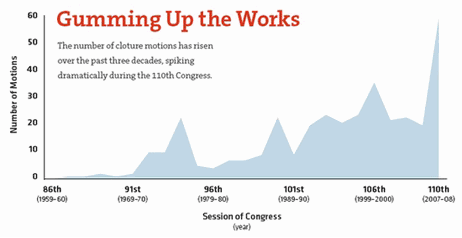
Here is an interesting graph from ThinkProgress:

It is the number of cloture votes taken in the Senate since the 86th Congress, back in the 50s. It demonstrates conclusively that Harry Reid’s oft repeated statement that it takes 60 votes to pass anything in the Senate, if true, has only recently become true. And it demonstrates, again conclusively, that the current crop of Republicans has accelerated the trend to the point of absurdity.

The Republicans are currently planning on filibustering the nomination of a candidate to head the Office of Legal Counsel because she had the temerity to criticize the spurious legal rationale for torture and other Bush era abuses that everyone agrees deserved that criticism. We can expect that every major Obama initiative will be threatened by a filibuster, meaning that each and every one, in order to pass Harry Reid’s Senate, will be watered down so badly that it will have no chance to succeed.

Reid throws up his hands and insists there’s nothing he can do. But in fact, his Republican colleagues have shown him the way. What did the Democrats do in the face of Republican threats to “go nuclear” when the Republicans were in the minority? They “compromised”, bargaining away their own practical right to filibuster Bush judicial nominees in favor of preserving a theoretical right to do so, so long (as the Clash would say) they weren’t “dumb enough to actually try it”. The compromise was a win-win for Republicans, knowing as they did that the Democrats would never have the nerve to reply in kind should the tables turn.

A prescient blogger (me) said this at the time:

Speaking of the filibuster, the Democrats should take the bull by the horns right now. Since they’re not going to use it, they should offer to make the Republican position explicit: that is, change the Senate rules to make it clear that a judicial nomination cannot be filibustered. Because I can guarantee you, come 2008, the Republicans will filibuster every judicial nomination they don’t like, and they’ll be calling it a constitutionally sancrosanct maneuver. And the Democrats won’t have the nerve to go nuclear. So do it now. The Democrats have managed to turn the filibuster into a tool only the right wing can use. At the very least, take it away from them while they have no choice but to agree. And who knows, putting it to them like that might make them give a thought or two to 2008 and beyond. They’re not looking as good now as they were six months ago, and they no longer can count on the permanent majority they thought they had.

Of course, it really didn’t take much prescience. It was obvious to anyone with a brain.

Here’s hoping, but not expecting, that Obama will invite Reid down to the White House and tell him to start playing some hardball. There are theoretical justifications, as the Republicans argued, for abolishing the filibuster. This once rarely used device was never intended to be an everyday, throwaway procedure. If the Republicans want to keep it, they should have to accept that it is to be rarely used. Otherwise, the Democrats should abolish it using the Republicans’ own rationale. It is a theoretical abomination and, at the moment, a clear and present danger to the survival of the Republic.


It’s that time again

Eyes tired straining at all those numbers in the Republican budget?

Suffering from outrage fatigue caused by corporate bonus babies, zombie banks and zombie Republicans?

Is even Keith Olbermann not enough to replenish your emotional batteries?

Then join us Thursday night, when we will once again Drink Liberally at the Bulkeley House, 111 Bank Street in New London. 6:30 PM sharp, or not so sharp.

Good drinks, good food and good conversation, not necessarily in that order.