A few weeks ago I wrote a post about an art exhibit in Vermont featuring portraits of rock stars that died at the age of 27, which included the likes of Jim Morrison, Brian Jones, Amy Weinhouse, and a host of others. Last week I saw this video here, featuring another singer that died young, but not, in her case, of excess. Her name was Eva Cassidy. I’d never heard of her, but I thought this rendition of Over the Rainbow was great, so I thought I’d pass it on. Maybe no one will ever top Judy Garland, but I think she comes close:
As a bonus, here’s her take on Louis Armstrong’s Wonderful World:
According to the commentary at youtube, this was her final performance.
For mysterious reasons, the media insists on spreading the government meme (apparently, since both parties were complicit, neither bothers to dispute it) that the government made money on TARP. Today’s Times for example:
Sure, the bank portion of TARP has been profitable so far. The Treasury Department estimates that it will make almost $22 billion from its bank support programs. That includes an estimated $3 billion loss from the smaller banks’ paper.
The government lent money to the banks at extremely low interest. The banks loaned it back at higher interest, and pocketed the difference. The government made money only if one disregards the interest payments made to the banks, which is absurd given the circumstances:
Because the US government is lending money to the big banks at near-zero interest rates. And the banks are then turning around and lending that money back to the US government at 3%-4% interest rates, making 3%+ on the spread. What's more, the banks are leveraging this trade, borrowing at least $10 for every $1 of equity capital they have, to increase the size of their bets. Which means the banks can turn relatively small amounts of equity into huge profits–by borrowing from the taxpayer and then lending back to the taxpayer.
Don't you wish the government would offer the 99% that kind of deal? Actually, it might make sense if it did, since it might stimulate the economy a bit. But free money is not for us peons.
What a strange country this is. We have a political party, whose members claim some sort of inside track to God. They speak in moral absolutes, yet they are, at times, oddly willing to "defer" to someone else's moral (if one can call it that when speaking of Romney) position. Consider Paul Ryan:
Ryan, of course, is against the exceptions for rape and incest, but says he’ll defer to Romney's views — which are frankly bizarre in light of the fact that he’s in favor of "personhood" which would render any abortion murder. But then he’s not exactly known for his philosophical consistency.
Deferring to another’s views. That sounds like “compromise”, an anathema to Republicans when dealing with a large (the major, actually) portion of the American populace. Ryan has insisted on imposing his views on everyone, no exceptions, but seems to feel it is perfectly proper to defer to, and even adopt, the views of a single person, when it suits his purposes. Last I heard, the Randian Ryan was calling himself a devout Catholic. What, one must ask, do the Bishops think of this craven outsourcing of his moral convictions to a feckless Mormon?
The fact is that Ryan’s former position was at least intellectually coherent, even if it was Medieval. The exceptions for rape and incest make sense only if one rejects the “personhood” of the fertilized egg. Once one accepts that premise, the “no exceptions” policy follows as the night the day. If one adopts the “rape and incest” exception, than one implicitly rejects that premise, and implicitly accepts that the question of whether an abortion is proper in a given circumstance is a matter of judgment, and the argument for individual judgment is compelling.
Why are all those Republicans urging Todd Akin to withdraw from the Senate race? He only said what they all purport to think. If life begins at conception, and they want the constitution to say that it does, then his position follows as the night the day. what he said was not much different than what one of their former leading candidate had to say about rape victims:
As horrible as the way that that son or daughter and son was created, it still is her child. And whether she has that child or doesn’t, it will always be her child. And she will always know that. And so to embrace her and to love her and to support her and get her through this very difficult time, I’ve always, you know, I believe and I think the right approach is to accept this horribly created — in the sense of rape — but nevertheless a gift in a very broken way, the gift of human life, and accept what God has given to you. As you know, we have to, in lots of different aspects of our life. We have horrible things happen. I can’t think of anything more horrible. But, nevertheless, we have to make the best out of a bad situation.
It's worth pointing out in this context that the Republican party, a wholly owned subsidiary of the 1%, which really only plays the religious nuts for suckers by getting them to vote against their own interests, has no intention of denying access to abortion to the daughters of said 1%. All they'll ever need do is hop on a plane.
I’m back, so it's time to commence whining about the people who are destroying our society. Not that I've managed to completely forget them, but it certainly helps to be in comparatively sane Vermont.
While in that island of sanity (only one Wal-Mart in the whole state) I began reading Joseph Stiglitz’s The Price of Equality, in which, among other things, he debunks the idea that our overlords are overachievers of some sort. In fact, as most of us could intuit, they are simply very powerful people who have managed to game the system so that they always win. Among other strategies, they seek to avoid transparency. The less their customers understand, the more they can induce them to make a sucker’s bet. So the following, from a story in Saturday’s Times, about the Facebook and other high-tech stock offerings, struck a chord:
In times of optimism, that knowledge dearth can actually work to the advantage of technology companies. Executives fill that emptiness with promises of paradigm-breaking ways of doing business, prompting Wall Street analysts to project amazing profits. Investors get excited and flock to their stock debuts. In short, it’s all about being seen as extraordinary.
In my humble little legal world, in which even the bankers are not these sorts of bankers, filling “emptiness with promises” is another word for fraud, but when you let the scam artists make the rules – well, then it’s an entirely different story-a perfectly legitimate way to do business. Results are the same as what we call fraud, of course. The folks making the empty promises walk away with billions (“millions” is so yesterday), while the suckers just walk away empty.
The FCC has fined Google $22.5 million dollars for willfully violating the privacy of millions of people, after it had promised to stop doing almost exactly the same thing in another context:
David Vladeck, who leads the agency’s consumer protection bureau, defended the penalty. “$22.5 million may not seem like a lot of money to Google,” he said in a conference call with reporters last week. “But we think it’s quite a substantial civil penalty … We hope this sends a clear message.”
We dug up some numbers for comparison to the Google penalty:
It’s 0.1 percent of Google CEO Larry Page’s net worth, according to Forbes.
It would take about five hours for the company to bring in that amount, based on sales from the most recent quarter.
It’s less than the gain Google’s stock saw Thursday, the day the FTC announced the settlement. Google added $39.2 million to its market capitalization that day.
So, to put it in numbers we can wrap our heads around, Google had to pay almost one quarter of its gross daily income for willfully violating the privacy rights of millions. One thing we don’t know: How much did Google make violating those rights, and by how much did that number exceed the fine? I.e., how much did it profit from its illegal behavior, even taking the fine into account? Did this penalty, in fact, echo the oft-sent “clear message” to corporate America that the costs of illegal behavior are dwarfed by the profits to be made before you are caught?
But lest we lose all hope, just remember that the American system of justice is more than capable of meting out retributive justice when it is truly deserved. Just consider Joel Tenenbaum and Jammie Thomas-Rasset, both of whom illegally downloaded almost dozens of songs, for which, according to the Google standard of one quarter of daily gross income we might expect them to be fined a whopping $100.00 or so. But no, true justice prevailed in these cases:
Without commenting on the merits of the case, the Supreme Court this morning let stand a $675,000 jury verdict against a 25-year-old Boston University student who downloaded 30 songs nearly a decade ago and then shared them with others on a peer-to-peer network.
The court denied Joel Tenenbaum's “write [sic] of certiorari” which means his appeal of a lower court's ruling and the judgment were turned down.
A new lawyer, a new jury, and a new trial were not enough to save Jammie Thomas-Rasset. In a repeat of the verdict from her first federal trial, Thomas-Rasset was found liable for willfully infringing all 24 copyrights controlled by the four major record labels at issue in the case. The jury awarded the labels damages totaling a whopping $1.92 million. As the dollar amount was read in court, Thomas-Rasset gasped and her eyes widened.
So you see, despite the fact that the actual damages suffered in both of the above cases probably could have been covered by one quarter of the daily gross income of the respective defendants, the American system of justice pulled through.
To paraphrase Mel Brooks “It’s good to be the Google”.
Presumably, Romney’s main reason for picking Ryan is not his early deficit-busting record but his more recent rise to celebrity as a crusading policy wonk determined to tame the federal government. Romney, who has been extremely vague about what he would do if elected, will now own Paul Ryan’s ideas, which include privatizing Social Security, turning Medicare into a voucher program, bloc-granting and drastically cutting Medicaid, and reducing discretionary spending to levels that would affect every popular government program. This Ryan agenda will now fill the vacuum created by Romney’s unwillingness to lay out the specifics of his own plan. Even before this (apparent) announcement, Democrats were planning on tying Romney to Ryan’s policy platform. Now Romney has done it for them.
It would help had Obama been a true champion of the middle class during his first term, but in fact, his administration’s loyalty was to the banks and bankers, who have abandoned him anyway for one of their own, in light of the fact that he hurt their feelings with some mild criticism every once in a while. But here, Obama benefits, for while he has really been ineffectual in many respects (consider the hopelessly inadequate mortgage relief program), he has been demonized as a radical so much by the plutocrats and Republicans that he can plausibly claim to be the champion of the middle class, as indeed and alas, he is, for he’s all we have.
I’m optimistic that the Democrats can get the bat on this ball. There’s a good possibility that Ryan will make the Palin pick look like a stroke of genius. For all her clownishness, there was never any impression that she would drive policy, unless, of course, McCain dropped dead. But this pick is a very clear signal, whether Romney admits it or not, of the direction in which he will be taking the country. It’s a direction in which virtually no one wants to go, and if the Democrats can merely convince most Independents of the truth, the election is in the bag, at least for Obama. This is also a signal that the Romney team, from the man at the top down, is singularly incompetent.
I have to take issue with Kevin Drum, who believes Harry Reid is, let us say, stretching the truth in his charges about Romney’s taxes:
Politically, of course, Reid’s ploy has worked like a charm. Romney’s taxes are back in the news and Romney’s ham-handed handling of the whole affair has kept it there. And that gives everyone a fifth reason to cheer on Reid: the end justifies the means.
Take a deep breath, folks. This is contemptible stuff and it’s not just business as usual. We’ve spent too many years berating the tea partiers for getting on bandwagons like this to get sucked into it ourselves the first time it’s convenient. It’s time to quit cheering on Reid and get off this particular bus.
He may be right about what Reid is doing, but I think he’s wrong when he prescribes that we return to the days when we reflexively condemned our own when they were accused of bad behavior. For one thing, we often just played into Republican lies (think Acorn).
Many years ago I read an article in Scientific American that argued, and I think persuasively, that the best way to stop someone from engaging in bad behavior is to adopt a tit for tat strategy. If a bad actor knows that he or she will be subjected to the same treatment he or she is dishing out, that actor will think twice about dishing in the first place. Well, Republicans have been titting for years, with nary a tat from Democrats in response. The result has been a ratcheting of bad behavior, to the point that it is now considered perfectly acceptable for them to lie about the citizenship of the president of the United States, or the military service of a decorated hero, to give but two examples. Compared to those lies, Harry’s, if it is a lie, is of the little white sort, since it has the redeeming quality of having a certain amount of truthiness to it. If we want to stop this sort of behavior, we have to show there’s a price, and while it may offend the pure of heart, tit for tat appears to be the most efficacious way to impose that price.
Pleasant times here in Vermont, blessedly removed from almost any exposure to what is happening out there in the world, though I do get the impression that the richest man to ever run for president, a guy who quite probably has paid taxes at a lower rate than I, has decided to attack the poorest people in the country as a campaign tactic. What a guy!
But I digress.
Before we came to Vermont I was interested to see how well they had managed to deal with the devastation visited upon them by Hurricane Irene. To be honest, though there are small things I’ve noticed, just because I was looking, for the most part it’s fairly hard to tell that so much of the state was underwater. This is probably the most dramatic example, and I suspect it hasn’t been fixed only because it wasn’t being used even before the hurricane.
Here's another picture, in context. The stream bed alongside the barn is, to the best of my recollection, at least twice as wide, and probably more, than it was last year.
Just a note. Part of the reason that they’ve come back so well is because at times like that, people do realize that we’re all in this together. When we pull together, we can overcome quite a bit, but when we persist in thinking, as some appear to do, that whatever success we achieve is due solely to our own efforts, then it’s a lot harder to overcome disasters. Maybe that’s why we haven’t been able to come back from the financial disaster gifted to us by the financial wizards who did it all for themselves (except when they needed to be baled out by the rest of us, but what of that?).
But I digress again. No politics.
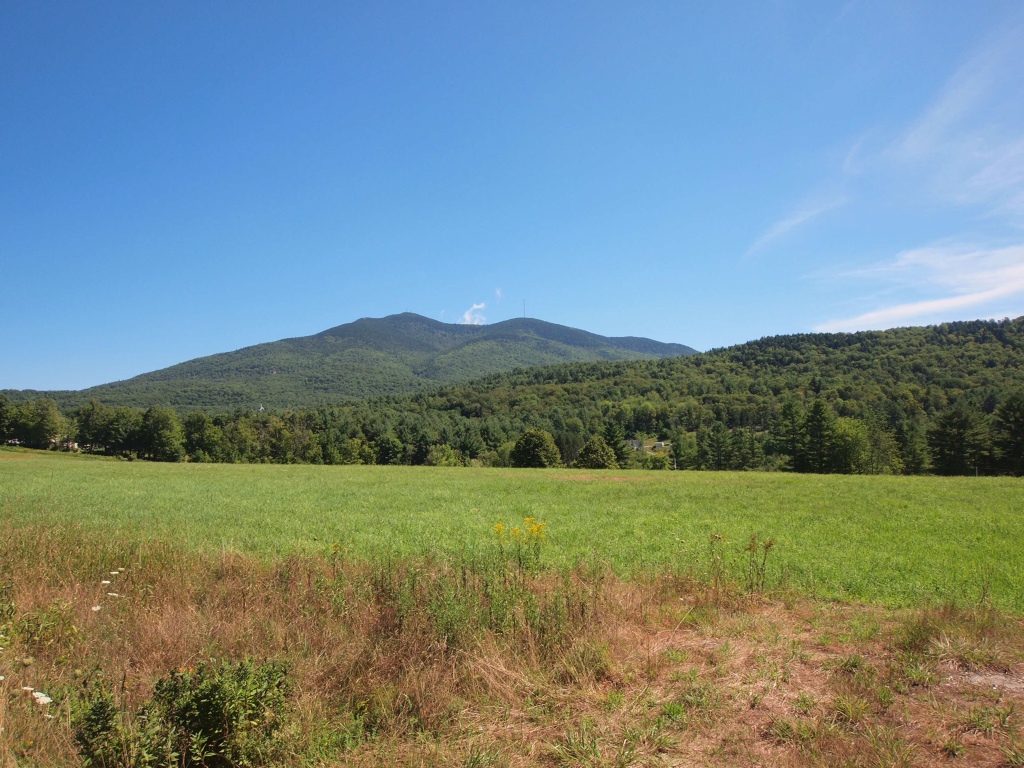
I rode my bicycle to Ascutney, Vermont today. Here's the Mount of that name, dramatically rising from an otherwise almost flat terrain.
Okay, so we’re beginning our annual Vermont vacation a bit early this year. My sister is renting the place we rent every summer this week, and our rental begins tomorrow, so we’ve been her guests since yesterday, and she’ll be our guest starting tomorrow. Political blogging will be sparse, though who knows, I may inflict more than I normally do up here, as, Allah or whoever be praised, our rental has wireless this year. No need to go to the Long Trail brewery to check email, a development that is decidedly a mixed blessing.
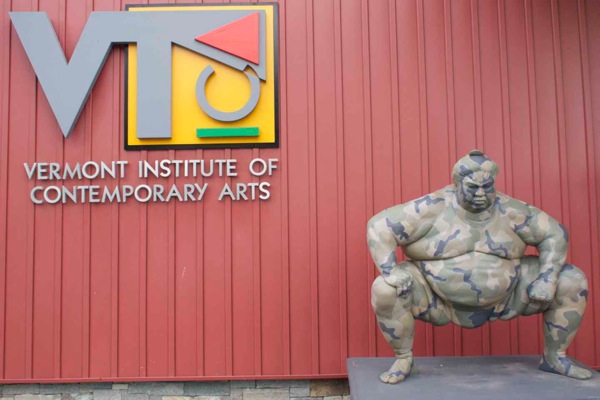
On our way up yesterday we stopped, as we always do (traditions are important) at the Vermont Welcome Center, where we saw an exhibit about the Vermont Institute of Contemporary Arts, newly opened in our second home town (very long story…we own property there) of Chester. The pictures on display featured Jim Morrison, Amy Weinhouse, and Jimi Hendrix, by an artist named Jack Dowd. So, we had to check it out.
The exhibit, titled Jack Dowd’s 27, features portraits of 27 rock starts that died at age 27, apparently a popular age for rock stars to die, when they choose to die young. Actually, from what I gathered from one of the very friendly folks at the gallery, there are more than that that died at that age, and Dowd hasn’t actually finished the full 27 he has in mind, but let’s not quibble.
Starting from the left that’s Jim Morrison, two that I can’t remember and can’t see well enough to jog my memory, then Jimi, (Janis is hidden behind the projecting wall, then Alan Wilson of Canned Heat, Brian Jones of the Stones, and Robert Johnson, who I didn’t realize died so young.
Speaking of Canned Heat, here’s our musical interlude, since I don’t think I’ve every posted anything by them. This features Wilson, who apparently was a highly talented but also highly depressed guy.
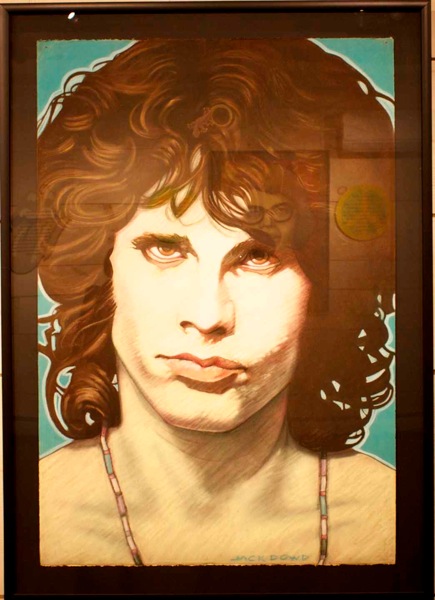
So, back to the art. I thought the Morrison portrait was the best. Unfortunately, this photograph is not that great, as the Wilson portrait is reflected in the glass covering Morrison.
Finally, another dead artist, who didn’t die when he was 27, greets visitors in triplicate as you enter and exit.
We were happy to learn that Chester has, at least for now, staved off a threat from the Dollar Store chain, which has been trying to open a store in town. We got a mailing a few months ago about the threat, and sent some money to the folks fighting against it, and it was good to learn that they have so far been successful. Apparently it’s too early to declare victory, but things are looking good.
What is also quite impressive is how well the Vermonters have come back from the flooding last year. Our agent told us a fairly hair-raising story about her own adventures, when she almost got swept away by the flooding. So far, we’ve seen only a few signs of the devastation.
 Posted with Blogsy