Skip to content

Where are the Republicans when we need them?

Like probably all of my readers, I received an email from Alan Grayson today, asking me why the White House has nominated a guy to high office who received a parting bribe from His old employer, the Bank of America:

When former Wall Street banker Stefan Selig was nominated for a senior Commerce Department role that is central to trade negotiations, Bank of America (where he worked at the time as a top executive) paid him a special $9 million “exit” bonus.

Even for those of us used to the obscene spectacle of corruption known as the revolving door between government and big business, this is both eye-popping and scandalous.

Let's be clear, the $9 million was not a normal yearly bonus. It was an extra bonus on top of a $5.1 million incentive bonus given to him for his job performance. And it was given to him right as he was poised to gain the power to write Bank of America's interests directly into our trade agreements.

Nice work if you can get it. Only in this gilded age would this not be considered a bribe.

Anyway, like everyone else that got the email I was not shocked, because I have lost the capacity for outrage, even about truly outrageous things.

No, my first reaction was: “Where are the Republicans when you need them”. Shouldn't they be all over this? Wouldn't it make more sense to go ballistic over this than Benghazi, a “scandal” that has less than one hundredth the sex appeal of Whitewater, the non-starter scandal of the Clinton Administration. Why, oh why, are the Republicans so quiet about this, leaving it to a lefty Democrat to oppose Obama (he who ordinarily should be opposed in all things)?

Well, that's what I wondered for half a second, but then reason prevailed. The Republicans may hate Obama much, but they love their banker backers more. Just as they never made any noise about Little Timmy's tax problems, they will never make any noise about Selig's bribe.

If by chance, you are still capable of feeling outrage about stuff like this, you can register your ineffectual protest here.

How privatization works

Apparently there is yet another showdown looming. The Highway Trust Fund is scheduled to run out of money in the summer. If nothing is done (and nothing ever is ) ongoing highway projects will be shut down. Yves Smith has some interesting observations at Naked Capitalism. She suspects that this will give Obama another chance to work with Republicans toward forming more “Public/Private partnerships”, which is another term for handing taxpayer money over to rich people, by giving them monopolies on what were previously publicly funded and operated services. In this case, Smith suspects a push to hand our highway system, or chunks of it, over to the rent seekers. I suspect it won't happen, because although the Republicans normally are quite anxious to serve the interest of the rent-seekers, it's a different story if Obama wants to do it too. Visceral Obama hatred has served us surprisingly well in the last few years; it may have saved Social Security as we know it. This trust fund issue may be a recurring topic over the next few months, but this post will veer in a slightly different direction.

It occurred to me that the experience of some states in privatizing infrastructure may hold some lessons for those like our own Dannel Malloy for the likely outcome of his efforts to hand our schools over to corporations. It turns out that, once they get the ability to do so, these rent-seekers start to demand terms that turn the situation into a heads they win, tails we lose situation (okay, that’s the norm, but this is particularly outrageous). If things go bad, the state steps in to help, and in some situations, the states involved have agreed to let purely public infrastructure deteriorate in order to benefit the rent seekers.

Infrastructure privatization contracts are full of “gotcha” terms that require state or local governments to pay the private contractors. For example, now when Chicago does street repairs or closes streets for a festival, it must pay the private parking meter contractor for lost meter fares. Those payments put the contractors in a much better position than the government. It gets payments, even though Chicago did not get fares when it had to close streets…..

Highway privatization contracts also often include terms that forbid building “competing” roads or mass transit. Some even require making an existing “competing” road worse. For example, the contract for SR-91 in Southern California prohibited the state from repairing an adjacent public road, creating conditions that put drivers’ safety at risk. A proposed private highway around the northwest part of Denver required that local governments reduce speeds and install speed humps and barriers and narrow lanes on “competing” roads to force drivers to use the privatized road….

Virginia decided to promote carpooling to cut down on pollution, slow highway deterioration and lessen highway and urban congestion. As a result, Virginia must reimburse the private contractor for lost revenues from carpoolers, even though not all of the people in a car would otherwise have driven individually….

via Truthout via Naked Capitalism

It is entirely foreseeable that once the school privatization train gets rolling, the rent seekers in that area will also demand protections for their profits and, indirectly but surely, deterioration of the remaining public schools. They are actually already achieving the latter by avoiding or discouraging children with special needs, who are then disproportionately the responsibility of the public schools. They are already exempt from some legal requirements that are imposed on public schools in many states, including, apparently, here in Connecticut. As they gain more influence by buying more legislators (given that they already own the governor here in Connecticut) they will be given ever greater leeway to allow education quality to deteriorate. After all, a guaranteed profit comes first.

They almost had me

Okay, when I found my way to this story: Sarah Palin: ‘Jesus Fought For Death Penalty Until Day He Died’, I initially thought it must be a joke. But, as I read, it seemed so…. well, plausible. But, in the end, I reluctantly concluded it wasn't true, just truthy.

Kabuki Show

I got a bit of a laugh when I read this in the Times yesterday:

The Federal Communications Commission’s chairman delivered a tough message to cable and broadband executives Wednesday, saying a lack of competition in their industry has hurt consumers.

The chairman, Tom Wheeler, said that the F.C.C. intended to address the problem by writing tough new rules to enforce so-called net neutrality, preventing big broadband and cable companies from blocking access to innovative new technologies and start-ups that might emerge as competitors.

via The New York Times: Stern Talk from Chief of FCC on Open Net

I imagine that the assembled executives did their best to appear frightfully concerned at the prospects of Wheeler taking “stern” action against them, but it is all really kabuki. They all know he's on their side.

Consider this:

Here's the dirty truth behind proposed rules gutting net neutrality the Federal Communications Commission will be considering next month: The FCC is “stocked with staffers” who just went through the revolving door from the internet service providers who would most benefit by the new rule. Lee Fang reports:

Take Daniel Alvarez, an attorney who has long represented Comcast through the law firm Willkie Farr & Gallagher LLP. In 2010, Alvarez wrote a letter to the FCC on behalf of Comcast protesting net neutrality rules, arguing that regulators failed to appreciate “socially beneficial discrimination.”

… Alvarez is now on the other side, working among a small group of legal advisors hired directly under Tom Wheeler, the new FCC Commissioner who began his job in November.

As soon as Wheeler came into office, he also announced the hiring of former Ambassador Philip Verveer as his senior counselor. A records request reveals that Verveer also worked for Comcast in the last year. In addition, he was retained by two industry groups that have worked to block net neutrality, the Wireless Association (CTIA) and the National Cable and Telecommunications Association.

Then there's Matthew DelNero, who was hired to work specifically on net neutrality. He used to work for an ISAP called TDS Telecom which has, of course, lobbied against net neutrality. One new advisor to FCC Commissioner Ajit Pai, (who used to be associate general counsel at Verizon and has called net neutrality a “problem in search of a solution” ) is Brendan Carr. Carr has worked for AT&T, CenturyLink, Verizon and the U.S. Telecom Association, “a trade group that has waged war in Washington against net neutrality since 2006.”

Chairman Wheeler, of course, came directly from lobbying for the telecommunications industry. There's obviously a high degree of expertise on telecommunications issues among all these people who seem to flow seamlessly between roles in industry and regulating that industry. But they aren't the only experts. There are dozens of people working in public interest groups who know these issues just as well who could be staffing the commission.

via Daily Kos

Amazingly, the article in the Times proves it's all a charade, though perhaps the reporter was unaware of that fact:

People who have been briefed on the chairman’s proposal say that while he opposes the blocking of content by an Internet service provider, his new outline would allow broadband companies to offer some content providers a faster lane through which they can transmit video and services, as long as they do not slow down other content to do so.

Some might say that there if you build a road and only let some people on the fast lane then you are not being neutral so far as users are concerned. It doesn't change the situation if instead of building a new road you turn a one lane road into two lanes, but charge a toll to anyone wanting to use the passing lane.

Anyway, here's how it will work. The present quite slow state of affairs in American internet service will become the ghetto for the content providers who can't afford to pay to go on the “fast lane”. But who says there can only be one fast lane? Why not multiple fast lanes at different speeds and different prices, always, of course, leaving that one slow, overcrowded, lane for the unwashed. Over at Daily Kos, they suspect that monopolists like Comcast will slow down the slow lane to force content providers onto the fast lane:

There's absolutely no question that Internet service providers will happily take the power to sell fast-lane delivery to the highest bidder Wheeler is proposing. There's no reason to believe that they won't use that power—just like Comcast did with Netflix—to slow down networks to try to force content providers to pay up.

But really, that won't be necessary, at least not directly. All they have to do is keep the speed limit on the slow lane right where it is, and, as potholes develop, be quite slow about fixing them.

So yes, I'm sure those executives were absolutely terrified as they listened to Tom Wheeler's threaten to make them even richer.

Never give the 99.9% an even break

I rarely pay attention to the emails I receive at work from organizations like the ABA and the National Law Journal, but this one caught my eye.

For anyone not somewhat experienced in litigation this issue might seem esoteric, but for me this attempt to game the rules of discovery is emblematic of the ongoing process in which the rich in this country are progressively stripping the rest of us of our money, our rights, and our dignity.

Much to the disappointment of the corporate titans, not every legal claim in our legal system must be heard in corporate kangaroo courts (otherwise known as mandatory arbitration, see here for a great example). What's a corporation to do? How can one insure that the little guy can never win? Sometimes owning the whole House and Senate, and influencing the judiciary in many and sundry ways (when you're not outright buying judges, just isn't enough.

Well, one way is to game the rules, and that's what the article is about. Big business suggests that the “requester” should pay the costs incurred by the opponent in responding to discovery requests. If, for instance, I sue a drug company for hiding the fact that it knew one of its drugs would kill me, I must pay them to seek out the emails and other information that prove my case. The object is to drive up the cost of litigation even more. As the article notes, the typical corporate defense to any lawsuit is to drive up the costs of litigation to discourage not only the actual plaintiff, but plaintiffs yet to come. This rule change would enable them to stonewall on discovery and then charge the opposition for doing so. Not only that, but it gives them endless opportunities to fight about what should be a side issue: the proper amount that the “requester” should pay. Given the steep hourly rates that the defense firms for major corporations charge, the cost of even a modest discovery request is likely to be exorbitant, but as the article points out, there are other ways to drive up costs, such as over-responding: providing needles of relevant information in a haystack of a response.

I don't know all the details of this, and my hope is that it won't pass, at least not right away. But, these people never give up. They have money and influence and they simply keep demanding. Just another brick in the wall.

More red states/blue states

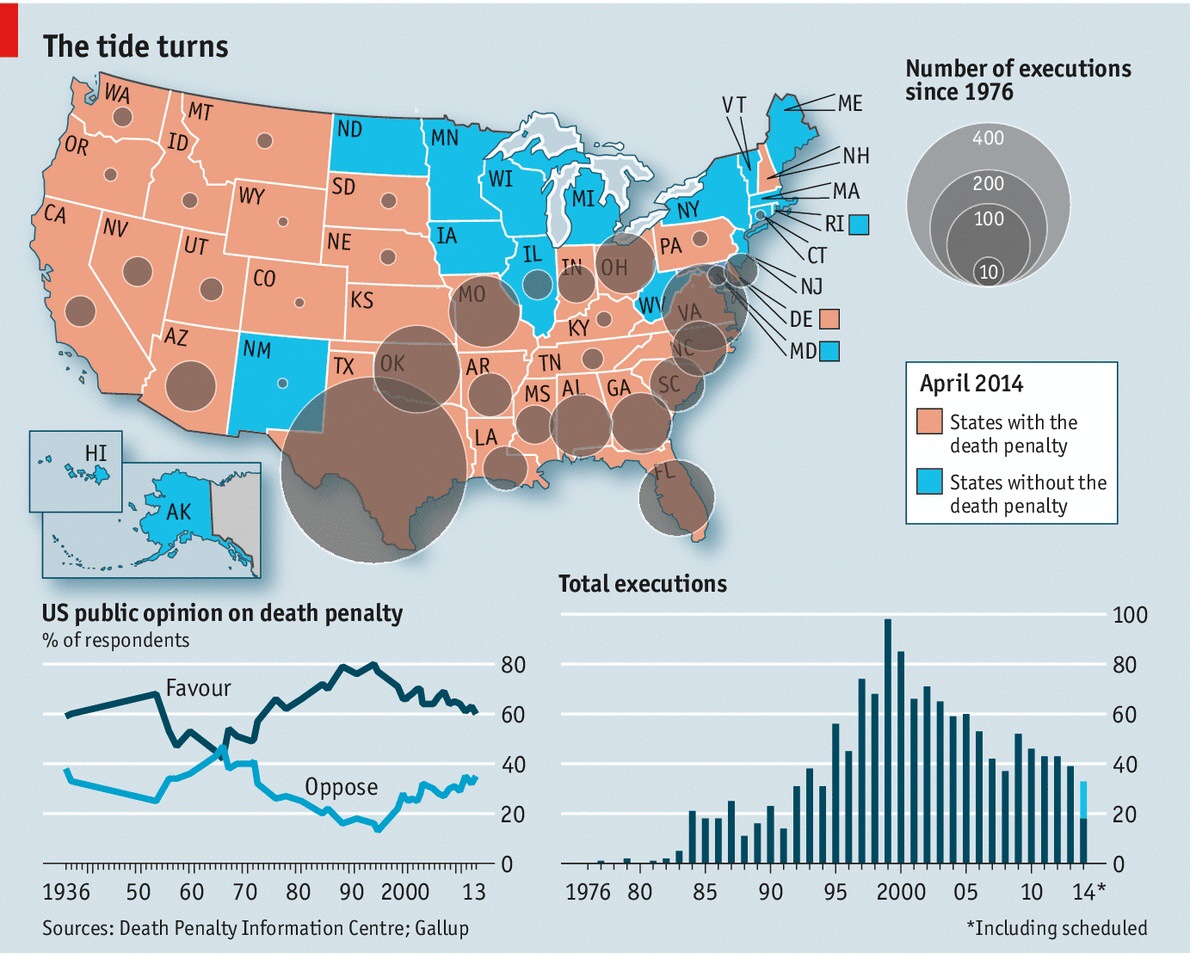
These state by state comparisons are fascinating in part because they are in the main, not at all surprising, yet every once in a while there are some interesting anomalies.

Take this map published by the Economist, (via Hullabaloo), showing those states with and without a death penalty (also imparting some information about the frequency of state sponsored killings):

20140427-172949.jpg

Quite predictably, the states that have no death penalty are, in the main, in the northeast sector. New England is now death penalty free, with the exception of New Hampshire, which retains the penalty, but doesn't carry it out (though in theory, they allow hanging there.)

The surprises are West Virginia and, perhaps less so, Alaska. Another, depressingly, is Ohio. But the good news is (and this counts as a good news post) that the blue area is spreading, both de facto and de jure. Why, in just a few decades, we may catch up with the rest of the civilized world.

GOP to Nation: Harry Reid is picking on us

It's been a while since I've had a “good news” post, so I'm paying a debt here. It truly does look like a bit of panic is setting in amongst the Republicans with regard to their prospects of taking over the U.S. Senate.

I don't think I've written about the upcoming election before, so I can't say I told you so (and anyway, they may win after all), but I've always had faith that the Republicans would snatch defeat from the jaws of victory this year. The nutcases are still in charge, and you can't gerrymander a Senate seat, so only the truly crazy states (looking at you, Deep South) are safe, and this year even those aren't (the Dems have a shot at Georgia).

The latest sign of uncertainty from the dark side is an apparent shift in campaign focus away from Obamacare (which is becoming quite popular among people who now have insurance and may, delicious irony, play a role in ridding the nation of Mitch McConnell) toward, of all people, the mild manneredHarry Reid:

The Associated Press reports that GOP Senate candidates are “adjusting their plans” to tie Democratic Senate incumbents to Harry Reid, arguing that he has abused his power and is no longer fit to remain Senate Majority Leader.

I don't think “He's picking on us”, has ever been a winning campaign slogan, especially coming from the modern Republican party. It bespeaks a certain desperation, but it does appear to be the new meme. Give Republicans credit, as soon as they settle on a line of attack, everyone joins in, beginning at the top with Reince Preibus, who is attacking Harry for misusing his taxpayer funded twitter account by using it in precisely the same way Republicans use theirs. I don't pretend to be an expert on twitter, but I'm having trouble figuring how Reid is misusing taxpayer money on twitter. Aren't twitter accounts free?

Anyway, this is all good news. When your opposition starts preaching to the extreme right side of the choir, you can't help but feel good about it.

A Day for the rational

The godless of Rhode Island have won a small victory:

Rhode Island’s governor has declared May 1 a “Day of Reason” to [recognize the state’s nonbelievers.

The Humanists of Rhode Island and the Secular Coalition for Rhode Island requested the proclamation, which the Friendly Atheist blog said is virtually identical to others signed by the mayors of Charlotte, N.C., and State College, Pa., and some members of Congress last year.

Providence, R.I., was named along with neighboring New Bedford, Mass., as the least Bible-minded metro area in the U.S. for the past two years, according to the second annual American Bible Society survey.

First, congratulations to Providence and New Bedford, and a tip of the hat to Roger Williams, whose unintentional legacy lives on. It's nice to know that somewhere in this great nation we pay tribute to reason once a year. Unfortunately, that leaves 364 days where it goes forgotten.

For every silver lining, however, there is a cloud, for fearless Lincoln Chafee hedged his bets:

Chafee also issued a proclamation designating May 1 as a Day of Prayer.

So May 1st in Rhode Island celebrates both reason and irrationality. What a great country we live in.

There are taxes, and then there are taxes

David Atkins points out that the effective tax rate in the U.S. is the third lowest in the developed world. He is taking issue with the right wingers who are constantly bemoaning our high taxes, and, in that sense, his rebuttal is spot on. But in a larger sense, I think the jury is still out, as it really depends on how you define taxes.

I'd argue that you have to add in tax equivalents; everything from ATM fees to debit card charges to drug prices inflated by absurd patent protections. Any payment necessitated by positive government action or, in many cases, government inaction, that allows a private actor to impose an economic rent on the country at large should be considered a tax, regardless of the pocket in which it lands. Debit card charges are a good example; each time a debit card is used a bank imposes a charge easily 100 times higher than its processing cost. That is a tax on merchant and consumer alike. The fed sets the rate that can be charged, and the charge it imposed, which just received the backing of a very corporate friendly circuit court, was very bank friendly. That is the functional equivalent of a tax. I count government inaction as well, though I'm sure many would disagree. The folks scraping money out of the economy by doing nothing other than gaming the stock market are imposing a rent on the rest of us that could easily be prevented if the government stepped up to the plate and did its job.

Where would the U.S. be if the costs of all those tax equivalents were computed and added to the mix? My guess is that we would rise significantly in the rankings. Our drug costs alone, the product, as Dean Baker has endlessly pointed out, of economic rents, would have to move us up several notches. Maybe not to number one, but my guess is that the citizens of number one (Denmark) get way more bang for their overall tax buck (including any economic rents they are forced to pay) than do we. That, of course, is the larger point. Generally speaking, we get something in return for the money we pay to the government , but we get nothing in return for the tribute we pay to the banks and other actors that benefit from the tax equivalents we are forced to pay.

Easter Sermon, giving the ghost his due

This is Easter weekend, and it seems fitting that I should abandon politics and turn my hand to religion. Regular readers know that I have an advanced degree in theology, having studied religion for eight years at Our Lady of Sorrows Grammar School (not making that up) on aptly named Grace Street (not making that up either) in Hartford. In the interest of spreading the word of god, I will, in this post, endeavor to educate my readers on some fine points of theology.

I was inspired to write about this topic while listening to Van Morrison's album No Guru, No Method, No Teacher yesterday. In the song in which the album title appear (*In the Garden*) he mentions the “father, son and the Holy Ghost” (I am leaving that term capitalized, as my Ipad's autocorrect did it for me. The pope must have some folks in the IOS development team). Anyway, it occurred to me that it is time someone paid tribute to the Holy Ghost, and I intend to do so here. Or at least try. I have not deigned to consult Google in writing about the ghost. This post relies strictly on the knowledge acquired while getting my degree. Where that is insufficient, I will make stuff up.

For you hell bound heathens, I must first explain the Holy Trinity.

There are in fact three Gods in One. We must all believe this, though it makes absolutely no sense. But having jumped that hurdle, let us go on.

God number one, first among equals if the truth be known, is God the Father. He is a contemporary of Zeus, but far more narrow minded and intolerant than his lightning wielding rival (allowing no other gods but himself and his two alter egos), though nowhere near as randy. While Zeus was constantly on the prowl, we know of only one human virgin that God the Father impregnated, that being Mary, who gave birth to:

Jesus, the Son, who existed since the beginning of time, but goes unmentioned in the Old Testament, despite what Christians may say. He came down to earth, exited Mary's womb, and became human to die for our sins. It is not clear exactly how this works or why an all wise and loving god would find this necessary. Be that as it may, somehow God the Father felt the need to have his Son tortured and suffer the pain of death for our sins, which somehow made things alright (at least for baptized Catholics), though why this “sacrifice” was such a big deal is not even clear. His messy death may have been a record breaker, but it was hardly the worst death ever suffered here on earth (he had company the day he died, for Christ's sake, and lets not even talk about the folks the Church put to far more grisly deaths) and, as Leonard Bernstein pointed out, if the story is true, he “had the choice when to live, when to die, and then become a God again” which puts him one up on every human who ever lived. I remember that while getting my degree at Our Lady of Sorrows, this quibble entered my mind, but I never raised it with Sister, as I had learned early on that one should not get Sister confused.

So now we arrive at the Holy Ghost. He goes unmentioned in the Old Testament, and is perhaps alluded to in the New. This would be at the time of the event referred to as the Pentecost, when the apostles were huddled together in a room, frightened to death that they were going to meet the same fate as Jesus, when they were suddenly inspired. Well, okay, I did go to Google, and here's the ghost himself making his appearance:

When the time for Pentecost was fulfilled,
they were all in one place together.
And suddenly there came from the sky
a noise like a strong driving wind,
and it filled the entire house in which they were.
Then there appeared to them tongues as of fire,
which parted and came to rest on each one of them.
And they were all filled with the Holy Spirit
and began to speak in different tongues,
as the Spirit enabled them to proclaim.

There he is and there he goes. Basically, he did for the apostles what Rosetta Stone software does for the rest of us; he had them speaking foreign languages in no time at all. Well, that's not quite fair to the ghost, because he had them speaking multiple languages simultaneously. That is a good trick. Not even Bill Maher or Richard Dawkins could deny that.

But really, that's pretty much it as far as the Holy Ghost is concerned. No one thinks about him much. Truth to tell, it's not even clear he's a he, though of course, he's certainly not a she. When he's not pictured as a tongue of flame, he's a dove, don't ask me why. He's most like an infusion; a deific tea bag if you will. When he shows up, he infuses your soul with faith; changing the weak water of your soul into the pungent Earl Grey of unquestioning faith. But pity the ghost. No one really warms up to him like they do to Jesus, or fears him like they fear Jesus's old man. No one prays to him. They even pray to Mary, who, strictly speaking, is not even a god, being the wrong sex and all. But nonetheless, he or it is there by your side, ready to fill you with faith if only you would open your heart and mind. My own theory is that the Holy Ghost (Apple did the caps again) got tossed into the mix because theres something distinctly un-mystical about the Holy Duopoly. Consider, would anyone remember Wynken and Blynken, if Nod didn't complete the picture? Good things come in threes (would Goldilocks and the two bears have made the grade?), and the ghost's job is to bring up the numbers. Still, one thing you can say for him or it, the ghost has been mostly harmless. No one kills in his name, starts wars, or oppresses women (see, I needed three examples or it wouldn't have worked). That may not sound like much at first, but it puts him head and shoulders above his competition.