Skip to content

What are they thinking? (Groton Edition)

Today’s Mystic River Press (no link available) reports that sentiment in the Groton Town Council appears to favor giving a tax break to encourage Groton Hospitality, LLC to build a hotel in town. The fact that the hotel is about 99% complete, sans tax break, apparently had an effect on the Council, which is thinking of abating only a year’s worth of taxes, rather than the three years requested.

I wrote the following to Mick O’Beirne, who was vocally against the tax break, and figured it could do double duty as a blog post about this absurd giveaway.

I was stunned to read in the Mystic River Press that the majority sentiment in the Council appears to favor granting a tax break to Groton Hospitality, LLC.

A strong argument can be made that it is bad public policy for municipalities to grant such tax breaks. Corporations often play one municipality off against the other, seeking ever more generous breaks as “incentives” to attract them to a given location. As often as not, they leave as soon as they have taken full advantage of the economic benefits they have wrested from the community.

Whatever the merits of such tax breaks may be in the abstract, they do not appear to apply to hotels. Hotels are built in particular locations because the developer believes that they will benefit from building in that particular location. They cannot be outsourced. If a developer wants to build a hotel in Mystic then it must build in Mystic. Groton is not in competition with other towns for such development. They are sited because of their locations, and it is unlikely that any particular developer would go elsewhere if denied a tax break.

Whatever the merits of giving such tax breaks to hotels may be in the abstract, they do not appear to apply to hotels that have already been constructed. It appears unlikely that Groton Hospitality, LLC will refuse to complete this hotel if it is denied a tax break. If I remember correctly, the Marriot tax break was justified because the developer claimed that it would use the money saved in taxes to build a grander hotel, which would yield greater tax benefits down the road. This argument, specious as it probably was, cannot apply to a hotel that is nearly complete.

Above and beyond the absurdity of giving someone an incentive to do something they have already done, there are issues of fairness raised by this proposal. This tax break will unfairly benefit Groton Hospitality vis a vis its competitors in Groton, many of whom have been in town for years, and most of whom have never asked for a dime of taxpayer’s money. This precedent having been set, however, how will the Council justify denying a tax break to a corporation that has fully completed construction but simply “forgot” to apply for a tax break before the last brick was laid?

Each time the Council grants such tax breaks, it shifts the burden of taxation from those benefitted to the rest of us. I have never complained about paying taxes, nor have I complained about my own assessment. But I do resent being asked to pay more via a higher mill rate in order to give an unfair advantage to a company that lacked the brains, foresight or gall to extort my money from the town in a timely fashion.

I note from the Mystic River Times that Mark Oefinger posed a question regarding the Mystic Marriot: “And it’s the third largest taxpayer in town. We went ahead and gave them a tax incentive. Would they have gone ahead with the project without it? We’ll never know”. We will never know, though I suspect they would have fought like hell had we tried to stop them. We do, however, know whether Groton Hospitality, LLC would have gone ahead without an incentive, because it did. It would be irresponsible if the Council gave it a tax break at this juncture, since there is no rational argument that can be made that the Town will realize any return for its investment.

I would appreciate it if you would share my thoughts with the entire Council.

My missive is somewhat misleading in one respect. According to the article, the precedent for giving abatements to projects after completion has, in fact, already been set. The Council actually did give an abatement to a completed project. One wonders how far back they’d be willing to go. Maybe every hotel and Inn in town should come knocking. On a more personal level, my wife and I have been thinking about doing some home improvements. Maybe the Council would abate our taxes to incentivize us.
Dem candidates urge Reid to reject telecom immunity

Harry Reid has a choice. He can do the right thing, or cave to George Bush and go against the wishes of the likely next (Democratic President). Finally, the Democratic candidates (those in the Senate, anyway) join in an attempt to stop something horrible from happening:

Dear Majority Leader Reid:

We understand that the Senate will shortly be considering amendments to the Foreign Intelligence Surveillance Act. As you know, the Senate Select Committee on Intelligence and the Senate Judiciary Committee have reported very different versions of the FISA Amendments Act, S. 2248, and it is up to you, as Majority Leader, to decide how the Senate considers this legislation.

We urge you to make the version of S. 2248 reported by the Senate Judiciary Committee the base bill to be considered by the full Senate. While the structure of Title I of both bills is the same, and both make improvements over the Protect America Act, the reasonable changes to Title I made in the Judiciary Committee ensure that the FISA Court will be able to conduct much-needed oversight of the implementation of these broad new surveillance authorities, and help to better protect the rights of innocent Americans. While we appreciate the hard work that the Intelligence Committee has done on this legislation, the process by which the Judiciary Committee considered, drafted, amended and reported out its bill was an open one, allowing outside experts and the public at large the opportunity to review and comment. With regard to legislation so directly connected to the constitutional rights of Americans, the results of this open process should be accorded great weight, especially in light of the Judiciary Committee’s unique role and expertise in protecting those rights.

We also believe that the Judiciary Committee bill is preferable because it does not provide immunity for telecom companies that allegedly cooperated with the administration’s warrantless wiretapping program. As this is such a controversial issue, we feel it would be appropriate to require the proponents of immunity to make their case on the floor.

Thank you for your consideration.

Sincerely,

Russell D. Feingold (D-WI)

Christopher J. Dodd (D-CT)

Barack Obama (D-IL)

Bernard Sanders (I-VT)

Robert Menendez (D-NJ)

Joseph R. Biden, Jr. (D-DE)

Sherrod Brown (D-OH)

Tom Harkin (D-IA)

Benjamin L. Cardin (D-MD)

Hillary Rodham Clinton (D-NY)

Daniel K. Akaka (D-HI)

Jim Webb (D-VA)

Edward M. Kennedy (D-MA)

Barbara Boxer (D-CA)

The stupid competition goes on

An already relentless melting of the Arctic greatly accelerated this summer, a warning sign that some scientists worry could mean global warming has passed an ominous tipping point. One even speculated that summer sea ice would be gone in five years.

Greenland’s ice sheet melted nearly 19 billion tons more than the previous high mark, and the volume of Arctic sea ice at summer’s end was half what it was just four years earlier, according to new NASA satellite data obtained by The Associated Press.

“The Arctic is screaming,” said Mark Serreze, senior scientist at the government’s snow and ice data center in Boulder, Colo.
Just last year, two top scientists surprised their colleagues by projecting that the Arctic sea ice was melting so rapidly that it could disappear entirely by the summer of 2040.

Cue the Republicans:

Tonight on CBS Evening News, each of the 10 leading presidential candidates will be asked, “Do you think the risks of climate change are at all overblown?” According to an advance transcript, every single candidate acknowledges the threat — except Mike Huckabee and Fred Thompson.

Huckabee responds that “scientifically,” he doesn’t know whether global warming is “overblown.” Thompson goes a step further, claiming that the “state of entitlements” and “extremists” who “want to do drastic things to our economy” are the real problems.

Maybe we should look on the bright side. 2 out of 10 means only 20% of the Republican candidates are environmental troglodytes, right?

Well, not so much. Rudy’s solution:

Giuliani never even returned calls to the forum organizers. While he admits to CBS that there “is global warming,” his solution is to rely more heavily on U.S. coal reserves. Giuliani has received more than $400,000 from employees of companies in the oil, gas, and energy industries. His law firm, Bracewell and Giuliani, also recently led the lobbying campaign on behalf of the utilities companies against the Senate energy bill.

Mitt? (Naked ambition caters to willful ignorance)

Orff had a question about the environment: “It’s eighty degrees today. What are we going to do about global warming?” Romney’s response was quick and concise. “We’re going to get ourselves off of foreign oil,” he said. “And to do that it’s going to take nuclear power, clean coal, more efficient vehicles, and then we’re going to dramatically reduce our greenhouse gases.” It was a good answer, but also a strange one. Not long ago, Romney released a glossy pamphlet detailing his positions on major issues. He sounded like Al Gore when talking to the environmentalist in New Hampshire, though his policy book’s treatment of global warming reads more like something from ExxonMobil. In it, Romney refers to the “debate” over “how much human activity impacts the environment”—code words for the global-warming-denial crowd. He offers no plan to “dramatically” curtail emissions of CO2, just an aside that “we may well be able to rein in our greenhouse-gas emissions.” As the governor of Massachusetts, Romney, in December, 2005, pulled out of a Northeast-state agreement on carbon reduction—a plan that he had supported the month before.

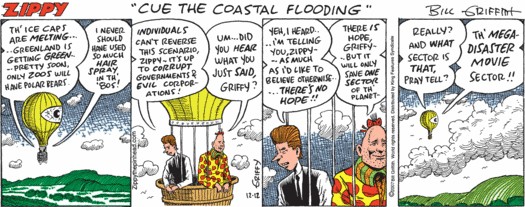
Cue Zippy:

zippy_the_pinhead.gif

10 more reasons than we had for electing Bush

[youtube]http://youtube.com/watch?v=addXg-iDSfc[/youtube]

The wind to their backs and caution in their steps

Paul Krugman (on his blog) notes that the majority of people in this country believe we are already in a recession and that they may be right. In any event, he says predictions of a mild recession next year may be overly optimistic. So lets fast forward to this November when we will have:

1. The worst and most unpopular president in history (a Republican) in the White House.

2. An ongoing recession.

3. An ongoing, unpopular and totally pointless war in Iraq from which the Republican candidate will offer no relief.

4. A Republican party perceived to be in thrall to bigots of every persuasion in a country grown more diverse and, despite the best efforts of Republicans, more tolerant.

5. A coming environmental disaster that only the Democrats (if anyone) are willing to try to avoid.

6. Increasing energy prices with a government in thrall to oil interests.

7. Increasing economic inequality.

8. People losing their homes to foreclosures in record numbers.

Those are just the things I could think of offhand in about five minutes. There is literally nothing going right these days, and things are going to be going even wronger in November. Add to that that each of the Republican candidates is so bad that as soon as one rises in the polls even Republicans collectively gag and start looking elsewhere.

With all that going for them, how will the Democrats blow it (or the Republicans manage to steal it)? And if they don’t blow it or meekly submit to another theft, will they take advantage of the wind at their backs by promising real progressive change, or will they neuter their mandate by running another of their trademark don’t-offend-people-who-will-never-vote-for-Democrats-anyway campaigns.

Right now, it’s not looking good. I could vote with some degree of enthusiasm for any of the Democrats seeking the presidency. But I can’t see any of them as the next FDR. There is a ray of hope, though. In 1932, most folks didn’t see FDR as the next FDR.

Backlogs at social security

Every once in a while I get to write about something I actually know about, and today is one of those rare days. This morning’s Times reports on the growing backlog of Social Security Disability cases. (The article was reprinted in the Day). In terms of the time I spend on my legal cases, 50% or more of my caseload consists of Social Security Disability cases, so I can claim to know a little about the process.

The article is a good summary of the present problem with the Disability system. A growing backlog at the administrative law judge level is causing the time between initial application and final approval to balloon. A disability case can go all the way to the Supreme Court, but before it enters the formal judicial system it goes through four stages, the initial application, the redetermination stage (replaced in our district on an experimental basis by the federal reviewing officer, the hearing before an administrative law judge (ALJ), and appeals to the Appeals Council, which is an internal appeal board. The article focuses on the delays at the ALJ level, which is where most of the action is from the attorney’s standpoint.

I happened to have an ALJ hearing this morning and, after the hearing concluded, mentioned the article to the judge. He made an observation with which I agree. The judge pointed out that the real problem lies elsewhere. It’s implied in this quote from the article in the Times:

But of the more than 575,000 who go on to file appeals — putting them in the vast line for a hearing before a special federal judge — two-thirds eventually win a reversal.

If two thirds of all cases that are appealed to an ALJ are reversed, then the real problem lies at the initial application stage. Too many people are being denied benefits in cases in which they are obviously entitled. The Times story has illustrative examples The line at the hearing level wouldn’t be vast if more of those two-thirds got their benefits at the time of the initial application. There are a lot of reasons this doesn’t happen. Claimants don’t have attorneys at the initial stage, and the record is often not complete enough to warrant an approval. But I’ve seen many cases in which I have simply been unable to understand how anyone could make a finding that the claimant is able to work. The article is right that the legal standard for proving disability can be hard to satisfy, but for some workers, including older workers, people with little or no education or people with intellectual deficits, the standards are relaxed quite a bit compared to those used in assessing claims by young or highly educated workers. There is an evaluation process that should lead to a favorable decision in many of these cases, but often (usually?) does not. I’ve often wondered who gets granted at the initial levels, since so many obvious winners find their way to me. Part of the problem is that the work is handed off to state agencies that appear to view their role to be much like that of a health insurance claims examiner: to turn down as many claims as they can. Overall, maybe it works. Maybe enough people with meritorious claims get discouraged and give up, thereby saving the system money. The delays also benefit the government in another way. Claimants get retroactive checks if they are ultimately successful, but the government doesn’t pay a dime of interest on claims that sometimes take five years to process. In effect, everyone in that long waiting line is lending the government money at 0% interest.

So solutions that seek to fix the problem at the administrative law judge level are going to fail unless the objective is merely to get rid of the backlog. You can do that by simply putting procedures in place that will allow for quick, unfavorable decisions at the hearing level i.e., simply push the problem upstream. The Commissioner of Social Security, good Bushie that he is, has recently suggested doing just that, proposing some regulatory changes that will speed up the system, with the explicit expectation that the reversal rate will decline. Some of the proposed changes seem innocuous, but could prove devastating for claimants. For instance, he wants to require claimants to specify each medical condition for which they are claiming disability. That may seem innocuous, but I’ve had more than one case in which my client did not understand that the condition her or she felt was disabling was minor in comparison to another. This is particularly true in the case of people who are mentally ill, who often believe they are disabled due to physical problems that are minor in comparison to their mental impairments.

Annals of Etymology

I just hope to [insert agnostic’s analogue of God here] that I used the word “etymology” correctly above. Here I toil away, sometimes posting three or four political posts a day with nary a comment, and I use a word wrong and I get in the middle of two English majors discussing the meaning, spelling and derivation of the word “petard“. In what is for this blog a virtual avalanche of comments (two if you don’t count mine) we learn more than we perhaps ever needed to know about said word. One thing’s for sure, I will never get that quote wrong again. On the other hand, if that’s what it takes to provoke comments, maybe I’ll bungle some more quotes to see if anyone catches me.

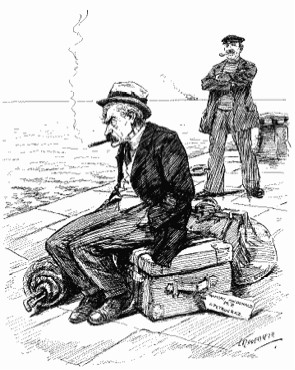
Here’s a cartoon “Dissenting Major” sent to me, which he didn’t know how to post directly in his comment, showing an earlier use of the phrase (quoted correctly, no doubt the cartoonist had an editor) for political purposes:

petard.jpg

HOIST WITH HIS OWN PETARD.

Mr. Ramsay Macdonald (Champion of Independent Labour). “OF COURSE I’M ALL FOR PEACEFUL PICKETING—ON PRINCIPLE. BUT IT MUST BE APPLIED TO THE PROPER PARTIES.”

Imagine

John Lennon, 1940 to 1980.

[youtube]http://www.youtube.com/watch?v=H7_6Vzj7Rng[/youtube]

Hung by their own petard

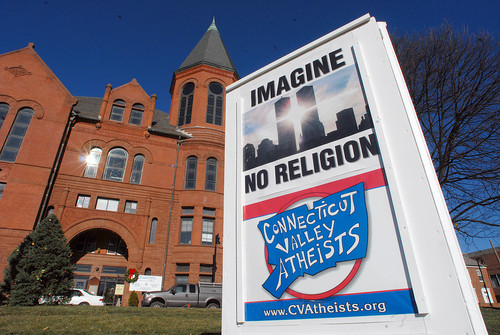
One of the things about the pesky Constitution is that, no matter how much one warps one part of it, some other part seems to get in the way of those who seek to pervert it. Case in point: The religious groups that wanted to use public fora to display their creches had to accept menorahs. That was bad enough, but they also have to accept displays from those who don’t believe in any God at all, which is exactly what happened in Vernon, where the Connecticut Valley Atheists beat the Christians and the Jews to the punch and got prime space on the Town Green for this display:

34167877.jpg

As Newton said, for every action there’s a reaction. Agnostics and atheists, in the past were content to let the religious alone, until the right wing started trying to push their particular brand of totalitarian balderdash down our collective throats, including the throats of plenty of believers. Now the secularists are beginning to push back, and it’s nice to see Connecticut, once the most hidebound Puritanical state in the country, leading the way. Some in Vernon are claiming the sign is inappropriate because its content is not only “religious”, but political. Putting aside the fact that political speech is exactly the type we should encourage in the public square, the dodge won’t fly for other reasons, as Dennis Himes, co-ordinator of the group, pointed out:

Himes said he would have preferred no displays relating to religion on town property, but decided to apply to place one in the park because he expected Christian and Jewish displays.

Himes said the whole issue became political when the town decided to allow religious displays on town property.

“The original question was whether Vernon would have a nativity scene on church property or town property,” Himes said. “The difference between those two is a political difference.”

Expect this sort of thing to pop up more and more, to the consternation of the religious right. The same thing happened when they got Congress to pass a law allowing them to have religious meetings in public schools after school. The constitution required that the privilege be extended to every group, not just the religious. Here’s what happened in Utah, home of the Mormons:

During the 1995-96 school year, a group of students wanted to form a club that would discuss and deal with sexual orientation issues. The district clamped down on the group and tried to stop it from meeting. The students fought back, staged a school walk-out and lobbied for their cause.

Finally, when the district realized it would be impossible to single out this one group; as a result they decided to ban all non-curricular school clubs. Along with the Gay-Straight Alliance, the Young Republicans and Democrats, Students Against Drunk Driving, the Polynesian Club and countless other clubs were prohibited from meeting. According to the ACLU, this is the only district in the nation that has gone to such extreme measures.

But even with the ban, the GSA figured out a way to continue meeting. Under the state’s Civic Center Act, any group can rent space from a public school after hours. So, the group found a sponsor, paid the rent and continued to meet. They are now one of the few non-curricular groups that still gather in the district and more such groups are popping up at other schools in the Salt Lake valley.

Imagine if you will, that the Supreme Court had never banned prayer in schools. Our much more diverse nation would have spent a lot of the last 50 years arguing about which prayers we should be saying, and to which god we should be praying. If the troglodytes on the present court bring them back, wait for the firestorm when the non-Christian majority school districts start praying to Allah, or, if equal time is required, the atheists demand hymns of praise to the beneficent laws of chance.

Sheldon Whitehouse speaks out on Bush criminality

Rhode Island traded a mediocrity for a first rate Senator when it threw out Lincoln Chafee last year.

Senator Whitehouse scores the Bush criminal enterprise in a Senate speech. (Full story here).

Let’s start with number one. Bear in mind that the so-called Protect America Act that was stampeded through this great body in August provides no – zero – statutory protections for Americans traveling abroad from government wiretapping. None if you’re a businesswoman traveling on business overseas, none if you’re a father taking the kids to the Caribbean, none if you’re visiting uncles or aunts in Italy or Ireland, none even if you’re a soldier in the uniform of the United States posted overseas. The Bush Administration provided in that hastily-passed law no statutory restrictions on their ability to wiretap you at will, to tap your cell phone, your e-mail, whatever.

The only restriction is an executive order called 12333, which limits executive branch surveillance to Americans who the Attorney General determines to be agents of a foreign power. That’s what the executive order says.

But what does this administration say about executive orders?

An executive order cannot limit a President. There is no constitutional requirement for a President to issue a new executive order whenever he wishes to depart from the terms of a previous executive order. Rather than violate an executive order, the President has instead modified or waived it.

“Whenever (the President) wishes to depart from the terms of a previous executive order,” he may do so because “an executive order cannot limit a President.” And he doesn’t have to change the executive order, or give notice that he’s violating it, because by “depart(ing) from the executive order,” the President “has instead modified or waived it.”

So unless Congress acts, here is what legally prevents this President from wiretapping Americans traveling abroad at will: nothing. Nothing.

That was among the most egregious flaws in the bill passed during the August stampede they orchestrated by the Bush Administration – and this OLC opinion shows why we need to correct it.

Read the article. Whitehouse is a good lawyer. He got Mukasey to give a contrary opinion during his confirmation hearings.