Skip to content

Scapegoating Dodd

I just got finished watching Olbermann’s show, in which law professor Jonathan Turley casually endorsed the canard that Chris Dodd is responsible for preserving AIG’s ability to pay the much and rightly maligned bonuses. We can expect Simmons to jump on this bandwagon. It’s a line also being pushed by the Treasury Department, which is trying desperately to deflect responsibility. It’s also completely untrue, as is well documented here at Firedoglake (this seems to be my day for linking to that estimable site. I encourage you to read the whole post, but if you’re too lazy, here’s the essence:

It’s impossible to know how many of those bonuses would have been covered by Dodd’s original language without examining the individual contracts. What is certain, however, is that the loophole regarding “retroactivity” which facilitated the payout of the bonuses that AIG cited in their white paper, was something that Treasury specifically lobbied for. For the “administration official” to blame Dodd in the pages of the New York Times for the payout of these bonuses, after the White House publicly fought him tooth and nail to weaken compensation limits, is completely disingenuous.

One point should be remembered if, as I suspect, this meme continues to spread. This was not inside baseball. At the time, Dodd’s amendment was in fact publicly deplored by the Obama administration. What he proposed is not what we got. It’s shameful that they’re trying to throw him under the bus to protect their own skin. It will be equally shameful if the media goes along with this line, without even bothering (as Turley apparently did not) to check the facts that should be easily obtainable in their own archives.

UPDATE: From the Huffington Post:

In an interview with CNN’s Ali Velshi Thursday, Treasury Secretary Timothy Geithner confirmed that his department had pushed Sen. Chris Dodd to add a loophole in the federal stimulus bill allowing bailout recipients to receive bonuses. Dodd had told the network Wednesday that he had been the one to insert the loophole, but at the request of the Treasury.

According to a commenter, my original post has been proven wrong. I did not, so far as I can see, say that Dodd never agreed to the final bill. I said, as did the folks at Firedoglake, that it was pressure from the Treasury (or White House if you prefer) that led to the adoption of the final language. You can criticize Dodd for caving to Treasury, but you can’t accuse him of slipping the provision into the bill of his own accord, particularly if you are speaking on behalf of Treasury.

The sanctity of contracts and bonuses by other names

One of the drawbacks of being an evening blogger is that by the time you get a chance to put in your two cents on the morning news, most of what can be said has already been said.

Nonetheless, let me add my mite to the chorus of outrage directed at Andrew Ross Sorkin of the New York Times, who tells us all to chill out and let those AIGers get their bonuses.

Why? Two very good reasons, according to Sorkin.

First there’s the “sanctity of contracts”. Since Sorkin has presumably, like the rest of us mere mortals, not read the contracts, this is an odd argument. But it’s particularly ironic since contracts are de-sanctified amazingly fast if one of the parties happens to be a union. Just ask the workers at GM, who are not at all to blame for the bad decisions that got their companies into their current predicament.

Second, we need the guys who got us into this mess to stick around and get us out:

A.I.G. employees concocted complex derivatives that then wormed their way through the global financial system. If they leave — the buzz on Wall Street is that some have, and more are ready to — they might simply turn around and trade against A.I.G.’s book. Why not? They know how bad it is. They built it.

So as unpalatable as it seems, taxpayers need to keep some of these brainiacs in their seats, if only to prevent them from turning against the company. In the end, we may actually be better off if they can figure out how to unwind these tricky investments.

Even if you take that argument on its face, its absurd, as Barney Frank has pointed out. But the more telling argument against it was made over at firedoglake:

So what Sorkin is saying is that we should just admit, in a very public way, that we have no ability to regulate the system. That if someone commits fraud and theft on such a massive scale, there’s nothing we can do but pay everyone off or they will use their knowledge to steal even more money. He’s saying that there is no authority, no viable regulation, no legal structure that can right this mess. All we can do is keep writing checks, pay off the blackmailers and hope that if we let them continue to get rich they won’t make matters worse.

Meanwhile, the other thieves and crooks, acting while attention is focused elsewhere, are finding newer and creative ways to preserve their right to loot from the public fisc. Again from firedoglake:

Anticipating restrictions on bonuses, officials at Citigroup Inc and Morgan Stanley are exploring ways to sidestep tough new federal caps on compensation, the Wall Street Journal said.

Executives at these banks and other financial institutions that received government aid are discussing increasing base salaries for some executives and other top-producing employees, the paper said, citing people familiar with the situation

And then there’s this from this morning’s Times:

Goldman Sachs got its bailout. Now some of its bankers, those aristocrats of Wall Street, apparently need a bit of a bailout too.

Goldman, which accepted billions of taxpayer dollars last fall and, as learned Sunday, was also a big beneficiary of the rescue of the American International Group, is offering to lend money to more than 1,000 employees who have been squeezed by the financial crisis. The loans, offered via e-mail last week, could range from a few thousand dollars to hundreds of thousands.

Some Goldman employees got rich before the markets collapsed, allowing them to invest several million dollars in the funds, often on a leveraged basis. Only three years ago, Goldman paid more than 50 employees more than $20 million apiece. In 2007, its chief executive, Lloyd C. Blankfein, collected one of the biggest bonuses in corporate history — nearly $70 million.

But one former Goldman partner estimated that a quarter of the bank’s roughly 100 partners are now worth $5 million or less because of losses on their company stock and other investments. Last year, the bank’s seven top executives received no bonuses. One of them, Jon A. Winkelried, resigned from his position as co-president a few weeks ago, saying he wanted to spend more time with his family. His estate on Nantucket is on the market.

These poor guys, some of them down to their last $5 million. My heart would be bleeding if it hadn’t practically stopped when I looked at my 401K statement. When they got their huge bonuses they couldn’t just buy stock at face value. They had to buy even more by leveraging their money, basically buying in to the scam they were perpetrating on everyone else. Now they are being bailed out with our money in the form of “loans”. I’m not buying that these are loans, or at least I’m not buying that they will stay loans. When the heat is off, when no one is looking, Goldman will forgive the debts, and presto-chango, you have a back door bonus.

Among other things, it is becoming clear that Obama made a huge mistake in picking Geithner (along with Larry Summers) for Treasury. He is entirely too comfortable with the mindset that got us into this mess and he is totally unaffected and non-infected by the righteous rage that is sweeping the country. Certainly, in retrospect, it would have been better if he had been the one torpedoed by tax problems, rather than Tom Daschle. I’m not one to excuse the leader by blaming the subordinates. That’s a Republican dodge. This is Obama’s mistake too, for shying away from exerting government control over these zombie institutions. We own 79% of this company and exert 0% effective control. That’s idiotic.


Simmons makes it official

To the surprise of absolutely no one, Rob Simmons says his family was unanimous in support of the decision he made weeks ago: he will run against Dodd for the U.S. Senate.

Simmons will run as a populist. If elected, he will follow his pattern as a Congressman, and be a loyal foot soldier for his right wing masters.

This race gives me the heebie-jeebies. It is eerily reminscent of the 2000 Congressional campaign when Simmons ran against Gejdenson, the only name Democrat in the District that he had a chance to beat. Sam ran a lackluster campaign. After 20 years in Washington, and a lot of close elections, he just couldn’t summon up the energy to run a first rate campaign. That, added to his unfortunate housing situation, did him in.

Dodd hasn’t had a string of tough elections, but in all other respects, right down to the unfortunate housing situations, he’s in the same situation as Sam. He can beat Simmons if he starts running hard right now. If he doesn’t want to put in the time and effort, and if he doesn’t want to reconnect with those of us in the trenches, then he could do us all a favor by stepping aside and let Blumenthal wallop Simmons.

I really have a bad feeling about this race. Dodd is a good Senator, but he’s suffering from several self inflicted wounds. It’s more important that his seat be occupied by a Democrat that that it be occupied by a Dodd.


AIG’s arm being twisted: It must give out big bonuses

AIG insists that it has no choice but to give out huge bonuses to the folks who drove it right off a cliff. Besides contractual obligations, it has to retain the “best and the brightest” (I didn’t make that up) to assist it in clearing out the wreckage caused by the best and the brightest. Apparently the Treasury Department agrees.

I have only my wife as a witness, but when I first read the article, my reaction was that such bonuses, as well as a lot of the other absurdities of this particular bailout, ably explained here by Gretchen Morgenstern (who is, in my opinion, a fantastic reporter), could be avoided by putting this bankrupt business into bankruptcy, where these “contractual obligations” could be shed as quick as lightning. In addition, AIG’s counterparties would have to come forward and would get compensated rationally, if at all. It seems pretty clear that a bankruptcy judge would do a better job protecting the taxpayer’s investment than the Bush Administration did, or the Obama Administration is doing .

Atrios, who can speak with more authority than I on economic issues, apparently sees things the same way.


Groton Forum

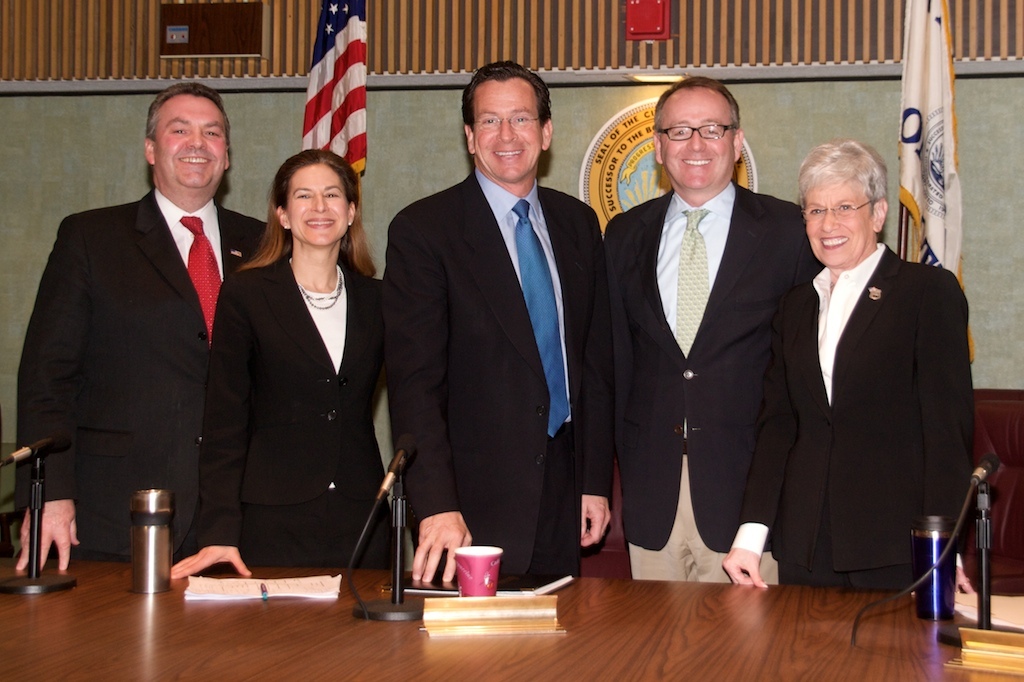
Yesterday, Nancy Wyman, Dan Malloy, Shirley Bysiewicz, and Jim Amann presented their “visions” for Connecticut to a packed house at the Groton Municipal Building. Dick Blumenthal was there too, but he just made some introductory remarks and then high tailed it to Hartford for a parade. Here’s the four, with our State Senator, Andy Maynard.

The most surprising thing about this forum was who was not there: the press. Ray Hackett was the one exception of which I was aware. Scott Bates, who has to be given a great deal of credit for organizing the event, told me that he let the press, including the Day, know about the event. The press absence was troubling for what it portends: as the newspaper business becomes less profitable the entire industry has entered a downward spiral, reducing reporters so as to reduce cost, which in turns reduces any incentive for people to buy and read the paper. Somehow, someone has to come up with an internet business plan that enables the press to make money for producing the raw reportage upon which us bloggers feed.

So, in the absence of the old media, this little backwater of the new media will do its best. I meant to post this last night, but was delayed by struggles with uploading to youtube, the precise nature of which there is no need to relate, I have finally got the opening statements of each speaker (can’t say candidate, three of them are exploring) on-line for anyone who wants to watch. All, unfortunately, except for Susan Bysiewicz. Her clip starts in the middle of her presentation. There’s a long story explanation for that; suffice it to say that I stepped into the breach with my camera when I had never intended to film the proceedings at all, so I only started recording after Susan had started. So, should she ever see this, I apologize for the fact that I don’t have her whole statement, but plead not guilty of any bad intent.

I will present all four without (much) comment. Due to youtube time constraints, and the fact that both Amann and Wyman went on longer than they were supposed to do, I was forced to cut each of them into two videos. Sorry about that.

Here is what I have of Susan’s statement:

Dan Malloy gets to go second, since he actually stayed within, more or less, the time constraints to which they all agreed. Sorry about the first few seconds. He was right after Susan, who spoke seated. When Dan stood up it took me a few seconds to pan back. However, I am not responsible for the folks who kept walking in front of the camera.

Next up, Nancy Wyman, Part 1:

Part 2:

Last, and least, Jim Amann. While he actually did not take as long as Wyman (by a few seconds), his statement, like his responses to the Q & A, seems interminable. Part 1:

Part 2:

Unfortunately, my memory card filled up just as the opening statements were finished, so I don’t have any of the Q&A. Each town chair, or designee, got to ask a question. The expected issues, such as property tax, transportation, regionalization, etc., came up. No one said anything incredibly stupid, even Amann, unless you count his insistence that he’ll be running against Fideli in 2010. Based on what they all had to say about Rell’s job performance, it’s hard to see why she wouldn’t run again. She gets a full paycheck for what, for her, is at most a part time job.

Again, Scott Bates deserves a lot of credit for putting this together. So far as I’m aware, it’s the first time this election cycle that all potential candidates (unless Ned jumps in) have been together.


Acute Analysis

Any thinking person who watched the recent Jon Stewart-Jim Cramer confrontation could come away with no other conclusion but that it was a complete disaster for Cramer. Not only did Stewart make him look like an idiot, he produced clear evidence that he was also, during his trading days, a criminal.

That’s not how Allessandra Stanley of the New York Times saw it.According to her, Stewart was playing right into CNBC’s hands:

Mr. Stewart made his feelings clear. “I understand you want to make finance entertaining,” he told Mr. Cramer. “But it’s not a game,” he said, using an additional adjective that was bleeped out. “When I watch that, I can’t tell you how angry that makes me.”

Part of Mr. Stewart’s frustration may stem from the fact that while he clearly won the debate, Mr. Cramer and CNBC stood to profit from the encounter. In today’s television news market, that cable network and its stars are like the financiers they cover: media short-sellers trading shamelessly on publicity, good or bad, so long as it drives up ratings. There isn’t enough regulation on Wall Street, and there’s hardly any accountability on cable news: it’s a 24-hour star system in which opinions — and showmanship — matter more than facts.

Mr. Stewart kept getting the last word, but Mr. Cramer may yet have the last laugh.

Apparently, CNBC has yet to understand that it stands to profit from the encounter. Its sister network, MSNBC, was told to make no mention of Cramer’s drubbing, and indeed, it was not one of the five things Olbermann thought we might be talking about last night, even though most of us were. CNBC itself has gone silent on the subject, but is apparently none too pleased that Stewart has revealed it to be a naked Emperor.

It is hard to see how Ms. Stanley could come to the conclusion she did. This may be a case of journalistic wagon circling. That might be understandable, if the people she is protecting were real journalists.


Friday Night Music-The Tokens

Unbelievable that they can still sing this song. According to the youtube entry, this was recorded live in 2008.

There’s an interesting story about this song. It was written by a poverty stricken African who remained poverty stricken for the rest of his life, while the song made millions for the folks who bought the rights for less than three dollars. His descendants managed to rectify the situation a bit, but too late for him:

Millions of dollars in royalties from the song “The Lion Sleeps Tonight” will go to the heirs of the late South African composer Solomon Linda, who died in 1962. In 1950, when blacks had few negotiating rights under apartheid, Linda sold the song, written in 1939, for fewer than two dollars. His three surviving daughters live in South Africa.

It’s unlikely that the Tokens had anything to do with this injustice, so we are free to enjoy what is the classic American version of this song.


Stephen Colbert Goes Galt

I spent all day on trial, and my mind is frazzled, so I’ve given up thinking for the day.

This is worth watching. It is a weird fact that the most nuanced punditry today is on the Comedy Channel. Sorry about the introductory commercial.


Blumenthal will also be coming to Groton

I just received word that Blumenthal will be joining Nancy Wyman, Susan Bysiewicz, Dan Malloy and Jim Amann here in Groton on Saturday. It’s not clear if he’ll be here as a potential candidate or in some other role. It really looks like this event will be the kick-off for the gubernatorial campaign.

Place: Groton Municipal Building
295 Meridian Street
Groton
Time: 10:00 AM


A good idea for Groton

Today’s Mystic River Press (which is not on-line, so no links), has an article about a local residential designer named Michael Sullo, who has come up with a design to turn what he aptly describes as a “big hole” in downtown Mystic into a public space.

For those not from the area, a little background. Almost an entire block of downtown Mystic burnt to the ground in March of 2000. Downtown Mystic is a major tourist attraction. John Rowland, then governor, rushed down to pledge that he would have the space back to normal within (if memory serves) two years. He was never heard from again.

The site is a strange one. There is almost no land. The old buildings were on a concrete dock that extended over the Mystic River. It’s a difficult spot to build on. There are building codes now. Complicating things further, the owners had no insurance. I was on the Town Council at the time, and the owner basically came to us and asked us to bail him out, using the implied threat that he would do nothing if we didn’t do so. We called their bluff. I suggested we take the place using eminent domain, but several Republicans on the Council almost had heart attacks, so that idea didn’t go anywhere. I can’t remember if I proposed using the place as a public space on the record to the council, but I’ve been saying it to anyone who would listen (and not many do) for years.

After we turned their bailout request down, the owners went in search of someone stupid enough to dramatically overpay for what is essentially building rights over a river. They found someone (actually a group of someones), who gave them a million dollars. In order to recoup their investment, the new owners needed to build very expensive condominiums on top of a retail bottom floor. Problem: absolutely no parking, and no ability to create any. The town kicked in a few spaces, to which the hypothetical rich condominium dwellers would have to walk, but I don’t think it was nearly enough. It’s now been nine years, and the space is still empty, not only an eyesore but a drag on all the other merchants in the downtown area.

Mr. Sullo’s idea looks like a good realization of what I’ve always felt we should do with the space. He envisions a roofed pavilion, in which “concerts and performances like Shakespeare” could take place. Other uses suggest themselves, such as art shows, political events, etc. If something like this were built, the events held there would attract people to Mystic, where they would no doubt spend money in the local establishments. If we do nothing I believe I shall be a very old man before anything occupies that space. If the space were dedicated to this sort of public use there could be no question about the propriety of the use of eminent domain, and I would suggest that the fair market value of that property, in this market, and for a rational buyer, is far less than the million dollars paid by the current owner.

Sidebar: One of the odd things about the above saga is the fact that the council didn’t bail out the former owners. I think the reason we didn’t do it was because they were local guys, and didn’t have insurance, which everyone found offensive. If they had been the Marriot corporation, we probably would have been more amenable. Witness the council’s recent willingness to give a tax break to a hotel developer as an incentive to build a building that had already been built.