Skip to content

Efficient Markets

Joe Nocera of the New York Times penned an interesting column yesterday about the death of an economic theory called the “efficient market hypothesis”.

You know what the efficient market hypothesis is, don’t you? It’s a theory that grew out of the University of Chicago’s finance department, and long held sway in academic circles, that the stock market can’t be beaten on any consistent basis because all available information is already built into stock prices. The stock market, in other words, is rational.

In the last decade, the efficient market hypothesis, which had been near dogma since the early 1970s, has taken some serious body blows. First came the rise of the behavioral economists, like Richard H. Thaler at the University of Chicago and Robert J. Shiller at Yale, who convincingly showed that mass psychology, herd behavior and the like can have an enormous effect on stock prices — meaning that perhaps the market isn’t quite so efficient after all. Then came a bit more tangible proof: the dot-com bubble, quickly followed by the housing bubble. Quod erat demonstrandum.

This reminds me a bit of the nature-nurture debate. Only a specialist could arrive at any conclusion other than that it’s a bit of both. Similarly, no one but an expert could maintain that the stock market is wholly rational. Anyone with knowledge of history knows that, in the short term, markets can be far from rational. If they were, then bubbles would be impossible, but bubbles have been with us almost as long as there have been tulips in Holland. In the long run, of course (in which time, as Keynes famously observed, we’ll all be dead), prices find their level. As one of Nocera’s sources points out, one of the ironic things about the “efficient market hypothesis” is that for those who accepted it as gospel, it proved to be true. If, on the other hand, one posited that the market was neither efficient or rational in the short term, one could bet against the bubble and beat the market, though of course one needs to be extremely perceptive to do so.

If this were only an academic issue it would be interesting, but not terribly important. After all, regardless of whether nature or nurture is winning the day in academic circles, in the political world we go on assuming that the two are intertwined, and public policy doesn’t suffer much. And it’s not very important that anyone be able to beat the market consistently. But the corollaries to the theory are what has helped bring us low. For if markets are efficient in real time, it follows as the night the day that we should simply let them do their magic, and avoid governmental interference. Which is precisely what we have done for the past too many years.

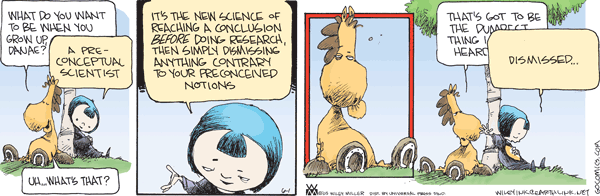
Whenever someone posits a theory that seems to fly in the face of both common sense and historical experience, we must suspect that they are working backwards: starting at a desired point and selectively gathering data to support that point. (See comic below) It’s a little like the creationists that engage in logical contortions to reach their illogical conclusions. In fact, the belief in the wisdom of free markets espoused by so many approaches religious faith in both its fervor and its reliance on faith above reason and experience.
The University of Chicago, from which this theory emanated, has been dominated by conservative economists. The theory supports the anti-regulation, free market ideology of that school, and of the conservative ideology generally. Unlike psychological theory, it has been adopted by people with real power to affect our economy, and we are now living with the results.


Home on the Range

Buffalo grazing at Bison Brook Farm in Preston.


A little weekend music

Last night my wife and I went to Burke’s Tavern in Niantic to hear our fellow Liberal Drinker Atul Shah’s band, Exit 72. I took a video of a song pretty much at random, I’m not really sure what it’s called. The young girl who pops up on the left at random moments is playing with a Wii videogame, bowling I believe. There wasn’t much I could do to keep her off screen.

Anyway, here’s Atul and his band.


Friday Night Music-Benny Goodman

This week marked Benny Goodman’s 100th birthday. My wife is a big fan of Goodman’s, dating from her days as a clarinetist for the Oberlin High Marching Band. Here he is with Teddy Wilson, Tony Terran, Dick Nash, Eddie Duran, Al Obidenski and John Markham at the Aurex Jazz Festival in Japan, playing Sweet Georgia Brown.


Amann’s big issue a bust

Speaking of tax breaks (see previous post), it looks like (who would have guessed) that one of Jim Amann’s talking points doesn’t bear close examination. The last time I saw our hapless (or is that hopeless) here, he was bragging about this efforts to make Connecticut Hollywood East. Apparently, he’s merely helped make Connecticut another Hollywood Sucker:

Many states that are cutting spending on schools, roads and other basics have been lavishing hundreds of millions of dollars in incentives on Hollywood studios to lure TV and movie productions — this, despite scant evidence that taxpayers come out ahead on such deals.

Connecticut’s revenue department, for example, found in 2007 that every dollar in tax credits generated only 20 cents in new tax revenue. Connecticut gave away an estimated $70 million in tax revenue that year.

“The credit does not ‘pay for itself,'” Jennifer Weiner, a policy analyst for the New England Public Policy Center at the Federal Reserve Bank of Boston, wrote in a January report about Connecticut’s incentives. “Increases in economic activity spurred by the film credit generate some additional tax revenue for the state from a variety of sources. This additional revenue is likely to offset some, but not all, of the initial cost of the credit.”

The article also points out that, contrary to Amann’s claims, the in-state jobs created are short lived and not all that lucrative.

It also appears that we have plenty of competition in the race to be Hollywood East, North or South. The studios have played one state against another, creating the typical race to the bottom that is an inevitable by-product of the tax abatement economic growth strategy.


Equality under the law

In this time of rising economic inequality there is another type of inequality that seems to be on the rise as well. Of course, maybe I’m merely being optimistic. Maybe this type of inequality has been with us always. This is reputed to be a country of laws and not of men, but that adage says nothing about corporations, and that appears to make all the difference.

Shouldn’t somebody be going to jail for this?


It was called the “Homeland Investment Act,” and was sold to Congress as a way to spur investment in America, building plants, increasing research and development and creating jobs. It gave international companies a large one-time tax break on overseas profits, but only if the money was used for specified investments in the United States.

The law specifically said the money could not be used to raise dividends or to repurchase shares.

Now the most detailed analysis of what actually happened — using confidential government data as well as corporate reports — has estimated what happened to the $299 billion companies brought back from foreign subsidiaries. About 92 percent of it went to shareholders, mostly in the form of increased share buybacks and the rest through increased dividends.

The data apparently resides in government files that are far too secret to allow us mere mortals to peruse, but to which some researchers recently got access, on the condition that they not reveal specifics about the corporate criminals. But they were able to give an example, culled from public SEC filings:

The study, titled “Watch What I Do, Not What I Say: The Unintended Consequences of the Homeland Investment Act,” was released this week by the National Bureau of Economic Research. It was written by Dhammika Dharmapala, a law professor at the University of Illinois; C. Fritz Foley, an associate professor of finance at Harvard Business School; and Kristin J. Forbes, a professor of economics at the Massachusetts Institute of Technology who was a member of the president’s council of economic advisers from 2003 to 2005.

“The restrictions on how the money will be spent seem to have been completely ineffective,” Ms. Forbes said in an interview this week.

“Dell was a great example,” she added, referring to Dell Computer. “They lobbied very hard for the tax holiday. They said part of the money would be brought back to build a new plant in Winston-Salem, N.C. They did bring back $4 billion, and spent $100 million on the plant, which they admitted would have been built anyway. About two months after that, they used $2 billion for a share buyback.”

If the law specifically says that the money can’t be used to buy back shares, and if the money was in fact used for that purpose, it would seem to be an open and shut case of tax fraud. We are talking big money; why have these corporations been allowed to engage in this massive fraud?

A minor point. I ranted for the umpteenth time recently about the stupidity of local tax abatements. This program is the federal equivalent, and it appears to confer almost as much benefit on the country as tax abatements confer on the towns.


Dodd at the JJB

CTBob posted Dodd’s JJB speech on youtube, and in the interests of spreading it around, I’m presenting it here:


More from Dodd on the Banks

One thing about being the head of the Banking Committee, you can make a lot of noise about things to which a lot of people can relate. Dodd is now warning the banks about gouging people with checking fees:

DODD PUTS BANKS ON NOTICE ABOUT EXCESSIVE AND DECEPTIVE CHECKING ACCOUNT FEES

WASHINGTON, D.C. – Senator Chris Dodd (D-CT), Chairman of the Senate Committee on Banking, Housing and Urban Affairs, today put banks on notice after recent reports of consumers being gouged by increased, excessive and deceptive fees imposed on their bank accounts. Senator Dodd pledged to work to protect consumers and cautioned the banks against excessive fees and the use of other deceptive practices that unfairly inflate the cost of bank accounts.

“While we just scored a tremendous victory for consumers against unfair and abusive credit card practices, we’re now seeing that a few banks have applied some of the same unscrupulous practices to bank accounts,” said Dodd. “At a time when so many families are already struggling to make ends meet, automatic overdraft charges and other excessive fees are forcing consumers deeper into debt. Banks and consumers should know that these actions have not gone unnoticed, and that I will continue to work to protect consumers from these fee increases and other unfair practices.”

I have a story that I could share if I had the time.

By the way, for the sake of my Republican readers who apparently don’t know the party affiliation of those Senators who head Senate Committees, I must disclose that Dodd is a Democrat.

This is pretty much of a throwaway post, by the way. I feel guilty that I was unable to post yesterday, and, as I’m heading off to Drinking Liberally in a few minutes, not likely to post again tonight


Reminder: Drinking Liberally Thursday Night

It’s that time of the month. If everyone who has promised to come, does come, we’ll have quite a crowd at our June Drinking Liberally get together. Remember, we never charge admission.

Time: 6:30 or whenever you want to arrive.

Place: Bulkeley House, Bank Street, New London.


Max Baucus gets an earful-figuratively if not literally

This is interesting. Apparently the people of Montana, or at least those interested enough in health care to attend bogus meetings with Montana Senator Max Baucus, are not happy with the representation they’re getting on the issue from their senior senator. They turned out for “town hall meetings” in which Baucus appeared only on pre-taped video, leaving his hapless aides to take the heat from the voters. Apparently, they prefer the single payer option. You know, the sensible medical system that saves us all a ton of money by bypassing the insurance companies.

At one meeting, his aide, Jon Selib, argued that employer based plans are very popular, but you couldn’t prove that by the people in the room.

Baucus, as the head of the Finance Committee, has a lot to say about the shape of health care. Single payer is, in fact, out of the question. Too many palms, including Baucus’s, have been greased by the insurance companies for the sensible solution to be considered. Baucus has refused, until just recently, to even meet with single payer advocates.

What’s interesting, though, is that Selib said this, as he cowered before the crowd:

“If you think your insurance company is screwing you … then you’d have the option of going to the public plan,” Selib said. “Senator Baucus is fighting tooth and nail to include that in any final deal.”

In fact, Baucus has hitherto been fighting tooth and nail to exclude the public plan from the program, though he’s been under increasing pressure to change that position. He’s deathly afraid of doing unto Republicans what they did unto him-use the reconciliation process. Better to screw 300 million Americans than upset 40 insane Republicans. In truth, his aversion to the reconciliation process might just be a cover for his desire to serve the interests of the insurance companies.

What’s important is that Baucus seems to be coming around on the public option. In a rational world, this would be considered a half ass measure, but in the land of the free and the home of the brave, it’s the only way to arrive at the single payer system. Properly done, a public option will drive the private folks out of business. The “properly done” part is a huge caveat, but if it passes quickly, Obama will have almost seven years to get it established, and build up a base of support with which the Republican who succeeds him may not wish to tamper. If Baucus is going to stop the obstruction then it just might get done.