Skip to content

Good news for the week

Each of our political parties is under attack. The Republicans are besieged by ever growing numbers of voters of all hues, but most frighteningly, for them, those of a brownish hue. They have responded to the attack in a most simple and direct fashion: by depriving those voters of the right to vote. They have done this without shame and have done it aggressively. They have taken effective action against voters, shutting them out of polling places in red states and those blue tinged states in which they gained temporary power. They have been particularly effective and aggressive in those states, such as Texas, in which they fear the oncoming demographic brown tide the most.

The Democrats are under attack by the forces of reaction, led by rich folks such as the Kochs, backed by frightened, ignorant aging whites. What they lack in numbers they make up in money, and their chosen instrument for gaining power is the 501(c)(4) non-profit supposedly devoted to “social welfare” but which really devote themselves to partisan politics pure and simple. The administration, you may recall, beat a hasty and craven retreat when it was discovered that the IRS was slow walking requests from such groups for certification that they were in fact legitimate. The right claimed that it was being targeted because the IRS looked for words like “tea party” in an organization's name when deciding who needed special attention. It turned out that they were searching for liberal buzzwords too. No matter, the people responsible for this eminently reasonable course of conduct were obliged to resign.

So what, you may ask, is the good news? It looks like business as usual; Republicans using power to maintain power; Democrats cringing and allowing their opposition to run roughshod over them.

Except, maybe, the Democrats, at least some in the Obama administration, are growing a spine:

New rules proposed by the Treasury Department and the Internal Revenue Service would clarify both how the I.R.S. defines political activity and how much nonprofits are allowed to spend on it. The proposal covers not just television advertising, but bread-and-butter political work like candidate forums and get-out-the-vote drives.

Long demanded by government watchdogs and Democrats who say the flow of money through tax-exempt groups is corrupting the political system, the changes would be the first wholesale shift in a generation in the regulations governing political activity by nonprofits.

The move follows years of legal and regulatory shifts, including the Supreme Court’s Citizens United ruling in 2010, that have steadily loosened the rules governing political spending, particularly by those with the biggest bank accounts: corporations, unions and wealthy individuals.

Under current rules, promoting social welfare can include some political activity, along with unlimited amounts of lobbying. Some of the largest political nonprofits — like Americans for Prosperity, backed by the conservative philanthropists Charles and David Koch — have used that provision to justify significant expenditures on political ads.

But under the new proposal, a broad swath of political work would be classified as “candidate-related political activity” and explicitly excluded from the agency’s definition of social welfare. Those activities include advertisements that mention a candidate within 60 days of an election as well as grants to other organizations making candidate-related expenditures.

“Depending on the details, this could be dramatic,” said Marcus S. Owens, a former chief of the I.R.S.’s exempt organizations division.

via New York Times

Of course, Republicans are already counterattacking, but my guess is that the Administration will stick to its guns. If the Democrats had any sense, they'd mount a propaganda campaign in support of this as noisy as the Republican’s incessant claims that we must eliminate voter fraud by eliminating voters. Once again, as is so often the case, the Democratic argument would have the virture of truth. These organizations are polluting our political system. There are ways to make that point take hold with voters. It is necessary in the first instance to be loud and proud about what you're doing. I’d be happy to see the odd progressive 501(c)(4) disappear if we can also get rid of, or at least hamstring, the Koch Brothers and ALEC. So here's hoping they won't back down, and that's the good news for this week.
Stand with the nurses

Our local hospital, Lawrence & Memorial has, of late shown signs of going down the path of corporatism. Part of that process is the Walmartization of its workforce. After all, if you pay your nurses a decent wage, it's that much harder for the hospital execs to get those inflated salaries (over $700k for the joker at the top). The nurses have been forced to go on strike. Read about it and sign a Moveon Petition in support here.

What religion is Exxon?

We truly have come to a strange place in this country, even jurisprudentially speaking. In this morning's Times we read that the court is likely to take up the question of the “Religious Rights of Corporations”. It seems that the Hobby Lobby objects to providing mandated health insurance benefits to its employees.

We seem to have lost sight of the fact that corporations are creatures of statute. They exercise whatever legal rights, and operate within whatever legal framework the legislature pleases to set up. They could be abolished, or at the very least the right to form new corporations could be abolished, at the whim of the legislature. It always amazes me that this fundamental point is never made when the issue of the “religious rights” of corporations is raised.

Only one court has ruled in favor of granting such rights to corporations, with one judge ruling that it was a far easier call than that made in Citizens United because “A corporation exercising religious beliefs is not corrupting anyone". There are, in fact, sound reasons to grant corporations some free speech protections, for corporations do have to speak. What Citizens United did was demolish the ability of the state to put limits on the way that corporations speak, as well as equating spending money with speech. It was wrongly decided, but although one must strain, it is somewhat intellectually defensible.

A corporation is a legal fiction. It cannot in any intellectually defensible way, be said to either have a religion or need to exercise religious rights. If religiously minded people believe that forming a corporation will force them to behave in ways that they find objectionable, they have the right not to form a corporation. They do not, on the other hand, have a “right” to form a corporation. They have the legal privilege to do so on the terms set forth in relevant statutes.

I'm being optimistic, and I'm betting the Hobby Lobby loses 5 to 4, but I could well be wrong. If it wins, then it will be interesting to see how the court, (think Bush v. Gore) manages to restrict it to the facts. Which religious beliefs are entitled to protection. Years ago, a more rationale court ruled that an Amish employer (not a corporation, but a real person), could not refuse, on religious grounds, to withhold Social Security taxes for his employees. How is that case distinguishable from the Hobby Lobby case, except for the fact that the idea of a corporation with religious beliefs is a legal oxymoron? What does the court do if one of our corporations converts to Islam and seeks to impose …gaspp!…sharia law on its employees? What of the corporation that starts its own religion, which has dogma that just coincidentally has a beneficial impact on the bottom line, such as a moral aversion to paying taxes or a firm belief that God, when he gave us dominion over the earth, was imposing a moral imperative to pollute?

A favorable ruling for Hobby Lobby will by no means be consistent with the free exercise clause, but it will do irreperable harm to the establishment clause. In the case at hand it would grant special privileges to a “religious corporation” that would be denied to secular corporations.

The legal claim is bizarre, but what's even more bizarre is the fact that it has a decent chance of prevailing.

Scum

There is really no other word for the people who run American corporations. Some of the European corporations are at least throwing some crumbs at the survivors of the Tazreen factory fire in Bangladesh, but according to the Times American corporations, including Walmart and Sears, are refusing to donate a plug nickel.

A handful of retailers — led by Primark, an Anglo-Irish company, and C&A, a Dutch-German company — are deeply involved in getting long-term compensation funds off the ground, one for Rana Plaza’s victims and one for the victims of the Tazreen fire, which killed 112 workers last Nov. 24.

But to the dismay of those pushing to create the compensation funds, neither Walmart, Sears, Children’s Place nor any of the other American companies that were selling goods produced at Tazreen or Rana Plaza have agreed to contribute to the efforts.

via New York Times

The amount involved ($6,000,000.00 total) is so low that the Walton's lobbyists only look for tax breaks that small for practice. Typically, Walmart responds to questions about its stinginess with a mix of hypocrisy and gobbledegook.

After the International Labor Rights Forum, an advocacy group based in Washington, wrote to Walmart to urge its participation in the compensation efforts, Rajan Kamalanathan, Walmart’s vice president for ethical sourcing, responded in an email that Walmart did not intend to participate. He wrote that “there was no production for Walmart in Rana Plaza at the time of the tragedy” and that the Walmart-related production at Tazreen was unauthorized.

In that email, made available by the labor rights forum, Mr. Kamalanathan made clear that Walmart was looking to the future: “Our focus is to positively impact global supply chain practices both by raising our own standards and by partnering with other stakeholders to improve the standards for workers across the industry. We will continue to invest our resources in proactive programs that will address fire and building safety in the garment and textile industry in Bangladesh to help prevent tragedies before they happen.”

via New York Times

Walmart can't spare the change because it needs it to hide its connections to the people that run its sweatshops that produce the crap that passes for clothing these days. As for the “proactive programs”, are there any suckers out there who would bet that Walmart will follow through with anything but self promoting PR? This is a corporation that is perfectly willing to let its American employees starve rather than paying them a living wage. It certainly isn't going to go out of a way to make sure that a few hundred Asians don't get fried every year or two.

It’s about time!

At long last, the Democrats in the Senate have ended the filibuster abuse by the Republicans. This is truly good news, making it easy to meet my weekly obligation to recount such things, and this time I doubt that I'll be limning the good news with cynicism, though first by way of aside: “Shame on you, Carl Levin”.

Let me balance that with “Thank you, Harry Reid”. It's about time, for sure, but better late than never.

There will no doubt be many pundits warning that the Democrats will rue this day. I doubt it.

McConnell has made threats that if Reid takes this half measure (it only applies to presidential appointments of the non-Supreme Court variety), he will retaliate by abolishing the filibuster altogether.

The reasons this should not concern us are legion.

First, the Democrats never made effective use of the filubuster in the first place. Witness the composition of the present Supreme Court. Need I remind anyone, that the filibuster did not stop the truly bad things that Bush did, such as transferring money to the rich through his “tax cut”. Democrats are too easily shamed, whereas the Republicans cannot be shamed. The only emotions they know are greed and fear.

In the short run, we have nothing to fear. It is, of course, possible that the Republicans will take control of the Senate next year. I personally have faith that they'll shoot themselves in the foot as they did in 2012, but let us assume for the moment that they don't. They can abolish the legislative filibuster in 2014, but to what end? It takes 67 votes to override a veto, and that's in the constitution.

Should they take the majority, and they abolisth the filibuster altogether, we also win. I suppose it is possible that one can find examples of the use of the filibuster to prevent something truly bad from happening. But the sad fact is that it has mainly been used to stop progress on every imaginable front. The filibuster was used in the thirties to protect lynch mobs, and its use since then has hardly been more noble. There are no Jimmy Stewarts in real life.

Imagine, if you will, what Obama could have accomplished in 2009 were it not for the filibuster. An effective stimulus, for one. Dare I say it? Perhaps he would even have gone for single payor, or at least a public option. The 2010 backlash would not have happened if Obama had been able to deal effectively with the depression in which we are still mired. Perhaps his own lack of vision would have stopped him anyway, but in real life it was the Republican's determination to bring down the economy in order to make him fail.

There is something to be said for a rule that allows a minority to slow the system down a bit. There is no defense for a system that allows the minority to call the shots, particuarly when, in actuality, only one of the two parties gets to do so. Up until today, the Republicans have controlled the Senate whether they were in the minority or majority. Those days are over, at least when it comes to appointments. Now it's up to Obama to pack the courts and the agencies with real Democrats.

Hope, though not much, for the South

Recently there was a special election for a Louisiana congressional seat. The results were somewhat shocking: a Republican who supported the expanded Medicaid benefits in Obamacare beat his mainstream (the “tea party” is now mainstream ) Republican opponent. (The district in question is scarlet red) It appears that even dumb poor Southern white people actually do want medical coverage.

Not an earth shaking development obviously, but it may just be that it presages a trend. For it occurs to me that there is an opening in the Southern branch of the Republican party for what I hesitate to call liberalism or progressivism, but something akin. The Republican Party has managed to leverage a racist message, overt or covert, into dominance in the South, while implementing policies that serve the interests of the corporations rather than the ignorant angry whites that vote for them. The fact is, these voters are not invested in the policies that their candidates support; they are just as like to support anti-corporate, pro-people policies so long as they can convince themselves that only they will benefit.

Back in the olden days it was not unusual for Southern Democrats to vote distinctly left of center and get elected and re-elected so long as they were reliably opposed to civil rights legislation. William Fulbright pops to mind. LBJ destroyed that wing of the party, along with the unmissed racist Southern branch, by destroying the Democratic Party's racist brand. The Northern and Southern branches had been in a fairly uneasy alliance since the New Deal, if not before. But, so long as you watched your tongue and didn't try to make it look like you were advocating things that might help black people, a Southern politician could lean pretty far left back then. Say what you will about Huey Long, but you can't call the guy a right winger, certainly not of the ilk we have today. I suspect that when his listeners heard him call for programs that would make “Every Man a King”, they understood without asking, or without him having to say, that the adjective “white” was understood to come just before the word “man”.

The Republican party's racist brand is now secure throughout the South, and, despite a few rumblings, the Northern branch of Lincoln's old party (history is full of ironies), to the extent it exists, seems uninterested in doing anything about it. So, there's room in the South for a Republican that appeals from the left to an electorate that is, after all, composed mainly of poor whites who can only claim, as Dylan observed, to “have more than the blacks”, which isn't much. At the moment, any Republican who comes along advocating programs for these people could gain a following, so long as he or she can convey the impression that only Christian white folks need apply. After all, the operative assumption is that all Republican Southern politicians are racists; they send that message in scores of ways, so that magic R will send the message all those Southern racists want to hear. It's not much, and it's certainly not optimal, but politics has always made for strange bedfellows, and at least a Republican of that ilk might make common cause with Democrats to do something for the little guy.

Not fiction

There truly are things going on in this country that you simply couldn't make up. If this were in a work of fiction, would you believe it?

Food donation boxes are a common holiday-season sight in supermarkets. Boxes for store employees to donate food for other store employees in need? That's more of a surprise, but it's exactly what can be found in a Canton, Ohio, Walmart:

“Please Donate Food Items Here, so Associates in Need Can Enjoy Thanksgiving Dinner,” read signs affixed to the tablecloths.

The food drive tables are tucked away in an employees-only area. They are another element in the backdrop of the public debate about salaries for cashiers, stock clerks and other low-wage positions at Walmart, as workers in Cincinnati and Dayton are scheduled to go on strike Monday.

via Daily Kos

Maybe those employees need the extra help because their food stamps are being cut in order to fund more tax breaks for the Walton Family. The sad fact is that outrages like this are becoming so commonplace that we accept them almost unthinkingly. I'll repeat a suggestion I made a while ago. Walmart has one weakness. It can't pack up and go elsewhere, and if it does, good riddance. Each state that cares about its people, even a little bit (translation: blue states) should impose a tax on any corporation employing 50 or more people if more than 15% (or some other appropriate percentage) of those employees require public assistance, including cash payments, Medicaid, and food stamps. We should, at the least, be able to recover the subsidies we are giving to Walmart.

It' stories like this that make me regret having lost my religion. One could take at least some cold comfort from believing that the Waltons will burn for eternity once they have departed this planet they have done so much to despoil. Alas, that will not happen, so we can only hope against hope that someday they will suffer here on earth.

Get off of my lawn!

I am feeling sort of crotchety today, so I'm going to vent a bit, as is my right as a near geezer. (I will never actually admit reaching that milestone, but I confess to getting ever nearer.)

First, let me direct my fire at the Democrats. I've been blogging since 2005 and I'm really tired of returning to a theme I first developed in the opening weeks of my blogging career. I'm not, of course, the first to expound on this phenomenon. Sadly, and most certainly, I shall not be the last.

For the past week we've seen Democrats of all stripes disgracing themselves trying to “fix” a problem with Obamacare that scarcely exists, or simply assuming the fetal position while they are attacked by Republicans. Is there nothing new under the sun? From Obama on down, Democrats hasten to respond to disingenuous claims by Republicans that, since Obama promised that everyone would be able to keep their insurance plans, he was somehow promising that insurance companies themselves would never cancel a policy again, not even those that were initially offered after the passage of the law that the insurance companies surely knew would become illegal once the law became effective. We even have so called Democrats, such as the congressperson from this states's 5th District, voting for a Republican solution that does nothing to solve the non-existent problem other than to let insurance companies continue to sell existing non-compliant but profitable plans, while dumping plans they don't like.

We live in strange times. We have a party that represents the interests of the corporations, the extremely rich and extremely crazy, which shamelessly and forcefully advocates for positions that most people abhor. We have another party that supports policies that most people support, in the sense that they prefer them to the alternative, which party is terrified to advocate for its positions. In any sane country this would seem to be a paradox, but here it's business as usual.

So much for that. Let me now direct fire in a different direction, toward the New London Day.

I have, of late, noticed that a lot of people who write for a living can't. Write, that is. Not to put too fine a point on it, they are strangers to the rules of grammar. I confess to having a thing about sportswriters in particular, who tend to repeat certain tropes. The most abused is the use of the same phrase to start or end an interminable number of sentences, but when that trite literary device is used, at least the rules of grammar are normally observed. What can one do but suffer in silence? But I reserve the right to carp when the English language is mauled beyond recognition.

Don't get me wrong. I feel for the local sportswriter. It must be hard to come up with original things to say about the latest contest between New London High and Fitch. Almost as hard as coming up with new ways to condemn spineless Democrats. But does that excuse the following opening sentence (opening paragraph, actually), which appeared in today's paper?

Never did they imagine they'd be celebrating the first state championship in the program's 37-year history when the season began.

I confess that I'm puzzled. It may be a sentence. It seems to have all the constituent elements. I think it has a subject. It has verbs in abundance. Perhaps the difficulty lies in the fact that it's so very hard to connect any of the verbs with an object. Equally baffling is the fact that it resists all attempts at correction. Oh, you could do it. With time and patience you can tease a coherent sentence out of this sequence of words, but it's not easy. All I can say is this: Had I written this sentence in fourth grade, good Sister Thomas would have made me stay after school until I got it right. Worse yet, she might have made me stay until I could successfully diagram it as written, in which case I'd still be at my desk today.

Rant over, except… wait. Hey, you kids, Get off my lawn!

Inequality for All

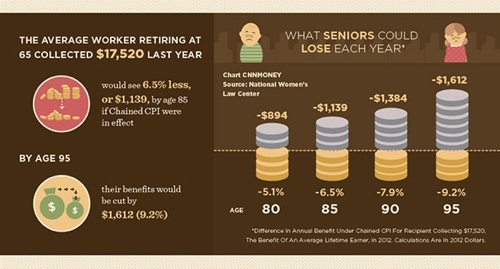
I got an email this morning from one Aldo Baker, of Democracy for America, who asks that I spread the word about the attack on Social Security and the true facts, which he claims you can see here. I’ll confine myself to one aspect of the current assault on Social Security: the push to impose the so-called chained CPI. As they explain, the current cost of living increase formula assumes a more or less static basket of goods and services, and raises benefits as the cost of those goods and services increases. The chained CPI, on the other hand, DFA explains, works like this:

Assuming when prices for one thing go up, people will settle for cheaper
substitutes (ie: if beef prices go up, they’ll buy more tuna fish and less
beef)

Here’s their infographic on the subject:


Now, much ink has been spilled in various blogs demonstrating that this is nothing more than a cut in benefits, as indeed it is, but unless I’ve missed something, there is something else about the chained CPI that has not elicited much comment. That is, the chained CPI only achieves the desired effect (a cut in benefits) if economic conditions are such that people are forced to buy more tuna fish (and later, cat food) instead of steak. If that rising tide were lifting all boats, the sales of steak would remain constant. People are forced to buy tuna fish only because their incomes are not keeping pace with prices, and that, of course, is a result of federal policies that have produced rising inequality. The chained CPI will accelerate the phenomenon it pretends to measure by further impoverishing the only significant segment of the bottom 99.9% that was previously at least somewhat protected. The elderly who might have been able to afford a steak now and then will be eating solely tuna, much like their children and grandchildren. Taking that money out of the economy will further depress it, helping to create or continue conditions under which the working generations will have no choice but to work at jobs at which their wages continue to stagnate or decline in real terms. This will force them to substitute cat chow for the canned stuff, which in turn will justify further cuts to social security, which in turn will further depress spending, further depressing wages. Of course, when 99.9% of us lose, it’s a sure thing that .1% of us will win, and really, isn’t that what it’s all about?

Humpty Dumpty bested again

Yet another example of the malleability of words and meaning. In this morning's Times we learn that the Euro, wonder of wonders, may be the source of the problems in Europe. That's no surprise to anyone who reads Krugman, et. al., but let that pass. What struck me was this:

True, there have been glimmers of good news lately. Consumer confidence among Europeans has improved, and recession has ended in countries like France and Spain. European stock indexes are up for the year. And yes, the euro in recent months has risen in value against other main currencies — although that is more curse than blessing, because it makes exports relatively more expensive outside the euro zone.

via New York Times

So, in this case, the word that's gotten the Humpty Dumpty treatment, most likely by one or more central bankers, is the word recession. When I was just a wee lad, I naively thought that a recession was a junior depression. Not so bad as the thirties, but bad. And I also thought that the bad thing about depressions, and by extension, recessions, was that a lot of people ended up unemployed. It followed, at least in my feeble little mind, that a recession ended when unemployment went back to reasonable levels, which in my naiveté I pinned at around 4%. Or, to be more precise, such a decrease in unemployment was at least necessary, if not sufficient, to end a recession.

Apparently, I was wrong. The Spanish unemployment rate is now 25.98%, down from a high of 27%. What definition of end of recession could possibly apply to a country with a 26% unemployment rate? Apparently, a benchmark was met, and unbeknownst to the people of Spain, that country, like this, left recession behind while millions were left unemployed. Apparently, these days, recessions end as soon as the bankers feel secure. Humpty would be awestruck.