Skip to content

How far a fall

The day that I started work at my law firm we inherited a case involving the New Haven Register. Since I had just started, and had nothing else to do, I carried a briefcase for the senior partner working on the case, on which we made a lot of money. At that time, the Register was owned by a trust set up by its founders, in which each of his children had a share. Several beneficiaries of the trust brought suit against the trustees. It was a long running family feud, played out in the courts. We arrived in the last act. The denouement involved the sale of the paper to what I believe is its current owner, for a large sum of money.

The Register is now owned by the Journal Register Co. and appears to now be worth a lot less than the amount for which it was sold back in 1986. In fact, the Journal Register Co. is on the verge of bankruptcy, but not necessarily because the Register is not worth anything, or because it could not turn a profit as a free standing enterprise.

Journal Register has said it is exploring strategic alternatives, including the sale of all or some of its assets, which include the New Haven (Conn.) Register, The Trentonian in Trenton, N.J. and about 20 other dailies.

The paper is burdened by big debt taken on to finance a disastrous purchase of a cluster of suburban Detroit dailies. It has warned in regulatory filings that it expects to be in violation of its loan covenants by July 23. Journal Register (Other OTC: JRCO.PK) was delisted from the New York Stock Exchange earlier this year, and now trades on the Pink Sheet.

Journal Register stock closed Wednesday at 14 cents a share, giving it a market capitalization of $5.5 million.

I don’t remember what the Register (just a part of the Journal Register Co.) sold for in 1986. I do remember that the plaintiffs suing the trust felt it should be sold for about $24 million, but it eventually sold for far more than that. Now the whole kit and caboodle is worth 5 million dollars.

It’s a shame to see a newspaper at risk, not because it failed on its merits, but because it couldn’t generate enough income to pay off loans for purchases from which it gained no advantage. I’m no economist, but it seems self evident that something has to give when a business is saddled with a large amount of debt incurred for purposes entirely extraneous to its own operations. The same would apply, it seems, in the case of a business bought on credit, which must then earn sufficient money not just to turn a profit, but to pay off a mortgage on itself that previously did not exist. This is particularly true if the business in question has a relatively slim profit margin. The preferred method of the modern capitalist to solve this problem is to cheapen the product, in the expectation that the customer won’t notice. Sometimes they don’t, but often they do, and the company dies, crushed by debt. In addition to the Register, we may lose the Courant (not that it’s worth that much at the moment) for exactly that reason.


Art on Groton Bank returns

Actually, I forgot to mention the first show in June. Audrey Heard sent a press release, from which the following is excerpted:

ART ON GROTON BANK will hold its second event of its second year at the Bill Memorial Library at 240 Monument Street in Groton City on July 19, 2008 from 10:00 AM to 4:00 PM. Paintings, sculptures, photography and fine arts crafts will be shown on the chain link fences surrounding the library property and its tents on the grounds.

Amont the artists participating are: Lynn Anderson, Karen Cashman, Carla Gaudio, Robin Grace, Robert Hauschild, Audrey Heard and jewelry maker Darryll Tootel. Over 70% of the artists are alumni of either Lyme Academy College of Fine Arts or of Rhode Island School of Design, an outstanding level of abilities. Who knows, you may buy a future masterpiece.

We bought a future masterpiece last year, and the price was right. If you’re not from the immediate area, this will give you a chance to see some fine art, soak up some Revolutionary War History, and, if your feeling fit, climb to the top of the monument to get a bird’s eye view of the area.

To get there, point your car toward Groton and head toward the monument, pictured here:

Monument

Audrey, pictured below, will be there to greet you.

Audrey

By the way, they have a very nice website, at www.artongrotonbank.org, where you can see some samples of the type of art they have on view.

Light posting

On Monday the Charter Revision Commission voted to send the proposed Charter on to the Town Council, along with a report that describes the changes we proposed. The folks who supported the referendum are writing a minority report. Since our original report does not address the referendum issue, and the minority report will only address the referendum issue, I thought I would try writing something up as a sort of rebuttal to the minority report.

So, I’ll be spending most of my evenings this week, when I would normally be writing this blog, writing about budget referenda.

More on the New Yorker

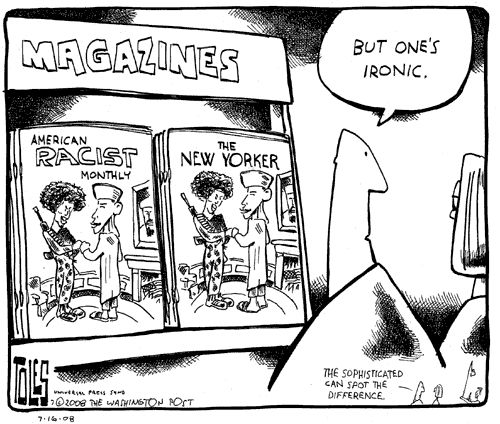
It has been interesting to see who has been closing ranks around the New Yorker. Jon Stewart, yes. Steven Colbert, not quite. Tom Tomorrow couldn’t quite see that his own brand of satire takes clearer aim at its intended target than did the New Yorker. Rubin Bolling, on the other hand, seemed to see the problems with the piece, which are well illustrated by Tom Toles.

Not so bright, and proud of it

[youtube]http://www.youtube.com/watch?v=srbX26vp57c[/youtube]

The New York Times is a “Far Left” Paper. Who would have thought it

Recently the New York Times reported on the dismay some of us have felt at Obama’s change of position on FISA. The article is titled Obama Supporters on the Far Left Cry Foul. The question immediately arises: why is opposition to gutting the Fourth Amendment a “Far Left” position. And if it is, shouldn’t the Times Reporter have sought comment from whoever wrote the New York Times Editorial that urged the Senate to reject the FISA bill?

We of the “Far Left” welcome the New York Times Editorial staff to the fold.

Not funny

My letter to the New Yorker:

I was shocked to see a reproduction of the cover to your July 21st issue on Americablog.

There is absolutely no excuse for publishing this canard. It is outrageous to suggest that Barack Obama and his wife are terrorists. I must assume, in charity, that your intent is to mock those who have spread rumors to that effect. If that is your intent, you have failed miserably, and have merely reinforced these racist lies. I realize that some of your covers have employed similar devices, but never regarding an issue as inflammatory as this, or one likely to have an impact beyond the people who are intelligent enough to “get” your intended meaning. Those of us who do not actually live in the upper reaches of New York society are painfully aware that there are a lot of stupid people in this country whose beliefs about Obama will be reinforced by your attempt at … humor?

My wife and I have subscribed to the New Yorker for years. It will be difficult, if not impossible, for us to see our way clear to continuing our subscription.

This appears to be the year of not funny under any circumstances political humor. Almost any joke by John McCain would do, but his “joke” about killing Iranians is the best case in point. There is no way you can joke about killing ordinary people who have done you no harm. It’s pretty hard with wife beating too.

On the other hand, if he told more jokes he might spend less time revealing his abysmal foreign policy ignorance (remember, that’s the stuff he claims he knows something about). Apparently, he just can’t let Czechoslovakia go.

A follow-up for Sean, if I might

Paul Choiniere has a column in the Day this morning about Sean Sullivan’s long shot candidacy in the Second District Congressional race. He summarizes Sean’s political philosophy:

He feels government has grown well beyond the means of the average taxpayer to support it, that the ever-larger budget deficits are a major cause for concern. He sees the role of the federal government as providing for those things that individuals cannot provide for themselves – a national defense, a social safety net for the most vulnerable, a reliable highway system. Sullivan predicts a national health insurance plan would be a disaster, and feels tax incentives can encourage a private-sector solution. (Emphasis added)

I wish Choiniere had followed up and asked Sean why he feels that a national health insurance plan would be a disaster. After all, Sean is someone who lived most of his adult life under the closest thing we have in this country to socialized medicine: the armed services health care system. Was it a disaster for him? By all accounts it functions well, as does Medicare, as does the VA system, as do most of the national health care plans in the civilized portion of the world. Why does Sean feel that the United States would be the exception?

Republicans have a strange detachment from reality. For many, their political philosophy is like a religion, based not on facts but on faith. They believe government cannot work and do all they can to prove it when they can take the levers of power. No amount of proof to the contrary can shake their faith. If a program works, they will either ignore that fact, work to subvert it (e.g., Medicare Advantage) or appoint people who oppose its purposes to run it. On the other hand, they retain faith in their own prescriptions despite overwhelming proof that they do not work. Consider supply side (a/k/a voodoo) economics, the claim that lowering taxes mainly on the rich leads to increased government revenue. Reagan tried it. It didn’t work. Clinton did the opposite. It worked. George Bush tried it. It didn’t work. Now McCain wants to do it again. The fact that it has been disproved in real life means nothing to these people. They believe and that is sufficient. (And besides, they’re all rich and it benefits them enormously)

By the way, I’m aware that Medicare has financial problems. If the system were expanded to cover everyone, those problems would largely disappear, since the more healthy people we bring into the system the sounder it would get. And it remains true that the Medicare Advantage program, which subsidizes more expensive private insurance, has increased the program’s financial woes.

Talking about rights

Does Khalid Shaikh Mohammed — the Guantánamo detainee who claims he personally beheaded the reporter Daniel Pearl — deserve the rights he denied Mr. Pearl? Which ones? A painless execution? Exemption from capital punishment? Decent prison conditions? Habeas corpus?

Such apparently unrelated questions arise in the aftermath of the vote of the environment committee of the Spanish Parliament last month to grant limited rights to our closest biological relatives, the great apes — chimpanzees, bonobos, gorillas and orangutans.

(New York Times, When Human Rights Extend to Nonhumans)

I’m not sure exactly why extending “rights” to apes raises all these questions, but I would submit that, at least in part, the quote above illustrates a problem with the way we Americans frame these issues, at least as they apply to humans.

It isn’t only whether Khalid Shaikh Mohammed (who, as Frank Rich points out today, may not be guilty of the crime to which he’s confessed) has a right to a painless death, but whether a civilized society should inflict any other kind, assuming in the first place that the death penalty should ever be used. That issue can’t be resolved solely by considering his rights.

The question is not, or not alone, whether individuals possess certain rights, but whether any society should demean and degrade itself by inflicting painful deaths, engaging in torture or setting up kangaroo courts, to name just a few of the crimes against humanity in which this country has engaged in the past seven years. Putting aside the practical objections to at least some of these activities (that they don’t work), we have proven in our own recent history that engaging in such practices destroys not only our claim to moral leadership, but our moral center itself. We became a compromised country when we chose to abandon the ideals we have espoused, and largely lived by, since George Washington opted to treat captive Hessian soldiers humanely, not as they deserved (they had been ordered to take no prisoners), but in accordance with our principles, not in accordance with theirs. Washington was not concerned with the Hessian’s rights, but with American principles and American honour.

As Hamlet told Polonius, “Use every man after his desert, and who shall scape whipping? Use them after your own honour and dignity-the less they deserve, the more merit is in your bounty.”

Addendum: I have received an extended comment to this post. I haven’t read all of it yet, but it is essentially a defense of the death penalty, grounded in Catholic theology. You can, of course, prove anything by a resort to theology, a philosophical system grounded in fantasy. Though I should add, to give it its due, that the Catholic Church is now against the death penalty, except, apparently, in extreme cases.

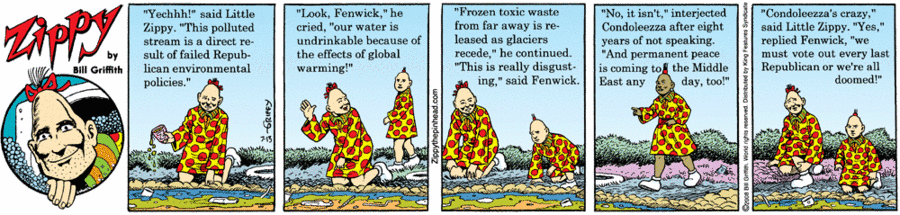
Little Zippy speaks words of wisdom

(Click the graphic to make it readable)