Skip to content

Scratch Pawlenty off the list

Seems to me that Tim Pawlenty has effectively put himself out of the running as a viable candidate for the Republican nomination for President:

Likely Republican presidential candidate Tim Pawlenty won’t be joining mock candidate Donald Trump in his efforts to put birthers back on the political front burner: “I, for one, do not believe we should be raising that issue,” Pawlenty said Tuesday morning on MSNBC’sMorning Joe. “I think President Obama was born in the United States.”

Now, there are only three reasons that a Republican candidate would make a statement like that. He or she could believe they would not be overheard, he or she could be under oath, or he or she could believe that one can win the Republican nomination by being the sole candidate seeking to appeal to the vanishing slice of Republicans who have not taken leave of their senses.

The first two don’t seem to apply, which leaves the last possibility, but given the fact that Pawlenty has been sucking up big time to the teabaggers, that seems unlikely too, so we must seek for a fourth solution, which would be that Pawlenty’s not very smart. I, of course, exclude the possibility that he is just being honest, because honesty is a quality not seen in a Republican for decades, and scarcely seen in a Democrat. Pawlenty should realize that the safe response to questions about Obama’s birth is as follows: “I believe that there have been serious questions raised, and I think the President should answer them”. Always understanding, of course, that no answer could ever be sufficient, even if Obama unearthed live coverage of his birth by a Hawaiian television station. This response gives comfort to the frothing millions while preserving deniability should the candidate actually get the nomination, at which time, of course, they will want to work their way back toward an appearance of rationality.

To add to his woes, Pawlenty has yet another grievous strike against him, and I’m not talking about the fact that he induces a catatonic state in the listener. While he was governor of Minnesota, he encouraged the banks in his state to offer Sharia compliant financial instruments. Since Muslims, like early Christians (who have, as we all know, cast off the prohibition) are not allowed to pay interest on loans, it is necessary to design Sharia compliant financial instruments that allow them, for instance, to buy a house. These “instruments” are, in fact, simply devices in which the lender charges the equivalent of interest, but the arrangement is defined in such a way that it is not called interest. This is a form of hypocrisy practiced by all religions, and it is harmless. Harmless, and probably good for the banks, which can bury a higher interest rate in a vehicle like that than in a normal loan, where they have to disclose the rate. But, as every Republican primary voter knows, Sharia law is a bogey man second only to the one that currently inhabits the White House.

So, Pawlenty is toast. The nomination will be going to one of the other improbable candidates.

This, by the way, will be the first in a series of post in which I prove conclusively that not a single of the declared or semi-declared candidates has any chance of getting the nomination. Yet, as we know, one of them will, so I will only be “wrong” about one of them, but even then, only in a very limited sense, as the survivor of the “I’m crazier than you” competition will end up being the biggest loser of them all. For there is one fact of political life that has been constant for lo these many years: an also ran at the convention lives on in the world of politics; a losing presidential candidate is immediately relegated to the role of laughingstock, except, perhaps, in the strange case of John McCain, who lives on, zombie-like. But the 2012 Republican candidate will be a historical first: the victim of a drubbing at the hands of a man who has ineffectually presided over a major economic downturn, and is therefore unlikely to escape what will be, in his or her case, a much deserved fate.

The Majesty of the Law

When I first read this article in the Times, it brought to mind Anatole France’s observation that
“[t]he law, in its majestic equality, forbids the rich as well as the poor to sleep under bridges, to beg in the streets, and to steal bread.”

Charlie Engle (who, though not exactly poor, was definitely not rich) was recently sentenced to 21 months in jail for taking out a liar’s loan from Countrywide. Meanwhile, Angelo Mozilo, the former head of Countrywide will not face prosecution, though he knew the loans he was making to folks like Engle, and reselling to anyone stupid enough to buy, were fraudulent. He paid a sizable (by my standards or yours) civil fine, but it hardly made a dent in his huge fortune. He certainly did not take as big a hit as Mr Engle will take when he makes a court ordered $260,000 restitution payment to Countrywide when he finally emerges from prison. That’s right. Our government indulges in the fiction that Countrywide was a victim of it’s own fraudulent business plan.

What Anatole France neglected to say is that while the rich are indeed prohibited from sleeping under bridges, if a rich man chose to do so he would surely escape punishment. Angelo Mozilo will never see the inside of a cell, though he helped destroy the economy, though mortgage fraud laws, the last time I looked, were supposed to apply with majestic equality to everyone.

Engle’s story is interesting for another reason, in addition to the disparity between his treatment and Mozilo’s. The investigation into his “crime” (there were millions of liars loans, and nothing special about his) was initiated by an IRS agent who saw him in a movie about long distance running, and decided he must be a crook. He had neither evidence nor reasonable suspicion. After finding nothing in his trash, he put an attractive female agent on the case, who formed a friendship with Engle, who then told her about his nefarious misdeed. The story is a bit reminiscent of the Starr investigation of Clinton. Starr, after no evidence could be found of Whitewater misconduct, decided to keep investigating until something, anything, could be found. The entire investigation appears to have been a gross misuse of power.

By the way, the article in question was written by Joe Nocera, who will be leaving the business section for the Op-Ed page. Bob Herbert will be missed, but judging by his work in the business section, Nocera will be a good replacement.


Friday Night Video-Some Wishful Thinking

It certainly does seem like years been it’s been clear. An ode to the coming Spring.

By the way, the video features, along with George: Ringo, Eric Clapton, Phil Collins, Elton John and Phil Collins. Not a bad collection of talent.


Wisconsin Republicans learned from their favorite son

Joe McCarthy must be proud of his home grown emulators. The Wisconsin Republicans have launched a brazenly open witch hunt against a Wisconsin professor who dared to write an op-ed piece in the New York Times that they didn’t like. The GOP demanded access to his emails, in the hope that they could make a criminal case against him for misusing his university email account. McCarthy would approve.

The professor, William Cronon, appears to be hopelessly naive, in that he actually thought that if he wrote a thoughtful, well reasoned piece opposing this updated McCarthyism, the Republicans might back off, but he’s been disabused of that notion. Only Republicans would have the nerve to claim that opposing an obvious attempt to intimidate is undemocratic. Only in America in the 21st century could they get away with it. McCarthy wouldn’t just approve, he’d be jealous.


Investigative Journalism at the Day

In today’s Day appears the second in a series of investigative articles. The first, which examined reaction in the boating industry to a proposed tax on boats, has now been followed by an equally hard hitting piece on the reaction among the folks who play with planes to a proposed tax on airplanes.

The results of the Day’s investigation are so surprising that I am still somewhat in a state of shock. It turns out that if you ask the people directly affected by a proposed tax whether it’s a good idea, they will tell you it isn’t, and they will have all kinds of facially reasonable explanations for their position. It’s even true that if you go out of your way to contact people who don’t really care, but would probably rather not pay the tax, they will express displeasure. For example, if you call some joker at Electric Boat, he’ll tell you that they will be “watching” the situation, even though such corporations would never really think of inconveniencing their corporate executives by making them drive a long distance to get on their private plane just to save a few bucks in taxes, which come out of the shareholder’s hide anyway. I, for one, could never have predicted any of this, so I must thank the Day for turning up this surprising bit of news.


Money in spam

Yesterday I was the victim of an onslaught of spam comments. 61, all touting the benefits of a device or drug that promised to enlarge a certain portion of the male anatomy. Each was from a different IP address, so it was rather tedious work adding them all to my blacklist. It appears to have worked, as today I got only one from the same source.

I always wonder how much these people can possibly make from such an obvious scam. Well, someone has done a study. You can read about it here. The long and short: there is power in large numbers. If you send out enough spam, a tiny percentage of people actually respond; and a tiny percentage of them buy. But a tiny percentage of a tiny percentage of a very large number can still yield some serious cash.


Delivering lives of quiet desperation, one sucker at a time

Today, as I was rambling through the internet, I came upon an advertisement for an institution of higher learning: Walden University.

At first I thought it must be a joke. Isn’t Walden the college for slackers made famous in Doonesbury? Indeed, it is, though in the comics the institution is, if I’m not mistaken, a humble college rather than a mighty university. And then, of course, there’s the connection to a former resident of Concord, Massachusetts.

I followed the link (which I will not provide here, so as not to increase their traffic) and found that, indeed, this learned institution does exist, it being one of corporate America’s latest devices to undermine the American way of life: the for-profit “educational” institution, designed to siphon off the maximum amount of federal student loans for the least amount of value in return. Naturally, this institution, like all such institutions, despite the fact that its name evokes the memory of the first American hippie, touts its MBA program.

In a just world, Henry’s literary executors would be able to step in and enjoin this perversion or Garry Trudeau would sue for trademark infringement. But alas, Walden University will be allowed to besmirch the pond, the poet and the comic college unmolested. But perhaps Henry should stop spinning in his grave. After all, the institution that stole his thunder may very well be responsible for creating hosts of ex-students who will, willingly or not, have to adopt his simple life style, as they labor to pay off the loans their former university was so helpful in helping them obtain.

Report from Boston

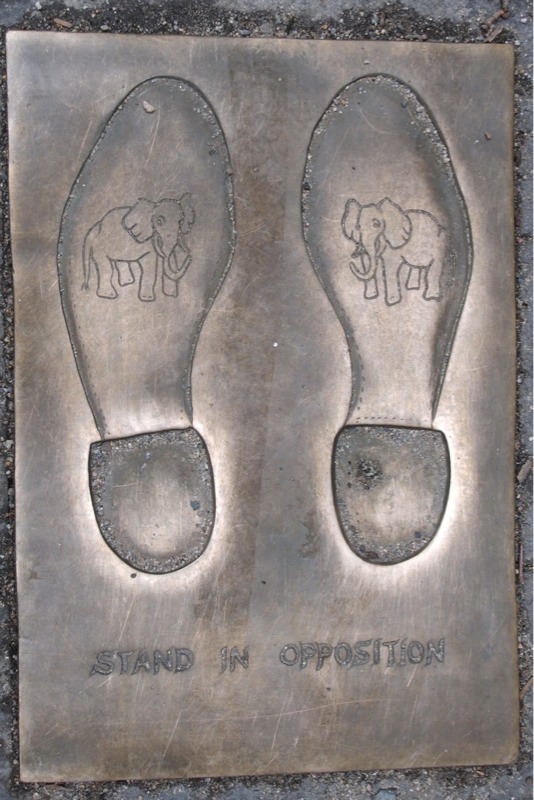
We are in Boston at the moment. Some friends of ours got tickets to Hair, and we joined them here to see the show last night. We got here early yesterday, so I did a little exploring in the environs. The old Town Hall is across the street from our hotel, and I came across this two part sculpture in the forecourt. You can interpret it as you will, but to me there is only one reasonable interpretation.

The piece consists of this sculpture of a donkey:


Now, directly in front of the donkey a plaque is embedded in the ground. You can see a bit of it in the picture above. Here’s the whole thing:


So here we have, as always, the plodding donkey trying to get its work accomplished, impeded always by the trumpeting elephant, who, taking literally the Groucho Marx jest, announces “whatever it is, I’m against it.” The political message is obvious, to this politically obsessed mind at least. How this salutary message came to be erected on what I assume is a public space, I do not know, but I heartily approve.

A bit of good legal news

Some good news to partially offset the fact that this allegedly bankrupt country is now raining expensive missiles on yet another country, with no clear explanation of what we expect to accomplish or how we know we’ve done so.

On Monday, a federal appeals court reinstated a key legal challenge to that surveillance: a lawsuit filed by the ACLU and others within hours of the FISA Amendments Act (.pdf) being signed into law. The lawsuit attacks the constitutionality of the legislation, which allows the government to electronically eavesdrop on Americans without a probable-cause warrant, so long as one of the parties to the communication resides outside the United States, and is suspected of a link to terrorism.

Folks with memories might recall that Obama’s vote in favor of those Amendments was perhaps the first indication of the kind of president he would eventually be. He voted in favor, thereby giving the government and telephone companies carte blanche authority to spy on us without governmental accountability. The bill represented precisely the kind of compromise Obama seems to love. It was marginally better than the alternative, but not enough to really matter. As with so many of the compromises that Obama has arranged since, it started with the Democrats conceding almost everything as an opening gambit. I am not, by the way, saying that Obama was responsible for this compromise. He wasn’t-and he was. He didn’t negotiate it, but he backed off his promise to oppose it at a time (the summer of 2008, when he was already the party’s candidate) that his fellow Democrats might have followed his lead.

Getting back to the court’s decision, it is especially heartwarming to report that it is our own Second Circuit Court of Appeals that reinstated the ACLU’s case against the FISA Amendments. The case was thrown out by the lower court because the plaintiffs could not prove they had standing.

Standing is yet another of those legal concepts that make sense in the real world but become instruments of oppression when put to the service of the national security state. A person has “standing” to sue if he or she has suffered a legal injury as a result of the challenged conduct. To take an absurdly simple case: If John Doe slips and falls on my sidewalk, he can sue me, because he has been hurt as a result of my negligence. If Jane Roe, who wasn’t even there, but hears about the fall, decides to sue me, she lacks standing as she has not been harmed by my negligence. In the case of the wiretaps, of course, those who have standing may never know it. The court bought into the plaintiffs’ arguments that they were harmed because their justified fear that they were targets forced them to engage in expensive, evasive maneuvering to avoid the spies.

So, some good news, though the odds are good that the Supreme Court will reverse, or eventually agree with the government that if it claims it suspects someone is a terrorist, or knows a terrorist, or knows someone who knows a terrorist, or has heard of someone who knows someone who knows a terrorist, then it has sufficient cause to spy on them in every way it can conceive.


A sign of hope

A bit of controversy about an SAT question, that read as follows:

Reality television programs, which feature real people engaged in real activities rather than professional actors performing scripted scenes, are increasingly popular. These shows depict ordinary people competing in everything from singing and dancing to losing weight, or just living their everyday lives. Most people believe that the reality these shows portray is authentic, but they are being misled. How authentic can these shows be when producers design challenges for the participants and then editors alter filmed scenes?

Do people benefit from forms of entertainment that show so-called reality, or are such forms of entertainment harmful?

When I read that many students considered this question unfair, I am somewhat ashamed to say that I figured it was because they thought the premise was unfair. But, much to my surprise and delight, the students weren’t upset because their misconceptions had been shattered, they were upset because the only test takers that could intelligently answer the questions were the very dolts that watched the shows. The question, in other words, was unfair because it was biased against students who had the good sense to read books, or at least watch more intelligent mass market offerings, instead of the dreck passed off as reality.

If it’s any comfort, and I know that it’s not, these students (at least the white ones), now know what it’s like to have to deal with a test that imposes cultural assumptions while allegedly objectively measuring intelligence or ability.

I remember reading about a test that was given to students in the state of New York that included a question that presumed a fairly high level of familiarity with the game of tennis, a familiarity that does not by any means cut across racial and class lines evenly, the Williams sisters notwithstanding.

Anyway, it is a sign of hope that so many students took exception to this question for all the right reasons.