Skip to content

The Price of Timidity

Or maybe it’s the price of deception.

According to a new Daily Kos poll, the Democrats are still ahead in generic polling. The problem is that very few of them intend to show up at the polls in November, as compared to Republicans and Independents, both of whom intend to show up in droves.

This is what happens when you run on a campaign of “hope” and then dash those hopes at every opportunity. If there’s a Democratic constituency Obama has not disappointed, I’m not aware of it. Add to that the milquetoast Harry Reid (“It takes 60 votes to pass anything in the Senate” and I don’t intend to make it difficult for the obstructionists) and a party that’s still in a defensive crouch from it’s wilderness years (you can count the number of Senators who are unabashed supporters of their own party’s platform on one hand), and it’s no wonder that Democrats are planning to sit next year out. In what other way can they express their displeasure?

Besides being incapable of delivering for their own, the Democrats are incapable of framing the debate. Whenever someone actually comes up with a way of making the Republicans look bad, someone steps up to make sure it doesn’t happen:

On the eve of the President announcing his war strategy in Afghanistan, critics of the policy have used the cost as a primary reason for their opposition. They could have used the argument that our presence in Afghanistan does nothing for our national security, fuels the insurgency and props up a corrupt government that inflames the local population, leading to no good outcomes whatsoever, but they went with cost. And David Obey put together a plan in the House to pay for the war through a graduated tax, the argument being that sacrifice must be shared and those cheerleading for more war should at least contribute something to it.

This has touched off a major debate inside the Republican Party, forking them between the war fever and the anti-tax fervor of their base. This was in full display on the Sunday morning shows, with Republicans from various wings of the party clashing over the concept of a war surtax. Richard Lugar (R-IN) called it a worthwhile notion on CNN, while Lindsey Graham (R-SC) on ABC called for cuts in domestic spending to pay for the war, the expected position for proponents of limited government and unlimited war.

But then there’s this:

The chairman of the Armed Services Committee backed off his support for a war tax today, saying the state of the economy prevents any tax increases.

“Well in the middle of a recession we’re probably not going to be able to increase taxes,” [Carl] Levin told CBS’s Face the Nation.

Levin still supports the idea of a surtax, but says it “should have happened some time ago.”

Good dog, Carl. Nothing like combining bad public policy with a tin ear for politics. How did these people get elected in the first place?

Only the Democrats could deliver this country into the hands of a right wing rump minority. If they do lose big time next November, the conventional wisdom will be that the country has turned to the right-the low turnout will be ignored. If these findings hold up, by the way, Chris Dodd can kiss his Senate seat good-bye.
Friday Night Music-Doubleheader

A couple of minor stars in the 60s firmament. First, Lou Christie. Back in the 80s PBS ran an oldies special on which he appeared. He gave a great performance. Unfortunately, it’s not on youtube, so far as I could see. An interesting factoid I picked up looking through his performances: one of his hits, Rhapsody in the Rain, was banned from many radio stations. Times have sure changed, it’s hard today to see what the problem was. Anyway, here he is singing a medley of The Gypsy Cried and Two Faces Have I.

Next, Del Shannon with a classic oldie. I can hardly remember a time when Runaway wasn’t an oldie. This is a particularly good performance, in my humble opinion.


Taxes are for the little people

There are few things more glaringly unfair in this country than the fact that hedge fund managers get taxed at a rate less than half of what most of the rest of us pay. According to this morning’s Globe, (Tax break on profits again in jeopardy) there’s a move afoot in Congress to change the law, but the takeaway upon closer reading is that nothing will change:

The endurance of the special tax break is testament not only to the power of financial industry lobbyists but also to the support of key lawmakers. For example, Representative Richard Neal of Massachusetts, a member of the House Ways and Means Committee, voted against the tax break in 2008 and acknowledges the provision is perceived by many to be unfair. But now he wants to delay action, saying he is worried that eliminating the tax break this year could be “a job killer at a very precarious time.’’

Neal said he wants the matter addressed next year in broader legislation for a tax overhaul. Referring to the perception of unfairness when private-equity firms benefit from the current tax policy while laying off employees in job restructuring, he said, “You can’t defend it.’’

You can’t defend it, but he doesn’t want to change it.

The theory is that the income hedge managers receive should be taxed as a capital gain because it is derived from capital gains; that is, they get a percentage of whatever they earn for their clients. They do not share in the losses of course. That would be asking too much.

It is a mystery to me how anyone can claim that taxing these people at the same rate as the rest of us will cost jobs. The folks making this claim are always sort of vague about whose jobs are at risk. Maybe it’s the gardeners or personal trainers these people employ. This from the Economic Policy Institute:

Defending this tax break are highly paid lobbyists such as Douglas Lowenstein and Grover Norquist who loudly and repeatedly make the claim that taxing hedge fund managers like everyone else will harm the average working family. They claim that taxing hedge funds like normal income will harm pension fund returns. This is wrong on two levels. First, the tax change would apply to hedge fund managers and not investors (many pension funds invest in hedge funds). Second, pension funds do not pay taxes. These lobbyists also claim that it would increase the cost of consumer goods and services because so many stores and chain restaurants are owned by private equity firms and hedge funds. This, too, is preposterous because, again, the tax does not apply to the investors or owners of those businesses but only the investment advisors who manage the funds of those investors. Moreover, the businesses owned by private pools of capital will have to compete with other similar businesses providing consumer goods and services—only now on a level playing field—and they will not be able to arbitrarily raise their prices.

As I understand it, we tax long term capital gains at a low rate in order to encourage long term investment. Since hedge fund managers depend on investment (by other people) it seems unlikely that taxing them at a higher rate would lower investment. Again, from the EPI:

There are two things economically wrong with this special tax provision for hedge fund managers. First is its impact on economic efficiency. It creates inconsistent economic incentives (i.e., distortions) for some labor income to be treated as ordinary income while other labor income is treated as capital gains, and the work done by investment advisors is undeniably a professional, laboring activity. Fund managers at pension funds, trusts, and endowments who provide similar professional services are paid a salary and possibly a bonus, and these are all treated as ordinary income. Only because hedge funds and private equity firms are organized as limited liability partnerships—which are already treated favorably for tax and liability purposes—are these same professional services taxed differently. The result is a distortion in the compensation and after-tax income between these super rich hedge fund managers and millions of others in the workforce.

The amounts of money involved are staggering:

A simple calculation shows that this preferential tax treatment for the top 25 individuals alone costs the Treasury almost $2 billion.

The fact that so much money is involved for so few people puts the lie to the idea that fairly taxing these people would discourage them from doing the same job they are doing now. They would still make piles of money were they taxed at a higher rate. Where else could they go to make so much money doing something so socially useless?

Yet, it would be reckless in the extreme to believe or even hope that the Democrats will do away with this tax giveaway. Representative Neal cannot defend it, but he prefers to wait until next year to deal with it, which is Beltway speak for saying he intends to do nothing about it at all.


Happy Thanksgiving

I’m tempted to say that anyone who is reading blogs on Thanksgiving should be ashamed of him/herself. This is my favorite holiday, since it has resisted all attempts to commercialize it, unless you count the retailers opening on this sacred day to steal a March on Christmas.

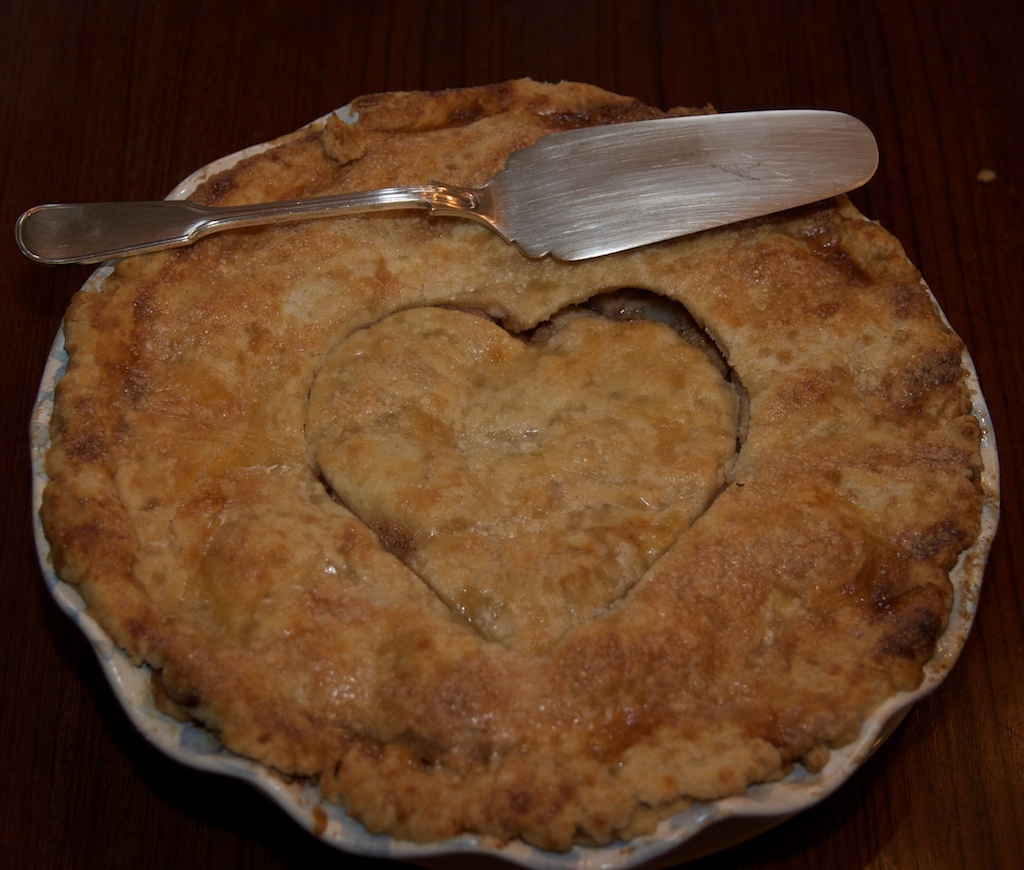
This year we decided to have an as much of Connecticut Thanksgiving as we could. Our Turkey was born, lived and died in Connecticut. We had Connecticut beer and wine; the onions in our onion soup were raised in our garden; ditto the garlic; the apple pie was made from local apples (see below). While the tea came from who knows where, it was purchased from a Connecticut distributor. We did blow it on the cheese, since Connecticut farmers are now making great cheese.

I have a custom on Thanksgiving. My wife does most of the cooking, so I do most of the washing up. Lest anyone think the distribution of work is lopsided, let me hasten to say that we live in an old fashioned household-no dishwasher, and we use dishes and pots by the score. It’s all by hand, and it’s a lot less satisfying than cooking. However, I pass the time happily enough, listening to music, and always starting off with this song. There’s lots of Christmas song, but only one Thanksgiving song.


You heard it here first-or at least before you heard it here

Cruising toward Thanksgiving, with visitors arriving today and tomorrow, there won’t be much time for blogging. I need some time off anyway. Who knows, maybe the quality of this stuff will improve.

Anyway, I noticed today that Alex Koppelman, at Salon, has endorsed Peter Beinart’s view, at the Daily Beast, that Joe Lieberman’s opposition to the Public Option has precious little to do with principles and everything to do with his resentment at his rejection by the people.

So why is he doing this? Because he’s bitter. According to former staffers and associates, he was upset by his dismal showing in the 2004 Democratic presidential primary. And he was enraged by the tepid support he got from many party leaders in 2006, when he lost the Democratic primary to an anti-war activist and won reelection as an independent. Gradually, this personal alienation has eaten away at his liberal domestic views. His staff has grown markedly more conservative in recent years, and his closest friends in Congress are now Republicans John McCain and Lindsey Graham. For Lieberman, the personal has become political, and it has pushed him further to the right.

Okay, it’s hardly awesomely original analysis. But I just want to point out that it was my immediate reaction to his filibuster threat, and I don’t have access to former staffers and associates:

Joe Lieberman is a bitter man. He blames progressives for his ignominious defeat in the 2006 primary, and rightly so. He has no principles left, having abandoned them years and years ago. So he sees this as payback time, the chance to get back at us, and at the Democrats, including Chris Dodd, who backed the legitimate candidate in 2006.

Have I ever mentioned the shouting match I got into with a Lieberman supporter at the 1994 State Convention? That’s right-1994. I told him that Lieberman would end up as a Republican, and I’m declaring myself to have been right. I’m proud to say that I have NEVER voted for the man, at least not when he ran for the Senate. I was turned off by his campaign against Weicker, and I simply skipped that slot on the ballot until I had the satisfaction of voting for Ned.


Same as it ever was

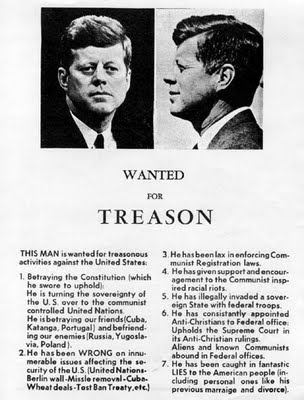
There’s nothing new under the sun, as digby reminded us yesterday.

Yesterday was the anniversary of JFK’s assassination. Here, as she points out, is a leaflet passed around in Dallas the day he was killed.

Seems Obama wasn’t the first traitor we’ve had as a president. But check out the last item in the Bill of Particulars. Obama has his birthers, and JFK apparently had those who insisted he had a secret marriage.

But I’m not quite right about there being nothing new these days. Nowadays, the people who put out this sort of stuff have been warmly welcomed into one of our major parties. That is something new.


Simmons pledges fealty to the crazies

Rob Simmons apparently thinks that the road to the Senate lies through the teabaggers. He has sent a fundraising appeal pledging to be the guy who assures that the Democrats never get that 60th vote to advance their big government agenda. Here’s a snippet from his appeal:

The fight in the Senate is just getting started. A tough road lies ahead for the Democrats, with members of their own party — including Senator Lieberman — voicing objections to key provisions of the Dodd plan.

But that’s no reason for complacency. If we know anything, it’s that Democrats led by Senator Dodd will do anything to get this trillion-dollar plan through. And the only reason they’ve gotten so far is that their party controls 60 votes and all the levers of power in Washington.

I am running for the Senate to take away that 60th vote and restore balance and sound fiscal management to Washington.

If we continue to show strength in our race against the architect of government health care in the Senate, the Democrats will begin to think twice about ramming through a plan in 2010 that Americans don’t want and can’t afford.

This is language designed to warm the hearts of the crazies. Simmons apparently intends to have them carry him to the nomination, after which he’ll have to figure out how to distances himself from them while retaining their votes. The question is whether they have gotten tired of being played for suckers, as they have been for so many years. I also understand he’s trying to get Jim Demint’s endorsement, another not so subtle message to the nutjobs.

But let us pause and give the Republicans credit. The Democrats have stood by and allowed the Republicans to frame the Health Care issue in such a way that it is not only politically acceptable, but in some cases politically advantageous to be a running dog for the insurance companies. Only the Democrats could have pulled that off. It’s what comes from compromising yourself into a corner, trying to appease your opponents. Let’s count all the votes that the Democrats gained in the Senate by neutering the health care bill and making it far more difficult to either explain or defend to the American people. Here’s the total: Exactly no votes.

Imagine if the Democrats had announced in advance that they intended to use reconciliation, and told the Republicans to pound sand when they complained. The Republicans would have been facing a completely different reality-a reality in which they could wrest concessions only by actually making constructive suggestions and by actually voting for the final product. They probably had more chance of getting 60 votes by going that route than by making a declaration of weakness at the start.

Still, it’s hard to see that opposition to health care reform is a winning strategy in Connecticut. We have our faults, but we still have a higher level of intellectual functioning than they do in Alabama or Arkansas. Simmons is counting on Dodd losing, rather than Simmons winning. Time will tell whether that’s a good strategy.


Dodd redux

Seems that I’m mentioned in a front page article in the Courant today.

The reporter, Daniela Altimari, sent me an email asking to talk to me about an “open letter” to Chris Dodd that I posted a few weeks ago. In that letter I bemoaned Dodd’s statement to the effect that Lieberman should suffer no consequences for his latest betrayal (at that point) of the Democratic party’s agenda.

I am always ambivalent about talking to reporters. It always seems that they are looking for the quote that fits their agenda. On the other hand, if you write a blog like this you sort of have a responsibility to defend your point of view, so I called her.

The result is here.

The part about me reads as follows:

Some express anger at Dodd for refusing to punish his colleague, U.S. Sen. Joseph Lieberman. Viewed by many Democrats as Public Enemy No. 1, Lieberman has taken a hard-line stance on health care, pledging to quash any proposal that contains a government-sponsored insurance plan. Dodd and other Democrats dismissed the idea that Lieberman, an independent who caucuses with the Democrats, ought to face consequences for his stance.

In an open letter to Dodd, John Wirzbicki, a member of the Groton Democratic Town Committee and a Dodd supporter, expressed his disenchantment.

“Enacting a health care program that is not a sham will enhance your re-election prospects,” Wirzbicki wrote in the Oct. 28 letter, which was posted on his blog, CT Blue. “Coddling Joe Lieberman won’t, particularly if by doing so you torpedo health care. If we end up with another Republican Senator from Connecticut, your supporters like me will be disappointed.”

In an interview, Wirzbicki emphasized that he remains a Dodd fan. “But something happens to people when they spend a lot of time in Washington. They start to become part of a culture that’s disconnected. For him to come out and immediately close ranks, it sort of makes you think the guy isn’t really aware of the feelings of people he relies on the most.”

Despite it all, count Wirzbicki among the Dodd faithful. “Dodd’s not perfect, but the fact of the matter is, you couldn’t ask for a much better senator. … I’m not going to abandon him because he’s human.”

I can’t speak to the rest of the article, but I can’t say that Altimari misrepresented my statements, though I’m not sure anything I said lends that much support to her main thesis. I wouldn’t have used the word “anger” to describe my reactions to his statements about Lieberman, nor would I use the word “disenchantment”, but those are actually minor quibbles.

She really didn’t produce much evidence in support of her claim that there is a sense of panic among Democrats about Dodd. We all recognize that he has a fight on his hands, but it’s a winnable fight, made more difficult by the fact that he will undoubtedly be dealing with a Connecticut press that will be pushing the same meme as Ms. Altimari. Meanwhile, we can count on his opponents to go unexamined (and I’m not talking about Alpert) until it’s too late to make a difference. Despite all the evidence to the contrary, the press will stick that “moderate” label on Simmons at every opportunity, despite his proven record of slavish obedience to his right wing masters, not to mention the teabag he claims to have wrapped around his pocket constitution.

Dodd can win. He is advocating some popular, progressive legislation right now. When the time comes, it would be helpful if he could maneuver his opponent into taking a stand on the issues he’s currently championing. Is Simmons for or against capping outrageous credit card rates? Inquiring minds want to know, and either way Simmons responds he loses. Still, when all is said and done, Dodd does need to energize his base, and he won’t do it by mollycoddling Lieberman, who, by the way, will stick a knife in Dodd’s back at the earliest opportunity.


Where the truth lies

Always in the middle it seems. From this morning’s Times:

Now that unemployment has topped 10 percent, some liberal-leaning economists see confirmation of their warnings that the $787 billion stimulus packagePresident Obama signed into law last February was way too small. The economy needs a second big infusion, they say.

No, some conservative-leaning economists counter, we were right: The package has been wasteful, ineffectual and even harmful to the extent that it adds to the nation’s debt and crowds out private-sector borrowing.

These long-running arguments have flared now that the White House and Congressional leaders are talking about a new “jobs bill.” But with roughly a quarter of the stimulus money out the door after nine months, the accumulation of hard data and real-life experience has allowed more dispassionate analysts to reach a consensus that the stimulus package, messy as it is, is working. (Emphasis added)

Yes, the truth always lies somewhere in the middle. Those liberal economists, blinded by their passion, could not possibly have been completely right.

And yet… The balance of the article appears to consist of one “dispassionate” person after another saying that the stimulus has worked in exactly the sense the liberals predicted-it has staved off disaster, but it is not enough to lift us out of this mess, particularly the employment mess.

But there are criticisms, mainly that the Obama team relied last winter on overly optimistic economic assumptions and oversold the job-creating benefits of the stimulus package.

Optimistic assumptions in turn contributed to producing a package that if anything is too small, analysts say. “The economy was weaker than we thought at the time, so maybe in retrospect we could have used a little bit more and little bit more front-loaded,” said Joel Prakken, chairman of Macroeconomic Advisers, another financial analysis group, in St. Louis.

It is an odd thing. The truth really does not often lie in the exact mid-point between two extremes. Ask Galileo and the Catholic Church. He was right, they were wrong. A compromise between them would have been just as wrong.

But the stimulus is not really a good example of a conservative/liberal divide with the liberals being right, because the opening premise of the Times’ article is highly misleading. At the time the stimulus was proposed, there was wide agreement across the ideological spectrum (of economists, that is) that a stimulus was needed. The Republicans were reduced to advertising for economists that would support their do-nothing position. They got some, but, as Brad Delong pointed out, “no current or former member of the President’s Council of Economic Advisers–Democrat or Republican, living or dead, sane or insane–has signed up for the Republican House caucus’s list of economists opposed to the stimulus package.” Since no economists are quoted in the Times article as claiming the stimulus was not needed, it is impossible to say who the “some conservative-leaning” economists are that are referenced in the second paragraph of the article. In fact, some of the conservatives quoted in the article, all of whom agreed that a stimulus was needed, criticize exactly those portions of the plan (tax breaks, for instance) that were opposed by liberals at the time as relatively ineffective in comparison to the “direct federal spending” that even conservative Martin Feldstein is quoted in the article as favoring.

This may be a case in which a divide was assumed that never existed. Of course it’s always possible to find a person with credentials who will take a position that his or her peers find absurd. There is probably a biology professor out there somewhere that doesn’t accept the truth of evolutionary theory. But that doesn’t mean that there is a dispute among biologists, anymore than the existence of a few ideologues with degrees means there was any real dispute among economists about the stimulus.

All that being said, the liberals, including the Times’ own Paul Krugman, were particularly prescient regarding the stimulus. They opposed the tax break portions of the plan, they called for even more spending, and they warned against removing the direct aid to the states, something thrown in as a sop to gain a veneer of bi-partisanship, which, as Krugman said it would, turned the governors of our states into 50 Herbert Hoovers. The article proves them right, sub silentio. So why does the article imply that the truth was situated in the mythical middle?


Friday Night Music-Them

A very young Van Morrison leads his then band mates in what I believe was their first state side hit. No doubt about this being a live performance. Sorry about the long intro.