Skip to content

Journalistic Ethics

What a great idea!

Pam and Russ Martens speculate that Forbes may have pulled an article critical of JPMorgan because they don’t want to damage an interesting relationship they have with said JPMorgan.

If Forbes doesn’t have to worry about a libel lawsuit, what else might be behind its rapid yanking of the article? As it turns out, Forbes sells, for hefty fees, the ability for corporations to write their own articles and post them as news articles on the Forbes web site. JPMorgan Chase is engaged in such a program with Forbes. Instead of stating that the content is paid advertising, the content carries the nebulous appendage of “BrandVoice.”

via Wall Street on Parade

Apparently, this has been going on for years at Forbes and other “journalistic” enterprises , though this is the first I’ve heard of it.

Now, this site is no Forbes in terms of page views, etc., but still, this has me thinking. Would I truly be compromising my principles if I let, say, the Donald Trump campaign post stuff on my site, provided I received a reasonable consideration? The answer is clearly “no”, provided the consideration was decidedly reasonable. That’s the American way.

Of course, like Forbes, I’d attach a clear notice, such as the term BrandVoice to any such post, to make sure my readers were aware that I didn’t necessarily approve of the content. Unfortunately, I’m having trouble coming up with a term as chock full of informational content as BrandVoice.

Half right at the Economist

Over at Down with Tyranny, I had the chance to read something of the Economist’s reasoning for calling Donald Trump a global threat. Don’t get me wrong, he is truly a threat, but their list gives away a lot of what the fear of the Establishment is all about. While we’re worried about living in a Nazi state, they have more prosaic concerns:

Thus far Mr Trump has given very few details of his policies– and these tend to be prone to constant revision– but a few themes have become apparent. First, he has been exceptionally hostile towards free trade, including notably NAFTA, and has repeatedly labelled China as a “currency manipulator.” He has also taken an exceptionally right-wing stance on the Middle East and jihadi terrorism, including, among other things, advocating the killing of families of terrorists and launching a land incursion into Syria to wipe out IS (and acquire its oil). In the event of a Trump victory, his hostile attitude to free trade, and alienation of Mexico and China in particular, could escalate rapidly into a trade war– and at the least scupper the Trans-Pacific Partnership between the US and 11 other American and Asian states signed in February 2016. His militaristic tendencies towards the Middle East (and ban on all Muslim travel to the U.S.) would be a potent recruitment tool for jihadi groups, increasing their threat both within the region and beyond.

Although we do not expect Mr Trump to defeat his most likely Democratic contender, Hillary Clinton, there are risks to this forecast, especially in the event of a terrorist attack on US soil or a sudden economic downturn. It is worth noting that the innate hostility within the Republican hierarchy towards Mr Trump, combined with the inevitable virulent Democratic opposition, will see many of his more radical policies blocked in Congress– albeit such internal bickering will also undermine the coherence of domestic and foreign policymaking.

There’s a lot to dislike about the Donald, so it’s amazing that the *Economist* managed to concentrate fire on many of his positions that come close to making sense. China probably is a currency manipulator, so it’s hard to take issue with the Donald on that one. The Mideast stuff is truly horrible, all sane people (are we in the minority now?) can agree on that. But an awful lot of us would just love to see him “scupper the Trans-Pacific Parnership”, and it’s on the financial issues that really affect the 1% that the Economist gives itself away.

What should be odd about their fear of the TPP being scuppered is that according to the words presently coming out of her mouth, the Economist’s preferred candidate is going to scupper the TPP if she gets elected. So, on that issue, there’s no difference.

But of course we all know that, in fact, she wouldn’t scupper it. In that, she’s probably no different than the Donald, who, despite what he says, would probably not scupper it either. He has, after all, made it abundantly clear that he feels licensed to do or say whatever it takes to get what he wants. Once he gets what he wants, he feels under no obligation to deliver on his promises. When he was a businessman, he did as a businessman does, and now that he’s a politician, he does as a politician does, and when he decides not to scupper the TPP, that’s exactly what he’ll tell his army of dupes. When Clinton announces that she won’t scupper the TPP, she’ll tell us that she modified it in some minuscule way that makes all the difference, and it is no longer objectionable. Since she hasn’t, at least to my knowledge, said exactly what has caused her to change her mind and want to scupper it, it will be easy for her to claim that a minor modification is sufficient to keep it afloat.

In any event, it’s remarkable that the threat the Economist perceives is not that the world’s most powerful country might be led by a fascist, but that it might refuse to surrender its sovereignty to corporate interests.

Really unbelievable

It is both mystifying and inexcusable that Obama would do this:

Democrats sitting on the U.S. Senate Banking Committee at Tuesday’s confirmation hearing to take testimony from President Obama’s two nominees for the Securities and Exchange Commission (SEC) must have felt like they were having an out of body experience — listening to the human personification of billionaire Charles Koch’s money aping his Ayn Rand, anti-regulatory double-talk from a witness seat. What had to be particularly nauseating to them was that this nominee was sent to them by President Obama who ran as a Democrat on a platform of hope and change. While the political makeup of the SEC is prescribed by law, so that one of these two nominees had to be a Republican, why pick this particular Republican?

On October 20, 2015, President Obama announced that his nominee to fill a Republican seat on the SEC would be Hester Peirce, a Senior Research Fellow and Director of the Financial Markets Working Group at the Mercatus Center at George Mason University. According to SourceWatch, the Mercatus Center “was founded and is funded by the Koch Family Foundations.”

The Board of the Mercatus Center looks like a Koch brothers’ fan club. Charles Koch, Chairman and CEO of Koch Industries, sits on the Board as does Richard Fink, Executive Vice President of Koch Industries, a sprawling oil, lumber and commodities trading company that is majority owned by Charles and David Koch who each have a net worth currently estimated by Forbes at $42.3 billion.

via Wall Street on Parade

Read on at the link for more of the gruesome details. There must be some RINOs out there that Obama could have chosen. Then again, it’s not like his picks on the Democratic side of the ledger (looking at you Mary Jo White) have been stellar.

Goodbye, Little Marco

This morning I opened up the New London Day (always a depressing way to start the day), and soon found myself brought up short when I read this:

Florida Sen. Marco Rubio ended his once-promising campaign after his devastating home-state loss, so the GOP primary is now down to three candidates: Trump, Kasich and Texas Sen. Ted Cruz.(Emphasis added)

It was an AP article, and I couldn’t get by the Day’s password barrier, so no link to the Day, but you can read the entire article here.

Now, I can’t claim to have followed this campaign more closely than everyone else in this benighted land, but I’ve paid close attention, and I must admit, it entirely escaped my notice that Marco’s campaign was ever promising.

I know that for reasons that escape me, DC bubble denizens wanted it to be promising, and saw hope where the rest of us saw only failure. It was obvious from the day he announced that Marco Rubio was going nowhere. How could these people not see that? The self delusion apparently continues. My wife told me that after Rubio finally surrendered, Chris Cillizza immediately tweeted about his prospects for the Florida governorship or another presidential run in 2020. This is a guy who lost by 20 points in his home state (that would be Florida), probably because he was a self indulgent asshole who decided that being a mere U.S. Senator was beneath him, and didn’t bother to work even when he wasn’t running for president full time, but Cillizza thinks that the people of Florida will turn around and hire him to be governor after rejecting him by a landslide in a Republican primary. News flash to pundits: He’s toast. This time next year he’ll be a lobbyist, a Fox News analyst, or pensioned off to a right wing think tank. Or, Donald Trump may make him an apprentice.

Crying Wolf

We all know the fable of the little boy who cried “WOLF!”. One benefit he conferred on the villagers he fooled, which always goes unmentioned, is that until he was exposed as a liar, they undoubtedly took measures to protect themselves from the non-existent wolf. Had there been a real wolf, they would have been prepared. So, in that spirit, I am about to cry WOLF!, or at least that’s what I hope I’m doing.

Despite what all the pundits may say, and all the party insiders may say, I believe that Donald J. Trump has a better than even chance of becoming the next president. I think that’s the case no matter who the Democrats nominate. I’ve previously given my reasons for thinking that Hillary could lose. Bernie, who after last night is out of it anyway, could lose for another set of reasons: were it Bernie vs. Trump my bet is that the establishment would find Trump less terrifying than Bernie. After all, when all is said and done, he’s a billionairre whose personal interests line up with those of the other billionairres, and who has been quite frank about the fact that when it’s a choice between what’s good for Donald Trump and what’s good for his fellow man, Donald Trump wins hands down. That’s the kind of thinking that warms the cockles of their hearts, so while they’ll no doubt grumble, they would back him given the alternative, and a compliant media would spend months smearing Sanders. There’s also the very real fact that people have been turning out in droves to vote for him, generally in greater numbers that vote in the Democratic primaries.

By now, it should be clear that the “Trump can’t win” trope is wearing a bit thin. If our betters knew better, he’d have faded away months ago. We are marching toward fascism. I am hoping that come November I will be a laughingstock for having made such a ludicrous prediction. In the meantime, I’ll be pricing out real estate in Canada.

Hillary’s against for-profit schools, except…

If this is true it is truly disheartening:

Student loan debt continues to be one of the largest economic issues plaguing the U.S., with the total amount topping $1.3 trillion. Hillary Clinton’s higher education policy touts debt-free degrees for underprivileged students. But is she being genuine in her efforts to address the issue?

While Hillary loves to rail against shady for-profit colleges on the campaign trail, she does have some financial ties to them that are likely to shape whether or not she holds them accountable for ripping students off.

It was recently revealed through Hillary’s emails that during her first year as Secretary of State she insisted that Laureate Education be included in the guest list for an education policy dinner hosted at the U.S. Department of State.

“It’s a for-profit model that should be represented,” she wrote in the August 2009 email, and as a result, a senior vice president at Laureate was added to the guest list. Several months later, former President Bill Clinton became an honorary chancellor of Laureate International Universities, which turned out to be incredibly lucrative. He was paid a cool $16.5 million between 2010 and 2014 for his role with the for-profit college.

via Raw Story

First of all, no one is worth that kind of money for the expertise they might bring to that particular table. So, what was Laureate paying for? But more broadly, for-profit “educational” institutions have to be among the very worst developments in this age of corporatization. There are some things that do not lend themselves to a profit making model. Hospitals are one, as we are rapidly learning. Educational institutions are another. We can all learn a lesson from Donald Trump, who had his very own university. You see, he’ll tell you that there are many things that business people like him do all the time, which they shouldn’t be allowed to do, but so long as they’re allowed to do those things, they have a duty to do them, because their only obligation is to make as much money for themselves as they can. Trump is not unique, and neither was his con job university. It’s really not expecting too much of the Clintons to stay away from the scum that run these scamming operations. After all, they really don’t need the money, even if they are dead broke.

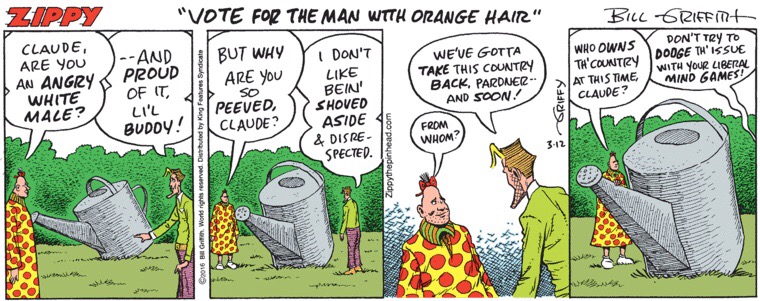
Zippy nails it


Thoughts on Hillary

Several days ago I went to our local Drinking Liberally chapter meeting, where we drank (not terribly liberally) and argued politics, Hillary people versus Bernie people. We also alternately laughed at, and were terrified by, Donald Trump, but that’s not what this post is about.

One of the liberal drinkers, an old and dear friend of mine, still actually reads this blog, and asked me why I had written in a previous post that I thought Hillary was a “deeply flawed candidate”. Truth to tell, my response at the moment was not terribly articulate. Anyway, I decided to expand on that characterization a bit. This rambling post, which I’ve worked on off and on for the last week or so, is the result.

First, let me make the standard disclaimer. When Hillary is nominated, and it seems certain that she will be, I will support her, vote for her, encourage others to vote for her, and generally look on the bright side of life so far as her nomination is concerned. But while the slim possibility exists that she will once again be denied the nomination, I will continue to hope.

Let me also say that I concede that it is entirely possible that she really is more electable than Bernie, despite some polling showing Bernie doing better against Trump in the general. It’s absolutely true that she is relatively bullet proof, the Republicans and the media having striven mightily, without success, to bring her down for years. Unless she’s indicted on those bogus email charges, she can probably withstand anything they try throwing at her. Bernie, on the other hand, is a relative unknown, and we can’t know as we look forward whether a Jewish (sort of) atheist socialist will be protected by the same Teflon that is working for a fascist, racist, misogynistic, narcissistic, con man (yes, Mitt was right-even a stopped clock after all). We don’t have the luxury of peeking into alternate universes, so we can’t know what would happen in the happier universe where Bernie pulls if off. So this is just about Hillary, but let me add that there are cogent arguments for the proposition that Bernie would be the stronger candidate, especially against Trump.

I believe we can all stipulate that it is not the year 2000 anymore, nor is it the year 2008. It has been eight years since the economy blew up, eight years during which almost every American has come to realize that there is something profoundly wrong with this country. We have had eight years of “incremental” improvements; eight additional years of a march toward oligarchy, eight years of a Democratic Party that seems intent on preserving the status quo, no matter how that affects its electoral success. Eight years during which the American people have almost forgotten the previous eight years. As I said, almost everyone realizes something is wrong. Not everyone can put their finger on the source of the problem. Donald Trump has, on behalf of the Republican Party, abandoned the dog whistle and has trotted out the usual scapegoats, while adding a few more. Bernie has, in my opinion, identified the source of the problem. I realize some people feel he is too focused on the oligarchs, but I think fundamentally he’s right. If the mass of people were prosperous, the other antagonisms in our society would be more easily ameliorated. I’m not saying you ignore them, but I think it’s much harder to sell hatred to people with full stomachs, new iPhones, and faith in their own futures.

Say what you want about Bernie, but he can emotionally connect to that underlying dissatisfaction, and even feel a sense of outrage about it. Hillary can’t. She can mouth empty platitudes, but she does it out of cold calculation, the Dick Morris inspired “triangulation” that seemed to work for Bill. She promises nothing except that she will listen, and those of us who are politically engaged know (even, I would submit, those who feel they must support her because “Bernie can’t win”), that once she is safely elected, the oligarchs will sleep easy. She may not shove as much money their way as the Republicans would, but she won’t take any away, and she certainly won’t put them in jail. I’m told by her supporters that she’ll appoint a justice that will help overrule Citizens United. Maybe so, but that’s a mere symptom of a disease, and this post is about Hillary the candidate. I firmly believe that Hillary is incapable of credibly pretending that she actually cares. It’s not that she’s identifying the wrong culprits, like the Donald, it’s that she isn’t really recognizing the problem at all. People can sense that.

The polls have shown that people don’t trust Hillary, and that’s not something that is likely to change over the next several months. It’s a given, for instance, among the politically aware, that Hillary will, if elected, change her position on the TPP Treaty. Her problem as a candidate is that no one, not even the politically unaware, believes her current claims that she opposes the treaty. Her recent statement that she waited until she knew what was in the treaty is a fairly transparent lie. We all knew enough about what was in it to realize it was a corporate Christmas tree long before she finally claimed to oppose it. What’s true of the treaty is true on a broad range of issues. When she can, she talks in generalities, promising to “look” at things, etc., but is there a soul alive that actually believes she’ll do anything, or try to do anything, that fundamentally changes the status quo?

Say what you want about the Donald, but he’s really good at pretending that he shares the sense of grievance of the people he’s exploiting. Hillary isn’t, and that will cost her a lot of votes. Not necessarily votes going to Trump, but votes that are never cast.

The Clintons have a reputation for being skillful politicians, but that’s subject to debate. Let’s put aside the fact that voting for the Iraq war was a terribly immoral thing to do. It was a politically stupid thing to do. The start of that war predates this blog, so you’ll have to take my word that even I could see how that war would play out. I don’t claim to be unique. Far from it. Many many ignored voices on the left (and even Al Gore) knew it would be a disaster, and many of us were saying that it was based on lies before that fact became widely acknowledged by a complicit media. Hillary voted for that war because she felt that vote would enhance her chances to become president. She was dead wrong. She would be ending her second term now had she done what she should have known was the right thing to do. I’ve seen no sign that she’s learned any lesson from that experience. In fact, she seems to have doubled down on her warmongering, such that the warmongers prefer her to Trump. For all his faults, the Donald has an almost instinctive knowledge of what his base wants and what will make them turn out for him. Hillary doesn’t, so far as I can see, nor, as the Iraq vote shows, does she have any ability to discern the probable flow of events. She has a gigantic challenge. She must motivate people to turn out to vote for her. It is an unfortunate fact that too often the Democrats ask not what they can do for America, but what they can prevent Republicans from doing to America. That’s important, but it hasn’t always been inspiring, and I very much doubt that Hillary will be very good at making that case. The vacant Supreme Court position may help, but that will only go so far.

Trump is the all but certain Republican nominee. It’s only a matter of time before the Republicans swallow hard and circle the wagons around him. They will, almost all of them, come to the conclusion that he’s not really so bad, and he’s certainly better than Hillary. But Trump is free from the chains that bind all the other Republicans. He has strayed time and again from orthodoxy. He is also the master of criticizing other candidates for things he himself has also said, done, or proposed. He gets away with it. There is nothing in what he has said in the campaign so far that would be inconsistent with his picking up on Bernie’s talking points, going after the banks, etc. He could easily concentrate on Hillary’s speeches and her refusal to release the text of those speeches. It’s an issue Bernie has raised, but he is pretty much ignored by the media. Were Trump to harp on it, the press would not stop talking about it. In that particular instance, Trump would be right, although in truth he would, as president, be as kind to the banks as Hillary. I think the issue could resonate. Hillary is applying for a job, and we are the folks that can give her that job. We know what she’s saying to us; we have every right to know what she’s saying to them behind closed doors. I’ve heard people defend her by saying that no one else is being asked to provide transcripts of their speeches. Even if that’s true, it’s irrelevant. They all should, but only Hillary is seeking the nomination of a party that allegedly represents people who actually want to put an end to crime on Wall Street. The hostility of the Republicans to the weak tea of Dodd-Frank pretty surely proves that they are enablers. We need to know if she would be an enabler too. Well, actually, we already know and we’re just looking for confirmation of that fact. Trump may, and probably will, promise to put some of those folks in jail. The fact that he won’t mean it is somewhat irrelevant. The fact is that he’ll be able to attack her from the left in ways that might appeal to credulous folks on our side of the great divide. We’re not, as a group, as stupid as those on the right, but Nader proved that there are plenty of deluded lefties out there.

It’s probably low on the list, because polls can obviously change, but it is not currently irrelevant that Hillary polls worse than Bernie in match-ups against Trump and Cruz. I know the arguments. But just as further attacks are unlikely to move Hillary down, it’s unlikely that any argument she makes to the American people can move her numbers up. Sure, there are exceptions, but people, in the main, support her as the lesser of two evils. They will vote for her, those that come out and vote, not because they want her to be president, but because they will want to avoid the alternative.

It is not irrelevant that Hillary is most unacceptable in precisely those states we will need to win in the general election. It’s very nice for her that she has won every Southern primary, but she will not win one of those states, and we don’t have proportional voting in the Electoral College.

As the campaign unfolds, I am dreading a Hillary nomination more and more, not because of any animus toward Hillary, but because I think the probability of a Trump win in such an election is ever rising. Maybe he would beat Bernie too, but at the moment, I think people are more willing to vote for a Jewish socialist atheist than Hillary Clinton.

In sum, I think Hillary is flawed because she’s running for president merely because she wants to be president. That may not cut it this year for a Democrat, though it describes each and every Republican candidate, including Herr Trumpf. We have to hope that the mass of people will, ultimately, decide to vote for the lesser of two evils. They might not do it. She will give them no other reason to vote for her. Yes, I’ve heard the argument that Bernie can’t deliver on any of his promises. If he can’t, that puts him exactly where Hillary is promising to take us. At least he will try, and simply by putting his issues out front and center he will move the national conversation to places it hasn’t been in decades.

I’m an unreconstructed 60’s liberal. I think we should nominate someone who believes what every liberal did in those long ago days. I don’t like neocons. I don’t like Wall Street. I don’t like fascists either. When all is said and done, this election comes down to this. Which of the Democratic candidates is most likely to keep us from fascism. I think that Sanders is that candidate. I concede that I may be wrong, but as time passes I am more and more convinced that Hillary would be the weaker of the two, assuming, as we probably cannot, that the Democratic Party does not do to Bernie what it did to McGovern. If it were absolutely clear that she, and she alone, could beat Trump, I’d swallow hard and support her now. I don’t think that’s clear at all.
Doctors, Lawyers, and the 1%

I’m a big fan of Dean Baker, but there’s one point he makes repeatedly upon which I beg to differ somewhat. His post today alludes to the issue:

Hey, can an experienced doctor from Germany show up and start practicing in New York next week? Since the answer is no, we can say that we don’t have free trade. It’s not an immigration issue, if the doctor wants to work in a restaurant kitchen, she would probably get away with it. We have protectionist measures that limit the number of foreign doctors in order to keep their pay high. These protectionist measures have actually been strengthened in the last two decades.

We also have strengthened patent and copyright protections, making drugs and other affected items far more expensive. These protections are also forms of protectionism.

via Beat the Press

Dean frequently makes the point that foreign doctors and lawyers can’t freely compete here in the states, and that this represents a form of protectionism. I don’t disagree with his premise all that much; it probably is a form of protectionism, particularly in the case of doctors, for the human body is pretty much the same everywhere. Lawyers could argue that a lawyer from India would not know the law here in the states, but that’s a pretty hollow argument when all is said and done.

My dispute with Dean has more to do with his categorization of these professions as high earners that we should count among the 1% that controls the economy. First, we have to bear in mind that it’s really the .001 percent that is running things. It’s quite likely that I’m in the lower reaches of the 1%, or close enough to to it that it makes no difference, but there’s a distance between me and the Koch Brothers that dwarfs the distance between me and the bottom 25%. The same goes for doctors (who by and large presently make more than lawyers). But the larger point is that, doctors especially, are facing a future in which their own economic destinies will largely be in the hands of others. I’ve observed it second hand, so to speak. I’ve been doing disability work for about 25 years now so I see a lot of medical records, and I’ve seen things change. In the early days most doctors worked out of their own offices or groups. That’s changing dramatically now. More and more, they are affiliated with hospitals and are salaried employees. They are also being replaced, to a great extent, by lower paid APRNs. Most of my clients never see a physician. There will doubtless come a time when doctors will find that they have lost bargaining power to the hospitals, which are themselves becoming mega corporations. Here in the New London area, for instance, the hospitals in Westerly and New London merged some time ago, and Yale-New Haven is now swallowing that combination whole. Hospitals, when not openly for-profit institutions, are non-profit in name only. CEO salaries are swelling, and the money to pay them has to come from somewhere. As in other fields, it will need to come from the workers; not just the nurses and the orderlies, but sooner or later from the doctors. I look forward with some pleasure to the prospect of doctors attempting to unionize in the coming years, as they realize they are being screwed. Good luck with that, by the way, as the right wing courts will no doubt find them to be supervisors and therefore not entitled to unionize. My point is, Dean, that we don’t need foreign competition to depress the incomes of doctors. That will be the inevitable result of the corporatization of the health care industry. There are similar forces at work in the legal industry. Witness the fact that it’s harder and harder for law school graduates to even get a job.

This is an equal non-opportunity country. The oligarchs are screwing us all, and that includes the so called professional class.

Afterthought: After I wrote this, it occurred to me that there is another “profession” that has been nearly ruined by the corporatization of America. Consider teachers at universities. For example, it costs about 60 grand or more to attend NYU these days, where you are likely to be taught by an adjunct making half that much in the entire year. The administrators and celebrity professors (who don’t actually teach) are making big bucks, but more and more the folks in the trenches are working for peanuts. There are still tenured professors, but those positions are disappearing fast. Now, it’s true that there’s no bar to recruiting foreigners to teach in our universities, but that’s not really a factor in driving down the pay of the people doing the actual teaching.

In a nutshell

This just about says it all:

In a February 11 interview, the Democratic National Committee Chair, Debbie Wasserman Schultz, was quizzed on these superdelegates by CNN’s Jake Tapper:

Tapper: “What do you tell voters who are new to the process who say this makes them feel like it’s all rigged?”

Wasserman Schultz: “Unpledged delegates exist really to make sure that party leaders and elected officials don’t have to be in a position where they are running against grassroots activists.”

via Wall Street on Parade

At least she’s honest about it. It’s rigged and she admits it.  We’ll have four more years of that should Hillary get elected. Four more years of the DNC, DCCC, and DSC pushing corporate candidates down our throats. Better than the alternative, I guess, but it’s a long term prescription for right wing drift.