Skip to content

Internet mysteries

As any regular reader of this blog knows, the average number of comments per post is zero.

Recently, I posted a picture of a dazed bird, and wondered if anyone could explain the phenomenon. I got three comments (I’m not including one I put up to thank the first commenter for the helpful information) which, if you do the math, exceeds the average even if you multiply that average by infinity. What I find baffling is how these folks got drawn to the site in the first place. I got the distinct impression that they weren’t regular readers. It’s not like the site would be at the top of the heap if you googled “bird”. Each of them obviously knew a lot about birds, so it was cool to get the comments, but it’s still mystifying.

This is not the first time that a throw away post has gotten a large number (for me) of comments. I often spend an hour or more on a post, trying to get it just right. Sometimes it never comes together; I conclude it’s crap, and it doesn’t go up. (Yes, that’s right, I’ve written stuff even crappier than the stuff I actually post). Most of those posts over which I’ve sweated get no reaction, but this one, which was a five minute filler, got three comments, all of them pretty informative, about a subject that I don’t normally write about. The internet is a mysterious place.


Subprime candidate

Dave Collins reports in the Day about Andrew Lockwood, candidate for a seat on the New London City Council. Lockwood, who “earned” a law degree from the Massachusetts School of Law, an unaccredited (by the ABA) law school in Andover, MA. Since then he’s apparently flunked the bar on a number of occasions, which in my humble opinion requires a great deal of effort.

But it’s Lockwood’s various scrapes with the law that drew Collins attention, including a number of arrests, lawsuits, etc.

Among them, Collins singles one out for special attention:

The most worrisome allegations that I turned up against Lockwood, in a routine search, were contained in a story The Day published about 10 years ago.

It reported on a lawsuit in which three separate plaintiffs claimed Lockwood was part of a “racketeering” scam that duped them into buying overpriced properties and securing mortgages for them with phony appraisals and credit applications. The suit also named two lawyers, a mortgage broker and an appraiser.

One of the plaintiffs, who the lawsuit said could neither read nor write and functioned at a “noticeably low intelligence level,” was enticed into buying a house for $63,500 that Lockwood had paid only $20,225 for the year before, according to the litigation.

Lockwood helped him fill out a credit application that erroneously reported that the plaintiff was a general manager of the car dealership Lockwood owned at the time and made $60,000 a year, the lawsuit said. The two other plaintiffs in the lawsuit had similar stories.

Lockwood told me that he never helped make out the application, that the plaintiff was simply a tenant whom he referred to a real estate agent to buy the house. He said he made substantial improvements to the house, contrary to the claim in the lawsuit, and that it was worth what it sold for.

The lawyer who brought the lawsuit said Thursday that the plaintiffs received a settlement in the case, although he could not recall how much or whether Lockwood had to pay anything.
Lockwood told me he did not pay anything to resolve the suit and that he believes the mortgage company involved was found to be at fault.

That was one of my favorite cases, but it’s true, my memory of the settlement terms is hazy.

I actually sued Lockwood twice, but in the second case I got out due to differences with my client. He eventually got a judgment against Lockwood, but I doubt that he ever collected. Lockwood is probably right that he didn’t pay anything to settle that case in 1999. When you do this work long enough you have a sixth sense about identifying the defendants that are effectively “judgment proof”. Some folks are always in the money, but never seem to have visible assets. I went after the lawyers, where the money is.

Anyway, that case, it turns out, was an early warning sign, a portrait in miniature of the practices that nearly destroyed the economy. These were subprime loans of the lowest order.

My clients had no business buying houses. The “general manager” of the car dealership, (as well as his wife) was on SSI due to the fact that he was mentally retarded. He certainly didn’t knowingly lie about his source of income. He could barely read. I had two other clients in the same case, each of which had similar stories, though they weren’t retarded. The common thread was poverty and Lockwood. (I don’t believe for a minute that he put substantial amounts of money into those houses before he flipped them; I certainly saw no sign of any improvements.)

The interesting thing, unsurprising in retrospect, was the fact that the bank involved (Ameriquest) was totally uninterested about the scam when I called them about it. I realize now that they couldn’t have cared less. They had sold the paper and made their money, and didn’t give a rat’s ass about repayment. Silly me. Back then I believed that mortgage lenders were interested in repayment. I probably should have sued them too, thinking about it now.

So this case had all the elements. Inflated home prices. Corrupt brokers. Crooked appraisers. Deceptive loans (all of the loans had balloon payment requirements the clients could never have made) and creditors who passed the risk to deluded investors. Lockwood was a minor but essential figure in this particular scam.

When Collins called me the first thing I asked when he told me Lockwood was running for office was whether he was running as a Republican. It was with much relief that I got an answer in the affirmative.

Republicans don’t do well in New London, and the odds against Lockwood are high. It’s a sign of how truly desperate they are that in the face of all of this evidence the town committee chairman is standing by his candidate.

By the way, Lockwood’s comment to Collin’s article (scroll down at the linked article) is well worth a read. Is he truly that illiterate, or does he think anything goes if you’re writing on the internets?

Dodd appearance in Groton on Saturday

I mentioned this some time ago, but it’s been a while so I’ll repeat myself. The Groton Democratic Town Committee is holding a fundraiser on Saturday, at which Chris Dodd will be the featured speaker. The event will be held at the Mystic Marriot on Route 117 in Groton (Groton gets no respect. Let me emphasize that the Mystic Marriot is not in Mystic). For the princely sum of $20.00 you can see Chris Dodd, Susan Bysiewicz, Dick Blumenthal and Nancy Wyman. Joe Courtney may be there, his schedule permitting, and there are even rumors (unconfirmed at this point) that a certain former candidate for the U.S. Senate may be in attendance. No promises on that last one.

If you’re from the Groton area, come on down. If you’re not from the area, but you’ve always wanted to see Groton, here’s your chance. Make a day of it. Check out the Monument; gawk at the Nautilus, whatever. If you want, you can go to Mystic and join the rest of the tourists. Just make sure to pay your $20.00 at the door.

This, by the way, may be our year in the local elections. Tonight we nominated a full slate of candidates. Two years ago we nominated only four candidates to the nine member town council. All four won, but we remained in the minority. This year we have nine candidates, including four incumbents. All we need to do is add one, and we take over the town. Then we will wield the infinite power that comes with total political domination in Groton. You can help foment this political revolution by attending the fundraiser and paying your twenty bucks.


Important GDTC meeting tomorrow

Tomorrow at 7:00 the Groton Democratic Town Committee will be meeting at the Town Hall Annex to nominate a slate of candidates for the elections in the fall. If you are on the committee, remember that we need a quorum, so please come to the meeting.


Health Care: Canada vs. U.S.

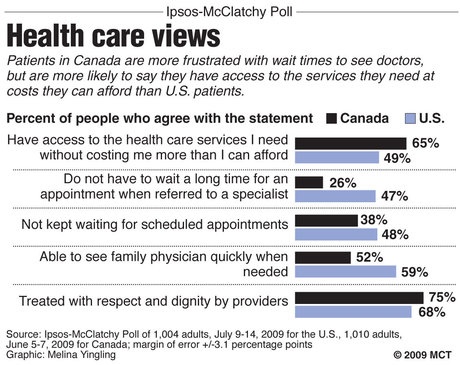
According to McClatchy, Canadians are much more likely than Americans to say they have access to all the affordable health care they need, but much more likely to gripe about waiting times.

The figures are in this graphic below

Now this tells us nothing about the actual waiting times, or the actual quality of care. It tells us only about perceptions. Canadians perceive that they are doing fine on the big issue: access to affordable health care; Americans do not. Canadians are much more likely to perceive that they are doing more poorly on a secondary issue: waiting periods. Humans being humans, the question arises. Is there a qualitative difference between the two systems with regard to waiting times, or is it the case that everyone likes to gripe, and if they’re satisfied with one thing, they’ll gripe about something else? I don’t know the answer on the waiting time issue, but I would make one observation. I review a lot of medical records as part of my disability practice. Waiting times can be impressive even here, and for folks without insurance the waiting time is often forever, which I suspect exceeds any waiting period experienced in Canada. It’s quite possible that the Americans are less unhappy about waiting periods because they’re just tickled pink to be able to see a doctor at all, while Canadians take access to health care for granted.


Great Veto Override

Congratulations to Representative Betsy Ritter (D-Waterford) (founding member and regular attendee of the SE CT Chapter of Drinking Liberally) and the Democratic Caucus for the override of Rell’s veto of the SustiNet plan for expanding health care access. Betsy has been talking about the bill for months and put a great deal of effort into its passage. It’s great to see that it survived Rell’s veto.

By the way, for the record, although Betsy rarely misses a meeting of Drinking Liberally, she has never been known to drink all that liberally. She is, lest anyone get the wrong impression, the soul of propriety.


Bird Tale

Maybe there’s someone out there who can explain this. As I mentioned a few days ago, we spent the weekend in Vermont. Yesterday morning, I went out onto the deck of the house where we were staying and there was this little bird, sitting on the deck, who didn’t move a muscle when I approached. It looked like it was in a bit of a daze. This picture was taken from approximately 3 inches away from it.

We were afraid that a funeral was in store. The bird sat there for half an hour; then suddenly gave itself a shake and flew away. We later saw a bird of his/her description eating from the bird feeder, looking perfectly chipper. One of our friends speculated that he may have stunned himself by slamming against the window or house.

Anyway, I was ever so glad it was not a terminal case, since I could see I would be designated to dispose of the corpse.


Numerical illiteracy

We get the Boston Globe daily, so I was generally aware that there is a movement afoot to relieve us geezers of our driver’s licenses as we get older. Yesterday, an article in the Day, at least on the surface, seemed to imply that there was little evidence that the elderly driver was a threat.

The headline read: “Elderly drivers in fewer accidents than others“. The sub-headine, if that’s what it called, pointed out that “Statistics don’t change push to change law”. The clear implication was that elderly drivers are statistically less likely to get into accidents than others.

But as has been said, there are three kinds of liars, the last of which is “statistics”. The first 17 paragraphs of the story make a compelling case, if you are numerically illiterate, that the elderly driver is not more likely to get into an accident than others. According to statistics, elderly drivers account for a smaller percentage of accidents than drivers in other age groups because while licensed geezers over 75 were 7 percent of those holding a license, they were only 3.6 percent of those involved in crashes.

These and other meaningless statistics lead some clueless experts, such as Russ Rader of the Insurance Institute for Highway Safety, to say that “there isn’t much evidence that elderly drivers are a big menace to other people on the road.”

Well, I’m not yet in the older than 75 category, but my mother is. She owns a car that is over 20 years old, which she bought new. It has less than 40,000 miles on it. These days, she might average 10 miles a week. I drive at least 10 to 20 times as much as she does. If she is one licensed driver, than I should count as 10 to 20 drivers in any reasonable comparison. Lots of elderly people have licenses but don’t drive at all. They should count as zero licensed drivers. It seems fairly obvious that simply looking at the percentage figures for various age groups tells you almost nothing.

Sure enought, in the 21st paragraph, long after most readers have moved elsewhere, we get to the nitty gritty:

[O]n the basis of miles driven, which the state does not track, the GAO found that drivers age 75 or older are more likely than all other drivers to be involved in fatal crashes The GAO report did not track nonfatal crashes.

So, the long and the short of it is that if you look at the only statistics that matter, the statistics disprove the headline. Geezers may be in numerically fewer accidents than others, but if they drive, they are more likely to get in an accident.

I’m not suggesting any particular course of action regarding elderly drivers. It’s a complicated issue, particularly in our car-centric society. I am merely pointing out that we can’t debate these issues in any reasonable fashion if we don’t understand basic math. I don’t know if this inability to understand basic mathematical or logical propositions is a peculiarly American phenomenon, but it is certainly not amelioriated by newspaper articles that misread statistics to prove a point that is simply not proven by the numbers on which they rely.


Art on Groton Bank-hiatus for me

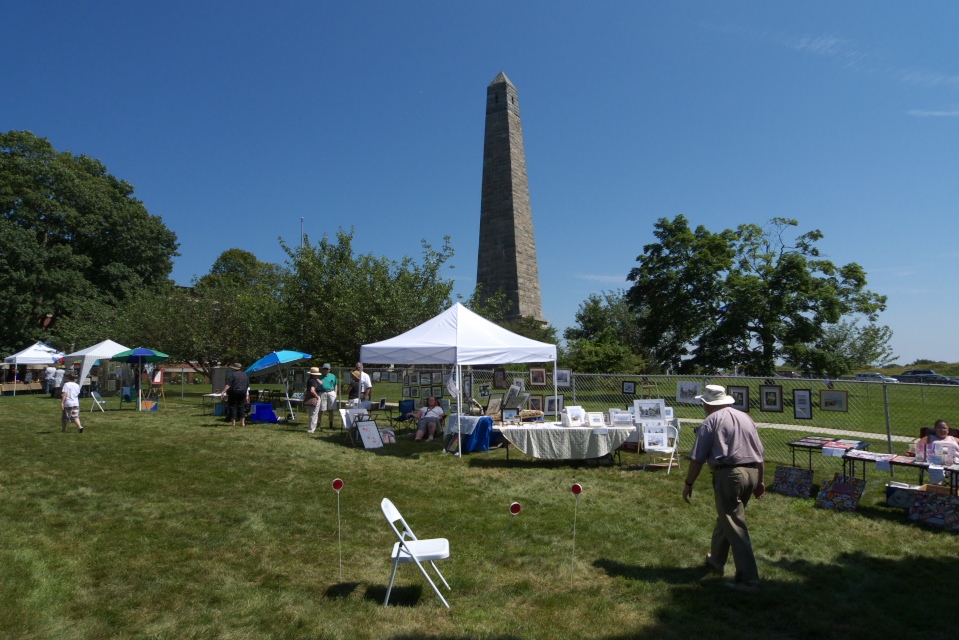
A few pictures from the Art on Groton Bank Exhibit today. An overview, with our historic Monument in the background.

Cows.

A collaborative effort, made on the spot. Is this a case of too many cooks?

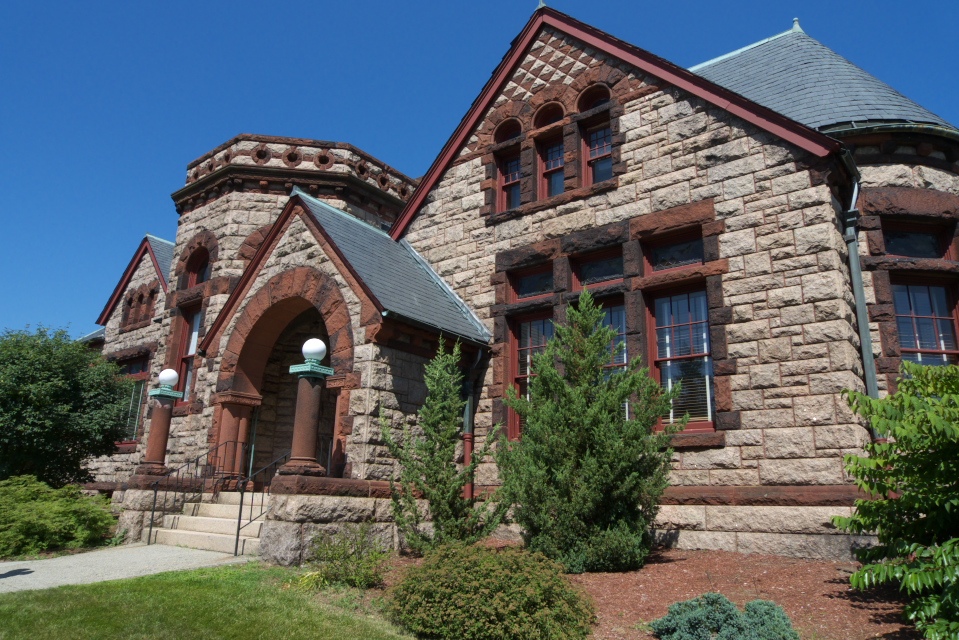
Though not strictly part of the show, there is a piece of art in that vicinity that we take for granted. The BIll Library is an architectural gem.

We didn’t buy a painting this year, but I got a great deal on a piece of pottery.

Tomorrow morning my wife and I take off for a mini-vacation in Vermont. We’ll be back Tuesday. My guess is that we’ll have no internet in the meantime, so this site is probably closing for a few days.


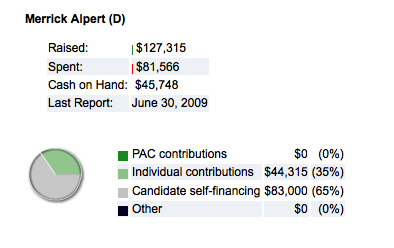
Merrick Alpert doubles his contributions

In for a dime, in for a dollar. Merrick Alpert donated almost twice as much to his campaign as all his other contributors put together.

At least Merrick is putting his money where his mouth is.

It’s sometimes forgotten that Merrick isn’t the only Democrat seeking to primary Dodd. According to Opensecrets.org, Roger Pearson has more money on hand than Merrick, but it’s obvious that they don’t have the latest information on Pearson’s finances.