Skip to content

Human Nature

According to Thinkprogress, Joe Scarborough has taken John McCain and Lindsay Graham to task for criticizing Obama’s hands off approach to the Iranian situation:

SCARBOROUGH: All we would do is undermine those people in the street, who the second that they are attached to the United States of America, the country after all that’s been known in Iran as the great Satan since 1979, we will undermine their cause … It’s so shortsighted I find it stunning. […]

What would John McCain and Lindsey Graham specifically have the president say? All of those people that are emailing in and telling me that I’m being liberal? Oh really? I’m being liberal? No I think it’s called restraint. Showing a little bit of restraint. Looking at the battlefield in front of you and not just running up Pickett’s Charge and getting gunned down. If you want to feel good about yourself — and you can only feel good about yourself by screaming about the evils of Iran — fine do that. But our leaders in Washington don’t need to do that because people will be routed in the street the second they are identified with the United States of America.

With all of which I heartily agree. But this post is not about Iran, it is about a somewhat irrational implied argument.

Now, Thinkprogress is a “progressive” site. Normally, it disagrees with Joe Scarborough. But the implied argument here is as follows: We normally disagree with Scarborough. If even he agrees with our position we must be right.

Now, this is something we all do. Left or right, it makes no difference. If a conservative finds him or herself on the same page as Teddy Kennedy, they will cite that agreement as proof positive of the justice of their position. For, after all, if even Teddy Kennedy (or Joe Sarbourough) can see the light….

In truth, this line of argument is totally illogical. If I believe that Joe Scarborough is usually wrong, then it stands to reason that I should re-examine my position if I occasionally find myself in agreement with him. After all, if he is usually wrong, there is a high probability that when he agrees with me, it is my position that is wrong, and not he that is right. But no one thinks that way. If we find ourself with a position in common with an ideological foe, we trumpet that fact as proof positive of the correctness of our position.

I should hasten to add that Scarborough happens to be right in this particular situation, not only in his position, but in the reasons he gives for his position.

For those with doubts, recall a little American history. Just before the 2004 election, Osama bin Laden issued a stern warning to the American people, warning them not to re-elect George Bush. The pundits, like the idiots they are, interpreted this as an endorsement of Kerry. The CIA, and the Bush people knew better of course. Osama, who is depraved but not stupid, knew that an attack on Bush would help Bush’s re-election campaign. Since Bush was the gift that kept on giving as far as Al Qaeda was concerned, and since Osama knew that his words would be taken at face value by the stupid American media, Osama made his endorsement in the way that he did. Obama doesn’t have the luxury to play the reverse psychology gambit, since the Republicans would skewer him at home, and because the government of Iran is very likely not as stupid as the American people or the American media. But an outright endorsement of the protestors would be seized upon by the Iranian government in just the same way as Osama’s “endorsement” of Kerry was seized on by the Republicans, except that it would be used as an excuse to not just discredit, but to oppress, the opposition. It’s not logical to argue that if even Joe Scarborough can see that, it must be true, but if even Joe Scarborough can see that, it must be true.
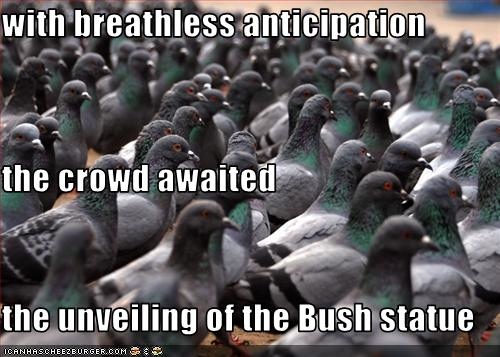


A silver lining to every cloud

Thanks to my sister for sending me this.


Sunday Book Review

Be warned. This is long and I’m not sure it’s worth the reading, but I enjoyed writing it, so what the heck.

Most of the books I read concern events that happened a long long time ago, if not far away. Thus, they are not really appropriate for comment on this blog. The book I just finished, Idiot America, by Charles P. Pierce, as the name implies, is strictly concerned with current events. No one with an ounce of historical perspective could deny that while idiocy has always had a place in America, it has reached its apogee in the here and now.

So, one might argue that Pierce has an easy job-no barreled fish is easier to hit than an Idiot in America. They are, after all, everywhere. But Pierce makes reading about them a pleasure. This book is Al Gore’s The Assault on Reason, salted by the outrage and mockery that Gore could not have employed. It’s a fun read throughout.

You might say that this is a book length meditation on a concept that Stephen Colbert brilliantly reduced to a single word: truthiness.

Pierce is not the first person to notice that the the notion of truth has become a malleable concept in this country. The very people who otherwise think in absolutes are the most likely to treat truth as a relative term, determined not by resort to objective provable fact, but to belief. In this country, Pierce correctly asserts, a firmly held belief (provided, usually, that it is grounded in Christian doctrine or some other creed, such as capitalism, entitled to unquestioning respect) is accorded equal status with provable fact. Thus, creationism and evolutionary theory are entitled to equal credence and equal treatment, because creationists vociferously assert their belief, and therefore are entitled to respect. But it goes one step further. It isn’t really even necessary for one side to have a deeply felt belief; it is enough that they pretend to believe convincingly though cynically. Thus, we give credence to the absurd charge that Sadaam was in league with Osama, or to the assertion that the verdict is not in on global warming. It’s not that facts don’t matter, it’s just that facts are not entitled to any precedence. Moreover, as Pierce points out, the traditional American skepticism of experts and intellectuals has been put to good use by the idiots. The fact that one is an expert in a given field is now positive evidence that the opinion of that person should be ignored. Put another way, we have promoted anyone who speaks loudly and emphatically about a subject to the status of expert, on an equal par with someone who has actually spent a lifetime studying the subject. Thus, Sean Hannity can qualify as an expert on stem cell research, or anything else about which he chooses to pontificate. (Cue Gilbert & Sullivan: “If everyone is somebody , then no one’s anybody” ) Of more moment, self styled neocon “experts”, who had no real understanding of the mid-East situation, trumped the real experts who insisted that a Sadaam-Osama connection did not exist. Fervent belief, or fervent pretending trumped the facts, both within the Administration and within the punditry. According to Pierce, discussion of issues degenerates into something like team sports, with partisans on both sides taking positions based on faith.

The book is a polemic, so Pierce can be forgiven a little exaggeration, but I do think he does underestimate the intelligence of the American people. (Yes, I can hear P.T. Barnum laughing) A lot of them are idiots, but not as many as the folks who lead them are wont to believe. In his treatment of the Schiavo case, for instance, he neglects to point out that while the Democrats in Congress largely scurried to protect their right flanks, the American people, once aware of the situation, were immediately, forcefully, and overwhelmingly non-idiotic. It was the beginning of the end of the Bush presidency and Republican ascendance. Yes, we are often idiots, but we are not nearly as idiotic as the Democrats assume us to be, or the Republicans want us to be.

Pierce is particularly effective when he writes about the victims of idiot America: the Native American inhabitants of the Alaskan town of Shishmaref, situated on a barrier reef island slowly being destroyed as a consequence of global warming, whose governor does not believe it is happening; or the employees of the hospice in which Terry Schiavo died, who were subjected to harassment ranging from the absurd-a subpoena from Congress to produce the brain dead Schiavo so she could testify about her wish to live- to the terrifying-death threats and other abuse. Of course, in a larger sense we are all victims. For example, if the Republicans have their way they will kill heath care legislation once again by endlessly repeating talking points that will be exceeding truthy, and exceedingly untrue. If history repeats itself, and it will, the truthy and the true will be given equal standing in the national debate, with a tie going once again to the truthy.

At times Pierce asserts that this is a game both sides play-and no doubt there have been folks on the left that have dabbled in truthiness- but in fact at the present time the willingness to cater to, and act like, idiots is a right wing phenomenon. At worst, the Democrats meekly cower in fear at the prospect of the idiot masses (who are still, when all is said, a minority among us). The true idiots, as Pierce demonstrates, are the members of the various groups that form the Republican base and a goodly share of the Republicans in Congress.

Pierce argues for an American exceptionalism-there are idiots elsewhere, but nowhere else are they treated with such deference and respect. I think that’s a bit of a stretch. Any culture in which “faith” is put on a par with fact will exhibit similar patterns of behavior. Europe is less idiotic now because Europe has, at least for the moment, lost faith in faith. But where faith is strong, similar forces will be at play. In today’s Times, for instance, we learn that neither side in Iran is concerned with facts any longer. They believe what they believe, evidence be damned and their positions are hardening. As in America, the two sides are losing their ability to talk to each other.

The book is an indictment. Other than a call for a return to reason, interwoven with a well deserved tribute to that most reasonable of the Founders, James Madison, Pierce offers no prescription. It’s not clear that there is one. Obama actually appears to be a guy who is more or less determined to act in a rational manner, idiots be damned. We’ll see how it works out.

As a sidenote, this book seems to embody a trend I’ve noticed lately-bad editing. Maybe it’s an over reliance on computers-spell check, etc. I know from experience that after I’ve worked on something for awhile I start seeing what I think I wrote, rather than what I did write. I have my secretary read my legal briefs so she can catch that sort of stuff. In Idiot America there are words misplaced, or misused (“literal” instead of “literally”) and sadly, for a book arguing for reliance on fact, glaring factual errors. For instance, the date Joe Wilson wrote his column in the Times is off by a year, and the date Andrew Bacevich, Jr. died in Iraq is off by five. These are obvious typos, but isn’t that what editors are for?

UPDATE: Corrected the name of Al Gore’s book. Sorry about that.


Stating the obvious, take 2

It is inconceivable to me that there is anyone out there who disagrees with Obama’s response to the Iranian election and the subsequent unrest. It seems so obvious that the folks in power there would just love to tar the opposition as American pawns.In fact, they are already forcing people to confess to being agents of foreign powers. Those Republicans that are insisting on a more aggressive approach are grandstanding for the home crowd. One must wonder if there is anything they wouldn’t do to destroy Obama.


Friday Night Music-Marvin Gaye

As best as I can determine, I haven’t posted Marvin before. I can’t imagine why.


A loss for Groton

Over the course of the last 40 years or so great chunks of Groton have been preserved for posterity as Open Space. Lots of folks were involved in the various efforts to preserve the many parcels that have been saved, but one person was central to them all.

Groton owes a huge debt of gratitude to Priscilla Pratt, who has quietly but determinedly led the efforts of the Groton Open Space Association (or its forebears) for those 40 odd years.

Priscilla would set out to preserve a threatened property, and against all odds, she would succeed, time and again. Many a developer left Groton in frustration, having seen a proposal die the death of a thousand cuts at Priscilla’s hands.

Never daunted, never deterred, often unfairly derided, as soon as she saved one piece she set her sights on another.

Last night at the Town Committee meeting Andy Maynard told us that Priscilla died recently. Many people in Groton don’t know her name, but each and every one has been benefitted by her work. Not too many people have had the quiet impact that Priscilla has had on her community. She leaves behind many hundreds of acres of preserved space as her memorial. During her life she deflected attempts to honor her for her work; now that she’s gone it is certainly fitting that one of the properties she saved by named in her honor.

Below are some pictures of Haley Farm State Park and some of its inhabitants, the first property that Priscilla saved, which would, if not for her and her brother, Mort Wright, now be filled with Coast Guard housing.


Putting things in perspective

I hadn’t heard about Congressman Pete Hoekstra (R) comparing he and his fellow Republican twitters with the folks storming the battlements in Iran, but he did. And here’s a blog with some great editorial comment about it.


Stating the obvious

It is common for the obvious to be overlooked in political debate. Buzzwords are allowed to fly around without, it seems, anyone slowing things down and examining the reality that is allegedly being discussed.

Double and triple kudos, therefore, to David Leonhardt of the New York Times, who penned a great column this morning about the “medical rationing” shibboleth. A moments reflection will suffice for any thinking person to come to the conclusion that any system of medical care, including the one we have now, rations care. Yes it’s obvious, but a lot of people work very hard to make sure the obvious isn’t noticed, so work like Leonhardt’s is really needed.

Leonhardt points out that there are at least three forms of rationing taking place right now:

There are three main ways that the health care system already imposes rationing on us. The first is the most counterintuitive, because it doesn’t involve denying medical care. It involves denying just about everything else.

The rapid rise in medical costs has put many employers in a tough spot. They have had to pay much higher insurance premiums, which have increased their labor costs. To make up for these increases, many have given meager pay raises.

The second kind of rationing involves the uninsured. The high cost of care means that some employers can’t afford to offer health insurance and still pay a competitive wage. Those high costs mean that individuals can’t buy insurance on their own.

The uninsured still receive some health care, obviously. But they get less care, and worse care, than they need. The Institute of Medicine has estimated that 18,000 people died in 2000 because they lacked insurance. By 2006, the number had risen to 22,000, according to the Urban Institute.

The final form of rationing is the one I described near the beginning of this column: the failure to provide certain types of care, even to people with health insurance. Doctors are generally not paid to do the blocking and tackling of medicine: collaboration, probing conversations with patients, small steps that avoid medical errors. Many doctors still do such things, out of professional pride. But the full medical system doesn’t do nearly enough.

He’s overlooking another form of rationing that is so common we tend to forget it: the rationing to which even the insured are exposed when their insurer denies coverage for medical procedures or drugs, often unjustifiably.

As always, the real question is not whether there should be rationing, but who should be doing it. Personally, I’m not impressed with the craftsmanship of the invisible hand.

Again, great column. Wouldn’t it be nice if this sort of analysis made its way onto the tube?


New Toy

Recently the folks who manage my office (I am not a management type) discovered that we could consolidate our mobile phone plans and save enough money to get “free” blackberrys (is that the correct plural in this context?) all around (or at least around all the partners).

So, today, I became the semi-proud possessor of a Blackberry Storm, and I’ve spent a good part of my free time today trying to figure it out, rather than doing something useful like in depth analysis of stuff I know nothing about. I must say, I’m not impressed with the Blackberry. My point of comparison is my wife’s Iphone, which seems superior in every way. The Iphone is far more user friendly and intuitive, which one would expect from Apple. But the Iphone is far and away a better performer when it comes to add on applications.

The Blackberry I got comes with one GB of on board memory, and it came with an 8 GB micro SD card, meaning that, at least in theory, it has more memory that my wife’s Iphone. I downloaded two “apps” to add to those that came pre-installed, and they ran fine. I then tried to download another, and got a dialog box informing me that I had only 4 mb of “application memory” left, and did I really want to waste some of it with this new application. After some searching around on the blackberry I found that I had almost an entire GB of free on-board memory, and all 8 GB of SD memory unused. After a little google searching I discovered that this memory could be used to store pictures, videos, or music, but not applications. Contrast that with the Iphone, which you can stuff to bursting with apps, if that is your wont. I gathered from the forums in which this is discussed (I get the impression that the Blackberry company maintains a discreet silence on the issue) that there is a 128 mb limit on the “application memory” almost all of which is filled out of the box. You can’t run an app off of most of the on board memory or off of an expansion card. I was doing the latter on a Palm Pilot knock off over 6 years ago, so it’s eminently doable.

I can free up space to accommodate other apps, but at this point I don’t know which of the prepackaged ones I need, and I haven’t found a way to store them somewhere in case I want to restore them.

It goes without saying that the software that came with the Blackberry assumes an all Microsoft world.

I shouldn’t complain, of course. I didn’t pay for it, and it does allow me to stay chained to my office email everywhere I go. What more can you ask?


Ari Fleischer: Still Spinnin’ after all these years

Are Republicans deluded, liars or both? Today’s example is Ari Fleischer, who says that George Bush deserves credit for the reformist surge in Iran. On one level these kinds of claims are untestable, but what we know about human nature argues strongly against Ari’s position.

Both Bush and Ahmadinejad were deeply unpopular in their own countries. They depended upon one another; whenever Bush needed to goose his numbers he would trot out a Middle East nasty, often Ahmadinejad. Ahmadinejad, in turn, depended on a United States threat to distract attention from the economic woes that he helped inflict on Iran. Ahmadinejad was probably better served by the scare tactics, since the threat was real. Bush really did want to attack Iran.

Once Obama got in, Iranians could feel somewhat freer to discount the red, white and blue menace and go with anyone but Ahmadinejad, which is what they apparently tried to do. If Bush can be credited with any role in the reformist upsurge, it is a only in a negative sense. He turned the pressure up so high that it was easy for Obama to relieve it by a few words and gestures. The people of Iran felt free to vote their domestic interests because the foreign threat receded. Ahmadinejad couldn’t sell fear, and without it he had nothing left.

That’s a large part of what happened here in the past few years. If any emotion put the Republicans in position to win (with a helping heap of questionable Ohio ballots) it was fear-a waning fear but one that was still strong. By 2008 that fear level couldn’t be sustained, and the other distractions Republicans commonly employ (e.g., fear of the “other”, whether that other be black, brown, gay, or Muslim) lost their effectiveness in light of the looming economic crisis.

So some of the same forces that beat the Republicans in 2008 created conditions in Iran that forced Khamenei to steal an election that his chosen candidate might easily have won had Bush still been in office.