Skip to content

Drip, drip, drip?

The Washington Post reports (via the Washington Monthly blog) that the White House is set to disclose more torture materials, which will probably put the lie to the Cheney induced meme that torture worked, so what’s the problem.

Government officials familiar with the CIA’s early interrogations say the most powerful evidence of apparent excesses is contained in the “top secret” May 7, 2004, inspector general report, based on more than 100 interviews, a review of the videotapes and 38,000 pages of documents. The full report remains closely held, although White House officials have told political allies that they intend to declassify it for public release when the debate quiets over last month’s release of the Justice Department’s interrogation memos.

One of my fond hopes, though it is still only a hope, is that Obama is managing the roll out of this material so as to allow pressure for investigations and prosecutions to build up over time. I keep recalling FDR’s admonition to a group of folks pushing him to take action on their behalf: “I agree with you, I want to do it, now make me do it.” It makes political sense for Obama to seem to come to these prosecutions reluctantly.

So, I ask myself, if I wanted to help that process along, and I were Obama, how would I do it? It certainly wouldn’t hurt to add fuel to the fire every time it starts to smolder. If you want to truly get something behind you, why not dump everything at once and be done with it? On the other hand, if you want to build support for prosecutions, why not give it out in pieces, with each piece of evidence more damning then the next. So I am somewhat hopeful that Obama has scheduled another evidence dump at a time well calculated to keep this issue front and center.

It doesn’t hurt, of course, that Dick Cheney is so eager to keep this issue on the front pages. If he has a lawyer the guy must be having daily heart attacks. Cheney is practically inviting a special prosecutor.


Mother’s Day Excursion

This year my wife and I decided to celebrate Mother’s Day by taking a little trip, so Saturday Morning (this is written Saturday night, but the wireless connection in our bed and breakfast went out, so it likely won’t be posted until Sunday) we set out for the Berkshires, slowly wending our way through Northwestern Connecticut. It’s an area of the state in which we’ve never spent much time.

So, because I don’t know what’s been happening and can therefore not comment on current events, having been cut off from the world, and because I feel like it, I’m going to post some pictures of the trip.

First stop (after lunch) was the Glebe House in Woodbury, which drew our interest because its website boasted that it had a garden designed by Gertrude Jekyll. Apparently the design was not carried out until years after she drew them up, and in truth, there’s not much to the garden. (Portion pictured below).

Turns out the house is somewhat of a shrine to Episcopalians, something we knew nothing about when we went there, since we both must have ignored that portion of the website. Apparently, during the dark days of the Revolution, when the Anglican church was in some disfavor (being almost totally a Tory religion), something was done (I’m still not clear what) that was a foundational event for Episcopalians in America. Among other things they chose a Bishop – Bishop Seabury. That’s a name with which I’m familiar, because the site of his boyhood home is in Ledyard, properly monumented, which I often pass on my bicycle rides. Groton boasts a church named after him, which is one in which the presiding priest is active in the effort to break away from the main church on the grounds that it isn’t bigoted enough against gays. Anyway, the house is worth seeing, even for a non-Episcopalian, because it is an extremely well preserved example, both inside and outside, of an 18th century New England home. The center chimneys, walls, just about everything, are as they were in that period. The people (docent, etc.) were very nice, and seemed frankly amazed that someone had come to look at the place.

Right down the street is the Hurd house, pictured here, which we were told is a good century and more older than the Glebe house, and also apparently well preserved.

Next stop was the White Flower Farm, a well known destination for gardeners. (Full disclosure: of the two of us, only my wife fits that description, but I enjoy looking at them). Herewith some pictures.


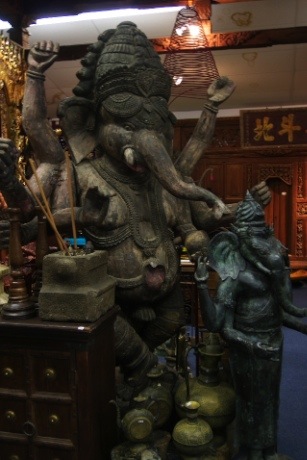
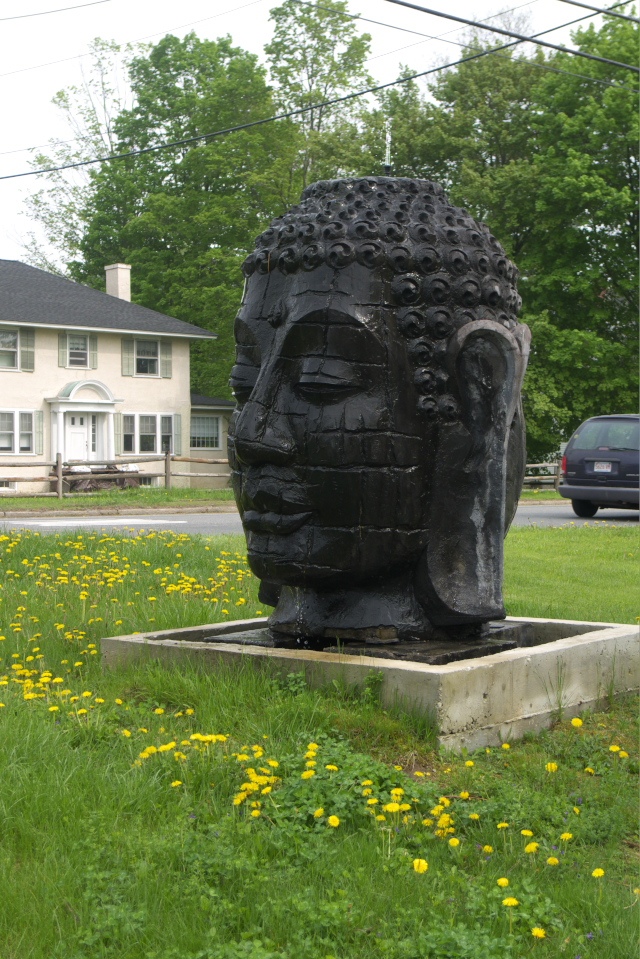
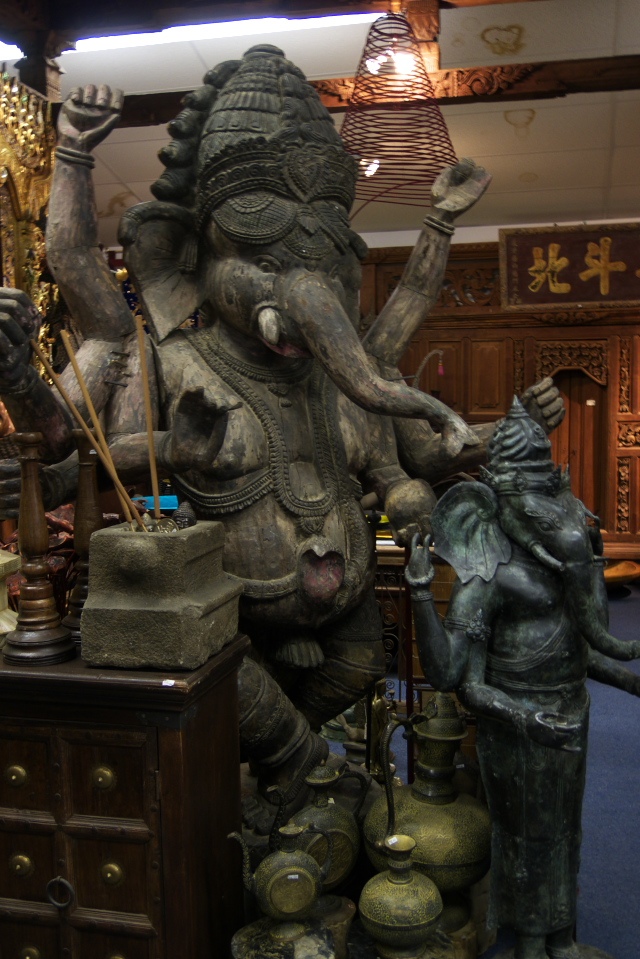
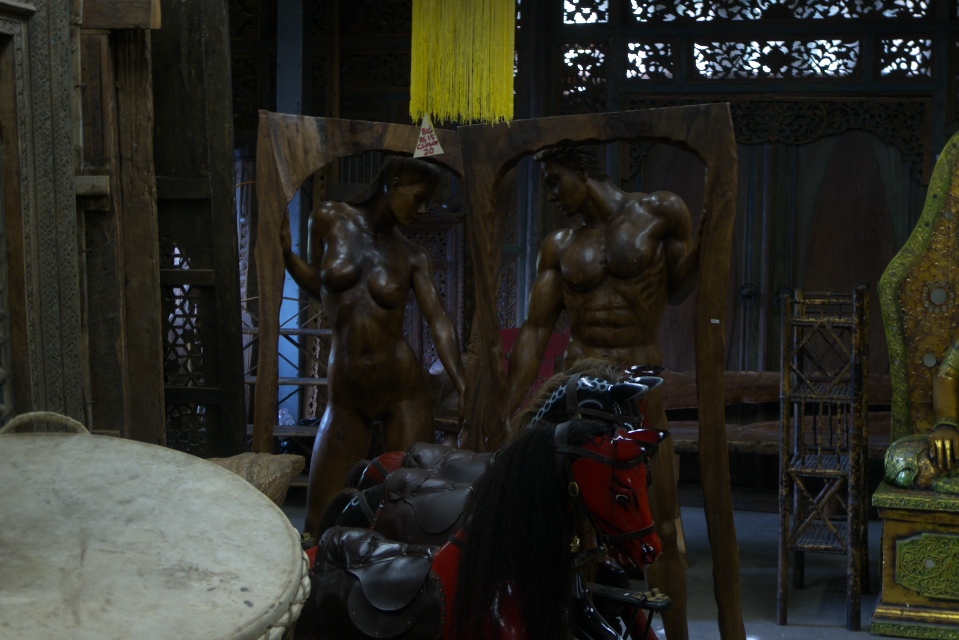
Finally, one of the reasons we went back to the Stockbridge area. The first time we ever went there we stumbled on Asia Barong, which is right next to the bowling alley on Route 7 in Great Barrington. The place is full of an incredible variety of Asian artifacts, leavened with some truly weird stuff. The first time we went there, we had almost no time to look around. The owner told us Spring was the best time to look around, since he went on his buying trip in the winter. Every time we’ve returned, the place has been closed, so we figured we’d make a trip up there when we knew it would be open, and we’d have leisure to look around. The owner claims to have the biggest collection of Asian artifacts in the country, and it seems like a believable claim.

As proof of the This is an example, which is displayed on the bowling alley side of the building.
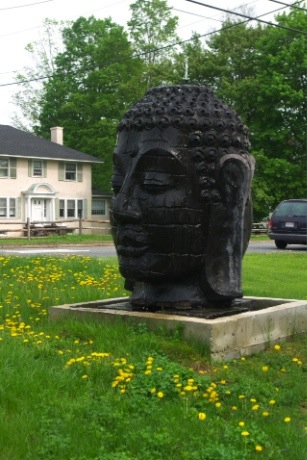
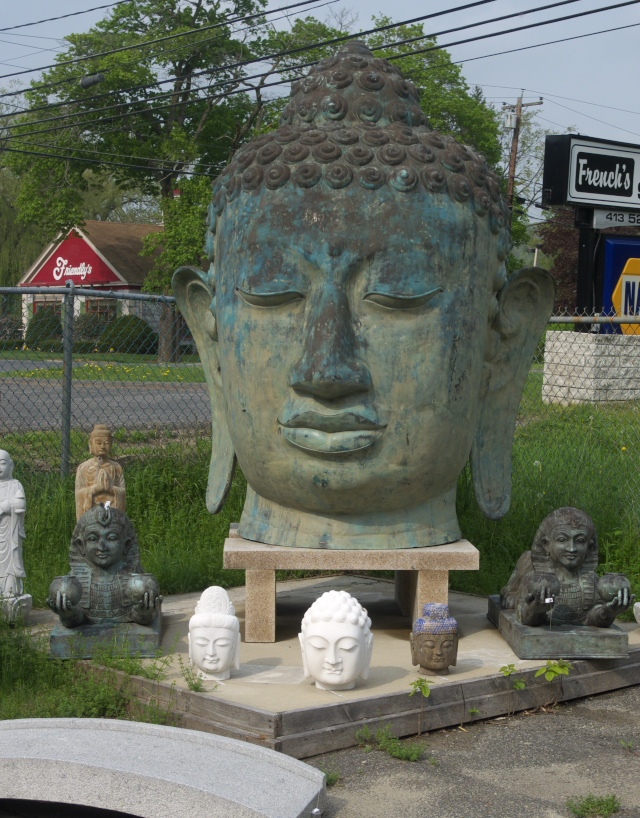
Here’s his brother, on the side of the property across the street from Friendly’s.
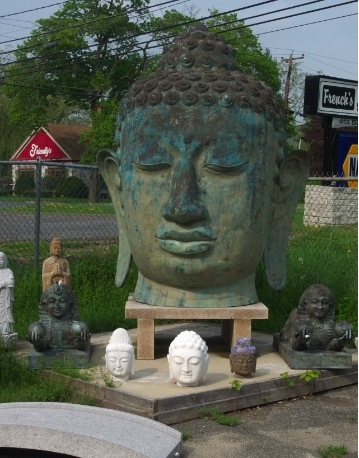
A sampling of the stuff on the main floor.


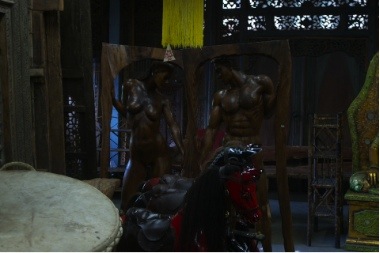
As proof of the aforementioned weird stuff, I submit the following. Notice the artful way I composed this picture to keep the rating to an R.
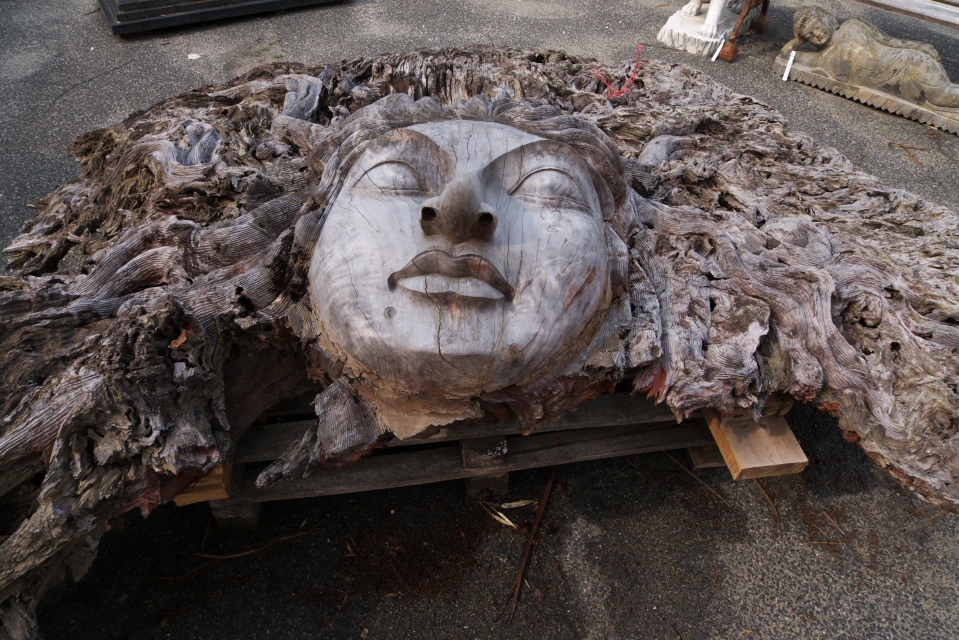
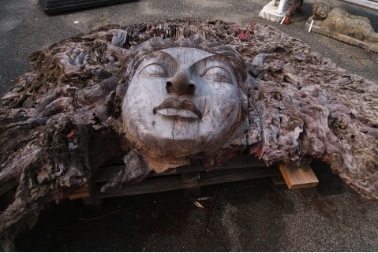
This is an amazing thing. It’s a sculpture carved from the base of a tree. The face is the base of the trunk; the tresses are the roots.
A lot of this stuff is reasonably priced. We got a Buddha’s head carved from pink marble (they pretty much littered the ground) for about what it cost us to eat for the day.

Finally, I must say a word about our Bed and Breakfast in West Stockbridge, the Shaker Mill Inn. Okay, the wireless kicked out, but the room we had was huge and well equipped. We got a decent breakfast (quiche, bagel, muffin, fruit, juice), which they put in the fridge for you to cook in the supplied toaster-oven or microwave. They even gave us free wine and chocolate, and greeted us by name when we arrived. Cost for the night was just shy of $120.00, which is a bargain in my book. Yes, it is right behind Troy’s Auto Body, but you can’t see Troy’s, and the view through the sliding doors is idyllic.

Anyway, we had a great time. We are one Buddah head richer, quite a few dollars poorer, but well satisfied with the weekend. And I have convinced myself that my Mother’s Day obligation was satisfactorily discharged.



Friday Night Music-Peter Seeger at 90

I’ve put Pete up before, but how can you ignore a legend’s 90th birthday. Here’s Bruce Springsteen (this is all talking, so skip it if you just want music) talking about Pete at the recent birthday bash.

As Springsteen says, Pete did outlast the bastards, or at least generations of them, including the crop that came to harvest in 2001. Unfortunately, there are always new generations of bastards, and you can’t outlast them all. Pete does have the satisfaction of having lived long enough to see the bastards that he battled recognized for what they were, while he became an American Institution. That’s a form of revenge that must taste awful sweet.

Here’s a gem from the 50s, or thereabouts, Little Boxes. It looks like it was made by someone filming a television set.

But of course, it wouldn’t be Seeger without This Land is Your Land. Here’s a spirited rendition with Arlo Guthrie (I’ve posted the Inaugural version already). As you will see, Bruce is wrong, he doesn’t always sing all the verses.

Speaking of the bastards, they win elections occasionally, but they’ll never have better music than us.


Crazy and/or stupid in Georgia

Wow. If you ever needed proof that the people of these states, particularly those in the South, have a habit of electing truly stupid and/or crazy people, check this out. Hendrik Hertzbert reports (I got to him via the Washington Monthly) on a Georgia State Senate Resolution that adopts whole hog the reasoning of the Kentucky Resolutions:

Really, you can’t make this stuff up. You have to read it in full to believe it. Even then you can’t believe it. You thought that “nullification” had been rendered inoperative by the Civil War? Well, think again. You considered secession a pre-Appomattox kind of thing? Well, reconsider. You assumed that John C. Calhoun was a dead parrot? Well, turns out he was only resting.The resolution is written in a mock eighteenth-century style, ornate and pompous. Just two of its twenty sentences account for more than 1,200 of its 2,200 words. But the substance is even nuttier than the style.

The resolution is written in a mock eighteenth-century style, ornate and pompous. Just two of its twenty sentences account for more than 1,200 of its 2,200 words. But the substance is even nuttier than the style.

For those of you not totally up on your history, the Kentucky Resolutions were written in a moment of weakness by Thomas Jefferson (Madison penned the Virginia Resolutions) as a protest against the Alien and Sedition Acts. The Kentucky Resolutions stated that the various states had the right to “nullify” any federal law that the state legislature, in its infinite wisdom, violated the constitution or the rights of the state. Much to Madison’s later chagrin, they formed the intellectual foundation for those who felt that secession was an option.

The vote in Georgia was nearly unanimous, with only one person of brain (and also of color) opposed. This sort of over the top reaction to a government that has behaved no differently than any other federal government since the Depression can, one would think, be explained by only one thing: the color of the gentleman that occupies the presidential chair.

But that’s where sheer stupidity must come into play. After a painstaking search utilizing the vote tally here, and looking at the pictures of the Georgia State Senators you can get to by following the links here, I conclude in amazement that the vote in Georgia was somewhat bi-partisan (a number of Democrats did not vote) and also bi-racial.

Jefferson’s frustrationin 1798 was born out of the fact that he saw no way to redress what was a clearly unconstitutional act. Marbury vs. Madison was about six years in the future, and in any event, the federal judiciary was, at that time, a branch office of the ruling Federalist party. That excuse is no longer operative. Jefferson was certainly aware, as Madison most painfully was, that in practice the theory would render the Union ungovernable.

At least in those days there was an identifiable threat. Where is the threat today, as opposed to a year ago, when we were ruled by a President who made daily incursions into our liberties and who considered the Constitution a technicality? What could possess a black Democrat to vote for a resolution that could have been written by the Confederate Congress? And why is the reaction to this so muted? In 1798 the country went crazy. Okay, maybe the lack of reaction is because we all know that state legislatures are pretty meaningless bodies when it comes to national law.

To all my left-leaning friends who confidently assert that Sarah Palin could never be elected President, consider that the crazies who passed this resolution are not confined to Georgia. Similar resolutions have passed in Oklahoma and South Dakota.

There is nothing you can conceive of that is so stupid that the American people would not do, given the right circumstances.


Call for Artists

I told Audrey Heard that my roster of readers, being limited, probably contains few artists, but one never knows. Audrey is looking for artists to display and sell their wares at Art on Groton Bank, which will be held this year on July 18th, as you can see below.

The picture is sort of tiny, but if you’re interested, you can download an application at ArtonGrotonBank.com. My wife and I have enjoyed the shows in years past, and bought one of our favorite paintings at one of them.


Drinking Liberally tomorrow

There can’t be good living where there is not good drinking.

Benjamin Franklin

If Ben were alive today, as a good liberal and enthusiastic (if moderate) drinker, he’d be making plans to attend Drinking Liberally tomorrow. As always, 6:30 PM, the Bulkeley House, 111 Bank Street, New London.

Don’t miss it!


Not a favorable comparison

Steven Benen, at the Washington Monthly, takes exception to the fact that the UK is banning political extremists from entering that country:

I can vaguely understand why these measures might be tempting, but it’s developments like these that remind me why U.S. civil liberties are worth appreciating.

I agree with his position that these bans are not a good thing, though I do find it somewhat delicious that Michael Savage is on the list, banned for hate speech. But I must take exception to his warm and fuzzy feelings about our civil liberties. My guess is that this country’s track record on banning people for political reasons is far worse, and of far longer standing, than the UK’s. This is from the New York Times of less than two months ago, discussing a case involving the Bush Administration’s refusal to allow a Muslim scholar to enter the country:

In its most recent brief in the case, last July, the government said both that the courts did not have the power to review such decisions and that the Supreme Court had repeatedly allowed the government to bar foreigners because of their views. The Obama administration has filed no briefs and has given no indication what course it will take.

That was the Bushies making those statements, but they were not always wrong, and their assertion about the Supreme Court is basically correct. I recall reading cases upholding this sort of thing when I was in law school, which was an enlightened age (the dying days of the Warren court) compared to the dark judicial ages in which we now exist. The folks on the Mayflower weren’t the last political dissidents to arrive on these shores, but ever since they arrived those shores have been ever less welcoming. We don’t compare favorably to the UK on this score.


The circle closes

Seldom are the victims (if only the secondary victims) of a conspiracy privileged to watch that conspiracy play out before there very eyes. The entire American people have now been so privileged, as we see the Bush torture conspiracy come to a successful end. It can truly be said that at no time has the conspiracy been truly secret. When now publicly acknowledged, its broad outlines have been known.

In today’s Times we get the word that a Justice Department investigation has concluded that while mistakes were clearly made, none of the lawyers who wrote those infamous memos should be prosecuted. The conspiracy is now complete.

Let’s review the definition of conspiracy. A conspiracy involves an agreement between or among individuals to achieve an illegal end by legal means, a legal end by illegal means, or an illegal end by illegal means.

Here, the illegal end is clear. The object of the conspiracy was to violate national and international laws against torture, and to get away with it if caught.

The means: Insulate the torturers by producing bogus legal opinions that gave them legal cover. You can do that because the opinions of the Office of Legal Counsel give government employees legal cover until a court finds them invalid. This leaves the lawyers themselves vulnerable, unless you determine that they were not criminal, merely incompetent. This requires that you ignore the inconvenient fact that the overarching conspiracy is patently obvious. Each participant knew, or should have known the obvious truth that no one in this entire conspiracy was acting in good faith. The legal principle that gives government employees cover if acting pursuant to an opinion from the Office of Legal Counsel presupposes that the opinion was given in good faith-that it is an honest attempt to discern the true state of the law, not a made to order brief designed from the start to reach a specific conclusion. The lawyers knew what they were doing. The torturers themselves could not have believed that they were not torturing, or is this a case in which they merely asked: “Who should I believe, John Yoo, or my lying eyes?”.

Now the Obama administration takes the last step in the conspiracy by sealing the deal, performing in precisely the manner that the Bushies expected should the torture come to light. There’s nothing to see here, and although some of these miscreants might have to lose their law licenses, there’s no need to get the torturers, or the people who were pulling those lawyer’s strings.

By the way, don’t try this at home. For the rest of us, claiming that we were following legal advice gets us precisely nowhere, if by following that advice we expose ourselves to criminal or civil liability. Nor does a good faith defense do a lawyer much good if they have exposed themselves or their client by giving bad advice. I’m aware of one exception. If a person is sued for malicious prosecution (suing someone without good cause) he or she can defend by saying they were relying on the advice of counsel. But that defense only goes so far. It gets the client off the hook, but not the lawyer, who remains liable.

It now remains to be seen whether Congress will do something about this national disgrace. I will risk a prediction that has little chance of being wrong: we will hear a bit of sound and fury, but in the end it will signify nothing.


Dodd speaks on torture

Okay, I give up. I normally spend my lunch time at work cruising the net, and often send links home that I think it would be good to write about. Often, unfortunately, I forget to send them. I just spent about an hour searching for a story I read about Obama’s tax haven proposal. I simply couldn’t find it, and I’m running out of time. So, nothing close to original from me today.

In fact, I can do no better than link to My Left Nutmeg, which, along with other selected Connecticut bloggers, made news across the blogosphere with its scoop on Chris Dodd’s take on the torture issue. Chris’s dad was a prosecutor at Nuremberg, so it stands to reason that he might have strong feelings about the issue:

I believe that waterboarding is torture. … Pat Leahy of Vermont has been arguing for a select committee – or a commission, I forget which he’s talked about – to go and review all of this. I agree with him on that. There’s some debate about whether he does it or the Intelligence Committee does it – somebody ought to do it. […]

In a sense, not to prosecute people or pursue them when these acts have occurred is, in a sense, to invite it again in some future administration. If you think it doesn’t mean anything, that you can basically do what you want and we’ll somehow just say, “That was yesterday, today’s today.” Had that handful of people who advocated at the Nuremberg Trials embraced that view – Nuremberg became the symbol of who we were. Even these thugs got a lawyer. Even these thugs had a trial, despite their acts. So we became a symbol of jurisprudence and the rule of law. […]

Let’s not forget that Dodd was a strong voice against the telecom bill, and against FISA. He’s been one of the few politicians who has bothered to make an issue out of civil liberties and constitutional issues, and he deserves re-election for that reason alone.

By the way, I am not bitter about the fact that I was not invited to this Connecticut blogger confab. I don’t feel the slightest amount of resentment. It wouldn’t mention it except that I feel the need to make my total lack of pique explicit.


A Good Witch

When my kids were little my wife and I read most, if not all, of the Oz books to them, both those by the original author, L. Frank Baum, and by his successor, Ruth Plumly Thompson. So I was interested when I saw Finding Oz in my local bookstore. It’s a biography of Baum by Evan I. Schwartz, which makes a more or less plausible case for the sources for the Oz stories and characters (he convincingly debunks the idea that it is a disguised attack on the gold standard). Among other things, he makes the argument that Baum’s mother-in-law was the inspiration for both the Good Witch of the South and the Wicked Witch of the West. In the book, there are two good witches; the beautiful one appears only at the end, and she’s the one Schwartz feels Baum’s mother in law inspired. This might be just a tired mother-in-law sort of joke, except that this particular mother-in-law was a remarkable woman, a relatively neglected woman’s rights advocate who was a full member of a triumvirate that included Susan B. Anthony and Elizabeth Cady Stanton.

Her name was Matilda Joslyn Gage. You can read more about her here, at the website for the Matilda Joslyn Gage Foundation. Baum was an early supporter of equal rights for women, quite likely influenced by Ms. Gage and her almost equally strong minded daughter. What I found interesting was the fact that she, alone among the then big three in the women’s movement, refused to make common cause with the temperance movement, which was dominated by religious fundamentalist women, and which, even then (if Schwartz is to be believed) Gage referred to as the “religious right”. She split with Anthony over the issue, and she turned out to be prescient, since the religious types abandoned the women’s movement as soon as it was no longer useful to them.

Gage believed that religion was an instrument of oppression, particularly against women, and had written extensively about the fact that the mass burning of witches had been essentially a war on women.

More from the website:

Unlike many of her sisters in the American suffrage movement, Gage was unwilling to compromise her position on the absolute necessity of religious freedom as a prerequisite for authentic women’s liberation. Specifically, Gage was not interested in forming alliances with organizations such as the Women’s Christian Temperance Union whose goals included eliminating the separation of church and state. Through her creation of the Woman’s National Liberal Union, her contributions to The Woman’s Bible, and perhaps most significantly, her publication of Woman, Church, and State, Matilda Joslyn Gage left a legacy of radical feminist analysis of the relationship between women’s oppression and organized religion. Her seminal work as a feminist, a freethinker, and proponent of a gyno-centric spirituality is striking not only because it stands so clearly in advance of the dominant thinking of her time, but because it continues to challenge sexist boundaries and assumptions in contemporary America.

While Gage’s opposition to the Church was nurtured over a lifetime, her most nationally recognized acts of defiance in this regard were accomplished in the last decade of her life. Among these was her organization of a society dedicated to the free expression of radical reform and free thought agendas which she organized after the merger of the National Woman’s Suffrage Association, of which Gage had long held both intellectual and organizational leadership roles, with the American Woman’s Suffrage Association.

Matilda Joslyn Gage was furious that the new organization, the National American Woman’s Suffrage Association (NAWSA) was openly courting the support of such conservative Christian groups as the WCTU led by the legendary Frances Willard. Gage, as a champion of the separation of church and state, was intellectually and morally repulsed by Willard’s goal that “…Christ shall be this world’s King. King of its courts, its camps, and its commerce; King of its colleges and cloisters; King of its customs and its constitutions.” When Willard declared that she wanted an amendment to the United States Constitution declaring Christ the author and head of the American government, Gage was disgusted. “This looks like a return to the Middle Ages and proscription for religious opinions, and is the great danger of the hour.” In Gage’s scholarly, feminist opinion, any move toward public reform in the name of religion was a move away from the goals of women’s true freedom.

Some things never change. We could use more like her.

By the way, according to Schwartz, the Wizard was inspired, to varying degrees, by Thomas Edison, P.T. Barnum, John D. Rockefeller and Swami Vivekananda.