Skip to content

Obama does a Lieberman-endorsement redux

If further proof that Obama is not the second coming (was there a first coming?), you can find it here, at Tom Tomorrow’s site:

So Barack Obama just recorded a radio ad for Rep. John Barrow (D-GA). Barrow has accused Democrats of wanting to “cut and run” in Iraq, and enthusiastically supports telcom immunity. He needs Obama’s support because he’s being challenged in the primary by State Senator Regina Thomas. Bonus ugliness: Barrow is white, Thomas is an African-American woman.

You would think that Obama would have learned his lesson, after the Lieberman thing in 2006. There is no reason why he should throw his weight behind this guy. He doesn’t need Georgia, because if Georgia is in play in November it means that he’s on his way to a landslide win. Nor does he need this guy in the Congress next year. As with Lieberman, the favor will not be returned, and he’ll doubtless line up with the Republicans to oppose Obama at nearly every turn.

Further proof that he’s not your un-typical politician: he’s been nowhere on the FISA issue these days. Could a few words from him put paid to the whole thing? We’ll never know.

While we can hope that Obama will turn out to be a truly great president, it’s important to maintain a certain amount of critical detachment. The disappointments, when they surely come, will be easier to deal with if we steel ourselves in advance. The downside to the great enthusiasm that he has engendered is the real possibility that he will prove to be just another politician when he gets into office. That could permanently turn off a large portion of the young people who support him so enthusiastically. His candidacy is a bit of an insurgency, so it’s disappointing that he seems to reflexively protect the intrenched against other insurgents. It’s also disappointing that he has been so disengaged from the ongoing rape of the constitution. He’s one up on John McCain, because he at least casts his vote, but he doesn’t speak out much. It’s partially understandable. The spineless Democrats in the Senate would no doubt cast their votes with Bush anyway, making him look weak. Still, while a leader does need followers, he or she also needs to take risks. It wouldn’t be so bad if he decided to start with saving the Constitution.

Sitting in Judgment

Yesterday I took a night off from blogging because I was in Hartford, judging moot court at UConn Law School. This gives us practicing lawyers the rare opportunity to play judge. It’s a lot of fun, making the poor law students squirm. The case this year was a civil case, which made me feel more comfortable than most years, since criminal cases are the norm, and I don’t really know criminal law. It was actually an excellent problem, since there were good arguments on both sides of the issue. I have to confess that I tend to be harder on the poor student who happens to represent the side I don’t like. I can’t help myself but, of course, it’s not their fault that they drew that assignment.

Put pressure on Steny Hoyer and his gang

Consider giving money to put pressure on Steny Hoyer to stop trashing the constitution. You can donate here. Glenn Greenwald explains:

It is now definitively clear that House Majority Leader Steny Hoyer is the driving force behind a bill — written by GOP Sen. Kit Bond — to vest the President with vast new warrantless eavesdropping powers and to vest lawbreaking telecoms with amnesty. Even as his office dishonestly denies that he is doing so, still more reports yesterday — this one from the NYT and this one from Roll Call (sub req’d) — confirm that a so-called “compromise” is being spearheaded by Hoyer and the House Democratic leadership. The ACLU and EFF are holding a joint call tomorrow to denounce Hoyer’s “compromise” as nothing more than disguised guaranteed immunity for telecoms and, further, because “the proposed deal could be used to authorize dragnet surveillance of Americans’ communications in violation of the Fourth Amendment.”

As a result, there is a major new campaign beginning today aimed at Hoyer and a handful of other key members of Congress who enable telecom immunity and warrantless eavesdropping. In order to raise as much money as possible for this campaign — far more than the $85,000 raised (and still being spent) in Chris Carney’s district as a result of his support for warrantless eavesdropping and telecom amnesty — we are working to create an alliance with numerous organizations and factions across the ideological spectrum which oppose civil liberties erosions, as well as with as many blogs as possible (modeled vaguely after the ideologically diverse alliance that has arisen in Britain in opposition to the sprawling and lawless surveillance state there).

A new definition of “mostly”

According to my Dictionary, “mostly” means “for the greatest part; mainly”. I looked it up to make sure that I hadn’t misconceived its meaning after reading this comparison of Bush and McCain in this morning’s Times. What with Bush’s second coming trying to distance himself from his soul mate, the Times provided a handy guide to the issues on which Bush and McCain mostly agree, and those on which they mostly disagree. I went right to the latter section of course, and I must say there were some stretchers in there.

Let’s start with the most obvious:

TAX BREAKS Mr. Bush opposes a windfall profits tax on oil companies. Mr. McCain has voted against similar taxes in the past, but this month he said he was “angry at the oil companies not only because of the obscene profits they’ve made but at their failure to invest in alternate energy.”

It’s really hard to see any disagreement there. A little razzle dazzle rhetoric does not a disagreement make. Here’s an excerpt from today’s USA Today:

McCain criticized Obama, his Democratic rival, repeatedly in excerpts of a speech planned for delivery Tuesday evening. He cited Obama’s advocacy of a tax on excess oil industry profits as well as the Democrat’s vote for President Bush’s energy legislation in 2005.

McCain reserved his sharpest words for the windfall profits tax.

Maybe we can’t blame the Times on this one. In the same USA today article:

But on May 5, campaigning in North Carolina, McCain said he was willing to consider the same proposal.

“I don’t like obscene profits being made anywhere. I’d be glad to look not just at the windfall profits tax, that’s not what bothers me, but we should look at any incentives that we are giving to people — or industries or corporations — that are distorting the markets,” he said.

Nonetheless, there was never any evidence that McCain favored such a tax, so whatever the merits of the tax, McCain and Bush are totally sympatico on this one.

Next up:

DRILLING Mr. McCain opposes drilling in the Arctic National Wildlife Refuge, once a top goal for Mr. Bush. On Monday, Mr. McCain said the federal ban on offshore drilling should be lifted, allowing states to pursue energy exploration off their coasts. The Bush administration has proposed drilling off the coasts in several states.

So while McCain opposes drilling in one place Bush wants to drill, he favors drilling in places even Bush doesn’t. I fail to see how they “mostly” disagree on this topic. They mostly agree, with McCain deviating in one respect for the sake of a quick pander.

Here’s my favorite:

Interrogation techniques: Mr. McCain has battled the Bush administration on a number of bills to end torture by the U.S. But this year he voted against a bill to force the Central Intelligence Agency to abide by the rules set out in the Army field Manual on interrogation. He said that a 2005 law he helped pass already prohibits the C.I.A. from “cruel, inhumane or degrading treatment.” But the same law gives the president the last word in establishing specific permissible interrogation techniques. The Bush administration has not ruled out waterboarding, considered illegal by Mr. McCain, as impermissible.

But in fact, McCain took a dive on anti-torture legislation. After all, he’s not being tortured anymore, and he really doesn’t care if he exposes the 100 year soldiers to torture by the other side, which can now rightfully claim that they have just as much right to torture as us. As Glenn Greenwald explains, Bush can get away with claiming that he can violate the Geneva convention because:

There are two reasons, and two reasons only, that the Bush administration is able to claim this power: John McCain and the Military Commissions Act. In September, 2006, McCain made a melodramatic display — with great media fanfare — of insisting that the MCA require compliance with the Geneva Conventions for all detainees. But while the MCA purports to require that, it also vested sole and unchallenged discretion in the President to determine what does and does not constitute a violation of the Conventions. After parading around as the righteous opponent of torture, McCain nonetheless endorsed and voted for the MCA, almost single-handedly ensuring its passage. That law pretends to compel compliance with the Conventions, while simultaneously vesting the President with the power to violate them — precisely the power that the President is invoking here to proclaim that we have the right to use these methods.

The entire article is worth reading. There is no distinction between Bush and McCain on this issue, in fact they both use the same MO. McCain, who has built in credibility on the issue, talks a good game, but when push comes to shove he’s pro-torture as was, unfortunately, a large percentage of the Senate. The knew precisely what they were doing, just as they know what they’re doing with the latest telecom farce. Bush is against torture just like McCain. Just ask him. He’ll tell you that “We do not torture”.

On this issue the Times gets one thing right. The legislation that ultimately emerged from the Senate vested the president with the power to violate the law. What it got wrong was characterizing McCain as battling with the Administration. Had he really been battling he could actually have effectively stopped the authorization to torture, or made a damn good try at it, since he could have provided cover for the other cowards who caved on this issue. But he didn’t. Again from Greenwald’s column:

In 2005, McCain led the effort in the Senate to pass the Detainee Treatment Act (DTA), which made the use of torture illegal. While claiming that he had succeeded in passing a categorical ban on torture, however, McCain meekly accepted two White House maneuvers that diluted his legislation to the point of meaningless: (1) the torture ban expressly applied only to the U.S. military, but not to the intelligence community, which was exempt, thus ensuring that the C.I.A.—the principal torture agent for the United States—could continue to torture legally; and (2) after signing the DTA into law, which passed the Senate by a vote of 90–9, President Bush issued one of his first controversial “signing statements” in which he, in essence, declared that, as President, he had the power to disregard even the limited prohibitions on torture imposed by McCain’s law.

McCain never once objected to Bush’s open, explicit defiance of his cherished anti-torture legislation, preferring to bask in the media’s glory while choosing to ignore the fact that his legislative accomplishment would amount to nothing. Put another way, McCain opted for the political rewards of grandstanding on the issue while knowing that he had accomplished little, if anything, in the way of actually promoting his “principles.”

A virtual repeat of that sleight-of-hand occurred in 2006, when McCain first pretended to lead opposition to the Military Commissions Act (MCA), only thereafter to endorse this most radical, torture-enabling legislation, almost single-handedly ensuring its passage. After insisting that compelled adherence to the anti-torture ban of the Geneva Conventions was a nonnegotiable item for him, McCain ultimately blessed the MCA despite the fact that it left it to the President to determine, in his sole discretion, which interrogation methods did or did not comply with the Conventions’ provisions.

Thus, once again, McCain created a self-image as a principled torture opponent with one hand, and with the other, ensured a legal framework that would not merely fail to ban, but would actively enable, the President’s ability to continue using interrogation methods widely considered to be torture. Indeed, by casting himself as the Supreme Arbiter of torture morality, McCain’s support for this torture-enabling law became Bush and Cheney’s most potent instrument for legalizing the very interrogation methods that McCain, for so long, flamboyantly claimed to oppose.

Finally, on waterboarding, again from Greenwald:

And then this year, McCain voted to oppose a ban on waterboarding, claiming that it was unnecessary given that waterboarding is already considered illegal by the Bush administration — an assertion about which he later admitted he had no real knowledge and which is, in any event, simply untrue.

If McCain is really against waterboarding he has a funny way of showing it. It’s hard to see how McCain is mostly opposed to Bush on this issue. They both oppose torture. Just ask them. But still, somehow, torture happens.

I grow tired. Suffice it to say that the same pattern prevails on most of the issues on which McCain and Bush “mostly” disagree. The disagreements are largely rhetorical, and dissolve upon close analysis. The Times gives McCain the benefit of the doubt throughout, or just makes up differences (the windfall profits issue) where none exist.


Open letter to Joe Courtney

Dear Joe:

A few months ago you and most of the other freshmen Democrats took a courageous stand. You were among the most courageous, because it was not so clear then that the Democrat with the narrowest 2006 margin of victory would have such an easy time winning re-election. You voted to preserve the Constitution by opposing telecom immunity. You also, as a by-product of that opposition, voted not to give Bush yet another blank check to violate the constitutional rights of Americans.

You and the other freshmen paid a price for that. The Republicans ran ads against you, trotting out the same old tired scare tactics that worked before. Only this time, it didn’t work. But whether it worked or not, the fact is that you, along with your fellow freshmen, took a risk for the Constitution.

Now, Steny Hoyer, your majority “leader”, who says he opposes telecom immunity, is set to cut a deal with the White House to give Bush everything he wants. As the folks at firedoglake, the experts on this issue, say:

Steny Hoyer has brokered a deal and entered into an agreement with the White House and the GOP that effectively gives the telecoms everything they want, with a nice bit of kabuki for a screen.

The sacrifice you made, and the risk you took, will be for naught if this is the end result. This is reminiscent of McCain’s anti-torture legislation, which ended up authorizing torture. In November, the voters will have suffered through six months of sky high gas prices. Many of them will be facing foreclosure. Many will be facing eviction, stuck with the choice that is no choice between paying for the gas to go to their low paying jobs, or paying the rent. Many more will have lost their jobs, and many times that number will be feeling financially insecure. They will not be worrying about the telecoms. They no longer believe the Bush who cried wolf about national security. There is no political need to capitualate on this issue.

The people who will remember this sell out, if it happens, will be the people who oppose this legislation-your supporters. You and the other freshmen should make it clear to Steny that you don’t want the risk you ran to be rendered meaningless. Stand up for the constitution yet again.

If FISA really needs to be amended, and of course it really doesn’t, then amend it without immunity. If Bush vetoes it, then shame on the Democrats if they can’t turn that against both McCain and Bush. Why, after all, should Bush endanger the nation in order to save the telecoms?

The Democrats have, so far, accomplished only one thing of value with their new majority. They have refused, so far, to sanction the telecom’s criminal behavior. Let’s preserve that accomplishment. The constitution, battered and bruised as it is, will thank you.

Norwich Bulletin takes on the Courant

It’s hard work, but someone has to do it. The Hartford Courant has made great strides in trivializing the news. It has its sight set on even greater depths, aiming toward a fifty-fifty mix of ads and news-lite. Today, the Norwich Bulletin proved it was up to the challenge. It’s had lots of practice, of course, being as it’s a Gannet paper, and all. Still, today’s achievement in front page triviality was stunning in its sheer bravado.

There, right on the front page of today’s “paper”, (on today’s website too), in big, bold letters, was this headline: Griswold man may have world’s largest spittoon collection.

I’ve got to hand it to the Bulletin. The reporter did her homework, having contacted a tobacco museum down South to ascertain that the Griswold man’s collection was larger than that of the museum.

Now we will find out: is the Courant up to the challenge. Can it find something even more trivial, perhaps even more ridiculous sounding, to grace its front page? Stay tuned.

Weekend garden blogging

A few pictures from the garden. This is June, so the roses are in bloom. As usual, clicking on a picture gives you a larger image.

My wife says that foxglove is a weed, but I say a weed is anything that grows where you don’t want it, and this stuff is fine right where it is.

McCain vs. McCain

[youtube]http://www.youtube.com/watch?v=hnb2IrsU1Cg[/youtube]

Polish Pride

Both of my sisters have sons who graduated, one from college, one from high school, this year. They decided to have a little joint celebration. Where better than a place where we could also celebrate half our heritage (one quarter and perhaps some minor fractions in the case of the kids): the Polish National Home. If you’ve never been there, you have a treat in store. We were given hand written menus, from which we could choose our favorite Polish foods. High on the menu: the kielbasa plate, the pierogi plate, the Golumpki plate, and the Polish platter. I hereby admit that my Polish bona fides were seriously undermined when I read the menu, as I couldn’t even recognize the Golumpki, despite the generous number of vowels, as the dish that I had always called Gwumpki.

You could get each of the first three dishes for $8.95, or you could get the Polish Platter for $10.95, which, so far as we could tell when it arrived, consisted of all three of the first dishes piled on a single plate. Only one of the brave souls who unwittingly chose to eat this massive amount of food was able to make an appreciable dent in it.

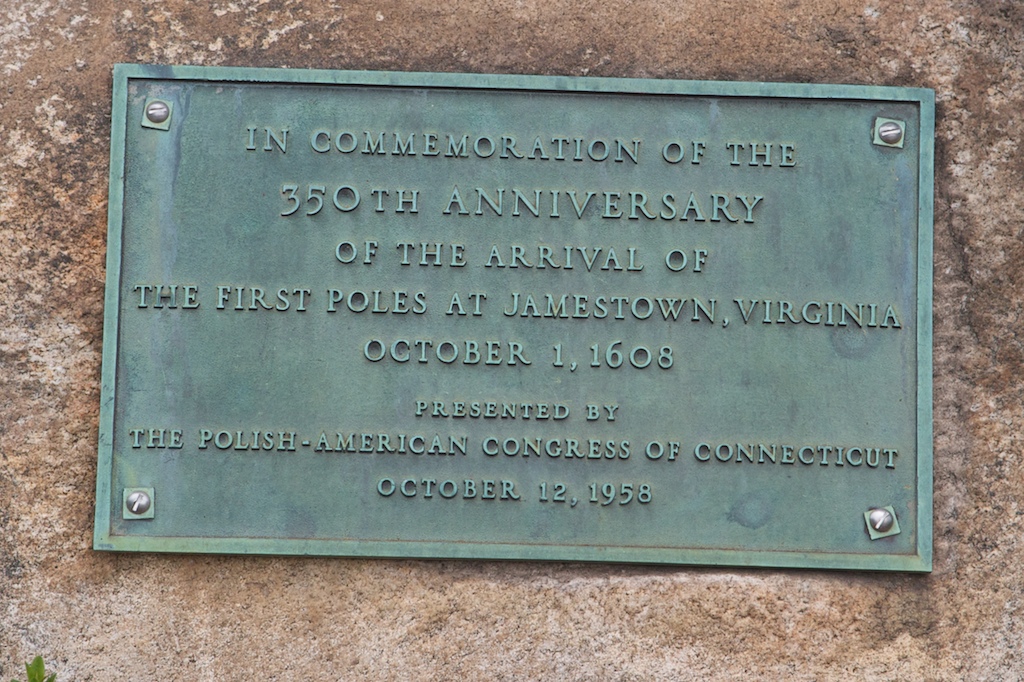
But I have not come to praise Polish cuisine, as distinguished as it is. I have come to help spread the word about the early Polish pioneers who may, nay must, have saved America at its very birth. For on the way out of the hallowed hall, my son noticed this plaque affixed to a rock near the entrance (click to enlarge):

So, on October 1st of this year, as the Google confirms, we will be celebrating the 400th anniversary of the settling of North America by the People of Poland, who apparently were accompanied by some people from England. According to some, it was the Poles alone who saved the hapless English at Jamestown, thereby saving the colony, and by extension, all of America. From a Book review of the seminal work, Jamestown True Heroes, by Arthur L. Waldo:

In “Jamestown True Heroes,” Waldo expands on the information he first presented in “First Poles…” The book is over 250 pages and contains a wealth of photos and illustrations. Much of the information that’s presented is based upon the lost Memorialum Commercatoris manuscript, supposedly written by Zbigniew Stefanski, alleged to be one of the Jamestown Poles. According to Waldo, an individual offered to sell the privately published manuscript to the Polish Museum of Chicago, where he was able to view it. We’re told the deal ultimately fell through and the mysterious manuscript was withdrawn, never to be seen again.

It would seem from the previous comments of Karen Majewski to this forum that professional Polish American historians doubt the veracity of the missing manuscript.

The names and backgrounds of the Jamestown Poles, their experiences as glassmakers, homebuilders, and well-diggers are documented in the manuscript along with an account of the Poles saving Smith from an Indian attack! The reader is told that the Jamestown colony had
absolutely no chance of survival if not for these five(?) talented and virtuous Poles. Waldo makes the correlation that, since the Poles saved Jamestown, and without Jamestown, there would have been no Plymouth, the Poles are responsible for the existence of America!

I haven’t witnessed such a degree of unabashed ethnic pride since watching Michael Constantine play Papa Gus in “My Big, Fat, Greek Wedding.”

It seems to me that the snark is uncalled for as is the skepticism of the “professionals”. Why should we doubt the existence of the Memorialum Commercatoris manuscript, in this, the age of the da Vinci code? Hey, if the Mormons are allowed to believe in the entire Book of Mormon, disappearing tablets and all, we Poles have every right to believe in the Memorialum, and consequently our primary role in saving the fledgling Jamestown colony. Waldo’s entire story just reeks of truthiness.

And how were we repaid for our heroic behavior on behalf of our incompetent Anglo-Saxon cousins? It appears that we Poles were subjected to the first documented voter suppression tactics in America, perhaps in history. That’s right, some 17th century Karl Rove tried to deprive us of our vote, but then, as opposed to now, truth and justice prevailed, at least for the Poles:

In 1619 the colonists were preparing to elect members of the new Virginia assembly. The governor announced that only men of English origin would be allowed to vote. The Poles responded to this announcement by laying down their tools. “No vote, no work” they announced.

This caused consternation and the court record of the Virginia Company for July 12, 1619, states: “Upon some dispute of the Polonians in Virginia, it was now agreed…they shall be enfranchised and made as free as any inhabitant there whatsoever.”

So, not only were we the first victims of voter suppression in the New World, we also organized the first strike. Apparently, the Poles were brought along in the first place because they had skills the adventuring English did not, so their work boycott was no empty threat. The above, by the way, is culled from sources other than the unjustly maligned Memorialum Commercatoris, sources that persons other than Mr. Waldo may access.

The Poles were granted equal rights, and they were allowed to vote, in the same year in which the first imported laborers from Africa were setting foot in Virginia. They unfortunately, didn’t have the leverage the Poles had, and they could not lay down their tools.

But that is another, sadder story. I write today to celebrate our Polish forefathers, few in number but huge in influence. Preservers of our first colony. The first Americans to fight for equal rights. All that, and Golumpkis too.

Time of War

Recently the Supreme Court ruled, by the slimmest of margins, that prisoners at Guantanamo have the right to file habeas corpus actions challenging their incarcerations. In today’s Times, Jonathan Mahler, writes that in doing so the Supreme Court has bucked precedent:

“The most important thing we do is not doing,” Justice Louis D. Brandeis once said of the Supreme Court’s abiding humility, its overwhelming preference to allow the people, through their elected representatives, to govern themselves.

And never is the court more reluctant to act than when faced with a challenge to the president during wartime. Consider the historical record.

The court has ruled against a president in a time of armed conflict no more than a handful of times, most famously in Youngstown Sheet and Tube v. Sawyer, when it held that Harry S. Truman lacked the constitutional authority to seize the nation’s steel mills to avert a strike during the Korean War. The invocation of two words — military necessity — by a commander in chief was usually all it took to silence a majority of the justices.

So it is extraordinary that during the Bush administration’s seven years, nearly all of them a time of war that began on Sept. 11, 2001, the court has been prompted to push back four times. Last week’s decision in Boumediene v. Bush, in which the court ruled that prisoners at Guantánamo Bay have a right to challenge their detentions in the federal courts, marks only the most recent rebuke.

I would suggest that the five remaining more or less rational justices recognize something that Mahler does not: that we are not in a “time of war”, or that if we are, it has become a permanent state of war, therefore different in kind than previous wars in which there were, for instance, identifiable enemies and objective criteria by which to judge whether the war was over. Bush’s argument boiled down to this: The country is at war, therefore the president has untrammeled power. Whether the court would ever have accepted that is an open question, but there was another, usually unstated corollary. We will, henceforth always be at war, and therefore the president will always have untrammeled power. The question therefore is a stark one: does the Constitution limit the president, and secondarily the Congress, in a time of permanent war? If it doesn’t then the Constitution is a dead letter. Right now its survival depends on the vote of a single justice.