Skip to content

Casting the feature as a bug

The AMA is opposed to a public option in the health care bill. (It has since tried to soften its opposition, but only rhetorically). The AMA agrees with some Republicans, if there is a public option, people might prefer it:

But in comments submitted to the Senate Finance Committee, the American Medical Association said: “The A.M.A. does not believe that creating a public health insurance option for non-disabled individuals under age 65 is the best way to expand health insurance coverage and lower costs. The introduction of a new public plan threatens to restrict patient choice by driving out private insurers, which currently provide coverage for nearly 70 percent of Americans.”

If private insurers are pushed out of the market, the group said, “the corresponding surge in public plan participation would likely lead to an explosion of costs that would need to be absorbed by taxpayers.”

One of the arguments I’ve never understood against public health plans is the one contained in the second quoted paragraph. The last time I checked the taxpayers were already absorbing exploding health costs. They were and are doing it in their capacity as consumers of health care. Insurance companies act as de facto taxing entities, with the disadvantage that consumers don’t get to vote for their overlords, and corporations demand exorbitant profits, something governments don’t do. Nor do governments tend to spend more than 20% of their budget figuring out ways to deny benefits. Added to the direct premiums we all pay are the indirect premiums they pay through their employer and the costs of expensive ER they absorb in one way or another because the uninsured do, in fact, have half assed but costly health care under the current system.

Most people (excluding doctrinaire right wingers) don’t really care where their health care dollars go. What they want is to get good health care for the least amount of money. If a government plan can get them there, then that’s what they want. At this point, most people have concluded that a government plan is the most likely route to that end. Judging by the experience everywhere else in the civilized world, they are, no doubt, correct.

By the way, for all those that would argue that Medicare is in financial trouble, recall that it is an insurance program for that slice of the population that requires the most health care. It’s costs are still rising more slowly that those of private health insurers. Medicare for all would no doubt require more money, but it would be more efficient than the system we have today, and overall it would be cheaper.

It is to be hoped that the public option passes, and that the dire predictions of the AMA and the Republicans are realized: that it drives the inefficient, deny-at-all-costs private companies out of the business. Then we can have decent health care at reasonable cost for everyone. In the final analysis, there are certain goods and services that are so vital that no private company can be given the right to control their distribution. Everyone is comfortable with the concept of public water companies, for instance. Here in Groton we have a public utility, that delivers electricity, cable and internet cheaper than its private competitors. A good argument can be made that in this day and age, all three of those commodities are so vital that government should be at least a player, to keep the corporations close to honest. We have seen the result of leaving health care to the corporations. We spend huge amounts of money for a horrible health care system, though we are constantly propagandized with the baseless claim that we have the best health care in the world.


Tweet, Tweet, Tweet

The Republicans appear to be dominating the political part of the world of Twitter. This was a self conscious strategy; having been thoroughly trounced in the blogosphere, they were not going to let themselves get beat again. So we get to read about Charles Grassley’s inane non-sequiturs, Gingrich’s fact free claims of Sotomayor’s alleged racism, or McCain’s rants about earmarks.

Whether by accident or design, Twitter is the perfect medium for Republicans. Given the character limit per tweet it doesn’t only encourage, it demands superficial thinking. Thus McCain, Newt, Grassley, et. al., can send a tweet to their media friends, who will dutifully pass it on, unanalyzed, to the public.

McCain, for instance, can tweet about earmarkswithout having to address the merits of the earmarks he attacks, or come to terms with the fact that the spending he attacks is such a small sliver of the federal budget that eliminating all earmarks, as he suggests, would make virtually no difference to the budget. It’s sufficient that the earmarks attacked sound funny, or can be made to sound funny by some creative misrepresentation.

In the political realm Twitter is as close as the Internet comes to talk radio. Thought free repetition of talking points, simplistic slogans about complex issues, mindless reinforcement of preconceived notions, all with no need to ever defend your position with facts and logical arguments. It’s the perfect environment for Republicans.


Madoff investors cry foul

I have a certain amount of sympathy for the Madoff victims, but I’m not sure it extends to giving them an AIG sized bailout. According to the Times ( “Victims of Madoff Seek Claims Overhaul“):

In a step that would substantially increase the price tag for Bernard L. Madoff’s long-running Ponzi scheme, lawyers for a group of his victims are asking a federal bankruptcy judge to reject the way their losses in the fraud are being calculated.

The customers say that, by law, they should be given credit for the full value of the securities shown on the last account statements they received before Mr. Madoff’s arrest in mid-December, even though they were bogus and none of the trades were ever made. According to court filings, those account balances add up to more than $64 billion.

Apparently, if the money the court appointed trustee recovers from Madoff is not sufficient to cover the losses, we taxpayers will be making up the difference (once the money in the Securities Investor Protection Corporation runs out). In some cases, Madoff simply padded his favored customer’s statements, giving them a greater benefit from the fraud than others. The victims argument would have the effect of making the government guarantee not just the losses, but the promises of the fraudster themselves.

It so happens that I was involved in litigation involving a Ponzi scheme some years ago, albeit a much cruder variant than Madoff practiced. Let us call the Ponzi practitioner “J.S.” J.S. took money from his investors and gave them back promissory notes payable in 6 months at 12% annual interest. That’s not so outrageous, except he also promised them substantial weekly payments in addition to the interest (with no reduction in principal) during the life of the loan. The effective rate of return was on the order of a couple of hundred percent or more.

Okay, I agree, anyone should have realized it was a scam. Yet in fact, when all is said and done, I’d say the mix of honest dupes, semi-honest dupes, and “investors” who figured they’d make out well before the house of cards fell down was probably pretty close to the like percentage in the Madoff case.

I got involved when some investors came to me when J.S. stopped paying. I couldn’t interest the Norwich police, who said it was a civil matter. (Eventually the feds thought differently, and J.S. did time). I told my clients we could sue in civil court, but I was sure we would never recover a dime.

Then, a miracle happened.

J.S. won 9 million dollars in the Massachusetts lottery. We saw his smiling face on the front page of the New London Day, and within weeks Mark Block and I brought him into involuntary bankruptcy, and a trustee was appointed (for some reason the Judge wasn’t willing to let J.S. run his own affairs in a Chapter 11), the winning lottery ticket (which paid off over a term of years) was sold, and the “investors” were paid.

They were paid in pretty much the same manner as the Madoff trustee proposes paying the Madoff victims. They were paid a percentage of the difference between the amount they invested and the amount of payments they received from J.S. It would have been laughable to insist that the weekly payments not be considered in determining the amount due, even though, according to J.S., those payments didn’t reduce the principal amount of the debt at all. People who got in early would have been advantaged over latecomers, for no particular reason.

Now there are differences between the two cases. As I say, J.S. was rather crude compared to Madoff, and his victims were definitely middle class, not the affluent types that Madoff targeted. Still, when it comes to determining a fair way to determine losses, its hard to beat the way we did it, or the way the trustee proposes in the Madoff case. The investors have a right to get their money back, but they don’t have the right to have Madoff’s promises fulfilled, particularly if we the taxpayers have to fulfill them. It’s bad enough we had to pay off on AIG’s credit default swaps, we should certainly not have to guarantee performance of a Ponzi scheme. (Okay, maybe credit default swaps are a lot like Ponzi schemes, but you know what I mean).


Peonies

Stuck at home today, as my bicycle is in the hospital. The first 10 speed I ever bought cost me $100.00. Over the years they’ve grown increasingly complex and expensive. The gear levers on my current bike, which are integrated somehow with the brake lever, simply stopped functioning. I don’t even know how they work, so I can’t fix them myself, and the bike shop opines that they need replacement. They’re going to cost half again what that first bike cost.

So, anyway, to further document the passing seasons, here’s the lone (so far) peony blooming in our front yard.

I am advised that peonies and ants have a symbiotic relationship. The blooms won’t open without the ant; I’m not sure what the ant gets out of his labor. Maybe just the joy or working, given the ant’s peculiar personality. You can see one in this close-up, if you look real hard.


Shocking news from New London

According to the Day, New London’s new police chief, Margaret Ackley, has promised a “no-nonsense, positive approach” to her job.

I was shocked to hear about it. It seems to me that the all-nonsense negative approach has not been given a fair trial.

Yes, there are some who might say that New London has been using that approach for years, but the fact is that at best New London has taken a mostly nonsense, mostly negative approach.

Ask any Republican (if you can find one) what went wrong in the past eight years and he’ll (they are just about all white males these days) tell you that George Bush wasn’t conservative enough. Why, they’re even using the “L” word about him, now that he’s gone.

The same goes for New London. Sure, they’ve tried nonsense on occasion. Just ask poor Nathan Hale, whose peripatetic school house is, I believe, once again on the move. But they really haven’t given it a fair chance. Every time someone advocates something truly non-sensical someone comes along and stops it, or at least grafts some sensible provisions into it. And as to negativity, no one will publicly advocate negativity, though in their hearts almost everyone is negative about New London.

But what’s truly shocking about the new chief’s stance is the fact that she sprung it on us only after she was selected for the job. Would anyone have considered her for the job if they had known in advance that she wasn’t going to allow any nonsense at all? Isn’t that a bit rigid on her part? It’s just not the New London way. I join my Republican brothers in demanding that we give nonsense a fair try before abandoning it as a policy. There are still pockets of New London that have not yet been destroyed, and a sound all-nonsense policy should take care of them in a matter of years.


Efficient Markets

Joe Nocera of the New York Times penned an interesting column yesterday about the death of an economic theory called the “efficient market hypothesis”.

You know what the efficient market hypothesis is, don’t you? It’s a theory that grew out of the University of Chicago’s finance department, and long held sway in academic circles, that the stock market can’t be beaten on any consistent basis because all available information is already built into stock prices. The stock market, in other words, is rational.

In the last decade, the efficient market hypothesis, which had been near dogma since the early 1970s, has taken some serious body blows. First came the rise of the behavioral economists, like Richard H. Thaler at the University of Chicago and Robert J. Shiller at Yale, who convincingly showed that mass psychology, herd behavior and the like can have an enormous effect on stock prices — meaning that perhaps the market isn’t quite so efficient after all. Then came a bit more tangible proof: the dot-com bubble, quickly followed by the housing bubble. Quod erat demonstrandum.

This reminds me a bit of the nature-nurture debate. Only a specialist could arrive at any conclusion other than that it’s a bit of both. Similarly, no one but an expert could maintain that the stock market is wholly rational. Anyone with knowledge of history knows that, in the short term, markets can be far from rational. If they were, then bubbles would be impossible, but bubbles have been with us almost as long as there have been tulips in Holland. In the long run, of course (in which time, as Keynes famously observed, we’ll all be dead), prices find their level. As one of Nocera’s sources points out, one of the ironic things about the “efficient market hypothesis” is that for those who accepted it as gospel, it proved to be true. If, on the other hand, one posited that the market was neither efficient or rational in the short term, one could bet against the bubble and beat the market, though of course one needs to be extremely perceptive to do so.

If this were only an academic issue it would be interesting, but not terribly important. After all, regardless of whether nature or nurture is winning the day in academic circles, in the political world we go on assuming that the two are intertwined, and public policy doesn’t suffer much. And it’s not very important that anyone be able to beat the market consistently. But the corollaries to the theory are what has helped bring us low. For if markets are efficient in real time, it follows as the night the day that we should simply let them do their magic, and avoid governmental interference. Which is precisely what we have done for the past too many years.

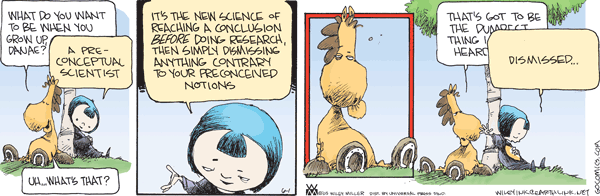
Whenever someone posits a theory that seems to fly in the face of both common sense and historical experience, we must suspect that they are working backwards: starting at a desired point and selectively gathering data to support that point. (See comic below) It’s a little like the creationists that engage in logical contortions to reach their illogical conclusions. In fact, the belief in the wisdom of free markets espoused by so many approaches religious faith in both its fervor and its reliance on faith above reason and experience.

The University of Chicago, from which this theory emanated, has been dominated by conservative economists. The theory supports the anti-regulation, free market ideology of that school, and of the conservative ideology generally. Unlike psychological theory, it has been adopted by people with real power to affect our economy, and we are now living with the results.


Home on the Range

Buffalo grazing at Bison Brook Farm in Preston.


A little weekend music

Last night my wife and I went to Burke’s Tavern in Niantic to hear our fellow Liberal Drinker Atul Shah’s band, Exit 72. I took a video of a song pretty much at random, I’m not really sure what it’s called. The young girl who pops up on the left at random moments is playing with a Wii videogame, bowling I believe. There wasn’t much I could do to keep her off screen.

Anyway, here’s Atul and his band.


Friday Night Music-Benny Goodman

This week marked Benny Goodman’s 100th birthday. My wife is a big fan of Goodman’s, dating from her days as a clarinetist for the Oberlin High Marching Band. Here he is with Teddy Wilson, Tony Terran, Dick Nash, Eddie Duran, Al Obidenski and John Markham at the Aurex Jazz Festival in Japan, playing Sweet Georgia Brown.


Amann’s big issue a bust

Speaking of tax breaks (see previous post), it looks like (who would have guessed) that one of Jim Amann’s talking points doesn’t bear close examination. The last time I saw our hapless (or is that hopeless) here, he was bragging about this efforts to make Connecticut Hollywood East. Apparently, he’s merely helped make Connecticut another Hollywood Sucker:

Many states that are cutting spending on schools, roads and other basics have been lavishing hundreds of millions of dollars in incentives on Hollywood studios to lure TV and movie productions — this, despite scant evidence that taxpayers come out ahead on such deals.

Connecticut’s revenue department, for example, found in 2007 that every dollar in tax credits generated only 20 cents in new tax revenue. Connecticut gave away an estimated $70 million in tax revenue that year.

“The credit does not ‘pay for itself,'” Jennifer Weiner, a policy analyst for the New England Public Policy Center at the Federal Reserve Bank of Boston, wrote in a January report about Connecticut’s incentives. “Increases in economic activity spurred by the film credit generate some additional tax revenue for the state from a variety of sources. This additional revenue is likely to offset some, but not all, of the initial cost of the credit.”

The article also points out that, contrary to Amann’s claims, the in-state jobs created are short lived and not all that lucrative.

It also appears that we have plenty of competition in the race to be Hollywood East, North or South. The studios have played one state against another, creating the typical race to the bottom that is an inevitable by-product of the tax abatement economic growth strategy.