Skip to content

Big Brother wants to protect us

It’s probably fair to assume that Orwell was hoping his predictions would be wrong, but probably not like this. Even he could not envision the extent to which Big Brother would be watching out for we little brothers and sisters. How could he, as he had no conception of the type of technology that would be available to those who wish only to protect us.

In order to serve us better (and we all know what’s coming after that phrase), our guardians on both sides of the Atlantic are making sure they do everything they can to make sure that they can warn us should we ever come close to transgressing. Or, maybe they just like to watch.

Here in America, as the Times reports, police departments all over the country know when we’ve been sleeping and know when we’re awake:

Law enforcement tracking of cellphones, once the province mainly of federal agents, has become a powerful and widely used surveillance tool for local police officials, with hundreds of departments, large and small, often using it aggressively with little or no court oversight, documents show.

The practice has become big business for cellphone companies, too, with a handful of carriers marketing a catalog of “surveillance fees” to police departments to determine a suspect’s location, trace phone calls and texts or provide other services. Some departments log dozens of traces a month for both emergencies and routine investigations.

With cellphones ubiquitous, the police call phone tracing a valuable weapon in emergencies like child abductions and suicide calls and investigations in drug cases and murders. One police training manual describes cellphones as “the virtual biographer of our daily activities,” providing a hunting ground for learning contacts and travels.

But the Brits have got (or will get?) our local cops, if not the FBI, beat by a country mile, perhaps fitting given we’re talking about Orwell’s homeland:

The government will be able to monitor the calls, emails, texts and website visits of everyone in the UK under new legislation set to be announced soon.

Internet firms will be required to give intelligence agency GCHQ access to communications on demand, in real time.

The Home Office says the move is key to tackling crime and terrorism, but civil liberties groups have criticised it.

Attempts by the last Labour government to take similar steps failed after huge opposition, including from the Tories.

A new law – which may be announced in the forthcoming Queen’s Speech in May – would not allow GCHQ to access the content of emails, calls or messages without a warrant.

But it would enable intelligence officers to identify who an individual or group is in contact with, how often and for how long.

Well, then, that’s alright. I don’t mind if the government knows where I am every second, who I’m talking or writing to, and what websites I’m visiting, as long as it doesn’t know precisely what I’m saying, unless, of course, if feels it needs to know.

Getting back to these shores, this all makes me think about the very malleable doctrine of original intent, used by our right wing judges to impose their legal philosophy (if it can be dignified by that term) onto a distracted nation, for according to the Times, it is hard to say if this government snooping is unconstitutional. We now know that the government may not attach a physical device to our cars to track our movements, but who can say whether it can do precisely the same thing by tracking our cell phones. After all, you don’t have to have a cell phone. You know, buyer beware and all that.

But isn’t it odd. The original intent doctrine essentially amounts to a belief on the part of judges that they can know precisely what the sainted founders would think of an issue. So apparently we now know that Jemmie Madison, who appears to have been a fairly rational guy, judging by his writings, would, after being fully briefed on the history of the last two hundred and 30 odd years, disapprove of requiring people who can afford health insurance to buy it. On the other hand, we can’t say with certainty whether Madison, who himself corresponded in code, would have had a problem with the government keeping track of the identity of his correspondents, the places he went, and the materials he read.
 

Curveball admits he threw a curve

What a surprise:

A man whose lies helped to make the case for invading Iraq – starting a nine-year war costing more than 100,000 lives and hundreds of billions of pounds – will come clean in his first British television interview tomorrow.


“Curveball”, the Iraqi defector who fabricated claims about Iraq’s weapons of mass destruction, smiles as he confirms how he made the whole thing up. It was a confidence trick that changed the course of history, with Rafid Ahmed Alwan al-Janabi’s lies used to justify the Iraq war.

Time to raise the minimum wage

I’ve been asked to say a few words about the struggle in our own state to raise the minimum wage. Much of the information I’m passing along was provided in an email I got from the Progressive Change Campaign Committee, which is hosting a website where you can sign a petition in support of Chris Donovan’s proposal to raise the minimum wage to $9.75 an hour.

Many years ago I worked for near the minimum wage when I worked as a lifeguard for the City of Hartford. I think the minimum wage was around $1.50 then, and I would venture that $1.50 was worth a lot more than the $9.75 that’s under consideration. Back then the price of gas was around 32 cents a gallon. It is now about twelve times higher, so by that benchmark, at least, the minimum wage should be close to $18.00 now. But, back then, other than the Vietnam disaster, the country was relatively sanely run.

As usual, politicians fear to go where the public would gladly tread, at least according to Progressive Change’s press release:

According to our polling, Speaker Donovan’s original proposal to raise the minimum wage to $9.75/hr is supported by 64% of likely voters in Connecticut.

Nearly 2/3 of those who support increasing the minimum wage to $9.75 do so strongly — 41% strongly support and 23% somewhat support a $9.75 increase.86% of Democrats, 54% of Independents, and nearly half of Republicans (46%) support Speaker Donovan’s $9.75 proposal

When given the option of increasing the minimum wage to Donovan’s $9.75 rate, higher than $9.75, lower than $9.75, or not at all, 54% of Connecticut likely voters want $9.75 or higher. Only 14% support an increase to less than $9.75 — nearly a 4 to 1 advantage for $9.75 or higher.

This means the $9.25 approved by the CT House Labor committee is much less popular that Donovan’s $9.75 proposal.

The polling questions, which are contained in the full press release appear to be straightforward and not misleading. They were reproduced in the press release I got, for which, unfortunately, I can’t find a link. It’s too lengthy to replicate here, so you’ll have to take my word.

Perhaps the most important part of the proposal is the provision that the minimum wage would increase with the cost of living. That does away with legislative battles and endless debates about the endlessly discredited Republican arguments against the very concept of the minimum wage.

We in Connecticut can be proud of the fact that our legislature is considering a bill that would actually help people presently living at the margins, while so many states, under Republican sway, are busily grinding the poor and middle class so they can divert more money toward the .1%.


Friday Night Music

There’s always a silver lining of some sort in almost any situation. The Trayvon Martin killing, despite the racism we’re hearing from the right, is no exception. At least from what I can see the reaction from the country as a whole has been remarkably post racial. In the old days a killing like this would have stirred outrage in the black community, but rather muted reaction from whites. This time, the folks donning hoodies come in every hue. That’s progress of a sort.

!

Yet more of the comic side of Mitt Romney

As he says, it’s funny because it’s true.

Redefining the Christian brand

Ed Kilgore at the Washington Monthly points out that the right has successfully co-opted the term “Christian” to the point where the press and many corporations use the term to refer exclusively to the subset of Christians who are totally out of their minds.

This is yet another example of the right’s successful abuse of the language, which Orwell predicted, and the right has now perfected. Too many people have accepted the use of terminology such as “pro-life”, for anti-abortion but anti-all other life, “values voters”, for bigots, etc.

There may be a silver lining to the fact that the crazies have stolen the “Christian” brand name. It may help swell the growing group of people who describe themselves as having no religion, a trend that, if we can only speed it along. People who have no religion, we can safely say, are more open to things like science and reason. Given the problems confronting us, it might be a good thing to have more people like that around.

Romney: I won’t tell you what I’ll do, cause you wouldn’t like it

One way to avoid the need to shake your Etch-A-Sketch is to not sketch anything in the first place. Apparently, a sketch free campaign, at least on certain issues, is what Romney has in mind. As he explained to the Weekly Standard, in so many words, if he sketched out his plans, he’d lose. Poor Willard has these occasional moments of near honesty that he simply can’t seem to avoid.

This , of course, is par for the course for Republican candidates. It’s not that Democrats always flesh out their ideas, it’s that Republicans never do, except for the Ron Pauls of the world, who have either no chance or no desire to win. For Republicans, it’s a matter of survival. If they tell people what they intend to do, as Romney implies, people won’t vote for them. They have thus evolved into masters of evasion, adept at promising popular generalities, but avoiding unpopular details. We Americans fervently believe in free lunches, and Republicans are good at promising them. The reality, when Republicans deliver, never quite measures up to the promise.

Witness Paul Ryan, who is delighted to be quite specific about the taxes he’ll cut, but grows evasive about the loopholes he promises to close to make up for the lost revenues. In fact, he intends to close only such loopholes as might be of some benefit to the middle class and the poor, and borrow the rest of the money needed to make up the difference. That wouldn’t go down so well, so like Romney he isn’t going to sketch it out, and he surely isn’t going to etch it.

Paul Krugman says that the media is not fawning over Ryan this time; that they are actually aware that his numbers don’t add up. I hope that’s true, but if so, wouldn’t it make sense for a David Gregory, for instance, to actually pin Ryan down? When he refuses to detail the loopholes, point out the failure and ask him again. When he fails again, do it again. Don’t accept that it’s “fair enough” when a politician refuses to answer a question on which the fate of millions might hinge. Maybe he won’t come back on your show, but the world would be a better place for that. Americans may be all too willing to buy a pig in a poke, but it remains the job of the media to open the poke and look inside.

Facebook threatens, but likely bluffing

Facebook, it is reported, has threatened to sue employers that demand access to the usernames and passwords of employees or potential employees.

Facebook would certainly have the financial wherewithal to intimidate smaller employees, but I would love to know, absent legislation, the nature of the legal theory on which they propose to rely. One suspects, from the language used in their announcement, that they realize their case would be weak:

“Facebook takes your privacy seriously. We’ll take action to protect the privacy and security of our users, whether by engaging policymakers or, where appropriate, by initiating legal action, including by shutting down applications that abuse their privileges.”

When lawyers threaten to take “appropriate” action, they are often hedging, as ofttimes the only appropriate thing to do is nothing. There may be some legal theory they can hang their hat on, but I question whether Facebook itself would even have standing to sue, and if it can’t come up with a claim to assert on its own behalf, it will need to fund a suit by an aggrieved worker, and good luck with that.

The sad fact is that at common law workers have virtually no rights. What rights they have are creatures of statutes. This particular privacy issue is unique to our times, so there are no statutes that specifically address it, and my guess is, few that can be tortured to do so. (I am putting the ever smaller unionized work force to the side, of course.) Blumenthal’s attempt to address it in Congress will probably go nowhere, given the anti-worker attitude of the Republicans, who effectively control both houses. Progress in most states seems unlikely, since workers are having trouble holding onto what were once considered fairly basic statutory rights. So don’t look for much progress on this on the legal front, as employers are operating in a buyer’s market, and if an applicant is not willing to debase him or herself for a job, the employer can go to the next person in line, who likely will.

It’s something we could do here in Connecticut, however. Were I in the Connecticut legislature I’d be quick to jump on it. The CBIA might not like it, but in reality it’s not the kind of thing likely to drive business elsewhere, but it would be popular, especially with young voters.

First they take Tom Paine, now it’s John Locke

A right wing blogger at the John Locke Foundation made a bit of news this week by posting a racist picture of Obama. I’m not writing about the racism, which is a bit like reporting the proverbial dog bites man (though, it would appear dogs bite men much less frequently than right wingers utter racial slurs). Besides, we are being trained to understand that it is impolite to notice racism, as it is unseemly political correctness and an insult to people who are just expressing their opinions, to which all of us are entitled, and about which right wingers must not be criticized.

No, I write not to condemn the racist, but to speak on behalf of poor John Locke, who, being dead these many years cannot defend himself nor assert rights over the use of his name. Anyone can commandeer it, for whatever purpose they choose. The right has a tendency to appropriate to itself, sort of by eminent domain, the names and reputation of the long dead, be it ever so unlikely that the person in question would approve. Witness the Cato Institute. Who knows, maybe if poor Cato was transplanted to this place and era, and was allowed to acclimate himself, he would become a uber-libertarian, though one suspects the acclimatization process would have to involve handing him huge sums of money to get him in the proper frame of mind. But I confess, I can’t speak with any authority on Cato. Being more familiar with Tom Paine and Martin Luther King I can say with confidence that their attempts to appropriate those notables would be actionable, were not the victims already dead.

As to poor John Locke, again, were he transplanted to this era, and properly cultivated, he might twist his philosophy into support for corporate oligarchs in line with the right wing funded institute that now bears his name. But certain things must give us pause. He was the philosopher that laid the intellectual groundwork for our own revolution, which was never, at least expressly, about preserving the rights of the ruling class. I haven’t read the Second Treatise on Government for a long time, but my recollection is that there was some stuff in there about property rights that don’t line up with right wing thinking. And who can say, in this time of purchased privilege, that this Lockean prescription to the legislature is in favor with the right?

They are to govern by promulgated established laws, not to be varied in particular cases, but to have one rule for rich and poor, for the favourite at court, and the country man at plough.

Perhaps they figure the requirement is satisfied so long as both rich and poor are barred from sleeping under bridges.

But putting politics aside, Locke was instrumental in ushering in the bygone Age of Reason. I realize the idea of using reason while thinking is considered quaint these days, but there’s really not much left of Locke if you take the reason out. If a group seeks to confer an endorsement on itself from a long dead person, they should consider whether he or she, properly brought up to speed (in Locke’s case, educated on the scientific and political events of the last three centuries ) would agree with them. Would Locke, for instance, abandon reason and reject climate science, as does the foundation that bears his name? We can never know, but I’d say the chances are as low as those that a reincarnated Tom Paine would appear on the Glenn Beck show, where, in death, he is so often enlisted to support positions that even Edmund Burke would disown.


Friday Night-No Music

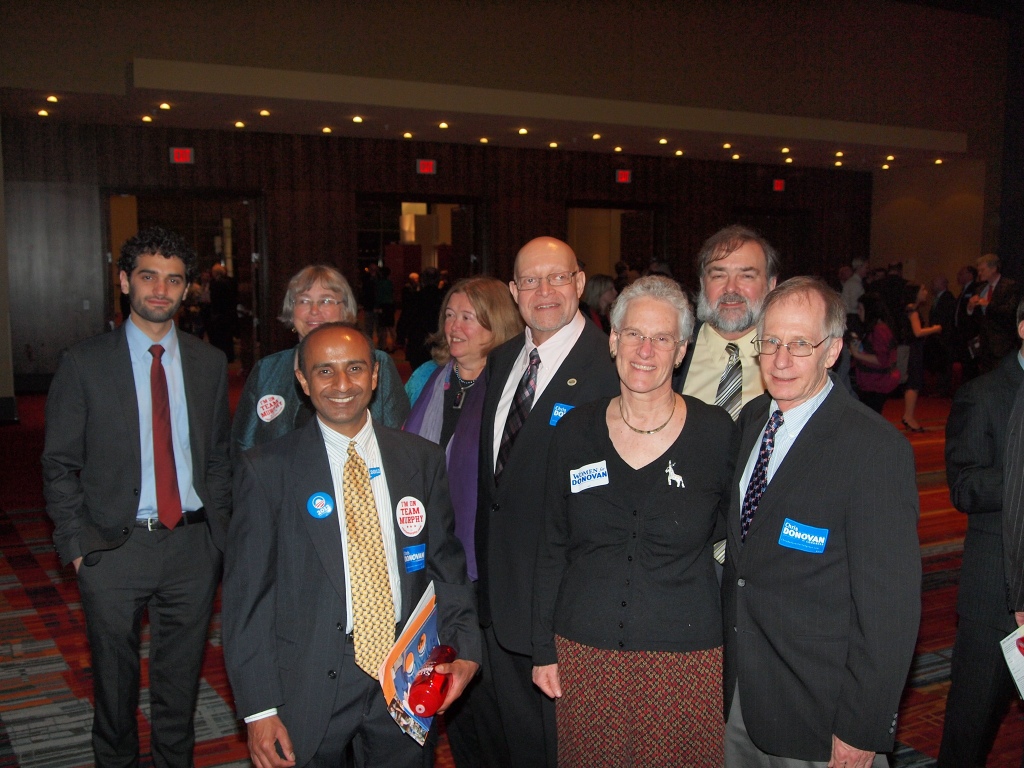
Just got back from the JJB dinner, and my mind is not working well enough to come up with anything worth putting up. Next week all should be back to normal.


Instead I’ll content myself with putting up a picture of the Drinking Liberally contingent and add that the featured speaker, Maryland governor O’Malley gave a workmanlike speech. If he’s looking toward 2016 he needs to sharpen his skills a bit, but then, there are many of us that remember Bill Clinton’s yawner at the ’88 convention, compared to which what we heard tonight was a barnburner.