Skip to content

Bring on the death panels

The release of Medicare cost information has been debated in the press for a few days. I don't pretend to be an expert, but like everyone else I was shocked by the amount of money some doctors are getting for drugs they are prescribing. Of course, they have their excuses, but it would appear that the law as presently structured gives doctors a perverse incentive to prescribe the most expensive drug available to treat any given condition, along with an incentive to over prescribe the drugs they do prescribe. The best and most concise explanation of the problem that I've seen is here at Mother Jones, penned by Kevin Drum. He uses Lucentis as an example. That's the drug that the top “earner” among the doctors made so much money prescribing. It is a very expensive drug, yet it is no more effective than another drug (Avastin), which is much much cheaper. So why would any doctor prescribe Lucentis? Because the doctors get paid what amounts to a 6% commission on each drug the prescribe.

The backstory here is that Medicare used to set the reimbursement rate for “physician-administered drugs” based on an average wholesale price set by manufacturers. This price was routinely gamed, so Congress switched to reimbursing doctors based on an average sales price formula that's supposed to reflect the actual price physicians pay for the drugs. Then they tacked on an extra 6 percent in order to compensate for storage, handling and other administrative costs.

I don't know if 6 percent is the right number, but the theory here is reasonable. If you have to carry an inventory of expensive drugs, you have to finance that inventory, and the financing cost depends on the value of the inventory. More expensive drugs cost more to finance.

However, this does motivate doctors to prescribe more expensive drugs, a practice that pharmaceutical companies are happy to encourage. I don't know how broadly this is an actual problem, but it certainly is in the case of Avastin vs. Lucentis, where the cost differential is upwards of 100x for two drugs that are equally effective. And the problem here is that Medicare is flatly forbidden from approving certain drugs but not others. As long as Lucentis works, Medicare has to pay for it. That's great news for Genentech, but not so great for the taxpayers footing the bill.

via Mother Jones

Drum suggests paying the doctors a reasonable flat fee for every prescription. That would certainly be helpful, but my own feeling is that we should bring on those death panels, which are, of course, merely intended to curtail unnecessary or ineffective procedures. If a two dollar drug works as well as a two hundred dollar drug, then Medicare should be able to mandate the use of the two dollar drug. Of course the right would scream bloody murder (at the same time as they are voting to end Medicare altogether) , but they always scream bloody murder, and it's time we stopped listening.
We won’t get no education

But we’ll have plenty of thought control

A few months ago I opined that the drift in our educational system (so well documented by Jonathan Pelto at Wait, What?) is toward the corporate model that has transformed the rest of the country. I predicted that we would soon see most of our education dollars going to pay the CEO's of privately run for-profit “education” delivery systems. Once they get their puppet politicians (Here's looking at you, Dannel) to deliver the public school systems into their grasps, the money will really start flowing to the top in earnest. Well, it's already happening:

A study of charter schools by the League of Women Voters in Florida found that they spend more on administration than public schools and they don’t get better academic results.

“In Hillsborough, three charter schools that have opened since 2011 are owned by Charter Schools USA, a for-profit corporation, and these three alone enroll more than 20 percent of all charter students. In 2011, Woodmont Charter School, one of these three, expended 44 percent of its total revenue on instruction and 42 percent on management fees and leases.

“By contrast, traditional Hillsborough County schools spend at least 86 percent of revenue on instruction. Woodmont had FCAT scores of D for 2012 and F for 2013, and this is not unusual, since charter schools composed 50 percent of all F-rated Florida schools in 2011. Meanwhile, the six traditional public elementary schools and one middle school within 1 mile of Woodmont all have higher FCAT scores.

via Diane Ravitch's Blog

Once they get a lock on the educational system they will find various ways of extorting more money from the taxpayer and returning ever less. For remember, unlike School Superintendents, they are licensed to bribe contribute to the people holding the purse strings. How depressing is it that we won't even be able to educate our kids (if you can call what they'll be doing educating) without enriching the next generation of Koch brothers.

Not your Father’s First Amendment

Matt Bevin, owner of a bell factory here in Connecticut is the Tea Party candidate who is softening up Mitch McConnell for November. He has, of course, inserted his foot in a number of his own orifices, his mouth being the least embarrassing. He's currently in a bit of trouble for attending a rally in support of cock fighting. He was defensive for a bit, but then realized that those attacking him were actually attacking the constitution (with Republicans it always turns out that an attack on them is an attack on the Founders), so now he's in counterattack mode:

Kentucky Republican Senate candidate Matt Bevin continued to address his presence at a rally for supporters of legalizing cockfighting by saying America's Founding Fathers were very involved in the cockfighting world too.

“But it's interesting when you look at cockfighting and dogfighting as well,” Bevin said in an interview on the Terry Meiners Show on Louisville's WHAS on Thursday. “This isn't something new, it wasn't invented in Kentucky for example. I mean the Founding Fathers were all many of them very involved in this and always have been [sic.]”

“I'm going to defend the right of people to freely gather and discuss whatever they want to,” Bevin said. “I'm a believer in the Constitution and in the First Amendment,” Bevin also said. “Not just for raising money but also for freedom of speech.”

via Talking Points Memo

I'm sure many have already pointed out that “the Founding Fathers were all many of them involved in slavery and always have been”, which, oddly enough, doesn't make slavery right, though by Bevin's logic, it must. I won't even mention that glaring problem, (or bother to find out whether James Madison really attended cock fights) because it's not what got my attention.

No, what struck me was the last quoted sentence. It now appears that, at least among Republicans, the primary purpose of the First Amendment is to enable them to raise money, with actual “speech” being something of an also ran. How times have changed in just the last 10 years, never mind 30. I can remember a time when corporations weren't people; when the idea that anyone would even argue that a corporation could have a religion was so absurd it would never occur to anyone to discuss it; and it was a given that there was a legitimate interest in limiting the role of big money in politics that overrode any infinitesimal First Amendment concerns anyone could drum up. Now, I admit that I am a geezer, (though relatively newly minted) but even my kids can remember such a time. All it took was a stolen presidential election, and we were able to arrive at the advanced stage of jurisprudence we now enjoy.

Benjamin Franklin warned us. We got a Republic, but we've failed to keep it. It will be a matter of historical interest, I guess, to find out how long we continue to insist that our oligarchy is really a democracy.

How long did the Romans hang on to the notion that the Empire was a Republic? I predict we'll beat their record.

Rural states cry foul

The Boston Globe reports that congress critters from rural states are clamoring to expand an already existing program designed to shift NIH research grants away from deserving populated states (such as the Globe's Massachusetts) to rural states that could not win the grants on their own.

“It’s hard to compete against MIT or Harvard… . They’ve had their share. A lot of state colleges and universities all over the country, from Idaho to Maine, have some ideas too, and I think we should give these people from smaller schools in other states an opportunity,” said Senator Richard Shelby of Alabama, the top Republican on the powerful Senate Appropriations Committee. “It’s time to fix that.”

Shelby is among many members of Congress advocating for the federal government to increase the amount of money set aside in a special program for researchers in 23 largely rural states that traditionally have had a difficult time competing for NIH grants. Backers of increasing the money in that program want to expand the number of states that benefit from it, as well as boost the amount of money by up to 14 percent.

“There’s a battle between merit and egalitarianism,” said Dr. David Page, director of the Whitehead Institute, a prestigious research institution in Cambridge affiliated with MIT. “If the table is tilted, we know the table is going to be tilted away from us. It’s straight out of Robin Hood.”

via The Boston Globe

I personally might be a little more sympathetic toward Shelby's Alabama, but for two things. First, his state, as is true for most rural (particulary rural Southern) states, already receives far more federal money than it pays in. Of course those of us who live in the states that ship money to the South can't complain, because that wouldn't be nice; everyone knows it's okay to mock out New York or Massachusetts, but you can't say an unkind word about the hellhole that is Alabama, or you'll be an elitist. When Senator Shelby starts to advocate equalizing the ration of federal tax payment to federal money received then maybe we can talk about the NIH grants.

The second reason I have so little sympathy for Senator Shelby is this: when it comes to funding scientific research, I'm all for sending my money to states that believe in science. I'm sure there are smart people that are born and even grow up in Alabama, but most of them leave when they get the chance. When they leave, they don't head off to states like, say, South Carolina, where a little girl's dream of having the wooly mammoth named the state fossil is currently foundering on the insistence of a brain dead legislator that the resolution state that the mammoth was “created on the sixth day along with the beasts of the field”. And lets not forget the fact that so many of these states officially deny the fact of climate change. No, our hypothetical smart Alabaman is far more likely to head North to Boston, or some other place where he or she can pursue real science in an environment where brains are appreciated. So, here's hoping that the Senators from the sane states will tell the rural states to stuff it, and I say this even though I have a soft spot in my heart for the state of Maine, even if it keeps sending Susan Collins to the Senate.

Spreading slums throughout the land

We usually consider slums to be an urban phenomenon, with slum dwellings usually consisting of run down apartment buildings. But, thanks to Wall Street and the wonders of securitization, slums may be coming to a previously middle class, single family neighborhood near you:

One of the reasons many investors have been skeptical of the way private equity firms have gone full bore into buying distressed single family homes is that property management is a hands-on business even when it’s done it the most favorable possible setting, an apartment building. Individuals who have invested in single family home rentals almost without exception report that even when they found it to be an economically attractive proposition, it was still oversight-intensive. Admittedly, there are some private equity firms who have bought rental properties who actually do seem to be targeting markets and renters in such a way that they might be able to do a decent job of property management, for instance, by buying homes where they can rehab the kitchen and bath plumbing using the same fixtures, screening tenants in person, and then inspecting the properties monthly and giving the tenants points for passing that they can convert into credits against a purchase or take in cash.

But the biggest fish in this ocean, Blackstone, is clearly taking the opposite approach, of doing as little as they can to maintain the houses and trying to fob off the responsibility onto the tenant, even when local regulations clearly prohibit it. So managing dispersed homes is no problem if you never planned to do the job in the first place.

via Naked Capitalism

The blogger at Naked Capitalism (Yves Smith) is optimistic that local landlord tenant laws will stymie operators like Blackstone, but I'm not so sure, and this is something I actually know something about first hand, having been engaged in landlord-tenant law for many years. Smith's post quotes from the Arizona landlord tenant law that is much like Connecticut's. Our laws require that the landlord perform all repairs, but makes a limited exception in the case of single family homes. There's qualifying language. The clear intent is to allow the parties to agree that the tenant will do certain things (such as mow the lawn) or that the tenant will do other repairs (presumably in exchanged for a reduced rent). These types of arrangements can work if both parties are reasonable, but, clearly, Blackstone and its ilk will try to stretch these somewhat vague provisions beyond recognition, and they may very well be able to do so more often than not. If a tenant balks at doing the repairs they may or may not get help from local building departments, and if they withhold rent they will almost certainly end up being evicted and replaced by another tenant. Even when tenants “know their rights” there are institutional barriers to actually getting those rights vindicated, among them the fact that tenants hardly ever have access to lawyers.

The states should take a proactive approach to this, by taking a long look at their statutes and amending them to prevent abuse before it happens. There are a number of approaches you could take. One possibility is to change the law as it applies to anyone owning three or more one family rental dwellings to clearly limit the work that can be fobbed off on the tenant. Another approach is the Truth in Lending approach. That statute contains what was often referred to as a private attorney general provision. A consumer with an offending contract could bring suit against a bank and collect statutory damages (no need to prove actual damages; the amount of damages is set by the statute) plus attorneys fees for establishing a failure to disclose in accordance with the act. For several years after the act was passed many lawyers made a living out of bringing such cases, until the banks cleaned up their acts. You could take the same approach with leases. Require them to contain certain clauses, and forbid other clauses. Give tenants a private right of action with statutory damages upon proof of violation, along with attorneys fees, and let the fun begin. If the states (obviously we'll get nothing from Congress) are a little proactive, they may prevent those slums from spreading.

Make it simple

The explanations for things are often not simple, though our politicians of a red hue often claim that they are. On the other hand, it is often the case that the best remedy for stuff that ails us is the simplest solution, a fact which politicians of both parties seem to do their best to ignore. Witness the Dodd Frank bill, which, in various half ass, complicated and confusing ways, attempts (or claims to attempt) to achieve the same result as the comparatively simple Glass-Steagall act in fact achieved for over forty years. While there are some voices crying in the wilderness, no one seriously believes we will reenact the Glass-Steagall act, precisely, one suspects, because everyone knows it would work, and that would displease the people who count.

For reasons probably related to the will of God, or some such thing, I have run across many references to simplicity today. In each , we are reminded that we live in a country that is averse to simple solutions, while being totally enthralled with simplistic explanations.

First on the list is Dean Baker's post, in which he again points out that we could seriously limit the activities of what have now been christened Flash Boys (insider traders by any other name) very simply:

There are many complicated ways to try to address this problem, but there is one simple method that would virtually destroy the practice. A modest tax on financial transactions would make this sort of rapid trading unprofitable since it depends on extremely small margins.

He then points out that this simple solution is unlikely to be adopted for the simple reason that it would work.

Here, we have Paul Krugman explaining why we couldn't get a simple solution to our health care mess:

I’ve always thought of Obamacare as a sort of Rube Goldberg device that awkwardly simulates the results of a single-payer system. It’s run through private insurance companies in part to buy off the industry, in part to let most people with good insurance keep it. It relies on a mandate plus subsidies, rather than full funding via the tax system, in part to keep down the headline spending number. And so on. The resulting system isn’t what anyone would design from scratch; it was, however, probably the only kind of system we could get.

via Paul Krugman's Blog

So here you have the supreme irony. We cannot enact simple solutions to complex problems because we are a nation of simpletons.

Sidenote: Krugman's reference to buying off the insurance companies reminds me that what is often referred to by economists as “rent-seeking” (which is what the insurance companies did during the health care debate) is simply a “tax” by another name. It would be interesting to know if the amount by which taxes have been reduced (mostly on the rich) in the last thirty years or so, has been more than offset by economic rents (which mainly affect the rest of us) pushed through Congress, in which case one could cogently argue that the Republicans have raised taxes more than the Democrats ever did, the difference being that the general public has gotten no benefit from these tax equivalents. I would pursue this in more depth, however, I just opened a 32 ounce growler from our local Beer'd brewery; my wife has refused to drink her share, and I am therefore somewhat incapacitated for further research. Still and all, a question worth pursuing.

The right finally gets the joke

Apparently whoever tweets for the Stephen Colbert show screwed up, and sent out a racially offensive tweet, for which act many on the right (e.g., Michelle Malkin) are demanding that his show be cancelled.

This can mean only one thing. They must have finally figured out that Stephen is not an actual narrow minded conservative bigot, (as they originally believed) but only plays one on television. Otherwise they'd be defending him on free speech grounds.

Stick a fork in him

(As Lou Reed would have said, we're he still with us, “he's done”.)

If Chris Christie still has thoughts of becoming president he should, perhaps, think twice after the reception his “investigation” into himself has gotten from the media. See the headlines collected here. Before Christie's fall from grace there was a widespread meme to the effect that he was a media darling, but you have to wonder whether his popularity was confined to the circle jerkers in the Beltway, and that the media frontliners may have had a different view. After all, they saw what an asshole he is on a daily basis.

There is a downside to Christie's demise, and believe me, he is dead. We non Beltway pundits are at a loss. Ask me who I think the next Republican candidate will be and all I can say is that it has to be someone, because they will, no doubt, hold a convention, and someone has to win it. But right now, there is not a single potential candidate on the horizon that even knows how to – Romney-like- pretend that he's sane. We have come to a bizarre place when Rand Paul, of all people, looks to have a chance to get the nomination.

Alas, we Democrats have problems of our own, facing as we do the dismal prospect of a Clinton coronation. No good will come of four to eight more years of a Wall Street friendly Democratic administration. It may very well be that a nation “conceived in liberty and dedicated to the proposition that all men are created equal” cannot “long endure”. The prospects don't look good, and the fact that Christie will not be the one leading us toward oligarchy is cold comfort indeed.

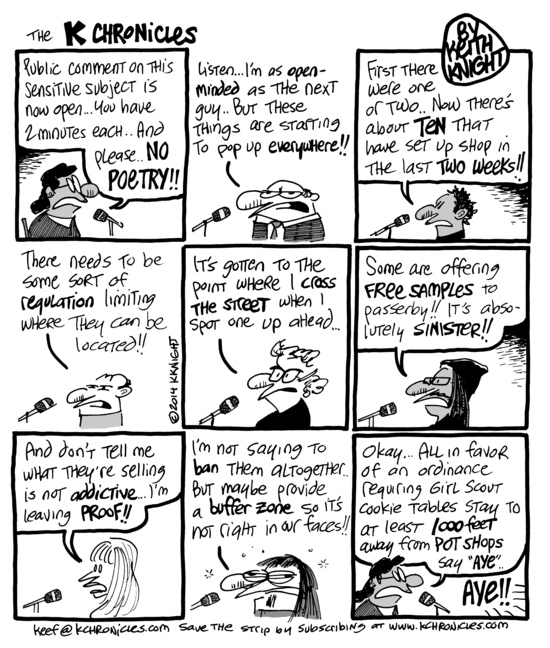
God **** the pusher girl

(With apologies to Steppenwolf)

I briefly noted this phenomenon a few weeks ago. I couldn't resist passing this along, culled from Daily Kos.


Another story from the world of organized crime

In this morning's Times, Jesse Eisinger documents yet more criminal activity on the part of Goldman Sachs. Perhaps I should amend that and say it is activity that should be criminal, if it's not already. It is an opaque deal which, even upon full explication is sort of hard to follow, but as I understand it, the gist is that Goldman took a company private and engaged in financial deals with itself (operating under various guises), the effect of which was to drive down the value of the preferred stock in the company, enabling Goldman to, in effect, get control of that stock at bargain prices, thus cheating the shareholders to whom, in at least one of its guises, it owed a fiduciary duty. The challenge is to count the number of conflicts of interest that Goldman had.

Eisinger ends like this:

When deals like this go down, I feel like we are nation of Jake Gitteses, watching big bank deals with incomprehension. In “Chinatown,” the private detective asks the wealthy baron Noah Cross: “Why are you doing it? How much better can you eat? What could you buy that you can’t already afford?”

Well, I can answer that question, with yet another repetition of a quote from a different movie, Superman 3 in which the capitalist villain played by Robert Vaughan explains it as follows: “It is not enough that I succeed, everyone else must fail”.

Sidenote: It occurs to me that this story illustrates the relative political and economic impotence of the bottom .99 of the top 1%, many of whom must be among the investors porked by Goldman Sachs.