Skip to content

Two and a half cheers for Obama

Regular readers (should they exist) will recall that I have been urging the Democrats to stand for something other than being the party that is not crazy (which, oddly enough, is not a compelling selling point in this country). In particular, I've urged forgiveness of student loans and free college tuition in public institutions. So, you can imagine I'm quite pleased that Obama has taken up the call:

Introducing his proposal here on Friday, Mr. Obama vowed to make college affordable for all Americans by investing $60 billion over the next 10 years to provide free community college tuition to as many as nine million students a year across the country. If Congress and the states adopted his plan, the president said, “two years of college will become as free and universal as high school is today.”

Via The New York Times

Obama loses half a cheer for confining his proposal to community colleges. I suppose this is strategic; his firmly held belief that he should always propose what he feels he will get after negotiations are over, but that makes little sense here for two reasons. First, it is a nonsensical way of bargaining, which has been proven repeatedly during his tenure. More importantly, he must be aware that nothing he proposes will pass this Congress, unless it is something like the TPP, designed to screw average Americans. Given that reality, he should recognize that this proposal is a PR move, designed to stake out positions that he can sell to the American people as the Democratic alternative to the Republican mix of theocracy and oligarchy. Given that reality, why propose giving people half a loaf, when you can propose giving them a full loaf just as easily and can justify it on policy grounds just as well.

But the point of this post is not to criticize Obama. He has brought the issue to the fore, and already progressives are using his proposal as a rallying point to push for universal free public college education. What struck me was the slant taken in the Times coverage, which started out be emphasizing the fact that some people would gain more than others from Obama's proposal:

In California, community college tuition and fees average less than $1,500 a year, the lowest in the nation, and with government grants, most students pay nothing. In Florida and Michigan, the cost is over $3,000, yet poorer students still attend free. But in Vermont and New Hampshire, prices are around $7,000, well over what government grants cover.

That broad range means that President Obama’s proposal to make community college tuition-free nationwide — if Congress and the states were to embrace it — would benefit every student of the two-year colleges, but that far greater benefits would go to students in the states with the highest tuition. And while it would aid the economically hard-pressed, it would also effectively extend federal aid to millions of middle- and upper-income students who do not qualify for it currently.

Almost any social legislation benefits some people more than others. There seems to be a widespread need in the press to try to set one group against another. Sure, the Times says, everyone will benefit, but some will benefit more than others, so let's stir up some resentment. Well, let's look at this a little more closely.

First, let's look at this from the perspective of the individual students involved, rather than the states in which they reside. Right now, the students in the high cost states are being screwed to a greater degree than those in the low cost states, though they all are being screwed. They have every right to complain about the injustice of their plight; far more right than low cost states will have to complain about equalizing the playing field. Obama's proposal merely puts each individual on the same level. If you want to look at it in terms of the flow of money to the various states, my guess is that, California aside, it would amount to a reversal in the normal flow of money from blue states to red, a result that no rational person should complain about. Finally, the implication that middle and upper income students should not benefit from this largesse is typical American thinking. We argue initially when creating welfare programs that they should be needs based. A few years later, we condemn them as welfare and try to undermine them. Social Security has, so far, proven impervious to right wing assault because everyone's ox gets gored if it is undermined. In the case of education, no one argues that the middle class (to the extent it exists) or the upper class should pay for public primary or secondary education. Obama is merely extending that widely accepted premise (currently being slowly undermined by the for-profit charter school industry) to college level education. As a nation, we are about 50 years late in starting this discussion, but better late than never.

Of course, the way in which this is implemented would be critical. If the Feds are paying, and the states are setting the costs, then it's pretty obvious that the states can start gaming the system. But that's of academic interest right now. The important thing right now is to get this discussion started. Nothing is going to get passed in the next two years. Here's hoping that the inevitable Hillary will see this as a populist issue she can embrace without upsetting her banker friends.
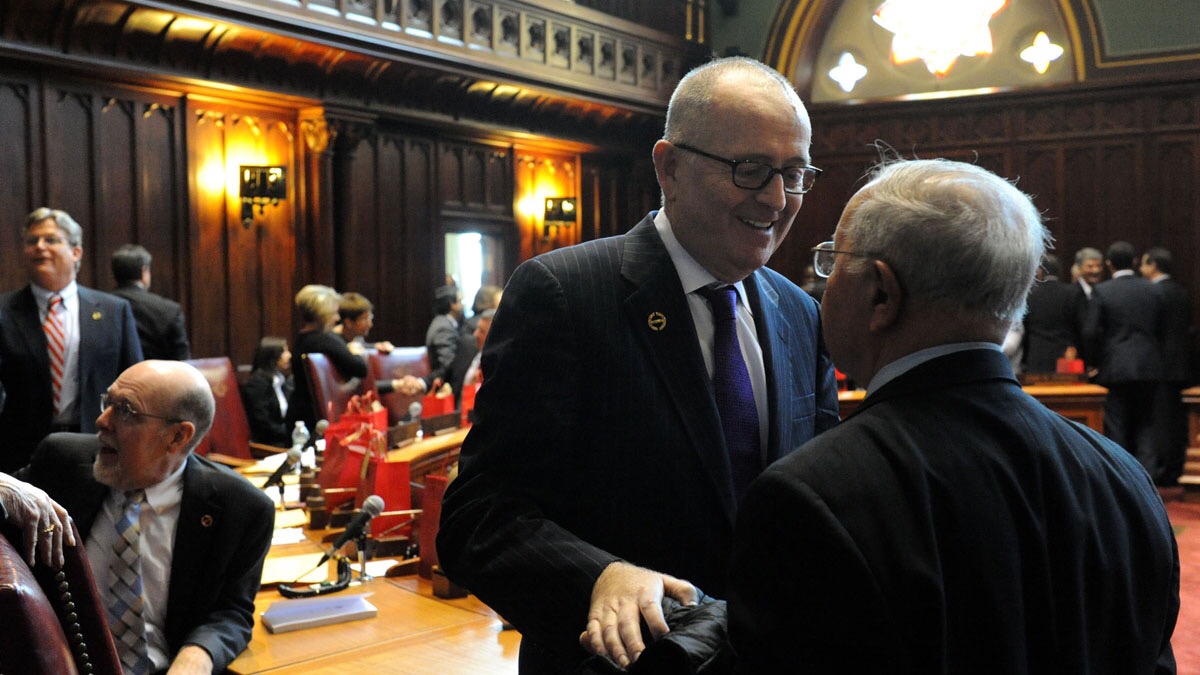
Good news in Groton

and Stonington, North Stonington, Voluntown and Griswold. Our state Senator, Andy Maynard, who was badly injured in a fall last summer, showed up at the Capitol to be sworn in to the term that he won from a hospital bed.

Andy sustained a brain injury. Apparently his ability to think and understand is not impaired, but he has trouble talking. One could argue that a politician who understands and thinks, but does not talk, is an improvement over the common herd, but more than likely his speech will improve and he’ll lose that advantage over his brethren and sisthren.

IMG_0069.JPG

(Picture courtesy, borrowed actually, from the New London Day)

Folks from outside our area may remember Andy as half of a pair of stars of a Daily Show segment, which highlighted the gentlemanly campaign, bereft of smears or negativity, between Andy and Stu Norman. Here we know him as a conscientious legislator and a truly nice guy. I have not always agreed with Andy, meaning he has something in common with everyone else on the face of the Earth, but I’m proud that he’s my State Senator and really glad that he’s made it back where he belongs.

Yet More Adventures in Economics

A few days ago I wrote about an article in the New York Times, that appeared to say that investors were fleeing the lower interest rates paid by European countries for the higher rates that the U.S. is paying. I was puzzled, as the argument made by the expert in the piece appeared to be somewhat inconsistent with the law of supply and demand. Why, I asked, did a perceived higher quality product cost less than risky Italian bonds? Put another way, if American bonds are so special why aren't we charging more, in the form of lower interest rates, to buy them.

Well, along comes Paul Krugman, to explain the real reason for the disparity.

So, here’s the question I was just asked: How can it be that interest rates on U.S. government bonds are so much higher than on European bonds — not just German bunds, but even Spanish and Italian bonds are now paying less than their U.S. counterparts. My correspondent asks, Is the U.S. government really a riskier bet than that of Spain?

The answer is no, it isn’t. In fact, investors assign virtually no risk premium to holding U.S. government debt, and rightly so. I mean, even if you thought the US might default in the next 10 years, what, exactly, would you propose to hold instead? A world in which America defaults is one in which you might want to invest in guns and survival rations, not German bonds.

In that case, however, what explains our relatively high interest rates?

Well, let’s compare with Germany, also perceived as almost completely safe — but paying much lower interest. Why?

The crucial point here is that German bonds are denominated in euros, while U.S. bonds are denominated in dollars. And what that means in turn is that higher U.S. rates don’t reflect fear of default; they reflect the expectation that the dollar will fall against the euro over the decade ahead.

But why should we expect a falling dollar vis-a-vis the euro? One big reason is that European inflation is very low and falling, while the U.S. seems to be holding near (although below) its 2 percent target. And other things equal, higher inflation should translate into a falling currency, just to keep competitiveness unchanged. If you look at the expected inflation implied by yields on inflation-protected bonds relative to ordinary bonds, they seem to imply roughly 1.8 percent inflation in the US over the next decade versus half that in the euro area, which means that the inflation differential explains about 60 percent of the interest rate differential.

Beyond that, there is good reason to expect the dollar to fall in real terms over the medium term. Why? The relative strength of the US economy has led to a perception that the Fed will raise rates much sooner than the ECB, which makes dollar assets attractive — and as Rudi Dornbusch explained long ago, what that does is cause your currency to rise until people expect it to fall in the future. The dollar is strong right now because the U.S. economy is doing better than the euro area, and this very strength means that investors expect the dollar to fall in the future.

So that’s what the Germany-US differential is about: higher US inflation (which is a good thing) plus the expectation that the dollar-euro rate, adjusted for inflation, will eventually revert to a normal level. Ultimately, it’s all about European weakness and relative US strength.

via Paul Krugman's blog

So, the disparity in interest rates does say something about the relative strengths of the economies involved, but not for the reasons cited in the Times article I discussed in my previous post. In a sense, simply comparing interest rates when different currencies are involved is like comparing apples to oranges. If everything were translated into dollars or Euros for comparison purposes, the effective rate of return, taking into account the anticipated change in the value of the currencies involved, may be higher in Europe (or the same) than that in the U.S. Of course, the investors could turn out to be wrong. The dollar may not fall against other currencies, in which case U.S. investors may do relatively better. (At least I think that would be the result).

This is yet another example of an amazing innumeracy in the press and among some experts. It reminds me of our media's insistence on directly comparing unemployment rates in the U.S. and European countries, without correcting for the various ways in which unemployment rates are measured in the countries involved. See, here, in the Wall Street Journal of all places, on the unemployment issue.

So, that's a question answered.

Adventures in Economics

I'm not sure there is any real point of contact between the topics covered by this post, other than the fact that both were provoked by articles in the New York Times. First up, is an article titled For Bond Investors, Ignoring Expert Advice Has Been Profitable.

The initial paragraphs point out that the experts have cautioned against investing in government bonds for years because they've been insisting that inflation is just around the corner. As the article puts it:

OVER the last three or four Januarys, the advice for investing in bonds has been remarkably consistent. It’s gone something like this: Beware of them, because inflation is going to rise, interest rates are going to spike and bond holders are going to lose enormous amounts of money.

Fans of Dean Baker and Paul Krugman knew otherwise, but then, in this country experts are people who are always wrong and never learn from their mistakes, or acknowledge them. I won't belabor the point that people who knew what they were talking about were saying years ago that high inflation was not in the cards.

But this is the part of the article that puzzled me. The article points out that U.S. borrowing costs are actually slightly higher than rates in Spain and Italy:

But seen from another angle, the interest rate the United States has to pay to borrow money for 10 years is far higher than that paid by economies that are not as solid. This shouldn’t be. Germany and France both pay less than 1 percent on their government bonds; even weak economics like Spain and Italy have been paying less to borrow money, with both under 2 percent.

“People at this point are incredibly confused,” said Heather Loomis, director of fixed income at J.P. Morgan Private Bank. “This is the point where people are at risk of throwing in the towel.”

Ms. Loomis said there were at least three reasons for this situation. First, the global recovery hasn’t been consistent. Those low European borrowing rates have pushed investors in those countries to put their money into United States Treasuries, driving down the yield.

Okay, maybe I'm missing something. I thought that the “market” was largely driven by supply and demand. If investors are unwilling to invest in Spanish and Italian bonds, shouldn't that be driving their borrowing costs higher? After all, no one is claiming they can't borrow all the money they need, so someone is lending to them at those low rates. And if those anxious investors are seeking shelter in the warm embrace of the strong dollar, shouldn't that put the U.S. government in a position to charge a premium for that safety in the form of lower interest rates? Isn't Ms. Loomis saying that investors are paying less for a higher quality product when they buy U.S. bonds? How is this consistent with our official religion of capitalism in which the market knows all and always behaves rationally?

Now, for something completely different.

The always excellent Gretchen Morgenstern tells us that the SEC is aiding and abetting yet another device to keep corporate boards safe from their shareholders. You may recall that, in theory, shareholders own the corporation, and they get to do things like vote to decide who runs the corporation, how much they get paid, and who is on the board of directors, etc. In practice, of course, corporate boards are self-perpetuating entities that are chosen to rubber stamp executive decisions and divert corporate profits and employee pay into the pockets of the top executives. The SEC, under the courageous leadership of Mary Jo White, is determined to make sure things stay that way.

It seems that some pushy stockholders at Whole Foods are asking that they be allowed to vote on a proposal by shareholder James McRitchie to enable stockholders with a 3% stake in the company to nominate candidates for directors. But the SEC says no, because the proposal would be confusing, in light of a similar proposal put forward by Whole Foods Management:

The company’s lawyers wrote to the S.E.C., asking to exclude Mr. McRitchie’s proposal from its proxy. Under S.E.C. rules, companies can exclude a shareholder proposal from their proxy filings if it “directly conflicts with one of the company’s own proposals to be submitted to shareholders at the same meeting.”

Whole Foods made this argument, saying that it planned to put its own shareholder nomination proposal on the proxy and that Mr. McRitchie’s would conflict with it. Whole Foods said that including both proposals would “create the potential for inconsistent and ambiguous results.” A spokeswoman for Whole Foods declined to comment further.

But Mr. McRitchie’s proposal posed a direct challenge to Whole Foods’ version. The ownership hurdle for an investor under Whole Foods’ planned proposal was a whopping 9 percent. Not only was that three times Mr. McRitchie’s threshold, but no outside investor holds such a stake in the company. The biggest outside shareholder owns just over 5 percent.

via The New York Times

Note this especially: Whole Foods was merely saying that it planned to introduce a proposal. That means that any company wanting to use this dodge need not even anticipate shareholder action. All it need do is introduce a competing proposal that suits management's interests after a shareholder proposal comes in. In other words, the company can always and easily block shareholder initiatives.

As a lawyer, I must say how jealous I am of the Wall Street lawyers that represent companies like Whole Foods. Life is easy for them. Only they could expect to win on such transparent nonsense. If you tried anything similar to this on behalf of a human being, you'd be laughed out of court. But, when you own the court, everything works out so well.

Bear in mind, this is an SEC supposedly run by Democrats. Imagine what a job they'll do if Republicans take charge. Then again, it's hard to see how anyone could do worse.

David Duke’s empty threat

This is sort of a follow up to yesterday's post. Seems David Duke doesn't realize how successful he's been:

Former Ku Klux Klan leader David Duke issued a warning to Republicans who have criticized House Majority Whip Steve Scalise (R-La.) for speaking to a white nationalist group in 2002, saying they “better be looking over their shoulders.”

In an interview with Fusion, Duke said he has ties to politicians on both sides of the aisle, and he is ready to release names if criticism of Scalise continues:

via Huffington Post

No need to quote more. In a nutshell: If anyone criticizes Scalise for being a racist, Duke will expose them as racists too.

This is, indeed, the emptiest of threats. First off, as I pointed out yesterday, being a racist is now a feature, not a bug, for aspiring Republican candidates, except, perhaps, in obscure corners of Blue America. If Duke exposes Republican racists, he is all but endorsing them, and giving them a leg up on other Republicans whose racist bona fides have not been vouched for by Mr. Duke.

But, you say, Duke is only threatening to expose racists who are criticizing Scalise for being a racist. He's exposing hypocrisy, and that's the danger for these Republicans. To which I say, where have you been for the last 15 or so years? This is the Republican Party we're talking about. This is the party of David Vitter, the guy who patronized whores, who before and after being exposed proclaimed himself the patron saint of family values. He's still in the Senate, having been re-elected by the same people that have made Duke a household name. His hypocrisy cost him exactly zero votes, which is approximately the number of votes that Republican hypocrites have lost on that score nationwide since 2008, if not before.

So, there is absolutely no danger to any Republican seeking to have it both ways so far as Scalise is concerned. They can condemn him for his “bad judgment”, and when they are exposed as having similar “bad judgment”, they can reap some racist votes while ignoring the charge of hypocrisy, secure in the well founded belief that they have nothing to fear on that score from the press or their constituents. It's a win-win world for Republicans these days. Only Democrats are held to the standards that Republicans espouse: just ask Eliot Spitzer.

Nothing new to see here

Just read this, which was a shame as I had been considering writing something to the same effect, but now I feel like a bit of a cheater.

Anyway, I too have been watching the Steve Scalise “controversy” with some amused bemusement, as I really can't see how retaining a racist in a leadership position could possibly have a downside for the Republicans. They have been the party of racism for 50 years now, and, ever since we entered our “post racial” period with the election of a black president, they have been more obvious about their racism than ever before. If there were ever any doubt of that, it should have been dispelled by the Fox coverage of, and Republican reaction to, the killing of unarmed black men by white police officers, not to mention the more politically significant attempts to restrict black voter participation both through the work of a partisan Supreme Court and state legislatures that have enacted voter suppression laws, the entire object of which is to suppress black votes. In the short term, they can only gain by reinforcing their white male base's conviction that the Republican party works for them, instead of the corporate overlords the Republicans really serve. Cue Dylan's Only a Pawn in Their Game, as relevant now as the day it was written.

What is truly laughable are the press reports that say the Scalise incident might interfere with Republican attempts to broaden their appeal to minorities. To which, one must ask: what attempts to broaden their appeal to minorities? No fair counting things that Republicans say that minorities should like. What have they done that actually furthers the interests of minorities in any respect? What have they actually proposed that fits that description? In order to do any such thing, they would have to do something that furthered the interests of the bottom 99% as a whole, and that is something they simply will not do. They can reap those poor white votes and screw those poor white voters only so long as they can convince them that “they've got more than the blacks, don't complain”.

When I was in college I took a sociology class from an excellent professor. Among the things he pointed out was that the groups least likely to be conned by a prevailing ideology are those groups that are on the outs. The Jews were surely the most likely group of Germans to see Hitler for what he was. In this country, minorities, particularly blacks, are far more likely to see through governmental bullshit than whites. They are therefore far less likely to buy into Republican PR aimed at getting their votes than are whites. I mean, how many blacks believe Fox is fair and balanced. Now, how many whites? Far easier to just prevent them from voting.

So, what the Scalise incident demonstrates, above all else, is the fact that racism is gradually becoming more respectable. For a while there, Republicans really felt the need to pretend that they were not racists, while they sent coded racist messages to the electorate. They have found, in recent years, particularly with the election of a black president, that there really is no down side to coming out of the closet. At this point you might say they are where Tim Cook was about six months ago so far as his sexual orientation was concerned. They are not declared racists, but everyone knows they are, and they feel no urgent need to deny it.

Yet another year

Off and on I’ve ventured predictions for the New Year in this space. I actually started doing it this year, but sadly, at least in the political realm, there is nothing to be optimistic about, and, even more sadly, the prospect is so depressing that it’s not easy to find anything funny to say. As Randy Newman sang, “The End of an Empire is messy at best”.

On a personal level, the coming year actually bodes well, assuming the bankers don’t find a way to loot us all of every last shred of our money, so I’ve got nothing to complain about. So, I’ve decided not to complain. At least not tonight.

After all, as Eric Idle sang, we should “always look on the bright side of life”, so here’s hoping that a miracle occurs and the world takes a turn for the better. It could happen.

Happy New Year to anyone out there reading this. This blog will return to doom and gloom tomorrow.

Torture is just alright with them

This post was written on Christmas Eve, but I've delayed posting it, since even to me posting something anti-religious on Christmas seems a bit tacky. Or is it residual Catholic guilt? Anyway…

I came across this post at Pharyngula, in which we learn that our Christian brethren are far less likely to oppose torture than we secularists, atheists and agnostics. In fact, we are alone in being more likely to oppose torture than support it. This is hardly surprising, inasmuch as nowadays (and it has likely always been thus) religion is used as a way of justifying what we find convenient to do anyway. When racists needed a place to send their kids after their schools were integrated, the first thing they did was found religious schools in which it was an article of faith that the races should not mix, because apparently Jesus wanted it that way.

The torture issue is richly ironic, given that said Jesus, the man who they all claim to love and worship, was tortured and then executed in brutal fashion. I've read the New Testament several times, and I don't recall any hint that Jesus approved of the treatment he was getting. But from the point of view of today's Christians, maybe they just figure that if it was good enough for Jesus it ought to be good enough for those Arab ragheads.

Perhaps the difference in perspective is a result of differing takes on the role of reason in decision making. Non-religious types may, indeed do, use their noggins more than “faith based” people. That term, after all, is simply another way of saying that one is comfortable with being told what to think by people who, more often than not, have good reason to want one to think things they themselves know are untrue. Thinking people know that torture doesn't work. As the folks at Consortium News point out :

It has long been known that torture does not work. One can go back to the Age of Enlightenment. In 1764, Cesare Beccaria published his groundbreaking work, On Crimes and Punishments, in which he examined all the evidence available at that time and concluded that individuals under torture will tell their interrogators anything they want to hear, true or not, just to get the pain to stop. Beccaria’s book led to a temporary waning of the state-ordered torture.

It is hard to believe that you would need to examine any evidence at all to conclude that people being tortured will say what their torturers want to hear. I would, wouldn't you? Nonetheless, it apparently needed saying.

Of course this begs the larger question. Torture is wrong, pure and simple. Somehow, Christians have talked themselves into believing that the god of love doesn't agree.

Our sainted Founding Fathers, products of the Enlightenment all, even the slave owners among them, also had a thing about not torturing people. Great discussion here and I should add that George Washington strictly forbade the mistreatment of prisoners, despite the fact that it was well known that the British were treating their own prisoners horribly. You see, to a certain extent, despite the evident contradiction of slavery, they were ..ummm…“Enlightened”. Their political descendants, see, e.g., the entire Republican Party and a good share of the Democratic Party, can only be described as “benighted”.

So, add torture to the list of evils that the religious find compatible with the Christian creed. It joins racism, sexism and homophobia, just to name a few items on the list.

Step into that frame

Something there is about liberals, progressives, or whatever we want to call ourselves, that seems to compel us to allow others to frame the terms of our debate. This is a somewhat trivial example, but because it is so blatant, I have to point it out.

This mostly excellent post at Naked Capitalism argues that our current military adventurism and policy of endless war has its somewhat obscure origin in George Bush the First's invasion of Panama. This invasion, which cost an uncertain number of innocent Panamanian lives, was undertaken for the ostensible purpose of arresting Manuel Noriega, for drug running. In actuality Bush was probably just pissed at him for yanking Bush's chain, since it was entirely predictable, and I'm sure it's happened, that another drug runner, ignored to date by the U.S., took over where Noriega left off (if, indeed, he was ever that important a drug runner).

This invasion was given the propagandistic name of Operation Just Cause by Bush and his cronies. It is hard to imagine a name for an invasion that is more obviously propagandistic. Every time one uses it, one validates the “cause”, whether one wishes to or not. It seems to this humble observer that one could call it the Panamanian Invasion, or if one wants to be more specific, the 1989 Panamanian Invasion. This is a fairly neutral phrasing, much like “World War II”. Now, how does the blogger at Naked Capitalism refer to the invasion. Need you ask? The use of the term itself tends to undercut his argument. There is no law that requires us to accede to government propaganda, just as there is none that requires us to call people opposed to abortion “pro-life” (which they most assuredly are not). Yet we do it. Can you imagine the right agreeing to call Obamacare (which itself started as a derisive right wing term) the Healthy Outcomes Act, had the administration tried to hang that moniker on it? But we on the left (present company excepted) fall for it every time.

Sony Baloney

Okay, I agree that a foreign government shouldn't be hacking corporations, which as the Supreme Court tells us, are people too.

But it strikes me that a movie whose plot revolves around a plan to kill an actual, non-fictional human being, is, to say the least, somewhat tacky. Imagine the response by this country's right wing (the sector most exorcised about free speech rights in this case) had North Korea, for example, put out a movie about killing W while the boy-king was still in office. It would have been a strange situation, because for once the right would have been right.

So, North Korea bad, but the movie bad too. Kim Jong- Il is a miserable excuse for a human being, but he is still a human being. Mock him by all means, but don't make a movie about killing him.