Skip to content

Not fiction

There truly are things going on in this country that you simply couldn't make up. If this were in a work of fiction, would you believe it?

Food donation boxes are a common holiday-season sight in supermarkets. Boxes for store employees to donate food for other store employees in need? That's more of a surprise, but it's exactly what can be found in a Canton, Ohio, Walmart:

“Please Donate Food Items Here, so Associates in Need Can Enjoy Thanksgiving Dinner,” read signs affixed to the tablecloths.

The food drive tables are tucked away in an employees-only area. They are another element in the backdrop of the public debate about salaries for cashiers, stock clerks and other low-wage positions at Walmart, as workers in Cincinnati and Dayton are scheduled to go on strike Monday.

via Daily Kos

Maybe those employees need the extra help because their food stamps are being cut in order to fund more tax breaks for the Walton Family. The sad fact is that outrages like this are becoming so commonplace that we accept them almost unthinkingly. I'll repeat a suggestion I made a while ago. Walmart has one weakness. It can't pack up and go elsewhere, and if it does, good riddance. Each state that cares about its people, even a little bit (translation: blue states) should impose a tax on any corporation employing 50 or more people if more than 15% (or some other appropriate percentage) of those employees require public assistance, including cash payments, Medicaid, and food stamps. We should, at the least, be able to recover the subsidies we are giving to Walmart.

It' stories like this that make me regret having lost my religion. One could take at least some cold comfort from believing that the Waltons will burn for eternity once they have departed this planet they have done so much to despoil. Alas, that will not happen, so we can only hope against hope that someday they will suffer here on earth.

Get off of my lawn!

I am feeling sort of crotchety today, so I'm going to vent a bit, as is my right as a near geezer. (I will never actually admit reaching that milestone, but I confess to getting ever nearer.)

First, let me direct my fire at the Democrats. I've been blogging since 2005 and I'm really tired of returning to a theme I first developed in the opening weeks of my blogging career. I'm not, of course, the first to expound on this phenomenon. Sadly, and most certainly, I shall not be the last.

For the past week we've seen Democrats of all stripes disgracing themselves trying to “fix” a problem with Obamacare that scarcely exists, or simply assuming the fetal position while they are attacked by Republicans. Is there nothing new under the sun? From Obama on down, Democrats hasten to respond to disingenuous claims by Republicans that, since Obama promised that everyone would be able to keep their insurance plans, he was somehow promising that insurance companies themselves would never cancel a policy again, not even those that were initially offered after the passage of the law that the insurance companies surely knew would become illegal once the law became effective. We even have so called Democrats, such as the congressperson from this states's 5th District, voting for a Republican solution that does nothing to solve the non-existent problem other than to let insurance companies continue to sell existing non-compliant but profitable plans, while dumping plans they don't like.

We live in strange times. We have a party that represents the interests of the corporations, the extremely rich and extremely crazy, which shamelessly and forcefully advocates for positions that most people abhor. We have another party that supports policies that most people support, in the sense that they prefer them to the alternative, which party is terrified to advocate for its positions. In any sane country this would seem to be a paradox, but here it's business as usual.

So much for that. Let me now direct fire in a different direction, toward the New London Day.

I have, of late, noticed that a lot of people who write for a living can't. Write, that is. Not to put too fine a point on it, they are strangers to the rules of grammar. I confess to having a thing about sportswriters in particular, who tend to repeat certain tropes. The most abused is the use of the same phrase to start or end an interminable number of sentences, but when that trite literary device is used, at least the rules of grammar are normally observed. What can one do but suffer in silence? But I reserve the right to carp when the English language is mauled beyond recognition.

Don't get me wrong. I feel for the local sportswriter. It must be hard to come up with original things to say about the latest contest between New London High and Fitch. Almost as hard as coming up with new ways to condemn spineless Democrats. But does that excuse the following opening sentence (opening paragraph, actually), which appeared in today's paper?

Never did they imagine they'd be celebrating the first state championship in the program's 37-year history when the season began.

I confess that I'm puzzled. It may be a sentence. It seems to have all the constituent elements. I think it has a subject. It has verbs in abundance. Perhaps the difficulty lies in the fact that it's so very hard to connect any of the verbs with an object. Equally baffling is the fact that it resists all attempts at correction. Oh, you could do it. With time and patience you can tease a coherent sentence out of this sequence of words, but it's not easy. All I can say is this: Had I written this sentence in fourth grade, good Sister Thomas would have made me stay after school until I got it right. Worse yet, she might have made me stay until I could successfully diagram it as written, in which case I'd still be at my desk today.

Rant over, except… wait. Hey, you kids, Get off my lawn!

Inequality for All

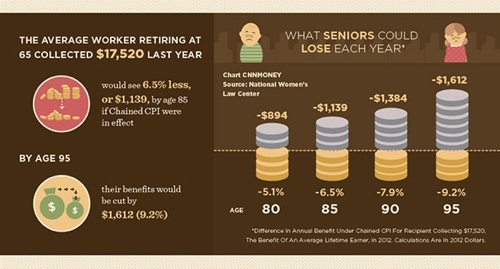
I got an email this morning from one Aldo Baker, of Democracy for America, who asks that I spread the word about the attack on Social Security and the true facts, which he claims you can see here. I’ll confine myself to one aspect of the current assault on Social Security: the push to impose the so-called chained CPI. As they explain, the current cost of living increase formula assumes a more or less static basket of goods and services, and raises benefits as the cost of those goods and services increases. The chained CPI, on the other hand, DFA explains, works like this:

Assuming when prices for one thing go up, people will settle for cheaper
substitutes (ie: if beef prices go up, they’ll buy more tuna fish and less
beef)

Here’s their infographic on the subject:


Now, much ink has been spilled in various blogs demonstrating that this is nothing more than a cut in benefits, as indeed it is, but unless I’ve missed something, there is something else about the chained CPI that has not elicited much comment. That is, the chained CPI only achieves the desired effect (a cut in benefits) if economic conditions are such that people are forced to buy more tuna fish (and later, cat food) instead of steak. If that rising tide were lifting all boats, the sales of steak would remain constant. People are forced to buy tuna fish only because their incomes are not keeping pace with prices, and that, of course, is a result of federal policies that have produced rising inequality. The chained CPI will accelerate the phenomenon it pretends to measure by further impoverishing the only significant segment of the bottom 99.9% that was previously at least somewhat protected. The elderly who might have been able to afford a steak now and then will be eating solely tuna, much like their children and grandchildren. Taking that money out of the economy will further depress it, helping to create or continue conditions under which the working generations will have no choice but to work at jobs at which their wages continue to stagnate or decline in real terms. This will force them to substitute cat chow for the canned stuff, which in turn will justify further cuts to social security, which in turn will further depress spending, further depressing wages. Of course, when 99.9% of us lose, it’s a sure thing that .1% of us will win, and really, isn’t that what it’s all about?

Humpty Dumpty bested again

Yet another example of the malleability of words and meaning. In this morning's Times we learn that the Euro, wonder of wonders, may be the source of the problems in Europe. That's no surprise to anyone who reads Krugman, et. al., but let that pass. What struck me was this:

True, there have been glimmers of good news lately. Consumer confidence among Europeans has improved, and recession has ended in countries like France and Spain. European stock indexes are up for the year. And yes, the euro in recent months has risen in value against other main currencies — although that is more curse than blessing, because it makes exports relatively more expensive outside the euro zone.

via New York Times

So, in this case, the word that's gotten the Humpty Dumpty treatment, most likely by one or more central bankers, is the word recession. When I was just a wee lad, I naively thought that a recession was a junior depression. Not so bad as the thirties, but bad. And I also thought that the bad thing about depressions, and by extension, recessions, was that a lot of people ended up unemployed. It followed, at least in my feeble little mind, that a recession ended when unemployment went back to reasonable levels, which in my naiveté I pinned at around 4%. Or, to be more precise, such a decrease in unemployment was at least necessary, if not sufficient, to end a recession.

Apparently, I was wrong. The Spanish unemployment rate is now 25.98%, down from a high of 27%. What definition of end of recession could possibly apply to a country with a 26% unemployment rate? Apparently, a benchmark was met, and unbeknownst to the people of Spain, that country, like this, left recession behind while millions were left unemployed. Apparently, these days, recessions end as soon as the bankers feel secure. Humpty would be awestruck.

Wishful thinking at the Times

For a variety of reasons blogging here will be sparse and sporadic for a while. Today I just want to point anyone who stops by here to Dean Baker's excellent post about a recent Times editorial endorsing the Trans-Pacific Partnership trade deal, that is currently being negotiated in secret. All indications are that the result will be the evisceration of environmental protection laws and of financial regulations, along with other measures designed to hasten the flow of money to the .01%. Despite all the evidence, the Times sees it differently, but as Baker points out, there is no evidence for the Times rosy view:

The result [of negotiations dominated by banks, drug companies and oil companies ] is likely to be a deal where corporations will use the trade agreement to block restrictions on their behavior that might otherwise be imposed by democratically elected governments. For example, the financial industry might use the deal to prohibit Dodd-Frank type restrictions that prevent the sort of abuses that led to the financial crisis. The oil and gas industries might use the deal to prohibit environmental restrictions on fracking. And the pharmaceutical industry might push for stronger patent-type protections. These will raise the price of drugs (like a tax) and slow economic growth.

Bizarrely, the NYT editorialized in favor of the the TPP, concluding its piece:

“A good agreement would lower duties and trade barriers on most products and services, strengthen labor and environmental protections, limit the ability of governments to tilt the playing field in favor of state-owned firms and balance the interests of consumers and creators of intellectual property. Such a deal will not only help individual countries but set an example for global trade talks.”

Yes, boys and girls, Goldman Sachs, Exxon-Mobil and Pfizer will put together a deal that does all these things. This is serious? 

via Beat the Press

One must wonder what is going on here. I can believe that the Times editorial writer would actually believe that the deal is designed to lower duties and trade barriers, even though that's not really the case. After all it's called a free trade agreement, and if you're lazy, have not an ounce of healthy skepticism (isn't the press supposed to be skeptical?), and have done no research into the issue then you might just draw that conclusion based solely on the fact that it's being called a “free trade” agreement. Such a person might be forgiven for not realizing that it is, in fact, a deal designed to preserve, protect and enhance corporate profits. But how could even our hypothetical lazy Times editorialist be so uninformed as to believe that this trade agreement, or any trade agreement would “strengthen labor and environmental protections”. What previous trade agreement has ever strengthened labor protections, unless you believe that destroying unions and destroying American jobs strengthens labor protections. You really need to be a fantasist to make an assertion like that. So the question arises, is the Times deluded, or is it shamelessly propagandizing for corporate interests.

As Groton goes…

Over at Daily Kos they are claiming to be covering all the races, big and small, yet I’ve seen nary a word about one of the biggest Democratic triumphs of the night. It therefore falls to this humble blogger to report the startling news, that here in the Town of Groton, home of the City of Groton, the Borough of Groton Long Point, and more political subdivisions than you can find in New York City, the Democrats have swept the table.

We are the majority on the Town Council, for the first time in 30 years. That means, from what I overheard, that one of our candidates (that would be Joe Delacruz), was not yet in his swaddling clothes the last time our fair city had a Democratic mayor.


Groton’s New Democratic Majority


From Left to right, Incumbent Rita Schmidt, Bob Frink, Rich Moravsik, Joe Delacruz, and Gen Cerf

The council consists of nine members. We only ran five candidates; the Republicans ran seven. All of our candidates won, so it turned out to be a good strategy.

We also preserved and extended our RTM majority and we have a majority on the Board of Ed. So, while you may have gotten results of those minor races in Virginia, New York and Boston at low rent sites like the Daily Kos, remember that news of this stunning Democratic victory was here at CTBlue exclusively.


UPDATE: I am reliably informed that not a single Groton Democrat lost yesterday. That may be something of a Groton record for any party.

Friday Night Music, the late great Lou Reed

This is becoming an occasional feature, but this week I had to bring it back. Lou Reed was a giant of rock, and his passing cannot go unnoticed.

A lot of great music, the obvious being Walk on the Wild Side, but I decided to go with Perfect Day. I found several really good versions, and since this is my blog, I decided to go with them all. Watch as few or as many as you’d like.

I think I may actually have used this one before. You just couldn’t make this up. Lou Reed and Pavarotti:


Then there’s this. Lou with the good Elvis:


Finally, this, featuring among countless others, Dr John, David Bowie, Duran Duran, and Elton John. A prize to whoever can name the most.

Tender Corporate Consciences

Back in July the 6th Circuit turned back a challenge to the Affordable Health Care act’s birth control coverage mandate, on the common sense grounds that while Mitt Romney may think they’re people, they can’t have religions. I thought I wrote about it at the time, but can’t find the post.

Anyway, this decision is one of those no-brainers that anyone with the least understanding of the law could predict. So, naturally, we now have a bunch of looney Republican judges ruling the other way:

The D.C. Circuit Court of Appeals — the second most influential bench in the land behind the Supreme Court — ruled 2-1 in favor of business owners who are fighting the requirement that they provide their employees with health insurance that covers birth control.

Requiring companies to cover their employees’ contraception, the court ruled, is unduly burdensome for business owners who oppose birth control on religious grounds, even if they are not purchasing the contraception directly.

“The burden on religious exercise does not occur at the point of contraceptive purchase; instead, it occurs when a company’s owners fill the basket of goods and services that constitute a healthcare plan,” Judge Janice Rogers Brown wrote on behalf of the court.

Legal analysts expect the Supreme Court to ultimately pick up an appeal on the birth-control requirement and make a final decision on its constitutionality.

via The Hill

The article is not clear on whether the employer in this case is a corporation, but the reference to “companies”, and the fact that the entity has 400 employees practically guarantees that we are not dealing with an individual here. So, here we have an anomaly (see my previous post for more on this subject). The owners of this corporation are not liable for its misdeeds in a court of law. In other words, they and the corporation are seperate entities when it comes to their pocketbooks. But they are indistinguishable when it comes to their alleged consciences, at least when those firmly held beliefs are consistent with the right wing views of the DC Circuit. As I’ve written before, this raises all kinds of interesting possibilities, for whose to say what strange beliefs corporations might find themselves impelled by self interest conscience to adopt. But rest easy, if the Supreme Court agrees with this abomination, it will likely restrict the result to the facts, much as it did in Bush v. Gore.

This, by the way, is the court that has three vacancies that Obama can’t fill because of Republican’s filibusters. Time to go nuclear.

Personal Responsibility is for the little people

This morning’s Times has an article about the travails of Craig Zucker, who founded a company that manufactured Buckyballs. Buckyballs were very small, very powerful magnets which, as the article explains, were a hazard to children. The package contained a warning, but that didn’t stop the carnage:

The product safety agency says it has reports of about 1,700 emergency room visits involving children who had ingested Buckyballs. The power of the magnet in some cases caused ripped intestines.

Written warnings do no good once the package is opened, and the fact is that Buckyballs were kid magnets as well as real magnets. It was inevitable, warnings or not, that they would cause real harm.

Mr. Zucker is by no means an evil man, and I must say that I myself almost bought a set of Buckballs, and would have done so had the price not been so high.

The Consumer Product Safety Commission has taken the unusual step of trying to hold Mr. Zucker liable for the cost of the product recall. Mr. Zucker feels that he should be shielded from personal liability. Isn’t that what corporations are for? He’s being assisted, the article implies, by the inevitable Koch Brothers, whose tentacles reach everywhere.

Holding Mr. Zucker liable for the harm he caused, whether intentional or not, would, according to him and his allies, cause irreparable harm to the nation:

The groups argue that holding an individual responsible for a widespread, expensive recall sets a disturbing example and runs counter to the business desire for limited liability. They contend that such risk would have a detrimental effect on entrepreneurism and openness in dealing with regulatory bodies.

“It really has a chilling effect on the kinds of things all of us were trying to do, which is involve corporate officers in these kinds of decisions — to decide if something should be reported and if there should be a recall,” said Lee Bishop, a lawyer for the manufacturers association, who helped draft the brief.

..

“This really punishes entrepreneurship and establishes a bad precedent for businesses working to create products for consumers,” said Daniel Z. Epstein, the group’s executive director. “It undermines the business community’s ability to rely upon the corporate form.”

There are some things that become so ingrained that we fail to ask fundamental questions about them. The concept of limited liability, in my humble opinion, is one of them. We assume, without asking “why?”, that the business community should be allowed to “rely upon the corporate form” so that the people who benefit the most from corporate wrongdoing can escape liability and responsibility when they are caught out.

First, a very brief course in the history or corporations. Initially, a corporation could be created only be the legislature, for a limited purpose, and usually to accomplish something that the legislature deemed to be a public good. Limited liability was an inducement for men (no women need apply) of means to invest without hazarding more than their investment, and it makes sense, and still makes sense if the person involved is investing money only and is not responsible for the day to day operation of the business, or, in the case of today’s banks, for instance, the day to day direction of the criminal enterprise.

But, back to the brief history. As time went on, and no doubt at the behest of the monied interest, the several states made it easier and easier to form corporations. Nowadays, you can form one for the cost of a filing fee and a small fee to a lawyer, and you too can conduct business behind a corporate shield. With a minimal amount of care you can reap any profits your “entrepeneurship” may yield, while evading any financial liability for any harm it might cause. It is, in brief, a way to launder liability much like some people launder money, and it is often simply a license to steal. I won’t bore you with war stories, but I’ve been involved in many a case where an individual took advantage of the corporate form to evade liability for debts of one sort or another that we mere mortals would be stuck paying, or at least, subject to suit for not paying.

So, returning to Mr. Zucker. The costs of the recall can be borne by a combination of three entities: his corporation, now defunct, him, and us, the taxpayers. It is not immediately clear why we taxpayers should pay for the harm he has caused over a thousand children, even if we stipulate that he meant no harm. The country is littered with non-entrepreneurs who have been held liable for unintentional negligence. The fact is, he caused the harm, intentionally or not. A case can be made that his corporation should pay, and no doubt the CPSC would be content with that if his corporation could pay, but it is bankrupt. There is no indication that Mr. Zucker has shared its fate. He remains wealthy as a result of selling a product that maimed children. So, the proper question is this: Is it good public policy to let “entrepreneurs” retain the profits from an enterprise that causes social harm? Why is it bad if “entrepreneurs” are made aware that among the risks they run is the possibility that they will be responsible for the harm they cause, which they must weigh along with all the other risks and benefits. Why must society at large pick up the costs, while the “entrepeneurs” pocket all the benefits?

Etymological sidenote: I’ve put the term “entrepreneur” in quotes because it’s use by the various corporate shills quoted in the article is instructive. The word, for some reason, gives us warm and fuzzy feelings. It evokes an image of a struggling inventor battling long odds to bring his brilliant idea to market. In Mr. Zucker’s case, that image almost holds water, but it’s not Mr. Zucker the Koch Brothers are concerned about. This case threatens to do something they and their ilk cannot abide: make them personally responsible for the social harm they cause. They shield themselves behind the term “entrepreneur”, because it does not evoke the same response as more accurate terms might bring to mind.
Enough Already

This past Sunday we had a chance to talk to Senator Blumenthal at a fundraiser in West Mystic. We asked him about the filibuster, an issue on which his position when elected was good, and on which he’s stood firm.

Today we’ve seen yet another example of Republican misuse of the filibuster, or, as it’s come to be known to our nation’s press, “blocking”. (Why, one must wonder, is the less precise word used in place of the reality?) Besides making it standard operating procedure, they’ve also made it standard operating procedure to lie about their motivations. One meme they’ve been spreading: Obama is engaged in court packing by appointing judges to fill vacancies in the DC circuit. That’s the opposite of court packing, but close enough for our media to allow the Republicans to spread the meme.

Apparently, Reid is keeping the threat of “going nuclear” alive. It’s really about time to pull the trigger. The filibuster does us no good, even when we’re in the minority, since Democrats won’t use it for anything important, and are easily shamed into dropping the tactic. Senator Blumenthal told us that he was one of 17 (all Democrats, mostly relatively newly elected) who voted to get rid of the filibuster. He told us that his Democratic colleagues told him that he didn’t understand, that if the shoe were on the other foot the Democrats would need the filibuster in order, for instance, to prevent confirmation of a judge who would overturn Roe v. Wade. “Or”, I said, “judges that might hand the government over to the corporations or overturn the Voting Rights Act”. He agreed with my observation, even referring to it in the brief speech he gave to the attendees. The fact is, as recent Supreme Court history demonstrates, that Democrats did nothing to stop the nominations of people who presented a clear and present danger to this nation. Both Alito and Roberts were known to be corporate tools. Both were known to be hostile to minorities. Both were known to be sure votes to overturn Roe. No one breathed a word about filibuster, or if anyone did, it was with a very shallow breath.

So, it’s time for Reid to activate that nuclear device. The Republicans will conclude soon enough, if he leaves it unused, that it will never be used.