Skip to content

Wells Fargo planned a party

Sometimes things move too fast. A friend of mine tipped me off to this story this afternoon, and I put it aside to rail against yet another example of corporate greed.

Well, it still is, and was, despite Wells Fargo’s decision to back down. It’s also yet another example of the collective blindness under which our betters labor. Don’t they realize that they should keep the excess within the confines of their gated communities for awhile? Meanwhile, which of the following are you going to believe:

This, from Wells Fargo?

“The event is not a ‘junket’ for executives but a four-day business meeting and recognition event for hard-working team members who made homeownership achievable and sustainable for borrowers across the nation.”

Or this?

The conference is a Wells Fargo tradition. Previous years have included all-expense-paid helicopter rides, wine tasting, horseback riding in Puerto Rico and a private Jimmy Buffett concert in the Bahamas for more than 1,000 employees and guests.

“I was amazed with just how lavish it was,” said Debra Rickard, a former Wells Fargo mortgage employee from Colorado who attended the events regularly until she left the company in 2004. “We stayed in top hotels, the entertainment was just unbelievable, and there were awards — you got plaques or trophies.”


Bonuses for regulators?

I actually think this is something worth exploring, from the New York Times’ Andrew Sorkin:

Maybe someone deserves a bonus.

Like someone who sniffs out the next Bernie Madoff. Or jousts with tomorrow’s gonzo bankers. Or defuses the Next Big Crisis in whatever Next Big Thing is dreamed up by Wall Street.

Someone, in short, who regulates.

Why not reward a regulator, or group of regulators, who bring down some big corporate game? A little incentive never hurt anyone, and if the bonus consisted of a portion of fines actually collected it could never be criticized as being based on the illusory profits on which so many Wall Street bonuses are based.

But the very next paragraph in the story gives one pause:

It is clear that the nation’s financial regulators were no match for Wall Street last time. The financiers were always one step ahead. But maybe that isn’t surprising. The financiers, after all, have a big incentive to outsmart the financial police. It is called a bonus. Wall Street lures a lot of bright minds with money. How can federal agencies compete? They can’t.

Actually, it ain’t necessarily so. Not everyone is motivated solely by money. There are plenty of people out there, and many at government agencies that are smart and dedicated to doing a good job. Lots of people believe they ought to work in a field where they can make a decent living and do some good, or at least do no harm. Government work fits that description, unlike Wall Street. Nowhere in this article does Sorkin mention that the people in charge of those regulators for the past eight years have reined them in at every turn, taking a chainsaw to those regulations, and refusing to allow them to get subpoenas to enforce the law (and then blasting them for not getting them when things go wrong). Regulation didn’t save us from this disaster because the political appointees charged with enforcing those regulations were ideologically averse to doing so, and each was looking forward to making big bucks in those regulated industries after doing their bit to destroy good government. No amount of bonuses to the underlings is going to correct that. If the American people insist on electing people who brazenly proclaim their intentions to serve the interests of the plutocrats they will continue to get regulatory misfeasance.


Profile in Courage

Headline from this morning’s New London Day:

Rell stands firm in her opposition to tax hike.

Let’s speak tautologically. How about, Rell refuses to make hard choices, or Rell tries to maneuver Democrats into taking political heat, or Rell stands firm in her support for local property tax increases.


Where’s Tripp?

Most conspiracy theories persist because they are inherently impossible to definitively disprove. Sarah Palin could defuse this one with ease, yet it persists and she does nothing to refute it, other than condemn it. I could spin out a conspiracy theory on that one. Maybe she’s waiting to debunk it at an opportune moment for her political career, when she’s looking for sympathy. Maybe she’s laying a Machiavellian trap for a future political opponent. All such theories seem far more improbable than the admittedly weird theory that the Bristol pregnancy was a fake.


A prediction

Once again Paul Krugman nails it in this morning’s Times. The Obama Administration, whether through timidity or ideological rigidity on the part of its economic team, seems poised to follow in the footprints of the Bushies. Well, not precisely. Bush spoke softly and carried no stick. Obama speaks harshly, but goes similarly unarmed.

When I read recent remarks on financial policy by top Obama administration officials, I feel as if I’ve entered a time warp — as if it’s still 2005, Alan Greenspan is still the Maestro, and bankers are still heroes of capitalism.

“We have a financial system that is run by private shareholders, managed by private institutions, and we’d like to do our best to preserve that system,” says Timothy Geithner, the Treasury secretary — as he prepares to put taxpayers on the hook for that system’s immense losses.

Meanwhile, a Washington Post report based on administration sources says that Mr. Geithner and Lawrence Summers, President Obama’s top economic adviser, “think governments make poor bank managers” — as opposed, presumably, to the private-sector geniuses who managed to lose more than a trillion dollars in the space of a few years.

And this prejudice in favor of private control, even when the government is putting up all the money, seems to be warping the administration’s response to the financial crisis.

If news reports are right, the bank rescue plan will contain two main elements: government purchases of some troubled bank assets and guarantees against losses on other assets. The guarantees would represent a big gift to bank stockholders; the purchases might not, if the price was fair — but prices would, The Financial Times reports, probably be based on “valuation models” rather than market prices, suggesting that the government would be making a big gift here, too.

And in return for what is likely to be a huge subsidy to stockholders, taxpayers will get, well, nothing.

Will there at least be limits on executive compensation, to prevent more of the rip-offs that have enraged the public? President Obama denounced Wall Street bonuses in his latest weekly address — but according to The Washington Post, “the administration is likely to refrain from imposing tougher restrictions on executive compensation at most firms receiving government aid” because “harsh limits could discourage some firms from asking for aid.” This suggests that Mr. Obama’s tough talk is just for show.

What we need is temporary nationalization, which is what worked in Sweden a while back.

And here’s where I come to my sure fire prediction. In a few years, thanks to all this no cost to the banks government largesse, these banks will be back making money and planting the seeds of yet another meltdown. When that time comes, the people who are now paying themselves bonuses on our dime will be lecturing the federal government about its budget problems, insisting that it must curb its massive deficits, deficits it incurred in rescuing them.


Ben Stein expelled from Vermont

There has been a bit of a storm brewing in the reality based scientific community, Darwin division, since Ben Stein was named to be the commencement speaker at the University of Vermont. Stein was the front man for a film called Expelled, which was ostensibly about the victimization of Darwin doubting scientists, but which was, in reality, a screed on behalf of the fantasists who insist that we teach religion as science. Along the way he stopped to blame Darwin for the holocaust. I wrote about the movie some time ago.

Several prominent scientists, among them Richard Dawkins, wrote to the president of the University president. Stein is no longer going to speak, for reasons unclear at the moment.

As I’ve noted, here and here, in addition to at the above link, Stein is an irritating know nothing about a lot of subjects. Among other things, he purports to be an expert on economics. Perhaps he is, in the BIll Kristol sense of being so reliably wrong that you can just go with the opposite of whatever he says. So I was somewhat amused when I read this portion of the email from the president of the University of Vermont to Richard Dawkins:

Although we have recently learned that Mr. Stein will be unable to receive the honorary degree here or to serve as Commencement speaker, please know that it was our expectation that his remarks would address the global economic crisis and that he would speak from his widely acknowledged area of expertise on the economy. (Emphasis added)

It would be interesting to know who, besides Stein, has acknowledged his expertise. This is the guy who, back in 2007, told us not to worry. Everything was going to be just fine. He repeated himself in July of 2008. Just recently, in an attempt to show us that he understood our pain, he oozed sympathy for a woman who is paying $12,000 a month on an interest only mortgage on a 2.7 million dollar house. The poor dear is about to see her alimony/child support cut in half to a mere $10,000.00 a month, and she’s about to ditch her sugar daddy who has been paying all her bills. She’s never held a job in her life. Only a Republican, which Stein most definitely is, could proffer such a story as emblematic of the current hard times.

There must have been a time when a person was considered an expert only if they actually knew what they were talking about in a given field. Only in our corrupt and declining age could people such as Kristol and Stein be considered experts. What’s shameful is that the economists of the world did not protest Stein’s speaking engagement as vigorously as the scientists.


Hygienic Art Show, XXX

This is Super Bowl Sunday. Super Bowls are counted in Roman Numerals, and so are Hygienic Art Shows. For those of you not from the New London area, the Hygienic Art Show is a yearly event held in what was once a restaurant, and is now an art gallery. The rules are simple: One Piece Per Artist, No Judge, No Jury, No Fees, No Censorship. This year the show has spilled over into what was once a furniture store on Golden Street. We avoided yesterday’s mob scene opening and went today.

For those of you unfamiliar with the Hygienic, here’s a smattering of the offerings. The welcoming side outside. We brought the face with us:

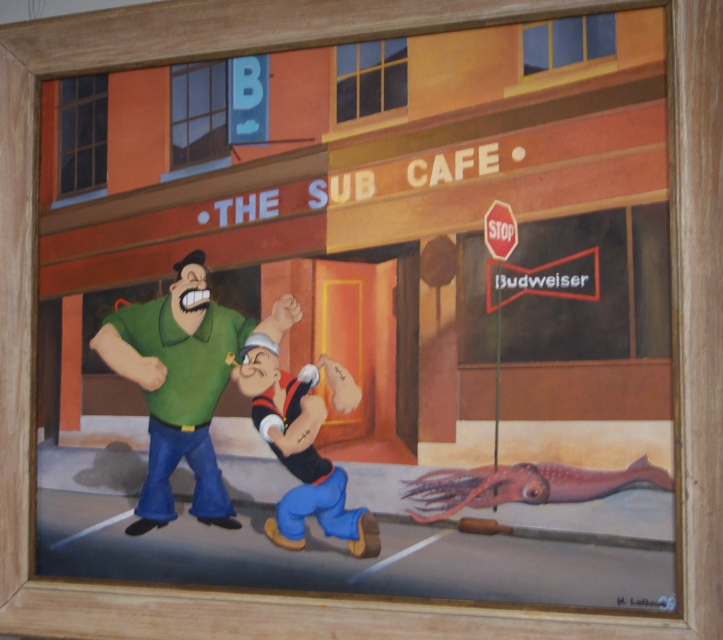
The Cafe below is a downtown New London fixture. The two characters in front aren’t quite New London fixtures, but they would fit right in.

A few pictures featuring our four legged friends:

The Golden Street exhibition hall:

And, finally, an Obama loving giraffe:

The exhibition runs through the 14th, and is on 79 Bank Street in New London, a stone’s throw from our Drinking Liberally meeting place, the Bulkeley House. There’s a great ice cream place across the street, for those inclined (like me) to more juvenile gastronomic treats. Unfortunately, the web site doesn’t give the hours for the exhibition, so it’s not at all clear that one could combine a visit to the Exhibition with a stop at our next Drinking Liberally, which will be this Thursday.


Our funny Senator

Lieberman jokes about waterboarding (via Think Progress):

More from Senator Lieberman: ‘We had hoped Vice President Cheney would be here tonight. I hope it’s not his back injury that’s keeping him away.Apparently, he hurt it moving some things out of his office. Personally, I had no idea that waterboards were so heavy.

It might be sort of funny, if not for the fact that Lieberman voted against barring waterboarding, since it’s not as if you were putting hot coals on people’s bodies.

I don’t believe in torture, but I must say that it would be poetic justice to try waterboarding on Joe to see what he thinks about the experience.


Connecticut Slipping?

This being Sunday, Super or not, it’s an appropriate day to try to offend some religious sensibilities, but I’m sorry to say that in the process I must take my home state to task.

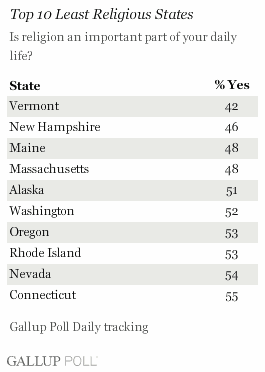
I reported back in June that Connecticut was NUMBER THREE!, trailing only Vermont and New Hampshire, in the degree to which its residents were not religiously inclined. It was a ranking about which we could be deservedly proud, and it seemed at least possible that we could overtake our frozen neighbors.

So imagine my dismay to find (via the Washington Monthly) that we have slipped to Number 10, according to Gallup:

The unkindest cut of all is that we trail Alaska, home of the Weird Witch of the North.

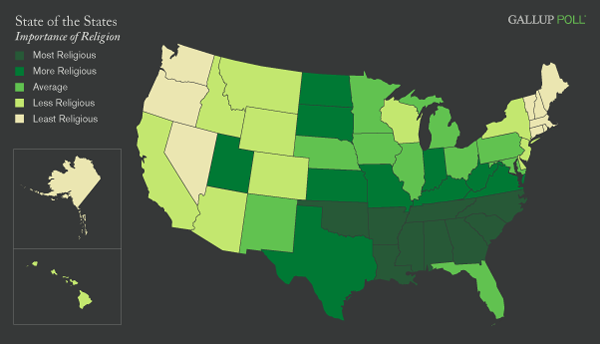
Before I go on to try to exculpate our common home from this blow to our reputation, I must shift a bit. Take a look at this:

The greener the state, the more religious. Now what’s interesting about this is that the extent of religiosity bears a more or less direct relationship to some other rankings. This being Sunday, therefore a day of rest, I’m not going to go to the trouble to prove all this, but I know I’ve read elsewhere that these deep green states also lead the nation in out of wedlock pregnancies, divorce rates, lousy education (except California is now in the latter group, despite its lack of religiosity), low incomes, low reading rates, and just general overall ignorance. No surprise there.

Anyway, back to Connecticut’s relatively poor showing. The answer may lie in the differing polling techniques. The Pew poll I reported on in June asked respondents whether they were “absolutely certain” that God or some god-like analog existed. The Gallup folks asked a different question: “Is religion an important part of your daily life?” Apparently, if you believe the numbers, religion is an important part of the life of every Nutmegger who is certain of the existence of the Hairy Thunderer. There’s reason to believe we would rise in the rankings if the question were slightly different. Still, being behind Alaska is somewhat humiliating.

Now, in defense of our Bible Belt neighbors, it is only fair to say that the high negatives obtained in those states are probably the result of massive lying on the part of the respondents. After all, they live in a culture where people are expected to say that religion is an important part of their life. Here in the Reason Belt, we have a more tolerant attitude. Confidentiality or not, people tend to say what they believe is expected, rather than what they really think.


Friday Night Music-Bettye LaVette and Jon Bon Jovi

I was holding a bunch of Friday Night suggestions from a liberal drinker in reserve, but the first few I checked either had embedding disabled or had been pulled down. My wife suggested this song, from the Obama Inaugural Concert. It doesn’t top the Pete Seeger clip, but it’s right behind it.