Skip to content

Extra Fuzzy Math

Not only is Max Baucus’s Health Care Bill a massive subsidy for the insurance companies, it is a massive attack on the poor, almost guaranteed to make the poor poorer in many and sundry ways.

Today, Ezra Klein highlights a provision that he, probably justifiably, asserts is the stupidest proposal in the history of man:

Baucus’s bill retains the noxious “free rider” provision on employers. Rather than a simple employer mandate that forces every employer over a certain size to provide health-care insurance or pay a small fee, the free rider approach penalizes employers for hiring low-income workers who are eligible for subsidies.

The penalty itself is a bit confusing, and if anything, even worse than one might imagine: The employer will pay the lesser of A) the average subsidy in the exchange times the number of subsidized workers or B) $400 times the total number of workers. Two examples should clarify this:

Baucus Corp has 100 employees and does not offer health-care coverage. Thirty of the employees receive subsidies on the exchange. The average subsidy that year is $5,000. Baucus Corp woulds pay $400 times 100 employees, as $40,000 is less than $150,000 ($5,000 times 30 employees). Each of those low-income employees is costing Baucus Corp $1,333 more than an employee who didn’t need subsidies.

Now imagine that Baucus Corp. only has five employees who need subsidies, and the average subsidy that year is $5,000. In that scenario, Baucus Corp would pay $25,000 rather than $40,000, because $25,000 is less than $40,000. Each low-income worker now costs Baucus Corp. $5,000 more than a worker who doesn’t need subsidies.

So in the scenario where Baucus Corp. has a lot of low-income workers, they cost a huge amount overall because they’re multiplied against the total number of workers. In the scenario where Baucus Corp. has a few low-income workers, they cost a huge amountindividually because they’re multiplied against the average subsidy cost. No matter how you look at it, the policy makes it profitable for employers to discriminate against hiring low-income workers.

Klein’s overall point is valid, though he doesn’t really explain it well. The cost per subsidized worker is not really the issue. The issue is the overall cost to the employer for all workers. If his rendition of the statutory formula is correct, then an employer has a clear incentive to not offer health care and not hire subsidized workers if the employer can avoid it. But many employers will not avoid hiring such workers, because the fine is capped at a certain point (basically once you exceed one subsidized worker out of twelve).

Say I run a corporation called MacRonalds. I don’t want to offer health insurance. I also don’t want to pay the fine. If I hire middle class teenagers who have health insurance through Mom and Dad, then I can avoid paying any fine, if none of them are receiving a subsidy, because zero times $5,000.00 is zero. Now, suppose I run a corporation called Bal-Mart, and I hire workers who are all eligible for the subsidy. The government is subsidizing them at $5,000.00 a person, but my fine is only $400.00 a piece, so long as more than about 1 in every twelve workers is eligible for the subsidy. Why should I pay for Health Care at thousands of dollars a year if it only costs me $400.00 an employee to shift the burden to the taxpayer? So the bill piles on perverse incentives. For those who can do it, avoid hiring subsidized workers all together. In Klein’s example, the employer is better off if it keeps the total number of subsidized workers under 8. For those who can’t keep their numbers down that far, because they pay so little, hire plenty and your “fine” is a bargain as opposed to actually paying for Health Care, and anyway, if you’re Bal-Mart, you can recover the extra cost by keeping pay down and making your employees work overtime for free. Meanwhile, of course, the actual employees will all be legally required to go out and get crappy health insurance with those insufficient taxpayer subsidies. Another perversity inherent in the formula: Employers who have large proportions of non-subsidized workers are probably benefiting from the fact that other employers are doing the right thing, and providing insurance for the spouses or parents of those workers. Responsible employers will be essentially subsidizing those that provide no benefits. The bill promotes a race to the bottom for employee benefits.

So far as I know, there is currently no law that forbids an employer from discriminating against a potential employee based on family income. It is ordinarily not a criteria an employer would tend to use. This bill creates an incentive to use it, and even if it outlaws such discrimination, it will be impossible to effectively enforce.

Of course, this is yet another example of why the employer based system makes no sense at all. This system can be gamed, and for the honest employer it presents a record keeping nightmare. But, since all sensible systems were taken off the table from the start, we are left with these absurd proposals intended to preserve and sustain, and allegedly improve, a private system that is fatally flawed.

It would seem elementary that legislators should take a look at any proposed system and ask themselves: how would I game this if I were subject to it? In this case, if I were an employer, how would I behave in response to this. Can anyone believe these fines would encourage a Bal-Mart to insure its workers, when it costs next to nothing to pay the fine? As Klein suggests, the perverse incentives would be abolished, or certainly minimized, if Baucus had simply provided for a substantial fine for each uncovered worker, rather than providing for discount pricing once the proportion of subsidized workers grows large enough.
Recipe for success

From the Economist:

CLINICAL depression is a serious ailment, but almost everyone gets mildly depressed from time to time. Randolph Nesse, a psychologist and researcher in evolutionary medicine at the University of Michigan, likens the relationship between mild and clinical depression to the one between normal and chronic pain. He sees both pain and low mood as warning mechanisms and thinks that, just as understanding chronic pain means first understanding normal pain, so understanding clinical depression means understanding mild depression.

Dr Nesse’s hypothesis is that, as pain stops you doing damaging physical things, so low mood stops you doing damaging mental ones—in particular, pursuing unreachable goals. Pursuing such goals is a waste of energy and resources. Therefore, he argues, there is likely to be an evolved mechanism that identifies certain goals as unattainable and inhibits their pursuit—and he believes that low mood is at least part of that mechanism.

This explains a lot. I used to think that I was just basically a failure, but I now am proud to say that I have a highly advanced unattainable goal detection ability, what I’m going to call my “donkey sense”. Examples abound. How well I recall my competitive swimming career, when halfway through just about every race (just about? I lie. It was every race) my donkey sense would kick in; I would realize that the goal of winning, placing or showing was unattainable, and I would settle for the attainable: last place. But my donkey sense has really shown its stuff in my political endeavors. When I was very young I aspired to be president of the United States, but my highly evolved unattainable goal detector would have none of that. By successive applications of mild depressive states I subsequently realized that the presidency, the Senate, the Congress, the Town Council, The Board of Education, and finally, a seat on the Groton Representative Town Meeting, were all unattainable. I am currently fixing my sights on a position on the Water Pollution Control Authority, although as I write these words I am beginning to get mildly depressed.

Now, you may wonder why I call this highly evolved personal trait my “donkey sense”. It is, of course, in honor of the Democratic Party, which has a collective “donkey sense” that makes my feeble talents look like overachievement. Take Health Care as only one example. Why, less than a year ago-can you believe it?-the Democratic Party, including even Max Baucus, was promising us a Universal Health Care system with a strong public option and strong restrictions on insurance company abuses. Well, it took me almost a lifetime to spiral down from the presidency to the Water Pollution Control Authority, but the Democratic Party, with its highly advanced collective ability to detect the unattainable took only 10 months to descend to the attainable. Realizing that it only controlled the United States Senate, the House of Representative and the Presidency, but that it was without influence among brain damaged racists, our elected Democrats, our “brain” so to speak, became mildly depressed and quickly realized that a good health care bill was unattainable. The Republicans meanwhile, who have failed to evolve these advanced unattainable goal detection genes, went right ahead and pursued their goal of killing the bill. The result is that our highly superior party has readjusted its goal to the point where it will now consider it a success to pass a private insurance profit enhancement act, an eminently attainable goal, even without Republican help.

Thank heavens for evolution. Thanks to its beneficent working, the Democrats are able to recognize that achieving true Health Care reform “is a waste of energy and resources”. Just wait until they turn their collective attention, and their collective donkey sense, to the financial industry.


Dodd on the comeback trail

The Daily Kos poll has Chris Dodd within four of Simmons and ahead of Foley, both of whom are largely undefined to most Connecticut voters. Three of the four Republican candidates are raising big bucks, so we can expect some bloodletting to take place on that side before the big show takes place. Gabe Rosenberg (whose emails I get since I’m a member of the Dodd Squad) says it’s a statistical tie with Simmons, since the numbers are within the margin of error. But that cuts both ways, Dodd could actually be even farther behind.

In any event, there’s every reason to think that the winner of the Republican primary will be a weaker candidate for the experience. Those guys, as we know, play rough, and there’s no reason to think that Simmons’ opponents won’t be beating him up on a regular basis. I could be wrong, but I think it’s going to be a contest to see who can tie the other guy most closely to George Bush.

By the way, I really don’t expect there to be much be way of fireworks on the Democratic side. Could be wrong, but I don’t think so.


I’m beginning to see a pattern here

FromBloomberg news:

Joseph Stiglitz, the Nobel Prize- winning economist, said the U.S. has failed to fix the underlying problems of its banking system after the credit crunch and the collapse of Lehman Brothers Holdings Inc.

“It’s an outrage,” especially “in the U.S. where we poured so much money into the banks,” Stiglitz said. “The administration seems very reluctant to do what is necessary. Yes they’ll do something, the question is: Will they do as much as required?”

In almost every area the pattern repeats itself. Take a problem, any problem. Propose a halfway measure to deal with it, then compromise from there to make Susan Collins happy. Oh, and give a gratuitous kick to your own supporters as you’re doing so.

Imagine this country 20 years from now, when we’ll be able to say we did something about the health care crisis, just not enough to make a real difference; and that we did something about the economic system, just not enough to prevent another, and worse, meltdown; and that we did something about the energy crisis, just not enough to actually reduce our dependence on foreign oil; and that we did something about global warming, just not enough to keep the waters from inundating our coasts. Now that’s change we can believe in!

Consider this: if Obama had been president in the ’30s, Social Security would be the privatized system Bush tried to impose.


Funny video

This video has been around for more than a week, and I guess it took off over the last couple of days, so by now, just about anyone not living in a cave has seen it. I just emerged from my cave today, and should any of you still be dwelling in such a habitation, this is for you. Bonus points for anyone who can remember the subject of the last funny internet video that used the same Hitler clip. I posted it, but I can’t remember what it was about.


The Times They are Changin’

One salutary by-product of all the hate and vitriol spilling out of the right is that Maureen Dowd appears to have woken up to the fact that there are more important things than Maureen Dowd. She actually wrote a reasonably good column today, in which she deals seriously with a serious subject-the racial animus behind the anti-Obama movement in this country. And I understand, from other sources, that this is her second reasonably good column in a row. It’s a shame that it’s taken a rebirth of what we thought was a bygone brand of American racism to bring Dowd to at least temporarily address real issues, but we have to take what we can get these days.


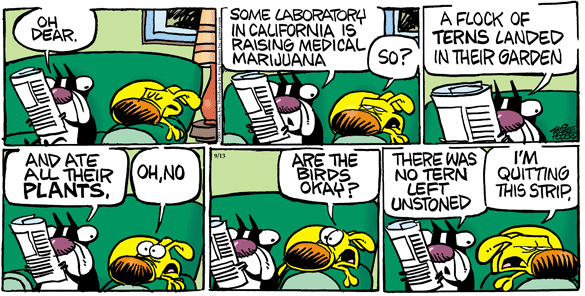
Today’s Comics

Dedicated to my brother-in-law, he of the terrible puns.


Environmental outrages

The Times has begun a major new series on water pollution, detailing the degradation of our water’s quality by the usual suspects, and the attendant health consequences. This looks to be a great piece of journalism, and is further proof that despite print journalism’s many failings, we need outlets like the Times to survive in some form. Who knows, this series may actually provoke some sort of salutary response.

There’s really nothing surprising here. State agencies, underfunded and understaffed, have greenlighted environmental crimes over the course of the last eight years. This trend was either initiated or encouraged, depending on how you look at it, by the Bush EPA, which preferred its water polluted, thank you. What is amazing about all this is how easy it became, the Times didn’t really have to look far, in many instances, for proof of what was going on:

Records analyzed by The Times indicate that the Clean Water Act has been violated more than 506,000 times since 2004, by more than 23,000 companies and other facilities, according to reports submitted by polluters themselves. Companies sometimes test what they are dumping only once a quarter, so the actual number of days when they broke the law is often far higher. And some companies illegally avoid reporting their emissions, say officials, so infractions go unrecorded.

In other words, the companies were fessin’ up, secure in the knowledge that they had a friend in Washington, and lots of friends in state Capitols, as the Times also demonstrates.

One interesting point made in the article is that today’s pollutant’s are relatively invisible. The water looks fine, only it’s poison, so it’s not as easy as it was in the 60s and 70s to take compelling pictures of dirty rivers and streams.

The health consequences of all this are serious, and of course, will be tremendously costly in the long run. It’s an object lesson in the interconnectedness of all things; if we would put money into enforcement of existing laws, and make some common sense changes in the law to go after non-point sources of pollution, we could avoid serious health costs (some obvious consequences are documented in the article) over the long term, since many of these poisons are slow acting. Wouldn’t it be nice if Congress had done the right thing 7 months ago, and put stimulus money into state governments instead of tax cuts. Had that money been made available, with some directly targeted to this kind of enforcement, we would have been investing in something that would have had beneficial results in both the short and long term.

In addition to enforcement, maybe we should be using some of that stimulus money to simply pay for installation of whatever equipment is needed to enable these polluters to stop. It rankles to shovel money at the bad guys, but there are times when you have to be practical, and in any event, it would be a trivial expense to what we’ve given to the Wall Streeters that have ruined our economy once, and who we are now enabling to ruin it again.

So kudos to the Times for bringing this issue to the fore, and double kudos for relegating the teabaggers to page 36 or thereabouts.


Groton Opens Local Headquarters

The Groton Democratic Town Committee formally opened its new Headquarters today. We had a reasonably good turnout, including two people who are exploring the idea of running for governor. You sort of get the impression that they are constantly tripping over each other, since they must be going to functions like this all the time.

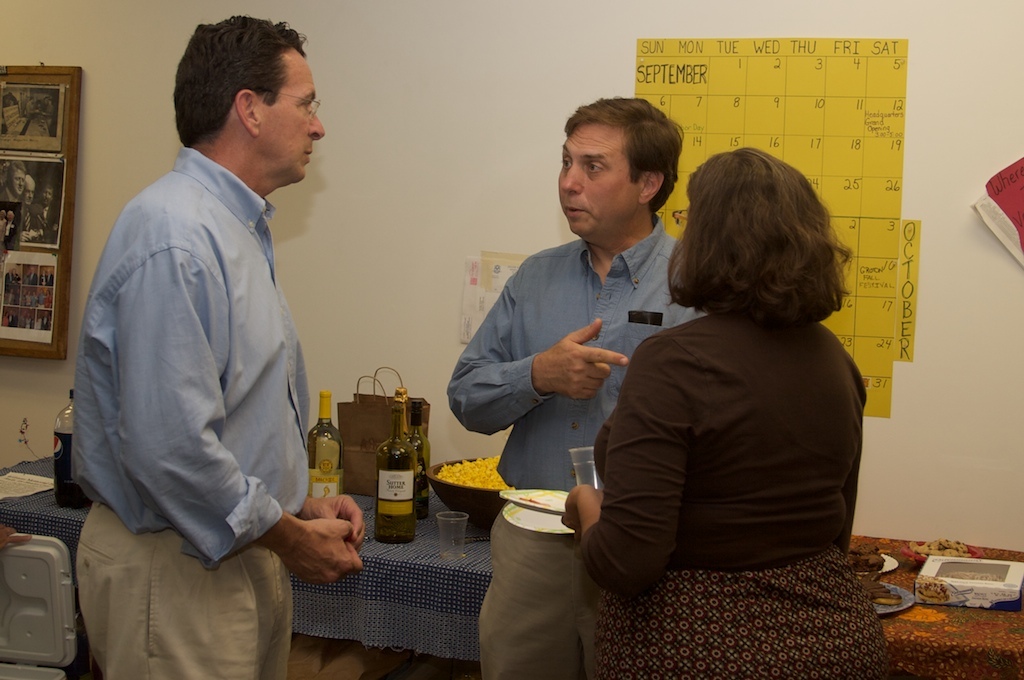
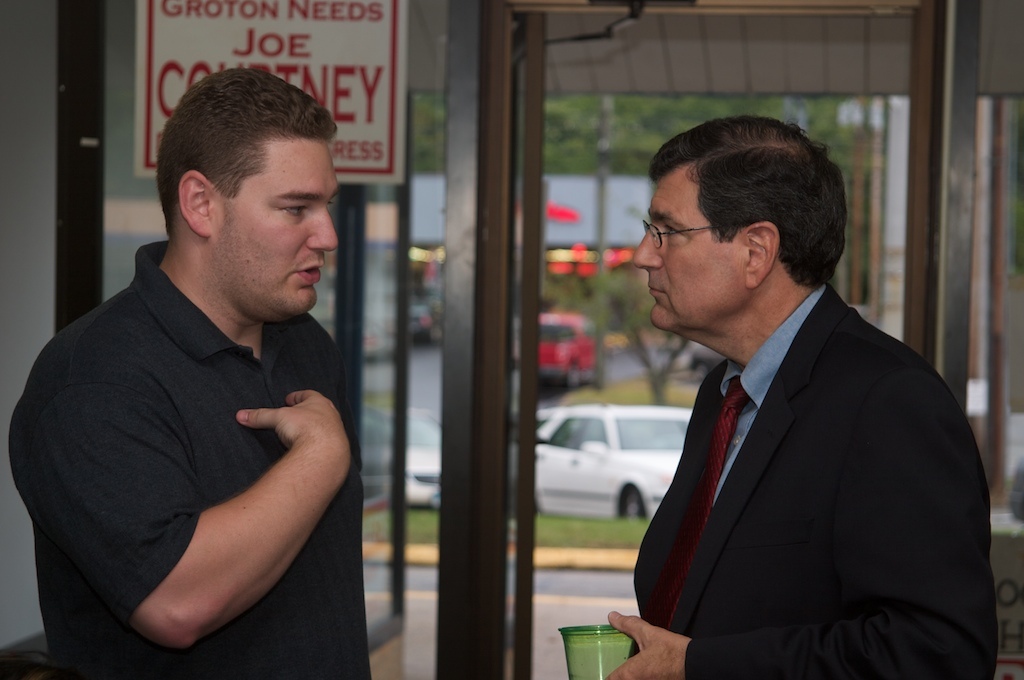
Gary LeBeau and Dan Malloy showed up, and Susan Bysiewicz and Nancy Wyman sent their regrets. This was actually a great opportunity for anyone actually interested in talking to these guys, because they both hung around for a while (LeBeau stayed until the bitter end) and you could actually hold a conversation with them. I have to admit I didn’t take the greatest advantage of the opportunity. I basically vented about wussy Democrats from Obama on down, though I have to say I really don’t put Malloy in that category. (I don’t know about LeBeau). It always impressed me that he didn’t take no for an answer at the 2006 convention and practically stole (but legally) the endorsement from DeStefano. He seems like a bit of a street fighter, something we can use more of in our high minded, ineffectual party.

Here’s Dan talking with RTM candidate William Rae and his wife Emma Palzere-Rae.

As I said, Gary LeBeau stayed pretty much until we closed up shop. Here he’s talking politics with Board of Ed candidate Dave Ferreira.

We got a great place for headquarters this year. Sort of a shame, because we could have used this kind of high quality space last year.

UPDATE: Corrected in line with the comment. I’m not sure where the “Shirley” came from.


Cave of the week

This is happening with depressing regularity:

FOX’s Glenn Beck, whose criticism got a top Obama aide fired this week, has also been agitating about ACORN and its involvement with the 2010 census. The Obama administration has just announced that it is severing its ties with ACORN, and they admitted that they made the move because of the conservative criticism.

What was it Obama said on Wednesday:

If you misrepresent what’s in the plan, we will call you out.

Apparently that sentiment only applies to misrepresentations about the health care plan. On every other issue under the sun (and ultimately, on real health care), they will apparently keep trying to satisfy the lunatics. Would that Obama would watch the video here (sorry, I can’t embed it).

This is the guy who promised to be a leader? He can’t stand up to Glenn Beck, and we’re to believe that he will deal with the health care crisis, the financial industry, and the war in Afghanistan? If Beck can push him around imagine what the “titans” of Wall Street and the generals will do with him. If he wants to know why his approval rating is going down, he need look no further than people like me. Were I polled now, I’d take one for the team and give him the thumbs up, but where there once was real hope there is now dread. The Obama administration has a bad case of battered spouse syndrome. Where will we be if they cave like this for the next four years?