Skip to content

Groton Dems pass resolution-but this is really yet another rant about the spineless Dems

I am proud to report that on Thursday our Groton Democratic Town Committee passed a resolution calling on our state legislators to require a special election in the case of a Senatorial vacancy. Based on the feedback we’ve gotten from some of those legislators there is no chance that our veto proof majority will pass such a statute because:

1. A couple of state legislators who plan to run for governor don’t want their own wings clipped, in the unlikely event they get elected; and because;

2. It wouldn’t “look good” for the Democrats to engage in such a raw exercise of political power, because it might look like an exercise of political power. Apparently it would be tacky to take advantage of political power. They’ll leave that to the governor.

Thus we see that our state legislature is pretty much the same as our national legislature: victims of the battered legislator’s syndrome. We see it in this morning’s Courant, where the Democrats whine about the fact that Jodi Rell is calling them soft on crime for not passing a “three strikes” law which has proven unworkable everywhere it has been tried. We see it in our national legislature, where Harry Reid is in the pre-cave stage on the FISA debate.

The Kennedys were reputed to live by a “Don’t get mad, get even”, code of conduct. That’s something that the Democrats here in Connecticut should consider whenever Rell engages in this type of political hit job. They have the power to hit her back where it hurts, but they have to be willing to do so. Instead they whine, and worry about whether they will “look good”, which they never do, since no one looks that good when they’re on their knees.

Republicans, on the other hand, don’t seem to care about whether they “look good”. In the U.S. Senate they are engaged in an exercise in raw political gamesmanship, threatening to filibuster any amendment to the FISA bill so that George Bush can excoriate the Democrats during the State of the Union address. Harry Reid appears to be maybe, finally, timidly learning that the proper response is to fight back, but unfortunately his method of “fighting” retains too much of the whine to do much good. He doesn’t understand that most of the country has long since accepted the fact that George Bush is a congenital liar, so no one would really be shocked, more likely they’d be pleasantly surprised, if Reid simply said that George Bush is lying about the FISA bill and he’s demanding telecom immunity only to make sure he can cover up his own criminal behavior. Not only would that constitute a bit of push back, but it’s the truth.

I’d say there’s a 90% chance that Reid will find some way to cave and give Bush what he wants. Here in Connecticut, the legislature will continue to get whipsawed by a third rate governor. Lucky for them, on the “three strikes” issue, they’ll likely find that it’s an issue about which voters will show more maturity than the politicians or the press.

UPDATE: A commenter asks if I have the language for the resolution. I actually drafted the resolution, but all the inflammatory stuff I put in about Lieberman was removed, as well as a lot of other whereases, so it’s now definitely the work of a committee. It reads as follows:

Whereas, Connecticut law currently provides that if a
U.S. Senate seat becomes vacant the Governor selects a
replacement who serves until the next federal election
and

Whereas, no person, not even the Governor should have
the power to select the person who will represent over
two million citizens of the State of Connecticut in
the United States Senate;

Now, therefore, we, the Groton Democratic Town
Committee, urge our legislators in the Connecticut
House of Representatives and the Connecticut Senate to
use their veto proof majority to amend Connecticut law
to provide that U.S. Senate vacancies shall be filled
by special election.

UPDATE TWO: In view of the comments below, I should add that the Town Committee also cut language (the “other whereases” to which I referred) about the possibility of Dodd leaving the Senate from the resolution. In my own view, he would be an ideal VP choice if Obama got the nomination, and he could certainly ably fill a top Cabinet position. While I admire and respect Andy Maynard, I respectfully disagree that now is not the time to do this. Not only is it the right thing to do, but there will never come a time when it is done except when the sitting governor is a member of the party in the minority in the legislature. It will always draw charges that it is politically motivated. Almost everything Rell does is politically motivated (witness the ‘soft on crime’ stuff referenced in the post), and it hasn’t seemed to hurt her at all.
Friday night Zappa

A couple of days ago I thought I’d try to find some Frank Zappa for a Friday night concert. What brought Frank to mind was this post on Americablog, that featured this video appearance of Frank on Crossfire.

[youtube]http://www.youtube.com/watch?v=8ISil7IHzxc[/youtube]

He makes them all look sort of stupid, doesn’t he?

Zappa was a musical genius, but he’s not everyone’s cup of tea, and the pickings on youtube, though many in number, are rather sparse from a musical variety point of view. I’m no prude, but I’m not interesting in offending, so some of the classic stuff is sort of off limits. Then there’s the bizarre, such as the clip here of a very young and conservatively coiffed Zappa on the Steve Allen Show playing the bicycle. Yes, you read that right. Steve actually had Zappa on for almost 15 minutes (the video is in two parts). I finally settled on this, which features some great guitar playing.

[youtube]http://www.youtube.com/watch?v=Y_i_HVBD9ks[/youtube]

Choosing delegates

A recent commentor asks about the way in which delegates are apportioned in the primaries. I did some digging, and here’s what I found. Start with state law:

Sec. 9-473. Notification by party chairmen of delegates allotted. Not later than the fourteenth day before the day of the primary, the chairman of each party shall certify in writing to the secretary the number of delegates to which such party is entitled pursuant to its rules. If such rules provide that such delegates are to be chosen from districts, the chairman shall also certify the number of delegates allocated to each district and the number to be selected at large, if any. Such rules may (1) prescribe a formula for the allocation of delegates to candidates based upon the percentages of the total votes cast for such candidates at the primary, or (2) require all delegates shall be allocated to the candidate receiving the greatest number of votes notwithstanding such candidate’s percentage of the total votes cast for all candidates. If such rules prescribe a formula for the allocation of delegates to candidates based upon the percentages of the total votes cast for such candidates at the primary, the chairman shall also certify such formula and all information necessary for the application of such formula to the results of the primary. The chairman shall furnish to the secretary, upon request, a written interpretation or explanation of any application of such formula.

As I read this, the state gives the parties the right to allocate votes on an apportioned basis, or hold a winner take all primary. I then went to the Connecticut Democratic Party’s truly awful website, and after following some non-intuitive links, found this pdf (Connecticut Delegate Selection Plan) which sets forth the delegate selection rules. As I understand it from a quick read delegate are chosen on a district level basis, with districts with a higher level of Democratic voters in the last two elections getting more district delegates. The district delegates must accurately reflect the preferences of the voters within that district. This language from the Selection Plan sums it up:

The Connecticut presidential primary election is a “binding” primary. Accordingly, delegate and alternate positions shall be allocated so as to fairly reflect the expressed presidential (or uncommitted) preference of the primary voters in each district. The National Convention delegates and alternates selected at the district level shall be allocated in proportion to the percentage of the primary vote won in that district by each preference, except that preferences falling below a 15% threshold shall not be awarded any delegates or alternates.

So, unless I’m missing something, the district delegates will reflect the percentages in that district. You can probably hypothesize some bizarre circumstances in which a candidate received a disproportionate number of votes (when compared to his or her statewide results) but it seems unlikely that in practice there would be any wildly inappropriate outcomes. It may be that a similar system was the cause for the fact that Obama got more delegates in Nevada (I think it was Nevada) than Hillary, despite his second place showing.

Finally, a candidate must make a threshold showing in order to get any delegates. I.e., if you get 1% of the vote, you are not getting one percent of the delegates. The threshold changes depending on the percentage of the vote obtained by the winning candidate. The default threshold is 15%, but in the case where no one gets more than 15%, the threshold is the percentage obtained by the leading candidate, minus 10%

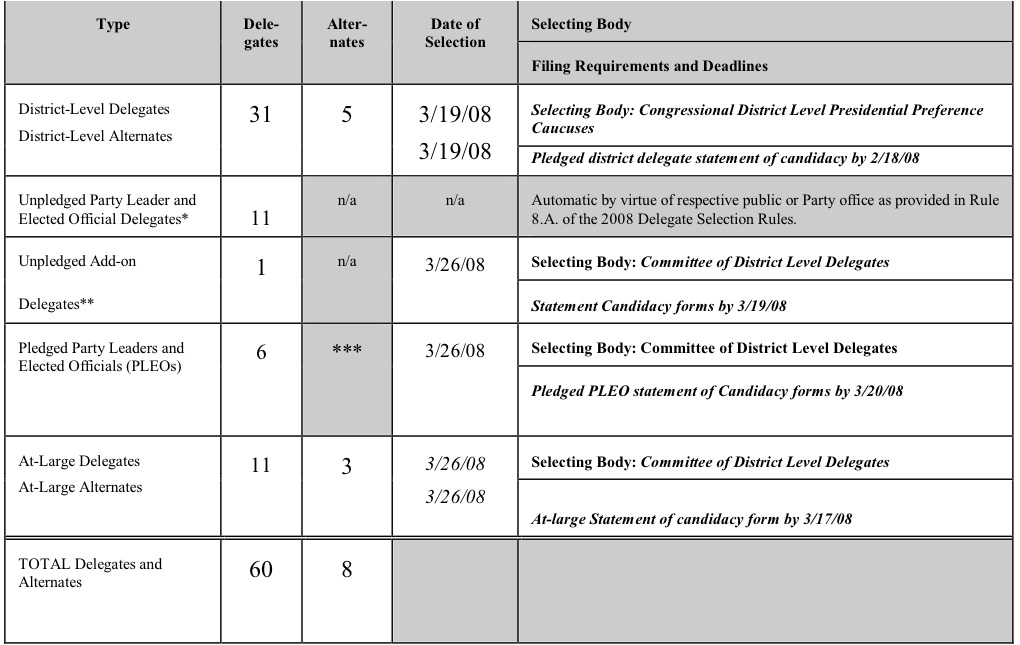
Connecticut chooses 31 district level delegates. The balance of the delegates include 11 super delegates, and some at large delegates chosen by a committee made up of district level delegates, so presumably the at large delegates should reflect the electoral results, unless by the time they are selected one or more candidates have withdrawn. Here’s a table from the Selection Plan (click to enlarge).

delegates.jpg

So, to answer the commentor’s ultimate question, a vote for someone other than Hillary or Obama is worth casting, so long as 15% of the voters in your district agree with you.

Documenting the lies

The Center for Public Integrity has created a database of all the lies told by Bush, his puppeteers, and his cronies in the run up to war. Some of the pages seem to be blank, at least when I went there, but there’s still plenty of material. Take a walk down memory lane, look for your very favorite lie, or as the site calls them, “false statements”.

New rules in the Senate

Harry Reid teams up with Mitch McConnell to lecture Chris Dodd: only Republicans get to declare filibuster and win. Democrats, members of the majority party, members of Reid’s own party, have to actually filibuster. New rules: it takes 60 votes to get something Democrats want; it takes only 51 to get something Republicans want, and to this day, it takes only a word from George Bush, the worst and most unpopular president in history, and he gets what he wants.

What are Hillary and Obama, alleged supporters of Dodd’s filibuster, actually going to do to support him? Nothing, most likely, though a word from either would probably stop Reid in his tracks.

More on this here and here.

The choice

Having trouble making up your mind between Obama and Clinton? Good reading at the New Yorker. Lot’s of arguments, pro and con for each. Food for thought, etc. I’ve decided to vote for Edwards, but I’m still wrestling with the Obama/Clinton choice because it does look like they’ll be the finalists. This article helps, though I still can’t make up my mind between them.

Who could ever have predicted?

We were cleaning up here at home recently, and I came across an old printout of an article from the Onion, to which I’ve referred before. It brought to mind a recent post about all those folks who keep telling us that nobody could have predicted this or that catastrophe. This article, entitled Bush: ‘Our Long National Nightmare Of Peace And Prosperity Is Finally Over’ shows how easy it sometimes is to predict catastrophe. The article was published three day’s before Bush’s first inauguration. It’s important to remember that lots of us, like the folks at the Onion, saw all this coming:

Mere days from assuming the presidency and closing the door on eight years of Bill Clinton, president-elect George W. Bush assured the nation in a televised address Tuesday that “our long national nightmare of peace and prosperity is finally over.”

“My fellow Americans,” Bush said, “at long last, we have reached the end of the dark period in American history that will come to be known as the Clinton Era, eight long years characterized by unprecedented economic expansion, a sharp decrease in crime, and sustained peace overseas. The time has come to put all of that behind us.”

Bush swore to do “everything in [his] power” to undo the damage wrought by Clinton’s two terms in office, including selling off the national parks to developers, going into massive debt to develop expensive and impractical weapons technologies, and passing sweeping budget cuts that drive the mentally ill out of hospitals and onto the street.

During the 40-minute speech, Bush also promised to bring an end to the severe war drought that plagued the nation under Clinton, assuring citizens that the U.S. will engage in at least one Gulf War-level armed conflict in the next four years.

“You better believe we’re going to mix it up with somebody at some point during my administration,” said Bush, who plans a 250 percent boost in military spending. “Unlike my predecessor, I am fully committed to putting soldiers in battle situations. Otherwise, what is the point of even having a military?”

On the economic side, Bush vowed to bring back economic stagnation by implementing substantial tax cuts, which would lead to a recession, which would necessitate a tax hike, which would lead to a drop in consumer spending, which would lead to layoffs, which would deepen the recession even further.

Turning to the subject of the environment, Bush said he will do whatever it takes to undo the tremendous damage not done by the Clinton Administration to the Arctic National Wildlife Refuge. He assured citizens that he will follow through on his campaign promise to open the 1.5 million acre refuge’s coastal plain to oil drilling. As a sign of his commitment to bringing about a change in the environment, he pointed to his choice of Gale Norton for Secretary of the Interior. Norton, Bush noted, has “extensive experience” fighting environmental causes, working as a lobbyist for lead-paint manufacturers and as an attorney for loggers and miners, in addition to suing the EPA to overturn clean-air standards.

The speech was met with overwhelming approval from Republican leaders.

“Finally, the horrific misrule of the Democrats has been brought to a close,” House Majority Leader Dennis Hastert (R-IL) told reporters. “Under Bush, we can all look forward to military aggression, deregulation of dangerous, greedy industries, and the defunding of vital domestic social-service programs upon which millions depend. Mercifully, we can now say goodbye to the awful nightmare that was Clinton’s America.”

Bush concluded his speech on a note of healing and redemption.

“We as a people must stand united, banding together to tear this nation in two,” Bush said. “Much work lies ahead of us: The gap between the rich and the poor may be wide, be there’s much more widening left to do. We must squander our nation’s hard-won budget surplus on tax breaks for the wealthiest 15 percent. And, on the foreign front, we must find an enemy and defeat it.”

If Bush hasn’t achieved all the goals he announced in the Onion, it’s not for lack of trying, and he’s still got one year to go.

Serious news aversion

From this morning’s Times:

The ousted editor of The Los Angeles Times on Monday offered a scathing critique of the newspaper industry and specifically his longtime employer, the Tribune Company, arguing that cost cuts, a lack of investment and an aversion to serious news was damaging the business.

(Emphasis added)

Could this be? Could the Tribune Company be averse to serious news. It hardly seems possible, does it. Let’s take a little unscientific survey.

The Front Page story in this morning’s Times. World Markets Plunge on Fears of U.S. Slowdown.

The fact that we’re heading toward world wide economic disaster does seem like serious news, doesn’t it?

The Front Page story in this morning’s Day: Global Markets Still Need Some Help

Why it’s the same story. And why not, since by anyone’s measure it’s phenomenally important. Weird angle (“Ha Ha, world. If we screw up here we can still take you all down!), but nonetheless, serious news.

Now, how about the Courant, our local Tribune newspaper. Surely the Courant, the flagship Connecticut newspaper, will make mention of the looming economic disaster, will it not? Let’s see. Top story: “Cheshire Dispatch Log Released”. Why, it’s only the 500th story about a freak crime that is supposed to have us all scared by the rash of home invasions, the number of which remains stalled at one. It must be somewhere, though. Let’s see, also on the front page: College Price Cuts Unusual. Hmmm, well there’s one more. Let’s see: Get Out of Our Town, a story about Suffield’s opposition to a biodiesel plant.

Wait, here it is, on the lower right hand side of the front page, in a tiny box: a one sentence teaser directing us to page A3. There it is, proof positive that the Tribune Company is not averse to serious news. It just knows how to prioritize.

Reagan, yet again

Lot’s of new developments on the Reagan front. Seems that Krugman doesn’t like Obama’s implied praise for Reagan either, for a reason similar to that offered by other commentators: that it reinforces a right wing narrative that we should be attacking.

Meanwhile, despite Tim Russert’s spin, Hillary Clinton does not follow Obama down that path, though she does say that she admires Reagan’s communications skills.

I have never quite understood Reagan’s moniker as the “Great Communicator”. I was there during that time period, and my recollection is that he successfully reinforced the beliefs of the believers, repelled his opponents, enchanted the media (suckers even then), and swayed the undecided in pretty much the same way presidents before him were able to do. No one ever called Nixon the Great Communicator, but he was able to rally people behind his war just as effectively as Reagan was able to rally them behind his voodoo economics. And remember, it’s never very hard to talk people into thinking that tax cuts are a good idea. Here’s Lou Cannon, the Reagan expert, on why Reagan was the great communicator:

Reagan became the great communicator because he stood for something. In 1980, when Reagan ran for president, he talked more about issues than any presidential candidate had in years. He talked about building up the defense budget, cutting taxes and balancing the budget. Former House member John Anderson (an independent presidential candidate that year) said the only way you can do the three of them was with mirrors. But Reagan did two of the three. So he talked about substance. But he kept his message basic and simple and on mainstream American concerns.

The first sentence is meaningless. The second sentence is a blatant lie. The rest could apply to any lying Republican politician. (I like the part of achieving two of his three goals. Obviously Anderson was right. Reagan began our descent into national bankruptcy. It’s not like baseball: two out of three equals failure.) What politician does not keep his or her message basic and simple and on mainstream American concerns?

Reagan was an actor, and could lie and mislead with conviction. He was singularly inept at press conferences, since he rarely knew what he was talking about. During his debates with Mondale he showed signs of the senility that became full blown only in the latter years of his presidency. His myth is strong in Washington circles and among the clueless Republican faithful. Had he really connected he would be more widely revered, but despite their claims to that effect, he is not. His myth is perpetuated because he’s the only Republican president since Eisenhower that didn’t leave office an object of derision, or universally loathed, or both.

Another cost of war

According to a new report from the Pentagaon “1 in 5 American servicemen and women who have been in Iraq are coming back with brain injuries.”. The same report says that “17 percent of the soldiers returning to war could have a traumatic brain injury”. Presumably, the soldiers returning with TBI run a substantial risk of having their injuries exacerbated by further service.

Not every traumatic brain injury is totally disabling, but many are, or at least make it very difficult for the victim to function. I have had a number of disability clients with TBI, and I have seen a wide range of effects, many of which can be pretty subtle. Expect the Department of Veterans Affairs to turn down a lot of these vets when they apply for service related disability ratings.

Until this past June, it was practically impossible for a person applying for veterans benefits to get legal counsel at the first stages of the process. That’s often where it’s most important, because the later stages of the process rely heavily on the record that is built at the first stage. The reason it was impossible to get counsel in the first stage is that it was illegal to charge a fee for representation at that stage. Prior to that, there was a $10.00 fee cap (you read that right) for representation at all stages. I learn from the internet today that Congress finally changed the system to make it more like the Social Security system, which allows a claimant legal counsel at all stages and also allows a claimant to authorize direct payment of a statutorily regulated fee to his or her attorney.

A lot of vets who apply for veteran’s benefits also apply for social security disability. If the VA makes a finding that a vet is 100% disabled, that finding is not binding on social security. It would be an act of justice if that were changed. You should only have to prove your case once, it seems to me. (You couldn’t make a favorable social security ruling binding on VA because VA only takes account of service related disabilities.)

Vets can get good medical treatment from the VA, but one unfortunate side effect of that treatment is that it is often harder to get the evidence you need to support a vet’s claim for social security benefits. Social security judges depend heavily on reports from treating physicians, meaning doctors who have a lasting relationship with the patient. My experience is that it’s hard to get such reports from the VA because 1) though there may be no rigid rule against giving them, there seems to be some sort of policy discouraging them, and 2) it is often the case that the vet does not have a specific individual responsible for providing treatment (i.e., no real “treating physician”), so there is no one to ask for a report. So far I have personally been lucky with cases involving vets, but it would not be hard for any social security judge so minded to turn down a good claim and write a bullet proof decision making a successful appeal unlikely.

So among other fallout from this war, we are likely to have a huge number of individuals with brain injuries that will seriously affect their ability to function, who will likely be left to shift for themselves by the country that sent them to war for no reason.