Skip to content

The Democrats learn the obvious

There are some things so obvious that one wonders why they need to be said, but in fact they do. An academic has given the Democrats some much needed advice, echoing what a lot of us unwashed have been saying for years:

This year, among Democrats, one such contender is Drew Westen, a professor of psychology at Emory University in Atlanta and the author of a new book called “The Political Brain: The Role of Emotion in Deciding the Fate of the Nation” (Public Affairs). Dr. Westen takes the unlikely position that the Democratic Party should, for the most part, forget about issues, policies, even facts, and instead focus on feelings.

What he calls “the dispassionate view of the mind which has guided Democratic thinking for 40 years” is deeply flawed, Dr. Westen argues. What decides elections, he maintains, are people’s emotional reactions, even if they don’t know it.

“The Political Brain” takes a different tack than, say, “What’s the Matter With Kansas?” by Thomas Frank or Al Gore’s “Assault on Reason,” which try to explain voter behavior in terms of self-interest and factual analysis.

“My message is the exact opposite,” Dr. Westen said. They’re explaining “why we should be more rational” instead of “why we should bring more passion into politics.”

Writing of the 2000 presidential debate, Dr. Westen says that instead of saying he was “not going to respond in kind” to Mr. Bush’s attacks on his credibility and character, Vice President Gore should have said that he was going to teach his opponent “a few old-fashioned lessons about character,” mentioning Mr. Bush’s drunk-driving incidents, business practices and Vietnam-era Air National Guard service, using the words “coward,” “drunk,” “crooked” and “disgrace.”

Parenthetically, why is this idea such an unlikely strategy for the Democrats? The Republicans have been using is successfully for thirty years.

There is no contradiction between going for the gut and making rational arguments, particularly for the Democrats. We’re on the right side of the issues, and an argument can both appeal to the emotions and convey accurate information. Right now, Michael Moore is showing how it can be done with Sicko. People agree with Democrats on the issues. We need to argue them forcefully. As Westen points out: “Democrats run from every issue where there’s passion involved,” he complains. “If you don’t say anything, you are giving them” — your opponents — “the right to define the public’s feeling.”

It follows that when you are attacked by your opponents because you’re making an effective argument, you do not back down-you keep on the attack. Here’s what you don’t do:

During the 2004 campaign there was a period when John Kerry had a line that said “if we can build firehouses in Iraq, we should be able to build firehouses in America” to huge applause. I assume that it had focus-grouped well, but during those heady days of “spreadin’ liberdee” it was subject to criticism from the otherwise thoroughly chauvinistic Republicans as being unpatriotic or “ungenerous” (which is really funny coming from them) and so he stopped.

The Steve Martin Defense

You.. can be a millionaire.. and never pay taxes! You can be a millionaire.. and never pay taxes! You say.. “Steve.. how can I be a millionaire.. and never pay taxes?” First.. get a million dollars. Now.. you say, “Steve.. what do I say to the tax man when he comes to my door and says, ‘You.. have never paid taxes’?” Two simple words. Two simple words in the English language: “I forgot!” How many times do we let ourselves get into terrible situations because we don’t say “I forgot”? Let’s say you’re on trial for armed robbery. You say to the judge, “I forgot armed robbery was illegal.” Let’s suppose he says back to you, “You have committed a foul crime. you have stolen hundreds and thousands of dollars from people at random, and you say, ‘I forgot’?” Two simple words: Excuuuuuse me!!”

Steve Martin on Saturday Night Live (1977)

Who knew that Steve had stumbled on to a brilliant legal strategy, at least when used by the Bushioso. Today, we learn that Alberto Gonzales was told prior to testimony before Congress that the FBI had abused the Patriot Act. (Aside to Congress: It is a given that the FBI will abuse any arbitrary power it is given). How did Abu know? Because the FBI told him so.

Based on what’s in this article, Abu has two possible lines of defense, should he ever put himself in the position of having to testify about this under oath (and believe me, it will be under oath). He can say that he didn’t read the reports, or he can simply say “I forgot”. My prediction is that once again he’ll trot out the Steve Martin defense, which he has already raised to a high art:

[youtube]http://www.youtube.com/watch?v=7IBvZlRqOTw[/youtube]

My guess is that he’ll never testify. We will soon be treated to the spectacle of a President claiming that his cabinet officers cannot be required to testify before Congress. They will claim executive privilege and run out the clock in the courts.

Private armies good-private lawyers bad

Adam Liptak, of the New York Times, has a problem with State Attorneys General who hire private law firms to bring actions against corporations who pollute or otherwise harm the public interest, even though he acknowledges that the use of the private lawyers level the playing field in legal battles against corporate criminals. The problem? The firms work on a contingent basis, meaning if they win they get a substantial premium over what they would have charged for their time. On the other hand, as he barely acknowledges, if they lose, they get nothing.

The article is neutrally titled (not): A Deal for the Public: If You Win, You Lose.
Why is that? Well, according to Liptak, and the corporate defenders he quotes, it’s partly because the lawyers who handle the cases get paid for their work, unlike the presumed typical situation, where they apparently work for free:

On the phone the other day, [Oklahoma Attorney General] Mr. Edmondson said that how he paid his lawyers was a distraction from the serious issues in the suit. He controls every aspect of the litigation, he said, and personally argued important motions last month.

Mr. Edmondson added that the state could not afford to address the problem any other way. “We are over $10 million in litigation costs to date,” he said. “We simply lack the resources in the attorney general’s office to handle this.”

Asked if he had given any thought to hiring lawyers by the hour, he said, “With what?”

But Oklahoma is a government, with the power to tax and to borrow, and it does not have to turn to a private business to finance a lawsuit it says is in the public interest.

“We’re not going to ask the taxpayers of the state of Oklahoma to pay the lawyers,” Mr. Edmondson responded. “Our adversaries would like us to ask the legislature to choose between this litigation and increased funding for education, for mental health or for corrections.”

But that is not quite right. The taxpayers may pay either way.

Any recovery in the case belongs to the state’s taxpayers, but Mr. Edmondson has signed a contract to give a big chunk of it away.

This is an interesting writing style. Do the paragraphs between quotes represent questions posed to Mr. Edmondson, or editorializing by Liptak? What struck me is the last paragraph. There is, of course, another way to look at it-that Mr. Edmondson signed a contract to get the taxpayers something instead of nothing. That, as Edmondson makes clear, is the real choice. In any lawsuit the parties must pay for their attorneys, so it is the rare litigant that is made completely whole. If one wants to reduce one’s financial risk to zero, one must expect the person that assumes that risk will expect more compensation in the event of success.

Liptak raises separation of powers issues, and points out that no less a defender of that principle than George Bush sees merit in the argument against contingent fee arrangements, having outlawed, by executive order, such arrangements on the federal level. The fact that the order also serves to protect Bush’s corporate masters is, apparently, a mere by-product of Bush’s principled stand.

Funny how Bush, who has pushed privatization of government functions to absurd limits, costing the American taxpayers literally billions of dollars, sees problems with privatization when the public interest is served, and when not a dime of taxpayer money is at risk.

In the best of all possible worlds, the various states would have ample funds to bring these lawsuits using their own lawyers. But they don’t have the money, particularly because the defense lawyers typically adopt a scorched earth defense strategy, driving up the costs to make such litigation prohibitively expensive.

Liptak is obviously sympathetic to the arguments of the corporate “victims” of this practice. But if the corporations get their way, and outlaw the contingent fee agreements, we can predict the results by simply modifying the article’s title: A Deal for the Public: You Lose.

Charter revision commission meets

There’s a good chance I won’t post tomorrow, since we are holding our first Charter Revision Commission meeting tomorrow at 7:00. Among other things, we’ll be setting a date for a public hearing. As always, the big issue is the referendum. If you’re opposed to instituting a referendum, please come to the hearing. Here’s one small example of the havoc these things cause, and it’s always the education budget that takes it on the chin.

Note that the people in East Lyme that are spearheading this are complaining about rising assessments, which the mathematically literate know do not, in and of themselves, raise taxes. New assessments redistribute the tax burden. The people complaining are those whose property values have risen disproportionately to the other people in town, and, like the GGG folks here, they want to redistribute it back toward people who have homes of lesser value. If they can’t do that, they want to cut the services in which they have no interest (the article points out that East Lyme’s population is aging, hence the school budget will get hurt).

Of course, it goes without saying (but I’ll say it anyway) that this would not be an issue if the towns were not over dependent on the property tax. It appears that once again the legislature will do nothing meaningful about the problem. Real property tax reform won’t happen until we have a governor who cares more about the state than his/her standing in the polls.

Weekend picture blogging, 2nd Edition

Alert readers may have noticed that I posted nothing yesterday. Oddly enough, the world continued to turn.

I had a good reason for this neglect. Both of my offspring were here, and we were celebrating a couple of birthdays (mine recently past, and my younger son’s, soon to come). We went for an excursion aboard the Argia, a sailboat that sails down the Mystic River, turns around and comes back. Among those aboard the Argia were a newly wed couple, a sailor and his bride. (He was wearing a sailor suit, in any event.) Herewith, a few pictures, for those of my readers not from the immediate area. Once again, both the colors and the sharpness are better if you click on the picture for an enlargement. For folks from Groton these sights are pretty routine:

And now for something completely different. At the moment I am sitting here on my patio, enjoying the ceaseless animal activity. We live on the remnants of an old farm. About 40 feet from where I sit, is a well preserved (four seater!) outhouse, from which hangs a birdhouse which is the social center of the local small fauna, not only the birds, but squirrels, chipmunks, voles (both of the latter often scurry right by me here on the patio) and groundhogs, not to mention the omnipresent deer, with whom we uneasily co-exist. The rodents (other than the groundhogs) eat the leavings of the seeds that fall from the squirrel proof bird feeder, thereby themselves uneasily coexisting with the ground birds, who grub for the same thing. We’ve toyed with the idea of mounting a webcam out there, but so far that’s as far as we’ve gone.

I’m no expert, but I think this is some sort of woodpecker:

Finally, the Sunflowers are blooming in my wife’s garden:

Bush: Just like Churchill, except without brains, common sense, or an understanding of history

A word to the wise: Beware of any newspaper article in which it is asserted as fact that George Bush reads books.

Case in point, a Washington Post article (Alone Yet At Peace), reprinted in the Day this morning. This is not the worst of the Bush hagiographies that have been inflicted upon us by the mainstream media, but the world would nonetheless have been a better place had it been spared this claptrap, served up whole by a procession of courtiers, named and unnamed. Example:

Bush is seeking out those who are, embarking on an exploration of the currents of history that have swept up his administration. For all the setbacks, he remains unflinching, rarely expressing doubt in his direction yet trying to understand how he got off course.

Now, I have parsed the final sentence in that quote, and I have come to the conclusion that, with an awful lot of effort, you can thread the needle and make it make sense. But even after putting in all that effort, you still come back to the common sense initial reaction: How can someone “understand how he got off course” if he refuses to acknowledge that he is going in the wrong direction?

What lurks below the surface of this article is a portrait of a man who has grown increasingly isolated and detached-who seeks solace for his failure in his belief (which can never be disproved in his lifetime) that history will judge him well. He consults with historians but is apparently not really interested in history, preferring instead to discuss good (him) and evil (pretty much everyone else). He continues to believe that he is carrying out God’s commands. The mental illness that this implies goes unmentioned.

Instead, we get a picture, in the main, of a man who has nobly shouldered the burden of being a great man misunderstood. He is like Churchill, because he says he is, and besides he has a bust of the great man. He is a man who cries at the sight of a wounded soldier, and even insists on confronting the wounds themselves (next thing you know, like Saint Francis, he’ll be kissing lepers), something that comes as news to those of us who’ve noticed that he has never attended a funeral and appears to prefer to use his wounded vets as backdrops for photo-ops or shields against unwanted questions about his personal corruption. He is “totally and completely aware of all the existing circumstances around him” according to (as usual) a “close friend” (How many close friends can one sociopath have?), even though, as one historian says, his alleged stoicism is: “either extraordinary self-confidence or out of touch with reality. I can’t tell you which.” How about both?

During the Clinton years, anything Bill did was covered with massive doses of cynicism. It was simply beyond belief that he would ever do anything because it was the right thing to do or because he had anything but political, and usually base, motivations. With Bush we see how the press can put a good face on almost anything. We have a president, according to the Post, who struggles with questions of good and evil. This is taken at face value. (We are not told on which side of the ledger he places torture.) In fact, every factual statement his sycophants make is taken at face value, no matter how inconsistent with the public record or what we already know about Bush’s character. There is no suggestion in this piece that anything these folks have to say must be taken with a ton of salt. Finally, and back to where we started, we are told that he reads books. No, he and his courtiers use books as props and name books on the President’s fictitious reading lists (remember Camus?) to send signals to a compliant press about the image that they wish to project. And, like good boys and girls, they project it.

Bush doesn’t need a bunch of historians to sit respectfully while he blathers on about good and evil and his Messiah complex. What he needs is a court jester, someone, like Lear’s fool, who will rub his face in his own mess.

How are we doing?

Today I consulted my Library of America volume of James Madison’s writings, looking for one thing, and chanced upon something else, that I thought I’d pass on. As any student of American history knows, the revolutionary generation, an intensely partisan bunch, nonetheless had a fear of parties, which they sometimes called factions. They were concerned to find a way to channel the natural propensity of people to form parties in such a way that, despite themselves, the natural interplay of the parties would advance the common good. Here’s what Madison said.

In every political society, parties are unavoidable. A difference of
interests, real or supposed, is the most natural and fruitful source of
them. The great object should be to combat the evil: 1. By establishing a
political equality among all. 2. By withholding unnecessary opportunities
from a few, to increase the inequality of property, by an immoderate, and
especially an unmerited, accumulation of riches. 3. By the silent operation
of laws, which, without violating the rights of property, reduce extreme
wealth towards a state of mediocrity, and raise extreme indigence towards a
state of comfort. 4. By abstaining from measures which operate differently
on different interests, and particularly such as favor one interest at the
expence of another. 5. By making one party a check on the other, so far as
the existence of parties cannot be prevented, nor their views accommodated.
If this is not the language of reason, it is that of republicanism.

If those are the domestic criteria for a health republic, we are failing miserably. Though he is speaking particularly to the danger of parties, he is also, I think, speaking more broadly about the necessary conditions to the survival of a republic. One could have an interesting debate about which of these criteria we come closest to meeting. My vote would be, very tentatively, for number 5, since events have shown that even a party so solidly entrenched as the Republicans appeared to be, can be toppled. Now we need to see if, by doing so, we the people have made, or will make, any progress on items one through four. Don’t bet on it.

Impeach Dick, then George

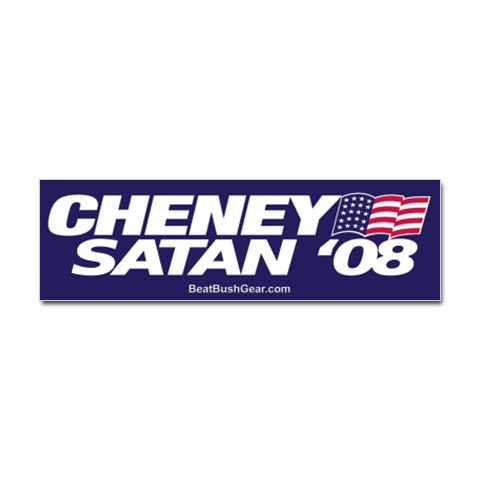
A new poll finds that 54% of Americans favor impeaching Dick Cheney, against a mere 46% that favor impeaching Bush. There’s something to be said for going after Dick first. He’s so massively unpopular. That 54% number could easily increase if it was tied to the argument that impeaching Cheney was a way to put pressure on Bushco to stop the war.

Dennis Kucinich has introduced an impeachment resolution against Cheney, consisting of three articles. Robert Greenwald produced this video supporting the resolution, which has now, apparently, picked up 13 co-sponsors.

[youtube]http://www.youtube.com/watch?v=HEzPVP6EVRk[/youtube]

The charges barely scratch the surface. He masterminded a criminal conspiracy in the Plame affair, which is in fact a criminal violation, as opposed to the abuse of office in the three charges. There is, for better or worse, no law against politicians lying to the American people.

In the past I’ve opposed impeachment mostly for practical reasons-that it would be a political loser for the Democrats. That might still be true, but I’ve pretty much come around to the view that it’s something they should do. It could be managed well, if they could frame the issues right. One way, perhaps, is to argue that Bush has forced them into it by consistently refusing to bow to the will of the majority of the American people. If the only way to stop a war is to impeach the president, then that’s what needs to be done. Both Bush and Cheney have committed high crimes and misdemeanors sufficient to impeach a hundred presidents. The Libby pardon is only the latest, but perhaps the clearest. It is so obvious that Bush did it to protect himself. And, as others have pointed out, no less an expert than James Madison said using the pardon power to hide your own criminality warranted impeachment:

In the same [Virginia ratifying] convention George Mason argued that the President might use his pardoning power to “pardon crimes which were advised by himself” or, before indictment or conviction, “to stop inquiry and prevent detection.” James Madison responded:

[I]f the President be connected, in any suspicious manner, with any person, and there be grounds tp believe he will shelter him, the House of Representatives can impeach him; they can remove him if found guilty..

Finally, isn’t it strange that impeachment has no traction in Washington, given the numbers above. There was never a point when anywhere near that number of people wanted Clinton impeached. Partly, that’s because the Republicans unwittingly (at least I hope unwittingly-could they have seen this coming?) inoculated Bush by making the impeachment remedy suspect, because the Clinton charade was so patently political. But the Democrats could overcome that by carefully framing the issue as a situation in which they’ve been forced to act.

Yet more spam protection

As I mentioned a few days ago I am being inundated with comment spam. It doesn’t appear on the blog, as it is blocked by a spam filter I installed some time ago. However, it does screw up my statistics, because each spam is counted as a unique visit. The raw numbers unnecessarily boost my ego, after which it is crushed by the reality.

I just installed another plug-in, called Bad Behavior, which allegedly keeps the spam totally at bay. It keeps track of the number of blocked spams at the bottom of the page, in case anyone is curious. I’m hoping it works, and doesn’t inconvenience any real people. If anyone has trouble accessing the comments, please email to me at the link on the upper right hand corner of the homepage and let me know.

Bushco spins the Times

I am going to climb out on a limb and say that the legal “debate” about the Bush commutation will die down more quickly than the public debate. Yesterday the Times published an article (Bush Rationale on Libby Stirs Legal Debate) that contained quotes from individuals who apparently could pretend with a straight face that they believed that Bush took his own arguments seriously.

Now, I’m not saying that there aren’t any judges who will be so outraged at what Bush did that they might use is as a basis for what they would want to do anyway. But it isn’t precedent, and few judges are likely to treat it as such. If I were a defense lawyer I might try using it too, but I sure wouldn’t expect much success. And as to the now-corrupt Justice Department, it will simply ignore the issue and continue to push for harsh sentences for people who don’t know the president. This is a ginned up, complete non-issue, not worth writing about. which can only distract from the main issue.

Still, it could be worse. Oh, wait, it is. Look at what the Times swallows whole:

Before commuting the prison sentence of I. Lewis Libby Jr., President Bush and a small circle of advisers delved deeply into the evidence in the case, debating Mr. Libby’s guilt or innocence and whether he had in fact lied to investigators, people familiar with the deliberations said.

That process, in weeks of closely held White House discussions, led to the decision to spare Mr. Libby from a 30-month sentence rather than grant a pardon. But Mr. Bush, defending the move Tuesday, left the door open to a pardon in the future.

The White House deliberations in the case of Mr. Libby, a key architect of the war in Iraq who served as chief of staff to Vice President Dick Cheney, were scattered throughout Mr. Bush’s regular business over the past several weeks, an administration official said.

That description, along with the accounts of two Republican allies of the White House, illuminated a process that was almost clinical, with a detailed focus on the facts of the case, which stemmed from an investigation into the leak of a C.I.A. operative’s identity. Mr. Libby was accused of lying to investigators and was convicted on four felony counts, including perjury and obstruction of justice.

Guess who provided this information to the Times. Well, you’ll have to keep guessing, “Because the deliberations were so closely held, those who spoke about them agreed to do so only anonymously”. That is, of course, a non-reason for being anonymous. The reason is equivalent to saying that they are anonymous because it suits their purposes. I wonder if these are the same White House aides who said that Bush was reading Camus or casually discussing the Nicomachean Ethics?

Don’t these people know when they’re being used? Isn’t this how this whole thing started-with White House spin being planted by anonymous White House sources?

Let’s be clear. Bush did not spend weeks debating the rights and wrongs of pardoning Libby. He may have spent weeks figuring out the best way to do it, or the best time to do it. He may have spent weeks trying to finds some other way of keeping Scooter’s mouth shut. But he did not-I repeat, did not, spend a minute examining the merits of the case against Libby or stop to think about how a pardon would jibe with his “tough on crime” policies. This was the decision of the head of a criminal enterprise who feels the heat coming just a little too close-nothing more and nothing less. And to answer my own question, these people are perfectly aware that they are being spun. They apparently think that what they are told by White House spinners is “news” because it is being spun by insiders. Their job, as they see it, is to pass the spin along, unfiltered by any pesky examination of the facts.