Skip to content

Friday Night Music

No question this week. Phil Everly died earlier this week, so the Everly Brothers it must be. They actually peaked slightly before my time, so in a sense I had to rediscover them. It really is a mystery why they couldn’t make the transition into the 60’s, given the influence they had on so many of the 60’s rockers.

Anyway, both of these videos are from 1983, when they reunited after a period of disharmony between them. But when they were together no one did harmony better. Case in point, Let It Be Me:

And they certainly did rock well:

Delicious

So, it turns out that Chris Christie'e people deliberately caused a massive traffic jam in NJ, as political payback against the Fort Lee mayor. Sort of weird when you consider that theres really no use punishing someone while denying responsibility. Sort of undermines the message. It's a little like Tony Soprano arranging an accident that the victim thinks really was an accident. No lesson learned.

In any event, this has to be one of the stupidest political stunts in history. The worst scandal is one that everyone can understand. Lives there an adult American who cannot feel for those victimized by these crimes; has not experienced the frustration of stopped traffic; who does not instantly react with rage at the idea of anyone deliberately and needlessly inflicting such misery on unsuspecting innocents? Whether he knew (he did) or not, Christie will never get this behind him. Hurricane Sandy, his equivalent to Giuliani's “September 11”, will be quickly forgotten. He can kiss the presidency good-bye. We Dems should be rejoicing; this makes the nomination of an unelectable right wing clown all the more likely.

UPDATE: a commenter asks how I can be so sure that Christie knew. Well, of course it is possible he didn't, but it is overwhelmingly probable that he did. I cite the following: Chris Christie and Richard Nixon.

To elaborate:

Chris Christie is, by all accounts, including his own, a control freak. He is also an arrogant, self centered bastard. It beggars belief that his underlings would engage in a criminal conspiracy on his behalf without his explicit or implicit approval. This particular crime was entirely consistent with the Christie campaign's treatment of other Democratic mayors in the state, not to mention their suspicions that if they did not endorse, their cities would suffer retribution during Christie's second term.

This brings me to Nixon. Watergate was a case study in the techniques employed to abuse power, and the response to expect when the abuse is uncovered. If Christie did not know in advance, he learned soon enough thereafter, so he is guilty of a coverup, which as Nixon observed, is what usually brings you down. The circumstances were such that he could have remained in ignorance only by a determined refusal to learn the facts.

In my own humble opinion, since Watergate we have become so inured to infringements of civil liberties in this country that if another Republican President (remember the IOKIYAR rule) did the same thing, his big white ass would be perfectly safe. In this country, tying up traffic is a far worse crime than starting wars or torturing Muslims, and that's why Christie can't survive.

UPDATE TWO: Okay, just had the chance to browse my RSS feeds and it looks like Christie went the “determined refusal to learn the facts” route.

Another major surprise: Government works!

I'm currently making my way through Doris Kearns Goodwin's latest, The Bully Pulpit, a sort of dual political biography of Teddy Roosevelt and William Howard Taft. Without getting explicit, she's making a lot of points about our current situation. Among other things, she claims, and I think I agree, that one of Teddy's greatest accomplishments was persuading the American people that the federal government had a role to play in controlling the excesses of capitalism and in bettering the lives of its citizens.

Actually, he didn't have to persuade the American people, but he had to overcome the resistance of corporate America to the idea. Back then, at least so far as I can see from Goodwin's book, the forces of sheer idiocy (think tea party) were safely confined in the insane asylums.

Well, here we are 100 years later, and we're at it again. Unfortunately, we have yet to see an American president this century who has made the argument for government as forcefully and consistently as either Roosevelt, or, surprisingly, Taft. (He wasn't his son's intellectual father)

Anyway, here's further proof, if proof we need, that government can get things done, even when it is hampered by corporate and yahoo resistance:

The average amount of electricity consumed in U.S. homes has fallen to levels last seen more than a decade ago, back when the smartest device in people's pockets was a Palm pilot and anyone talking about a tablet was probably an archaeologist or a preacher.

Because of more energy-efficient housing, appliances and gadgets, power usage is on track to decline in 2013 for the third year in a row, to 10,819 kilowatt-hours per household, according to the Energy Information Administration.

That's the lowest level since 2001, when households averaged 10,535 kwh. And the drop has occurred even though our lives are more electrified.

In the early 2000s, as energy prices rose, more states adopted or toughened building codes to force builders to better seal homes so heat or air-conditioned air doesn't seep out so fast. That means newer homes waste less energy.

Also, insulated windows and other building technologies have dropped in price, making retrofits of existing homes more affordable. In the wake of the financial crisis, billions of dollars in Recovery Act funding was directed toward home-efficiency programs.

Big appliances such as refrigerators and air conditioners have gotten more efficient thanks to federal energy standards that get stricter ever few years as technology evolves.

Those incandescent light bulbs are being replaced with compact fluorescent bulbs and LEDs that use 70 to 80 percent less power. According to the Energy Department, widespread use of LED bulbs could save output equivalent to that of 44 large power plants by 2027.

via The Associated Press (Emphases added)

Now, imagine what government could do if it were not frustrated at every turn by Republican ignoramuses that insist that we will have to tear their incandescent bulbs out of their cold dead hands.

By the way, for those keeping track (and I know you're out there Barbara) this post doubles as a good news post.

Who could have known that outsourcing government doesn’t work?

Here's further proof, should anyone need it, that “privatizing” public functions often makes those services more expensive and lower quality.

For decades, citizens have been sold on the mantra that the hungry private sector can do a better and cheaper job of providing services than “inefficient” government. Now it is true that there were some badly run government entities that have done better when privatized (the poster child is British Telecom). But particularly on the state and local level, where voters demand a high level of accountability, this premise was always dubious.

First, as we’ve discussed at some length, outsourcing in the private sector often fails to deliver on their promises. But those dead bodies are seldom discussed. The fleeced buyer has every reason to hide the botched initiative. And they are often prohibited from discussing them: corporate IT projects, for instance, have non-disclosure provisions. As a result, CIO Magazine used a series of failed state outsourcing deals as a forensic exercise relevant to private sector, arguing that the problems were broadly the same.

But a new report by In the Public Interest, Out of Control: The Coast-to-Coast Failures of Outsourcing Public Services to For-Profit Corporations, shows why voter should regard outsourcing proposals with considerable skepticism. Remember, a corporate outsourcer will have to preform the same tasks as a government body would, plus he expected to recoup his selling/contracting costs and earn a profit margin. As we’ve seen with mortgage servicers, and the Out of Control confirms, one of the approaches used by private companies to meet their profit targets is to cut corners on compliance with the rules and with service levels. And when outsourcing is motivated not by ideology or a belief that savings can be achieved, but by service problems, all too often there’s reason to suspect that the legislation that the supposedly underperforming bureau is executing is cumbersome or poorly thought out. In other words, the problem is being treated as one of government execution, when it’s actually one of bad drafting or overly complicated requirements that won’t go away by fobbing them off to a private company.

via Naked Capitalism

Not surprisingly, many of these companies go the full Wal-Mart, and exact a hidden subsidy:

The report also reveals that one of the ways these contractors meet their targets is by effectively fobbing costs back on the state, by paying [workers] low wages that force them to rely on public services. in 2008, 80% of the employees working on Federal service contracts made less than a living wage; the level is likely to be similar for state and local contracts. And of course, this means that local governments, perversely, are sabotaging their economies by driving wages and hence demand and eventually their tax bases down.

This is not surprising, so I won't dwell on it more, but I think it helps illustrate a point I've tried to make before. Private companies are certainly good at making things, such as computers, etc., providing that they have competition. I would freely admit that we'd still be struggling with the “C:\” prompt if we had to rely on the government to develop our technology. But government is far superior at providing services. It provides social insurance, for instance, at lower cost and of greater value than private enterprise. The only innovations in which the insurance industry is interested are those that involve new ways to deny coverage. The principles of insurance are well known. It's math, pure and simple. I think we'll find, as we hand over our schools to private enterprise, that the same principle applies. There may be more room for innovation in education than in insurance, but any value added by such innovation will be more than overwhelmed by the harm that will be done to teachers and students alike by profit driven schools. We can see that in the for profit colleges, and we will get no different from for-profit (or pseudo non-profit) grammar schools. We might think we have, for we will no doubt be treated to endless propaganda about how much better our educational system is when we've reduced our teachers to powerless, underpaid and demoralized automatons. But that won't be the reality, no matter what the education CEOs and their bought politicians tell us, just as, despite the propaganda to the contrary, we never have and never will get a decent health care system based on a private insurance model.

Friday Night Music

This feature is becoming occasional only, as it becomes harder and harder to adhere to certain self imposed limitations, the most important of which is that there shall be no repetition of artists. Anyway, one of my readers (my only reader?) asked me if I’d ever featured the Youngbloods, to which I responded that it’s hard to believe I hadn’t, but I really can’t recall doing so. He suggested this song, from their Elephant Mountain album. I never had that album. I had the one that everyone had, which included Get Together, a veritable anthem. Here they are on the David Frost show, and yes, this is a live performance and I’ve actually got someone in mind for next week, so maybe this feature will get a second life. Here’s the Youngbloods doing Ride the Wind.


Great David Brooks takedown

I don't read David Brooks. I let other people do that for me. He's just another Edmund Burke wannabe, without the brains to pull it off. But I did read him once or twice in the past, and my distant memories are enough to know that this parody of his recent marijuana column is spot on. Read and enjoy.

A bit of sanity, in Utah of all places

A state legislator in Utah is proposing a state constitutional amendment “that that would exempt religious institutions from performing same-sex marriages even if the state is required to issue marriage licenses to gay couples”. Now, your first reaction might be to roll your eyes, but the guy's rationale, to my mind, makes sense, and even though he's a Republican, it sounds like he's sincere:

“The truth is, the main reason I'm proposing this is that I just want people to relax,” Rep. Jacob Anderegg told the Tribune in an interview published Monday. “If they know they have their federal religious guarantees in writing, I hope they will just relax.”

I doubt that the amendment will do much good. Most of the strident opposition to gay marriage is, at bottom, about raising money off of gullible fools. They don't want to relax. But it certainly can't hurt, and who knows, despite my reservations, it might cause some relaxation. It is, of course, totally unnecessary. I can't imagine there's a lawyer on any side of the political spectrum that would argue that you can constitutionally force a religious institution to carry out any marriage to which it has some sort of bigoted objection. You couldn't, for instance, force the Pope to marry two Jews, whatever their gender might be. The whole idea is almost as ludicrous as imagining that it's consitutional for the government to spy on everyone's email all of the time. Oh…wait.

What's truly surprising about this is that it comes from the land of the Mormons, a state in which it is absolutely shocking that there is a single state legislator, not to mention a Republican state legislator, who wants people to relax about gay marriage. That in itself is huge progress.

Something we can all agree on

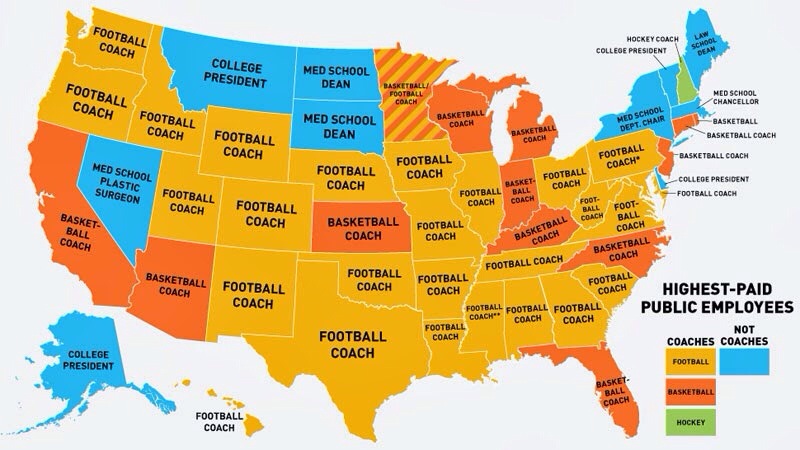
If you’re like me (and you should be) you’ve seen lots of maps of the U.S. showing differences among the states in graphic fashion. Typically, they show the Southern States coming off as one might expect: worst. For instance, divorce rates are higher in the Bible Belt, as are rates of teen pregnancy. The disparity is pretty much a constant. On whatever measure, we in the sane states come off better.

So, does it come as a refreshing surprise, or a profound downer, that by one measure, we are almost universally stupid. It’s not surprising really, but when you see it in a graph it is downright depressing. Herewith, the highest paid “public servant” in each of the 50 states.

20140102-174152.jpg

via Hullabaloo

Well, actually, New England comes off only half bad, though Connecticut should hang its head in shame.

No Mystery Here

This morning the Times ran one of those year in review stories, this one about house prices. The story notes that, in what should not be a suprise to any sentient being, the increase in house prices of recent days appears to be a passing phase, and it's more than likely that the rate of increase will slow further. We are to believe this is a bad thing, although we are not told why, but we can let that pass. The article also notes that house prices have still not reached there previous highs, which, so far as I can tell, we are also supposed to think is a bad thing.

You would never know from reading the article that the previous highs resulted from a housing bubble, meaning they never would have gone that high if someone unlike Alan Greenspan had been in control, and that they were by definition (it was* a “bubble”, remember) unsustainable at those levels.

This amnesia is not terribly surprising, but what always surprises me (well, not really) is the fact that the role of rising inequality in the housing market is rarely mentioned, and then only obliquely. If we were talking about yachts, we might expect rapidly rising prices. But we are talking about homes. Everyone needs one, but usually only one. Some people have two, three, or, like John McCain, can't remember how many they have. But there is simply not enough demand for excess housing generated by the 1% to have a significant impact on national home prices, particuarly since the rich tend to segregate themselves. If wages are stagnant or declining in real terms, it stands to reason that home prices cannot, absent a bubble, increase very much in the long term. People can't buy what they can't afford. Basic laws of economics (of the common sense variety) would dictate that housing prices should remain relatively stable. The quality of our housing stock might decline, since the cost of improvements, to the extent any individual homeowner can afford them, will be harder to recover. The solution, of course, it to reverse the flow of money to the top. Until that happens, housing prices will only rise if the banks are allowed to create another bubble, which, I admit, they are likely to do as soon as the government agrees to look the other way.

Where are the Obama haters when we need them?

A few days ago, I noted my utter lack of surprise at the fact that Eric Holder has refused to enforce a subpoena sought by some government officials investigating JP Morgan's role in aiding Bernie Madoff. It seems there is some doubt that the financial geniuses at the bank really didn't know Madoff was scamming his clients, and that the bank may actually have knowing enabled the con. What a surprise.

Anyway, one thing I didn't note, was the fact that there has been very little coverage of this in the national press. Pam Martens noted this fact today:

Since December 16, major business media have failed to dig deeper into a potentially blockbuster story involving the Justice Department’s refusal to honor a Wall Street regulator’s request for a subpoena against JPMorgan Chase to obtain Madoff related documents the firm was refusing to turn over. JPMorgan Chase was Madoff’s banker for the last 22 years of his fraud. The Trustee in charge of recovering funds for Madoff’s victims, Irving Picard, said in a filing to the U.S. Supreme Court this Fall that JPMorgan stood “at the very center of Madoff’s fraud for over 20 years.”

It’s a big story when a serial miscreant like JPMorgan – which has promised its regulators to change its jaded ways in exchange for settlements – risks obstruction of justice charges by denying one of its key regulators internal documents. It becomes an explosive story when the Justice Department, the highest law enforcement agency in the land and the regulator’s only source of help in enforcing a subpoena for the documents, sides with the serial miscreant instead of the regulator.

via Wall Street on Parade

I think I can clear this up. When push comes to shove, even in this terribly partisan age, the parties tend to silently come together when it comes to covering for the big banks. We first saw that in January of 2009, when Little Timmy Geithner, Wall Street's candidate for Treasury Secretary, breezed through his confirmation hearings despite tax problems that would have sunk better nominees. They would certainly have derailed any of Obama's other nominees, none of whom were anywhere near as terrible as Geithner.

In order for an issue like this to get coverage in the national press, someone must raise a hue and cry. There happens to be a party in this country that is not much good at governing, but is awfully good at raising hues and crys, yet, as in the Geithner situation, it has been strangely silent about what by any measure is a profoundly acrid smell being emitted by the Department of Justice. If such a hue and cry was raised, the folks at the New York Times and Washington Post would dutifully follow up, printing reams of stories about incompetence or corruption at the Department of Justice, as they have dutifully done about the roll out of Obamacare (while, in many cases, ignoring the fact that the glitches are being cleared up). Matter of fact, only a Republican hue and cry gets much press; we Dems can hue and cry till the cows come home, but nobody seems to notice. Anyway, you don't have to be a news junkie to know that the Republicans attack virtually everything Obama or his administration does, so what gives here, when they have an actual legitimate issue? Silly question, of course. As Randy Newman sang, “it's money that matters”, and the banks have a lot of it, and tend, as Hamlet said, “to spread the compost on the weeds, to make them ranker”.