Skip to content

Having it both ways with the unions

This is the second time I’ve read that Malloy claims that he won in November because of the unions, and that the race was as close as it was because of the unions. It’s a clever formulation. Sure, the unions helped push him to victory by busting their asses, but they only needed to bust their asses because of the resentment so many voters felt toward those very unions. Or toward state workers. Or toward people who weren’t them making money, or getting benefits. Or something.

I can buy into the first assertion: he wouldn’t have won without the unions busting their asses. But is there any empirical support for the latter half of his assertion? Malloy’s was the only state wide race that was at all close. Are we to believe that anti-union resentment was focused on the governor’s race, to the exclusion of the other races? Which of the other Democrats was anti-union? Is there any hard evidence that anyone motivated by anti-union animus, as opposed to a generalized sense of misdirected tea party style grievance, would have voted for Malloy but for his support for the unions, or their support for him? My general sense, though I could be seriously misinformed, is that anti-union people, particularly people who make their decisions based on anti-union animus, tend to be hard core Republicans, who wouldn’t vote for Democrats under any circumstances.

Maybe there is polling that supports Malloy’s assertion, but I’m guessing this is something he simply came up with in order to justify his partial (he’s no Scott Walker, and I’m not implying that he is) demonization of state workers. Sure, he says, you helped me, but I’m going to have to stick it to you, and by the way, it’s really your fault.

But, of course, it’s not their fault, or only in a very small way. It’s not their fault that the state chose not to adequately fund their pensions. It’s not their fault that the right wing has been able to spread the myth that they are overpaid, particularly given the typical refusal of Democratic politicians to refute that myth. Maybe it’s their fault for failing to protest that inadequate funding or for not demanding more than lip service from people like Malloy, but those failings didn’t likely lose Malloy many votes.

As Jonathan Pelto has been pointing out on his blog, Malloy seems to be setting up these workers to be the scapegoats when his budgetary “fuzzy math” gets exposed. Blaming the unions for the close election, when, given the margins the other Democrats got, he maybe should be blaming himself, looks to be part of that scapegoating process.
A proud record

Great article at The Big Picture about McKinsey & Co, the firm for which Rajat Gupta worked. Gupta, was recently sued by the SEC for insider trading.

It’s the classic modern success story. Massive success through massive failure.

McKinsey is a global consulting company, which has managed to make huge amounts of money while achieving the following:

• Advocating side pockets and off balance sheet accounting to Enron, it became known as “the firm that built Enron” (Guardian, BusinessWeek)

• Argued that NY was losing Derivative business to London, and should more aggressively pursue derivative underwriting (Investment Dealers’ Digest)

• General Electric lost over $1 billion after following McKinsey’s advice in 2007 — just before the financial crisis hit. (The Ledger)

• Advising AT&T (Bell Labs invented cellphones) that there wasn’t much future to mobile phones (WaPo)

• Allstate reduced legitimate Auto claims payouts in a McK&Co strategem (Bloomberg, CNN NLB)

• Swissair went into bankruptcy after implementing a McKinsey strategy (BusinessWeek)

• British railway company Railtrack was advised to “reduce spending on infrastructure” — leading to a number of fatal accidents, and a subsequent collapse of Railtrack. (Property Week, the Independent)

It’s rather obvious that these folks shouldn’t be sued. With a sterling record of failure like that, they should be put in charge of the U.S. economy.


Untitled

At the beginning of the year I posted a number of (mostly political) predictions, among which was this one:

The Ipad will be updated, and I will find a reason why I absolutely need one, but Lon Seidman will get one first.

Well, the Ipad 2 was announced today. I was disappointed to hear that the only improvement over the Ipad I have now is faster processor speed and two cameras I will never use. On the other hand, how can I resist the attraction of increased processor speed and two cameras I’ll never use? I’m being torn apart here. This was, after all, one of only two prediction I made in which I have any ability to influence the actual outcome. It may be my only chance to get one right1 .

As I see it I have three choices:

1. Buy the new Ipad as soon as I decently can, and enjoy the benefits of increased processor speed, two cameras I won’t use, and the satisfaction of knowing that I correctly predicted the future.

2. Wait for the already rumored IPad 3, which is probably coming this September. If the rumors are correct, then I still have the chance of making my prediction come true, and I’ll get an Ipad with faster processor speed, two cameras I won’t use, and some additional features I don’t need, but, for some weird reason, want anyway.

3. Wait to see what Lon thinks, and I hereby invite him to give us his take on the new Ipad, available on February 11th, assuming he’s not going with option two.

On the other hand, if I really want to help Obama stimulate the economy, I could go with options one and two, but that risks a nasty divorce.


  1. Not quite true. I have already finished all the Doctor Whos, unless you count the “Classic” series.?


Suppressing fiction in Canada

Via Reader Supported News we get sad news. It seems those notoriously “polite” Canadians have made Rupert Murdoch feel unwelcome. They have a law there that “requires that ‘a licenser may not broadcast … any false or misleading news'” How rude. Well, naturally, Fox knows when it’s not wanted and it’s not in Canada.

Now, current right wing Prime Minister Stephen Harper wants to make Canada a comfortable place for Rupert, and, in a move that tells you everything you need to know about how the right gets and keeps power, has tried to do the right thing by repealing this onerous law, but the Canadians won’t have it, so we’ll have Fox all to ourselves.

We can be proud of the fact that here in America it’s perfectly okay for the media to lie and deceive. In fact, it’s constitutionally protected, as Fox itself has proven:

On February 14 [2010], a Florida Appeals court ruled there is absolutely nothing illegal about lying, concealing or distorting information by a major press organization. The court reversed the $425,000 jury verdict in favor of journalist Jane Akre who charged she was pressured by Fox Television management and lawyers to air what she knew and documented to be false information. The ruling basically declares it is technically not against any law, rule, or regulation to deliberately lie or distort the news on a television broadcast.

The attorneys for Fox, owned by media baron Rupert Murdoch, argued the First Amendment gives broadcasters the right to lie or deliberately distort news reports on the public airwaves.

What a great country! Fox was right, of course. It does have a First Amendment right to lie and deceive, and like the good Americans they are, they rightly feel an obligation to exercise their First Amendment rights to the fullest, with America itself the hapless beneficiary.

Fox is too good for Canada and so are Rush, Sean, Glenn, and all the other right wingers that are kept off the chilly air up North by Canada’s insistence on journalistic standards on the public airwaves. Thank goodness we don’t have to worry about that here.


I stand corrected, and other random notes

A while back I said that the New York Times “sent its reporters into Wisconsin with orders to find some union members that would trash talk the public employees”. I was wrong. Turns out, as Keith Olbermann points out (yes, Keith now has a blog), that the Times was fully satisfied to settle for someone who merely said, or possibly implied, that he was a union member, even though he …well, he wasn’t. But not to worry, the Times has made it all okay by correcting its front page article in a tiny correction that does not even hint at the fact that the correction undermines the entire premise of the article. Inquiring minds want to know: How did the Times get hooked up with that particular guy?

Meanwhile, Paul Krugman also takes notice of the media’s strange inability to notice the folks on the streets when they’re not deluded right wingers.

But of course, the media has more important things to think about, like the Oscars. I don’t normally read about such stuff, but I did glance at the article in the Day and realized that even when reporting on such trivialities, the media is attracted to trivialities. Does that make them meta-trivialities?

Case in point: It seems, apparently, that Janet Jackson had it all wrong. No need to take your clothes off to get some publicity. Just use a certain four letter word at the Oscars and you guarantee yourself lots of ink, from a press corp that apparently is totally titillated by someone using the most overused word in America. Interestingly, while we here in America are protected from actually hearing the word that is not for the faint of heart (so we can obsess about it being spoken), people in the rest of the world hear it un-bleeped, survive and apparently go about their business.


Wouldn’t this be wonderful

Roger Ailes to be Indicted.

I’ll believe it when I see it. I think IOKYAR runs too strong in this country.


Something completely different

My RSS feeder is clogged with feeds, to the point where I am “fed” about 2000 new articles a day, of which I can only read a fraction. Nonetheless, I keep adding to them, and I would plug the newest addition.

By way of background, I enjoy science blogs, particularly those devoted to evolution. One is them is Why Evolution is True, by Jerry Coyne, author of a book of the same name. Yesterday he posted about a leading “Intelligent Design” advocate named William Dembski, who claimed to have refuted evolution by pointing out that it was impossible for ants to have developed one of their behaviors: the fact that they tend to take the shortest path between two points. This from Dembski:

Now here’s an interesting twist: Colonies of ants, when they make tracks from one colony to another minimize path-length and thereby also solve the Steiner Problem (see “Ants Build Cheapest Network“). So what does this mean in evolutionary terms? In ID terms, there’s no problem — ants were designed with various capacities, and this either happens to be one of them or is one acquired through other programmed/designed capacities. On Darwinian evolutionary grounds, however, one would have to say something like the following: ants are the result of a Darwinian evolutionary process that programmed the ants with, presumably, a genetic algorithm that enables them, when put in separate colonies, to trace out paths that resolve the Steiner Problem. In other words, evolution, by some weird self-similarity, embedded an evolutionary program into the neurophysiology of the ants that enables them to solve the Steiner problem (which, presumably, gives these ants a selective advantage).

I should pause here to say that it is never a problem to explain anything from an ID perspective, since one explanation (God did it) fits all, although I’ve never seen an explanation for why so many things in nature aren’t terribly well designed from any common sense perspective, like the giraffe’s laryngeal nerve.

Coyne links to Myrmecos, which is, of all things, a blog devoted to ants and other such creatures, where Alex Wild explains the behavior quite simply, and guess what, Jesus didn’t do it. In a nutshell, ants lay down a scent, which their compatriots follow. The scent is strongest along the shortest path:

When two points (say, two nests, or a nest and a food source) need to be connected, ants may start out tracing several winding pheromone paths among them. As ants zing back and forth down trails, pheromone levels build up. Long trails take more time to travel, so long-trail ants makes fewer overall circuits, more pheromone dissipates between passes, and the trails end up poorly marked. Short trails enable ants to make more trips, less time elapses between passes, so these trails end up marked more strongly. The shortest trail emerges.

Apparently, this phenomenon is well known, and Dembski could have discovered it with a bit of googling before Wild addressed it. But that would have ruined his narrative. This tactic of simply ignoring established evidence is typical of the right, across the board. It works in the short term, in politics as well as religion, to play on people’s ignorance to push your own agenda. It even works in the long term, if you can constantly distract people today, and get them to forget that you were wrong yesterday, the day before that, and the day before that.

But, I rant, when I mean to plug. Wild is a photographer, and his blog is chock full of some great insect photography as well as fascinating information about ants, wasps, etc. Check it out.


As expected

A brief I told you so. So far as the New York Times is concerned, yesterday’s demonstrations didn’t happen. Not a mention, so far as I could find. Maybe we should bring guns to our rallies, but of course if we did, we wouldn’t be justifiably angry Americans like the tea partiers, we’d be arrested.

Meanwhile the networks are certainly discussing the Wisconsin situation-but only with Republicans.
UPDATE: Following a link from a MoveOn email, I find that the Times did cover the story. It was not in the early edition that I get delivered to my home. The web article, to which I’ve linked, is followed by the following: “A version of this article appeared in print on February 27, 2011, on page A4 of the New York edition.” It would be interesting to see if the entire web article made the print edition, or whether it was heavily edited. It was definitely not on page A4 of the paper we got.


Pictures from the Capitol

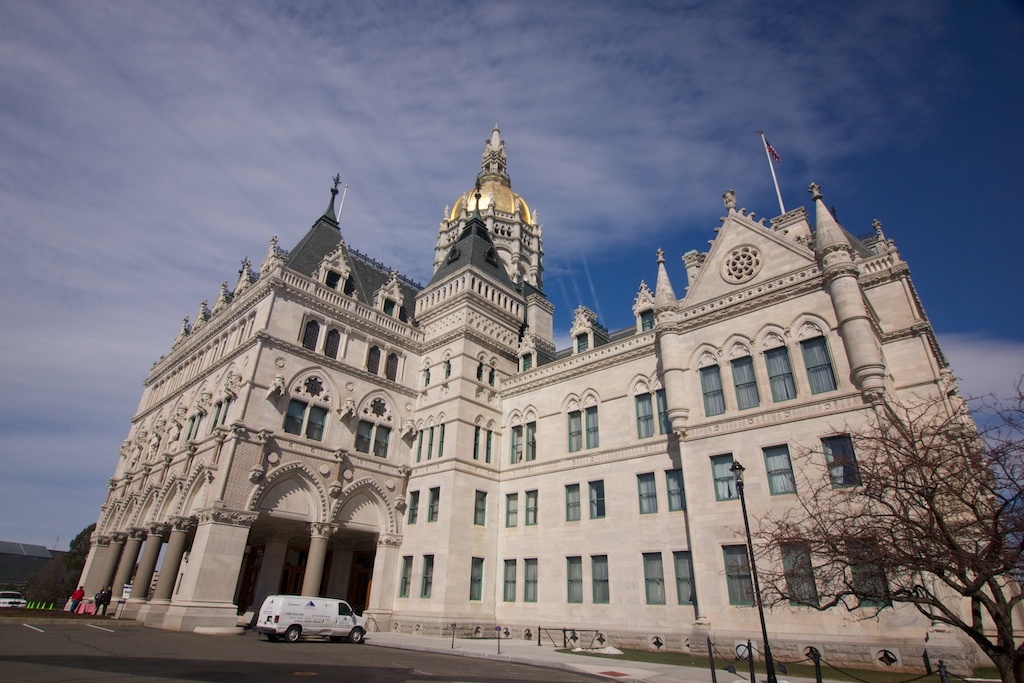
My wife and I went to the rally in Hartford at the State Capitol, seen below gloriously distorted by my new super wide angle lens.

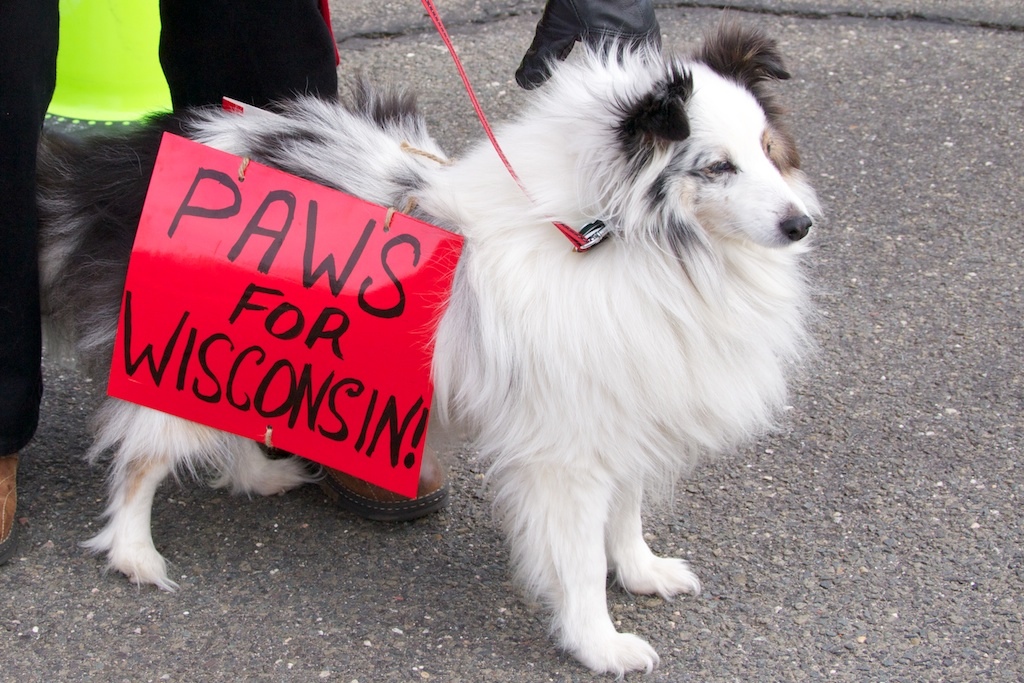
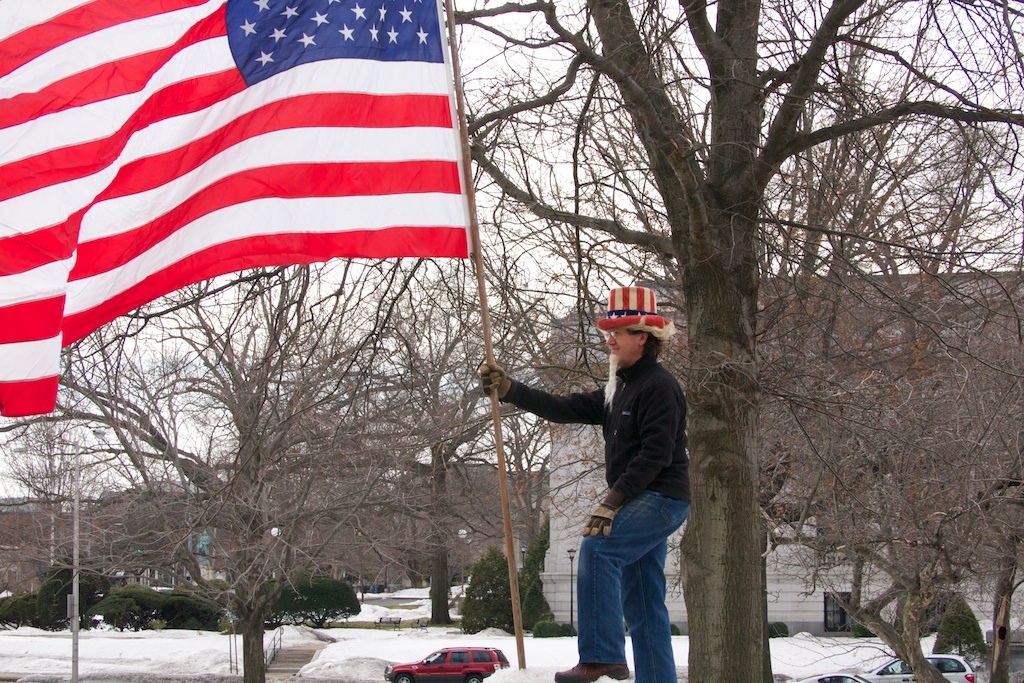
I mostly busied myself taking pictures of signs. A few choice ones below, and, if you’re interested, another page of them, complete with slideshow, at my MobileMe gallery, at this link.


These rallies, nationwide, were every bit as big, if not far bigger than the tea party rallies that have gotten so much attention, but of course these will be ignored. At the end of the day, however, we vote too, and we also get angry. Just as the Koch brother’s money and the right’s propaganda got the deluded tea partiers motivated to vote in 2010, the Koch brother’s money and the Republican party’s overreach will get us motivated in 2012. What our choices will be that year is another question. There was a teeny (maybe 5 people) tea party counter-demonstration at the Capitol. If the rally is covered at all, I assume they will get at least equal coverage, if not more.


Friday Night Video

Dedicated to John Stewart. Sometimes it’s just not appropriate to maintain your ironic distance and push the faux equivalency bullshit.

Natalie:

Pete

Speaking of choosing sides, why aren’t there any big name Democrats standing with the people of Wisconsin? They’ll raise money off this situation, no doubt, but when it comes to actually standing up for what they purportedly believe, they all seem to have other things to do.