Skip to content

Art on Groton Bank Saturday

Just a reminder. Once again Art on Groton Bank will hold an event in the shadow of the Groton Monument, right next to the Bill Library at 240 Monument Street.

If you’re in the market for some good original art at reasonable prices, stop on by. Even if you are not interested in buying, it’s fun to look.


Heads Simmons Wins, Tails Dodd Loses

Numerous bloggers on the left have remarked about the fact that the media’s propensity to find that any development, no matter how superficially negative for the Republicans, is actually good news for them. It’s mainly a national media phenomenon, but it does tend to infect local media as well. Consider this from this morning’s Day, an excerpt from an article about Chris Dodd’s stellar fundraising quarter:

But the [Dodd] campaign also showed an eye for some of the public relations missteps that have dogged Dodd over a difficult year. The senator’s press release boasted that the campaign “received more individual donations from Connecticut than any other state.”

Just three months earlier, Dodd’s first quarter report showed robust fundraising, but, the Connecticut Post reported, only four contributions from individuals who reside in Connecticut.

Simmons, meanwhile, is in a position to highlight the geographic breadth of his support, as he attempts to tap into a national wave of criticism to topple Connecticut’s suddenly vulnerable senior senator. The challenger’s campaign has received contributions, a Simmons campaign release said, from 49 of the 50 states.

Three months ago it was a negative that Dodd’s money came from out of state. Simmons, on the other hand, is now blessed because he is able to brag that so much of his money comes from out of state. Am I missing something, or is there something inconsistent here?

Speaking of the Senatorial campaign, Merrick Alpert has announced his fund raising numbers, and they ain’t pretty. Via Connecticut Bob:

New London, Connecticut – Merrick Alpert’s US Senate campaign reported today $44,315 in donations for the 43 days since Merrick Alpert announced his candidacy.

Merrick does some wild spinning, but these numbers are dismal. This is not a credible candidate. To put it in a little perspective: if Merrick doubled his take every quarter he wouldn’t get into credible candidate territory until the quarter ending June 30, 2010, and wouldn’t have a quarter as good as Chris just had until the quarter ending September 30, 2010. Money is still the name of the game in politics and with that kind of fundraising, Alpert will be lucky to keep current on the rent for his New London HQ. Here’s hoping that someone will do a little looking at who the donors are, particularly the on-line donors. How many were steered his way by Fox and Friends (i.e., how many are historically Republican donors)?


Afraid of empathy

Charles Grassley, who has somehow been elected a United States Senator,quakes in fear at the prospect of a judge who is able to feel empathy:

President Obama said that he would nominate judges based on their ability to “empathize” in general and with certain groups in particular. This “empathy” standard is troubling to me. In fact, I’m concerned that judging based on ’empathy” is really just legislating from the bench.

The Constitution requires that judges be free from personal politics, feelings and preferences. President Obama’s “empathy” standard appears to encourage judges to make use of their personal politics, feelings and preferences. This is contrary to what most of us understand to be the role of the judiciary.

It should be noted here that Obama did not say he would nominate judges based on their ability to empathize “with certain groups in particular”, unless by certain groups Grassley refers to ordinary people. But let that pass.

Of course Grassley is just grandstanding, mindlessly repeating a meme that has so far failed to spread, and will most likely not spread. But let’s for the sake of discussion, examine the point.

First let’s examine the meaning of the word, and I know this is tiresome for Republicans, who, like Humpty Dumpty, like to make words mean whatever they say. But if we insist on letting the word mean what it actually means, it means this:

Identification with and understanding of another’s situation, feelings, and motives.

In a nutshell, a person able to empathize is one who is able to walk in another’s shoes. I would argue that it is impossible to be a good judge without being able to empathize. It’s certainly impossible to be a good lawyer, or at least a good litigator. The job requires an ability to see both sides (or all sides) of an argument-to put yourself in the place of another and try to see things from their point of view. It’s necessary for a lot of practical reasons. If you can’t do it, you can’t anticipate the other guy’s arguments. If you can’t empathize, you can’t advocate well for a client, who might have problems and life experiences totally foreign to your own. And if you can’t empathize, and you’re a privileged white male such as John Roberts, you can’t understand the perspective of the individual as opposed to the corporations which are the sole entities with which you can relate.

Grassley seems to believe that there really is such a thing as the “law”, which can be applied mechanistically. If that were the case, we could replace judges with computers. Justice Holmes wrote that “The life of the law has not been logic ; it has been experience.” That experience should include other’s experiences, which we cannot appreciate without empathy. Judges are called judges for a reason; they are supposed to exercise good judgment, and that requires empathy.

Of course, in reality, Grassley has no objection to empathy. He has no problem with a judge that can empathize, it’s just that he has a problem with the people with whom he’s afraid Sotomayor will empathize.



How much would you pay?

Editor and Publisher reports that the New York Times is doing a survey to determine how much its readers would pay for access to its website. As one who is still paying for three print newspapers and several magazines, I think I can make a credible claim that I am not reluctant to pay for the news.

But I would be reluctant to have to pay for access to individual newspaper websites. The great thing about the web is the fact that one can follow a chain of links to wherever one wants to go. It would be frustrating in the extreme if one ran into subscription roadblocks at every website one attempted to reach.

On the other hand I fully agree that we can’t expect to get the news if we don’t expect to pay for it, and that it’s very likely that advertising alone won’t produce the revenue that’s needed.

I have a modest proposal. I recognize that this may run into anti-trust issues, but if necessary Congress should step in and clear the way.

I would be happy to pay a monthly fee for access to all newspapers on the web. The revenue from that fee could be distributed to the various papers based on a reasonable formula, considering number of hits, etc. Local newspapers might get a larger share of the fees from people residing within their geographical areas. My point is that we should provide for a stream of revenue while maximizing the convenience to the consumer. I am willing to pay so that I can access, let’s say, the Miami Herald, should a link take me there. I’m not willing to open an account with the Herald to enable infrequent access. I also think that there should be some sort of provision for a family plan for this sort of thing. We buy the physical Times every day. My wife and I both read it, and there’s no extra charge. Same with cable, as many as you like can watch without any extra charge. The same should apply to news subscriptions.

A little imaginative thinking is needed to resolve this issue. We are approaching a crisis. I love bashing the media as much as the next guy, but the fact is we need it, particularly the print media. We would need to assure that new entrants to the field would not be barred or that artificial roadblocks were not built into the system. I don’t think any of those problems are insurmountable. In the end, I think people would pay a monthly fee for access to news, just like they pay for cable, etc.

In my own case, I would probably save money under such a plan, assuming I dropped the print subscriptions. But that shouldn’t matter much to the publishers, since the cost of web distribution is so much less than the cost of physical distribution.


Groton Odyssey

For reasons of no interest to anyone but us, we couldn’t stray far from home today, so we took the chance to take in a few of Groton’s many attractions. Few people outside of Groton know that Mystic is not all there is to our fair town.

This is the view from Fin’s Cafe, which is located at UConn’s Avery Point campus and is open to the public. We went there for lunch and had the place almost to ourselves.

This was the view of my meal (fish and chips), which was surprisingly good. It’s hard to make fish and chips that aren’t acceptable, but it’s also hard to make them especially good, and these were pretty darn good.

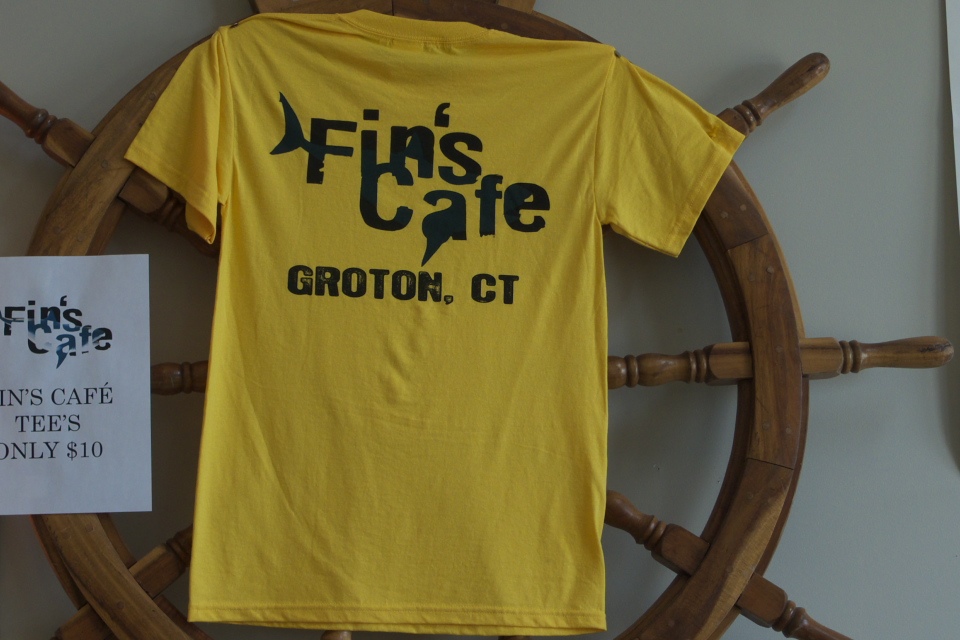
Here’s proof that we really were at Fin’s Cafe, in case anyone doubts it

And for those of you unfamiliar with the area, you might be surprised to learn that here is the view of Long Island Sound from the UConn Avery Point campus, taken from what was once the lawn of a turn of the (last) century robber baron, whose house you can see in the succeeding picture.

Groton is also blessed with a working farm, situated right in the middle of Town. Well, actually, Groton doesn’t have a middle of Town, but to the extent it does, this farm is right there. The field is populated by free range chickens and sheep. None of the latter were in evidence today, but the chicken were out in abundance, and are apparently quite used to being fed by visitors, as they came running when this Mom and her kids (who are hidden behind her) went up to the fence with some feed.

The farm stand sells eggs direct from the above depicted chickens, some produce, and local honey and maple syrup.

The farmer seemed like a very nice guy. We have been meaning to stop in for ages and finally took the opportunity today.

So much for our quick trip through Groton. Fireworks tonight, but we’ll be staying home.


Student loan companies demand access to guaranteed profits

There is a sort of replay of the health care debate, writ much smaller, going on now in Congress. The Obama administration wants to go to a single payer system-in the student loan business. This runs counter to the long tradition in this country that mandates that some private company or individual should always be put in a position to divert a goodly portion of government outlays from their intended purpose to themselves. This is private enterprise-emphasis on the private, not so much on the enterprise, as some might call it welfare.

The federal government already makes some loans directly to students, but most federal student loans are handled by private firms even though there is virtually no private capital available for financing the loans. The industry argues that it provides competition and better marketing and servicing of loans.

The administration’s view, shared by a number of Democratic lawmakers, is that the private lenders should no longer be paid by taxpayers to operate a virtually risk-free business in which they essentially use taxpayer dollars to originate loans, with repayment guaranteed, and then resell those loans to the Treasury. (Emphasis added)

It’s not quite clear who these folks provide competition for, unless it’s with each other. Nor is it explained why, in this particular case, we need competition. However, it is an article of faith in this country that competition is always good, so I won’t belabor that point too much, except to say that the track record appears to indicate that the competition takes the shape of fraud. Nonetheless, according to the industry, it is absolutely necessary that it be there to divert $15 billion taxpayer dollars into its own coffers, and out of the hands of student borrowers.

For the moment, things are looking up for the single payer system. But don’t count the do nothing industry out. There’s a lot of money in them thar loans, and all the usual suspects are standing ready to divert our money into the hands of these useless middle people. Naturally, that includes Republicans:

Some Republicans have said that in curtailing the role of private lenders, Democrats are trying to expand government.

Senator Lamar Alexander, Republican of Tennessee and a former federal education secretary, said direct government loans were never meant to monopolize student lending.

“This effort by the Obama administration for a Washington takeover of student loans is just one more example of a long line of Washington takeovers of banks, insurance companies, car companies, health care, that I totally object to,” he said.

It’s sort of hard to see the problem with the government taking over the administration of the loans it is making with its own money, but I’m sure the problem is crystal clear for Republicans. In any event, the status quo is a two-fer for Republicans-a chance to line the pockets of campaign contributors and an opportunity to claim that a government program that they have worked hard to cripple doesn’t work.

As I said, things are looking up on this front at the moment; critical Democrats in the House have grown a spine on the issue. But I’d put my money on the student loan industry, because it will be putting its money into the “people’s” representatives.


Friday Night Music-The Dead

The consensus at our last Drinking Liberally was that I had never posted any videos of The Grateful Dead, a grievous oversight which I shall try to rectify today.

In truth, for reasons I cannot explain, I never listened to the Dead when I was young. I never owned one of their albums, never went to their concerts, and never even, so far as I can recall, made a reel on reel tape (yes, I had a reel on reel, I am that old) of someone else’s album.

So, my knowledge of the band practically begins and ends with Keep on Truckin’ which I present here:

While grazing through youtube looking for Dead stuff, I was somewhat surprised at the paucity of material. Given their reputation for allowing taping, etc., I thought there’d be a lot of stuff, but there’s not really that much, and some of the videos I watched were terribly out of sync (music lagging the words by seconds). I did stumble on this one, which I enjoyed: an older Jerry Garcia singing Peggy-O.


Priorities

In Yesterday’s New London Day the first three pages were full of stories about a man who abducted his ex-wife. The next couple were about Michael Jackson’s funeral. You had to get to page 5 or 6 before you hit any real news. In today’s paper the front page is again all about the same abduction. It is an interesting fact that this event happened, certainly worthy of coverage somewhere in the paper, but two days of front page coverage? Who cares?

Other than the woman who was abducted, this story has precisely no impact on the ordinary lives of the people of Connecticut.

Buried on page 2, in a News in Brief article, is the fact that our benighted Governor vetoed a health care bill. Support it or not, that bill would have had a lasting impact on the people of this state. People should at least know about it. But according to the Day, it is far less important than a tawdry story about a mentally disturbed, publicity seeking criminal. But why complain? Had it been covered, the substance of the bill would have been ignored in favor of the political gamesmanship involved in its passage or defeat.

I suppose it may be true that people read sensationalistic articles, and tend to glaze over when real issues are covered, but the fact is that TV has it all over the print media when it covers these pseudo-events. After all, besides the breathless anchors, TV offers moving pictures and entirely thought free content, something print can’t do simply because it requires reading.

Print media is dying, in part due to the internet, but also in part because it has abandoned its reason for being. It no longer seeks to inform, preferring to compete with television, from a decided disadvantage, in the titillation derby. It may get some sort of short term advantage by ignoring stories of real importance, but over the long run it only encourages its readers to drift away


Here we go again, even before we’ve cleaned up the first mess

From Bloomberg (via Josh Marshall):

Morgan Stanley plans to repackage a downgraded collateralized debt obligation backed by leveraged loans into new securities with AAA ratings in the first transaction of its kind, said two people familiar with the sale. …

Two years after the credit markets began to seize up, costing the world’s biggest financial institutions $1.47 trillion in writedowns and losses, banks are again taking so- called structured finance securities and turning them into new debt investments with top credit ratings. While the Morgan Stanley deal is the first to involve CDOs of loans, banks have been doing the same with commercial mortgage-backed securities in recent weeks.

Life is certainly more speeded up these days. It took 66 years for Congress to un-learn the lessons of the Great Depression (1933: passed the Glass-Steagel Act; 1999: repealed it). It took these bankers less than nine months to unlearn the lessons of the Great Bailout. But then, maybe they’ve learned those lessons only too well. Why not act recklessly if you know you’ll cash in with big bonuses and that Uncle Sam will ride to the rescue when disaster strikes. Meanwhile, Congress appears to have learned nothing, except how to take money from bankers eager to destroy the economy yet again.


Finally