Skip to content

Overreacting

Things are getting a bit fevered out there:

You know, it strikes me that the best way to really restore sanity and a measure of stability to the mortgage industry is to ensure that the people most harmed by predatory lending practices, who were on the receiving end of extraordinary dubious financial advice which has, in many cases, cost them not only their home, but also their credit rating and future viability in the job market, is to bar them from seeking remedy in the the courts.

Oh, shit. What am I saying? That’s not what I think at all. Must be the after effects of those weird Republican drugs I was taking over the weekend that always make me think the stupidest, cruelest shit imaginable is really, fundamentally awesome. Well, at least we don’t have to worry about Democrats proposing that sort of nonsense.

What’s that you say? Oh, shit.

The “oh, shit” link (the post is from Suburban Guerilla) is to an article about Hillary Clinton, and the clear implication is that Hillary has proposed barring homeowners from suing predatory lenders. If that’s true it is not borne out by the linked article:

The New York senator proposed greater protections for lenders from possible lawsuits by investors, a variation of so-called tort reform. For years, GOP leaders have called for restrictions on what they consider unwarranted lawsuits against businesses. Democrats have often resisted them on grounds they limit injured parties’ legitimate rights to redress.

“Many mortgage companies are reluctant to help families restructure their mortgages because they’re afraid of being sued by the investment banks, the private equity firms and others who actually own the mortgage papers,” Clinton said in what she billed as a major address on the economy at the University of Pennsylvania.

There is nothing in the article to support the contention that Clinton is trying to bar the homeowners from suing. Clinton is talking about people who invested in the sliced and diced mortgage backed securities. I.e., she is turning the Republican guns back at them, since it is the fat-cats (well, slightly less fat now) who would be thrown out of court.

We Democrats have to stop beating up on our own.
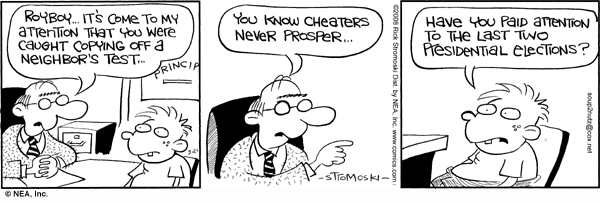
In which I beat several dead horses

From this Morning’s Times:

“The news business is something worse than horrible. If that’s the future, we don’t have much of a future,” Sam Zell, who bought the Tribune Company last year, said recently in The Baltimore Sun.

The Tribune Company, and therefore Sam Zell, owns the Hartford Courant.

Years ago I heard a story about the company that made Gravy Train dog food. Spurred on by the bean counters, it continually cheapened the formula in its gravy making dog food. Sales began to plummet. At first they couldn’t figure out why. Then they found out: the cheaper formula no longer made gravy. I heard this story years ago, and can’t vouch for it 100%, but it has the ring of truthiness.

Which brings us to Mr. Zell’s Hartford Courant. Today’s front page features the following:

1. Top Story: First born children get more attention from their parents.

2. There’s a woman in Connecticut who does animal autopsies.

3. People in the tiny upscale suburb of Colebrook help each other.

4. Look inside for a story about Personal Digital Keyboards if you want to play the piano.

5. There’s an antique mall in New Haven, look inside.

Also on the front page, besides the above “articles”:

6. A “link” (sorry, I can’t think of the correct term) to the sports pages, re: the UConn women.

7. A “link” to a story about “Bunnytown”, a “Kid’s Show for Grownups”.

8. A “link” to a story on page A3 about the 4,000th American casualty in Iraq.

Maybe the reason newspapers are having such a hard time is that they’re not making gravy anymore, or not much of it, judging by the above. No doubt Mr. Zell would tell us that he’s giving the people what they want, but the fact remains that the decline in newspaper readership corresponds in time to the de-newsification of the average newspaper.

Sidebar: Also in this morning’s Times, we are told that the media is paying less attention to the Iraq War, which is blamed on the fact that the public is losing interest. There’s a chicken and egg problem there, but that seems to be mostly ignored in the article.

To every cloud there is a silver lining, of course. I was struck by this:

“I was getting on average three to five calls a day for interviews about the war” in the first years, said Michael E. O’Hanlon, a senior fellow on national security at the Brookings Institution. “Now it’s less than one a day.”

It would be nice if we could conclude that the media has stopped calling Michael O’Hanlon because he was wrong about Iraq at the start and has been consistently wrong all along, but that is too much to hope for. In this country, being consistently wrong is a mark of distinction. Why, even Hillary wants to put Alan Greenspan in charge of fixing the mess he helped create.

“Moving paper fantasy” hits real wall

Last month I mentioned an article I read about “credit default swaps”, another off the books sort of financial chicanery that might be lurking in the background ready to cause financial havoc. These are, as best as a I understand, freely tradable credit “insurance policies”, which, for the holders, amount to bets that insured loans will default.

There are three excellent articles in today’s Times on the financial crisis, one on the front page (here) , and two in the business section (here and here). The first article has been justly criticized for noting that George Bush and his treasury secretary are philosophically opposed to regulations that hamper economic activity, as if there are people who are philosophically in favor of such regulations. Nonetheless, it does a pretty good job of laying out the issues we will be facing as we look to regulate investment banks and the various financial instruments in which they trade. If, as seems more and more likely, we are to endure another four years of a Republican chief executive, we are likely to get next to nothing by way of real regulation of these entities. If the people opposing these regulations had the interests of these institutions at heart they would accept a fair degree of regulation, because their long term existence is at risk if they must compete with other unregulated institutions in dealing with ever riskier and more complex instruments that they don’t understand. But if you stand to gain a hundred or two hundred million dollars in income in a year or two, income you get to keep when the institution you are “serving” tanks, you have a powerful disincentive to fight something that might be to everyone’s long term good. It is beyond belief that these greedheads are allowed to make unregulated decisions that, eventually, are bound to have catastrophic effects on the economy. But they are, and there are always true believers who will tell you that unregulated markets are the cure for all that ails you, notwithstanding history and common sense to the contrary.

Both articles in the business section put those credit default swaps at the heart of the financial mess and/or the recent bailouts, and Gretchen Morgenstern, in the first of the linked articles from the business page, pretty much claims that the recent Bear Stearns bailout was at least in part an attempt to deflate this unregulated market:

But a closer look at the terms of this shotgun marriage, and its implications for a wide array of market participants, presents another intriguing dimension to the deal. The JPMorgan-Bear arrangement, and the Bank of America-Countrywide match before it, may offer templates that allow the Federal Reserve to achieve something beyond basic search-and-rescue efforts: taking some air out of the enormous bubble in the credit insurance market and zapping some of the speculators who have caused it to inflate so wildly.

Of course, it could be simple coincidence that the rescues caused billions of dollars (or more) in credit insurance on the debt of Countrywide and Bear Stearns to become worthless. Regulators haven’t pointed at concerns about credit default swaps, as these insurance contracts are called, as reasons for the two takeovers. (And Bank of America’s chief executive, Kenneth D. Lewis, has flatly denied that his deal with Countrywide was at the behest of regulators.)

Yet an effect of both deals, should they go through, is the elimination of all outstanding credit default swaps on both Bear Stearns and Countrywide bonds. Entities who wrote the insurance — and would have been required to pay out if the companies defaulted — are the big winners. They can breathe a sigh of relief, pocket the premiums they earned on the insurance and live to play another day.

On the other hand, the big losers here are those who bought the insurance to speculate against the fortunes of two troubled companies. That’s because the value of their insurance, which increased as the Bear and Countrywide bonds fell, has now collapsed as those bonds have risen to reflect their takeover by stronger banks.

Naturally, of course, the losers will not really be the speculators who have caused the problem, because they are the hedge fund managers. The losers will be the people who invested in these hedge funds. There is probably no need to shed tears for these folks, but it would be nice to see the managers take it on the chin. But will they? According to Morgenstern:

It’s pretty clear that some major losses are floating around out there on busted credit default swap positions. Investors in hedge funds whose managers have boasted recently about their astute swap bets would be wise to ask whether those gains are on paper or in hand. Hedge fund managers are paid on paper gains, after all, so the question is more than just rhetorical.

If I understand that right it means that the hedge fund managers can give themselves a payday by declaring paper gains when they buy these instruments, and then hand the losses over to the investors (and the hedge funds) when those paper gains become real losses. Like the heads of all those mortgage companies, they’ll walk away with real millions while leaving failed companies in their wakes. Presumably this will cause more financial havoc, and as with the investment banks, we will somehow end up picking up the pieces.

Friday night Music-Woody Guthrie

I’ve made it a rule to avoid this type of video, in which there’s actually no video, but most rules are made to be broken. It being Good Friday, this song seemed to be appropriate.

[youtube]http://www.youtube.com/watch?v=EDS00Pnhkqk[/youtube]

It’s time for her to go

Josh Marshall links to this article at the Politico that argues that the press has been complicit in pushing a narrative that Hillary Clinton still has a chances to win the nomination. In this morning’s Times, even that narrative appears to be crumbling. Bill Richardson’s endorsement is likely the first in a cascade of endorsements from super delegates, who recognize the need for this battle to be over, to allow Obama to pivot and face McCain.

Wouldn’t it be nice to see Hillary put her country (and, incidentally her party) first and leave with her head high? We have an uncommitted superdelegate here in the Second, our own Joe Courtney. Maybe it’s time for Joe to get on board the Obama train, no matter which of the two he would actually prefer. We need to circle the wagons around our eventual candidate. That candidate, it now seems clear, will be Barack Obama. So long as Hillary is out there it will be more difficult for Obama to deal with the Swift boating he is currently enduring.

Today’s Comic

soup2nutz2008048899321.gif

Happy Good Friday

Today we observe Good Friday, on which the believable events of the Easter myth took place. It takes no stretch of the imagination to believe that a person with a revolutionary message like Jesus’ would be executed. As for the rest, well return from the dead is a bit hard to swallow, Richard Nixon’s political comeback notwithstanding.

I spent a large part of last evening searching youtube for a good outtake from the film version of Jesus Christ Superstar. In my humble opinion Webber and Rice did a good job of exploring some of the issues raised by this fable, particularly the fate of poor Judas. It is the case, after all, that we can only assign real blame to him if he was not, as the story implies, a cosmic pawn in Jesus’ game. I had never seen the film version before. It turns out the whole thing is available on youtube, chopped into pieces, song by song. Unfortunately it is terribly dated. Jesus and his pals are portrayed as a bunch of roving hippies; and what’s with all the males, including the high priests, wearing clothes that bare their chests? (Except Jesus of course). So the film’s a no-go. Before I leave that subject, why is it the case that in every film about Jesus he’s portrayed as a sort of weakling blond guy, who appears more acted upon than actor? The guy was a Middle Eastern Jew and was a carpenter for at least 10 years. That was before the days of power tools folks. He should be portrayed as muscle bound, dark skinned, and dark haired and, god or man, someone with a little charisma and intestinal fortitude. I mean, the man drew large crowds and, if the story is to be believed, withstood torture and a grisly execution. Even the CIA couldn’t have broken him.

So, since Jesus let me down again, at least his filmed versions, I am falling back on an old stand-by, the very best movie ever made about crucifixion, The Life of Brian, in which we learn a few lessons about life:

[youtube]http://www.youtube.com/watch?v=1loyjm4SOa0[/youtube]

Now that’s true theology.

The news, 21st Century style

This morning’s Day (I couldn’t find the article on-line), on page A-3 (not the Entertainment section), contains a short AP article reporting the latest developments in American Idol. The doings on the TV show are reported as straight news. We are informed that a contestant that one of the judge’s didn’t like has been voted off the show. What’s next? Perhaps we’ll be getting page three accounts of the latest developments in popular soap operas.

This is not quite the same as reporting fantasy as reality, but it comes awfully close. Is this a reflection of the way people think, or is the media creating a mode of thinking that blurs the line between fact and fiction. Perhaps the tendencies reinforce one another. We live in strange times indeed.

Vidal gets in the last word

Old enmities die hard. Gore Vidal takes a swipe at Newsweek for sullying his reputation in the course of burnishing that of the loathsome William F. Buckley. It’s worth reading, if just for the prose stylings, though it appears to suffer from a lack of editing. I’m old enough to dimly remember the debate to which Vidal refers, in which Vidal defended the rights of the demonstrators in Chicago 1968, and Buckley stood up for the police state. Vidal is right that Buckley consistently got a free pass from the “liberal” media, which chose to ignore his Neanderthal views and some quite despicable actions because he kissed their asses and used big words, which in the view of many made him a bona fide intellectual. All that aside, there seems to have been a falling off since then, judging by the type of idiots who pass for commentators these days. Buckley does appear to be an intellectual giant compared to pygmies like Sean Hannity, and when was the last time someone as decidedly left wing as Gore Vidal was allowed on national television.

Toward the end of his screed Vidal makes an observation about the state of our media which I must pass on, since it is in accord with my own thinking, and therefore must be right:

The unique mess that our republic is in can be, in part, attributed to a corrupt press whose roots are in mendacious news (sic) magazines like Time and Newsweek, aided by tabloids that manufacture fictional stories about actual people. This mingling of opinion and fiction has undone a media never devoted to truth. Hence, the ease with which the Republican smear-machine goes into action when they realize that yet again the party’s permanent unpopularity with the American people will cause them defeat unless they smear individually those who question the junk that the media has put into so many heads. Anyone who says “We gotta fight ’em over there or we’re gonna have to fight ’em over here.” This absurdity has been pronounced by every Republican seeking high office. The habit of lying is now a national style that started with “news” magazines that was further developed by pathological liars that proved to be “good” Entertainment on TV. But a diet of poison that has done none of us any good.

Unfortunately, this paragraph is one that suffered from bad editing or bad transcription, but the basic message gets through.

Thirty and counting

Today my wife and I celebrated our thirtieth anniversary. I’m none the worse for wear. At least I don’t feel the worse for wear. That’s not really so surprising since I’ve spent those years married to her. What’s amazing is that she’s also held up remarkably well, despite spending thirty years married to me.