Skip to content

Friday Night Music

Well, this weeks choice should be no surprise. Pete Seeger died this week, so he’s the obvious choice. The folk craze crested just before I became musically conscious. I got my transistor radio when I was about nine, but if they weren’t playing it on the Big D, I didn’t hear it, and they weren’t playing Pete, since at the time, he was fighting contempt of Congress charges and they weren’t going to play his music, though they were playing plenty of other people playing his music. The first song of his that I really recall hearing was Little Boxes, but the song that I most associated with Pete (not knowing he had at least partially written We Shall Overcome, and had wholly written If I Had a Hammer, was this gem, which made an irrefutable argument against the Vietnam War in just a few verses:

For good measure, here he is singing If I Had a Hammer, way back in 1956.

It’s great that he outlived the people who tried to hunt him down in the fifties, and he’ll live on in our collective memories while they will live in infamy. One thing that comes through in all of his performances is how genuinely nice he was.

By the way, there’s a petition out there to have the new Tappan Zee bridge named after Pete, who spearheaded the drive to clean the Hudson. It’s unlikely that barely Democratic Governor Andrew Cuomo will agree to do it, but it can’t hurt to add your name.

Yet another chapter of “What Could Go Wrong?”

Wall Street’s latest trillion-dollar idea involves slicing and dicing debt tied to single-family homes and selling the bonds to investors around the world.

That might sound a lot like the activities that at one point set off a global financial crisis. But there is a twist this time. Investment bankers and lawyers are now lining up to finance investors, from big private equity firms to plumbers and dentists moonlighting as landlords, who are buying up foreclosed houses and renting them out.

via The New York Times>

There is absolutely nothing that distinguishes this particular scam from the one the banks pulled the last time. If anything, this will encourage even worse misbehavior on the part of all concerned. Start with the reasonable assumption that the people writing these loans won't give a damn if they are ever repaid. Add to that the fact that the people taking out the loans will also not care if the loans are ever repaid, so long as they can drain as much money as possible from these properties while they let them rot. For, unlike the last time, the individual actors will be safely ensconced behind corporate shields; when the properties go into foreclosure the only entity owing any money will be an LLC. These people have learned their lesson all too well; when this all blows up in their faces they will be well protected on our dime, and in the meantime they can skim money out of the economy while once again adding no value to it. This time the nation will be left with yet another crash and crumbling housing stock to boot.

One added feature, which some small minded people might call a bug: this hastens the feudalization of the United States of America. It won't be long, I suppose, before they drop the “land” and just ask us to call them “lords”.

Banking going postal?

I mentioned a short time ago that I was reading Doris Kearns Goodwin's Bully Pulpit. I'm not still reading it. I'm not that slow. One thing I was interested in was the fact that both TR and William Howard Taft advocating postal banking, i.e., allowing people to open savings accounts at post offices. It was a way of allowing people to access banking services without accessing banks, which were unavailable to many in any event. I can't recall Goodwin actually saying that the bill passed, but apparently it did, for according to the folks at Naked Capitalism, the post office was in the banking business, to a limited extent, from 1911 to 1967.

A couple of times I've advocated for a state bank here in Connecticut, much like the state bank in (of all places) North Dakota. It would be a public option, so to speak. Well, apparently there's a movement to bring limited banking services back to the post office. Not only would it bring banking services to underserved communities, but it would also get some money to the post office, which Congress has legislated into a permanent state of bankruptcy. Apparently, the post office at least arguably has the statutory authority to do this without having to go through our dysfunctional Congress.

Still, I can't help but think that we have come to a sad state of affairs when the progressive folks at Naked Capitalism are encouraging their readers to support this plan, part of which involves the post office getting into the payday loan racket. Granted, compared to the highway robbery of the payday lenders, the effective rate of 28% it would be charging is a “screaming bargain”, but it's still about 27 percentage points more than I get for lending my money to my bank, and far more than the world's biggest deadbeats, the big American banks, pay Uncle Sam to borrow money to finance their crimes.

Where will all our money go, long time passing?

Isn't it odd how so many plans to help the American worker involve giving their money to Wall Street?

Another map of the stupid

And more glory to our part of the country. Just recently I wrote about a recent study that purported to explain the red state divorce rate as a by-product of religious fanaticism. Well, here's a few more studies proving that we blue people are superior.

First, check out the map at this link, which shows the locations of publicly funded schools that teach creationism. There is some disturbing data there, in that the stupid appears to be infecting parts of Indiana and Ohio. I can understand Indiana, which has a redneck history from way back, but I'm hoping that Ohio will get disinfected when they throw out the tea party legislature they so improvidently elected in 2010 or thereabouts. Anyway, nice to know that Medieval thinking is alive and well- somewhere else.

But wait! Here's more data to make your chest swell as a proud blue stater, even prouder Northeasterner, and ultra-proud New Englander. Check out the map and data list here, rating the urban areas of this country by religiosity. The survey was done by a religious group, so it's probably suspect, but I'll take it. In the list, the first, so to speak, shall be last, and the last first. I.e., the truly godless, and therefore superior, are toward the bottom, and New England holds two of the bottom (remember, that means “top”) five spots, and the Hartford/New Haven area comes it at number 6! God only (well, he doesn't really) knows how Cedar Rapids, Iowa got into such august company, but they're welcome to the party. If they earned it, they deserve the glory.

Fuzzy math

Yet another entry in the totally not surprising category. Times Reporter Catherine Rampell reports that she has been totally unable to get at the numbers behind the oft repeated estimate that the NYC area will benefit from the Super Bowl to the tune of $550 to $600 million. Seems everyone who repeats the number has simply heard it from someone else, but when you reach the end of the line, there's no there there.

The closest I got to the source of the numbers was this: Alice McGillion, a spokeswoman for the New York/New Jersey Super Bowl Host Committee, using careful, passive-voice syntax, said the estimate was commissioned several years ago as part of the local bid to host the event, which takes place next Sunday at MetLife Stadium in East Rutherford, N.J. But, Ms. McGillion added, “a decision was made” not to release the study that generated the numbers. She could not say why it was never released, who created it, what the underlying assumptions were, or even whether it represented just benefits or included costs. After a while, she stopped returning my calls and emails.

Which is perhaps not unexpected, because virtually every time a government or athletic organization describes the economic benefits of hosting a major sports event, economists pick apart the calculations as flawed, myopic or outright fraudulent.

via The New York Times

This is yet another example of rent-seeking, which perhaps reaches its most obnoxious peak in the sports arena. Andrew Cuomo was all set to throw $200 million at Syracuse University to build a football stadium, but does anyone believe that he would throw that kind of money at a state of the art research or teaching facility? Detroit is bankrupt, but as Bloomberg News reports, Michigan Governor Snyder “approved a plan to put public money toward a $450 million downtown arena on behalf of the National Hockey League’s Red Wings and their billionaire owners”. Meanwhile, astoundingly, the NFL actually gets away with calling itself a non-profit, while it is, in fact, all about profit. We in Connecticut are not exempt, of course, with our boondoggle football stadium in East Hartford and our highly paid basketball coaches, one of whom was given a multi-million dollar contract before he ever nailed down a winning season. To put it in perspective, that's enough to pay the measly salaries of about 30 adjunct professors.

So, back to the Super Bowl. Chances are that the New York economy will never net anything close to $600 million off of the Super Bowl, but there's a good chance the Nonprofit Football League will, since New Jersey and New York will dutifully absorb all the costs.

Credit where it's due: Tom Coburn, of all people, has introduced a bill to strip the NFL of its non-profit status. Well, you know what they say about stopped clocks.

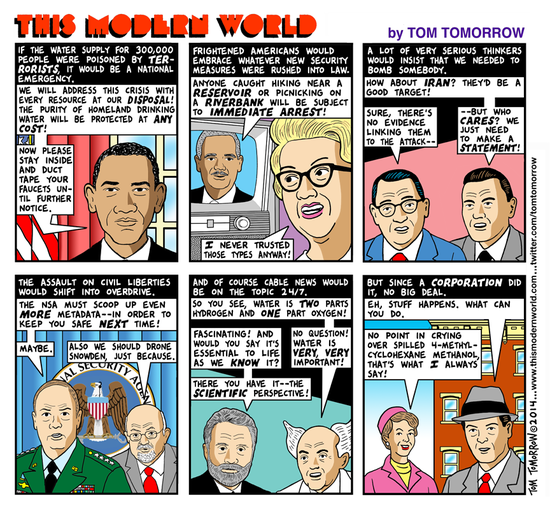
No such thing as a corporate terrorist

Tom Tomorrow’s latest:

Defining Normal

Dean Baker has a lot to say about an article in this morning's Times about the current housing market, which, as he points out, seems to be written from the perspective of the mortgage lending industry.

Dean quotes this statement from the article:

“Tighter lending standards are shutting out close to 12.5 million consumers who would qualify in normal times.”

One thing Dean doesn't point out is that the article never defines precisely when it means by “normal times”, but the implication is clear. Later in the same article, as Dean points out, the article states:

Mortgages are roughly seven times harder to get than they were five years ago, according to the Mortgage Bankers Association’s credit availability index, and they show few signs of getting easier.”

So, apparently 2008 was normal times, a time when the mortgage industry was permeated by fraud, was at the top of a ready to burst bubble, and anyone with a heartbeat could qualify for a loan.

Some people might argue that we have returned to normalcy, that while it might be inconvenient for some to be unable to qualify for a mortgage, and for others to not have the values of their homes balloon by 15% to 20% a year, for the rest of us it might be convenient to avoid the negative effects of yet another housing bubble and the inevitable mortgage industry bailout that must follow.

Here's an example of what was once actually normal: The first time I ever applied for a mortgage my wife and I were interested in buying a newly renovated home in the historical district in Mystic. The price was something like $38,500.00. The house is surely worth 10 times that today. We were turned down because the banker felt the house was overpriced by $500.00. Of course, he would have approved us in a second if he didn't have to worry about us re-paying the mortgage, as was the “normal” situation in the bubble years. But he did, so we didn't get the loan. You could argue that he was a bit too conservative, and maybe he was, but then again, that bank still exists and it got exactly $0 in bailout funds.


Friday Night Music

What can I say? It is cold outside.

Scientific proof that red states are full of yahoos

There is nothing quite so satisfying than having your preconceptions scientifically confirmed. Of course, when they are so confirmed, you don't question the solidity of the science.

I've written numerous times about the fact that there is a clear difference between red states and blue states. By almost any commonly agreed metric, we are better than them, and to boot, statistics seem to show that the red states in particular fail to practice what they preach. They preach fiscal austerity and personal responsibility, for instance, but absorb far more tax dollars than they emit. They preach religious virtue, but in practice, well…

Among other things the rate of divorce, teen pregnancy, etc., are all higher in the red states than the blue. How can this be, you might ask, when those states are full of devout family values Christians. Well, it is no surprise that divorce and teen pregnancy rates in the red states are higher because those states are full of devout family values Christians:

In a new study titled “Red States, Blue States, and Divorce: Understanding the Impact of Conservative Protestantism on Regional Variation in Divorce Rates,” which will be published later this month in the American Journal of Sociology, demographer and University of Texas at Austin professor Jennifer Glass set out to discover why divorce rates would be higher in religious states like Arkansas and Alabama – which boast the second and third highest divorce rates, respectively – but lower in more liberal states like New Jersey and Massachusetts.

It was previously thought that socioeconomic hardships in the South were largely to blame for high divorce rates, however Glass and her fellow researchers concluded that the conservative religious culture is in fact a major contributing factor thanks to “the social institutions they create” that “decrease marital stability.”

Specifically, putting pressure on young people to marry sooner, frowning upon cohabitation before marriage, teaching abstinence-only sex education and making access to resources like emergency contraception more difficult all result in earlier childbearing ages and less-solid marriages from the get-go, Glass writes in the paper.

“It’s surprising,” W. Bradford Wilcox, director of the National Marriage Project, told The Los Angeles Times. “In some contexts in America today, religion is a buffer against divorce. But in the conservative Protestant context, this paper is showing us that it’s not.”

via The Huffington Post

Unlike Mr. Wilcox, I'm not at all surprised. I would, however, be interested in knowing the “contexts in America today” in which religion really is “a buffer against divorce”.

So, as I said, this confirms my preconceptions, so it must be correct. Actually, you could probably arrive at the same result through the process of induction (or is it deduction? …whatever) without the rigorous science that I'm sure went into this study.

In any event, yet more proof, if any were needed, that we don't need no religion round here.