Skip to content

Housekeeping

In response to overwhelming demand (one commenter, with whom my wife agreed) I am going to create a new category, entitled “Music”, to which I will retroactively assign the Friday night music series. It may take a while, but I’ll do it as quickly as my schedule allows.
Typical

Today the Public Editor of the Times does what he does best, cover for the Times, if only half heartedly. This time for it’s choice of Bill Kristol as a columnist. Subtitle on the RSS Feed: Is hiring William Kristol the worst idea ever? I can think of many worse.

So could I. The overriding point is that there are probably an infinite number of people who could do a better job.

But I write again not to protest this stupid move, but to protest the following:

Of the nearly 700 messages I have received since Kristol’s selection was announced — more than half of them before he ever wrote a word for The Times — exactly one praised the choice.

Rosenthal’s mail has been particularly rough. “That rotten, traiterous [sic] piece of filth should be hung by the ankles from a lamp post and beaten by the mob rather than gaining a pulpit at ANY self-respecting news organization,” said one message. “You should be ashamed. Apparently you are only out for money and therefore an equally traiterous [sic] whore deserving the same treatment.”

This has become standard operating procedure on the part of the media when it is attacked. Hoyt says he received 700 messages; Rosenthal obviously received other messages, so let us assume there were at least 1,000. Exactly one is reproduced, from someone so illiterate he or she could not spell “traitorous”, or even run it through a spell-checker. Hoyt implies, but does not state, that this message was representative, but that seems unlikely. Again, we have the tendency to cherry pick the worst in order to tarnish everyone. For if the message is not representative, why reproduce it?

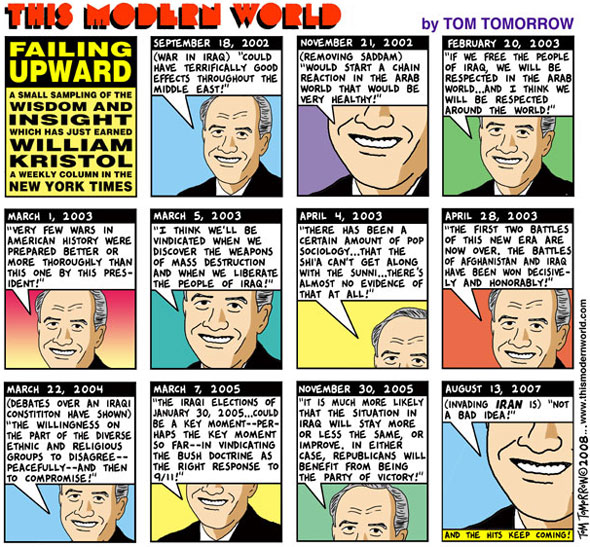
To add to his sins, Hoyt fails to truly engage with the criticism I have heard the most. No, it’s not that Kristol suggested prosecuting the New York Times, though that is mentioned. It’s not even that he was wrong about the Iraq war. It’s that he is wrong about everything. Full time, all the time. Perhaps Tom Tomorrow can help:

original-image010808.jpg

Comics Saturday

As I’ve mentioned before, we get three papers in the morning, and I have about twenty minutes to read them (except on Saturdays and Sundays, of course). No matter what, I read the comics, as it is a tenet of my religion. Only the Courant’s comics will do. I scorn the Day’s comic page, and of course we all know that the Times is too highbrow to stoop to running the comics, except of course on their op-ed page, where they run both Maureen Dowd and Bill Kristol.

Today, there were three good ones, so I will pass them along, in the order of funniness.

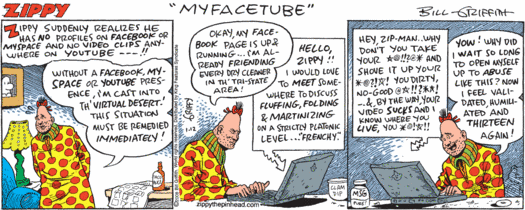
First, Zippy, which today is almost eerily comprehensible:

zippy_the_pinhead.gif

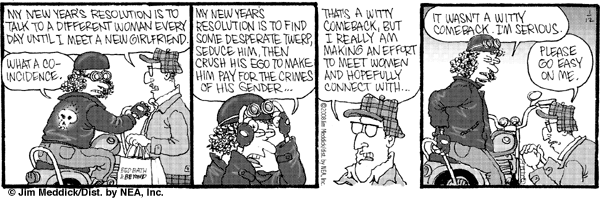
Next, Monty, who, in case you don’t follow the comics, is trying to fulfill his New Year’s resolution of talking to a new girl every day until he meets his true love:

monty20080112223612.gif

You have to appreciate the little touches in these cartoons. Note the store name on the bag that Monty is carrying. You may have to click on the cartoon to get a little bigger view.

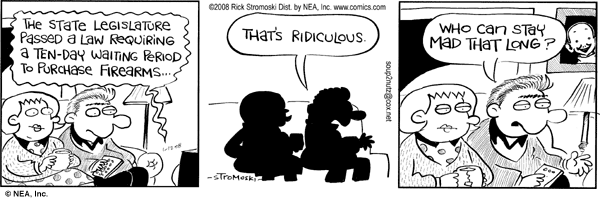
Finally, Soup to Nutz, which makes a compelling case for laxer gun laws:

soup2nutz20080112223612.gif

Your liberal Media

Must reading at Media Matters. Chris Matthews has serious problems.

Court rules torture okay

McClatchy reports (In voiding suit, appellate court says torture is to be expected):

A federal appeals court Friday threw out a suit by four British Muslims who allege that they were tortured and subjected to religious abuse in the U.S. military prison at Guantanamo Bay, Cuba, a ruling that exonerated 11 present and former senior Pentagon officials.

It appeared to be the first time that a federal appellate court has ruled on the legality of the harsh interrogation tactics that U.S. intelligence officers and military personnel have used on suspected terrorists held outside the United States since the terrorist attacks of Sept. 11, 2001.

The detainees allege that they were held in stress positions, interrogated for sessions lasting 24 hours, intimidated with dogs and isolated in darkness and that their beards were shaved.

The court rejected other claims on the grounds that then-Attorney General John Ashcroft had certified that the military officials were acting within the scope of their jobs when they authorized the tactics, and that such tactics were “foreseeable.”

It was foreseeable that conduct that would ordinarily be indisputably `seriously criminal’ would be implemented by military officials responsible for detaining and interrogating suspected enemy combatants,” Circuit Judge Karen LeCraft Henderson wrote in the court’s main opinion.

Judge Janice Rogers Brown dissented with parts of the opinion, saying that “it leaves us with the unfortunate and quite dubious distinction of being the only court to declare those held at Guantanamo are not `person(s).’

‘`This is a most regrettable holding in a case where plaintiffs have alleged high-level U.S. government officials treated them as less than human,” Brown wrote.

In upholding a lower court’s rejection of all the claims but those under the Religious Freedom Restoration Act, the circuit court said that the interrogation tactics, which Rumsfeld first authorized in 2002, were “incidental” to the duties of those who’d been sued.

“It is an awful day for the rule of law and common decency,” said Lewis, the detainees’ attorney, “when a court finds that torture is all in a day’s work for the secretary of defense and senior generals. . . . I think the executive is trying to create a black hole so there is no accountability for torture and religious abuse.”

(Emphasis added)

Incidentally, the four plaintiffs were clearly innocent of any wrongdoing. Not that it matters, apparently.

What’s up with wassup?

Any WordPress experts out there? I was using a plug in called Wassup to keep track of readership. I liked it because my daily hits increased from the numbers reported by the last plug in I used, which also crapped out for some reason. I mean, who cares if the numbers are real, so long as you’re ego is massaged a bit?

Anyway, I had to disable Wassup because it was returning some sort of error, which appeared at the top of the page whenever someone came to this illustrious blog. If anyone knows how to fix it, or can suggest an alternative plug in that works I’d appreciate hearing from them.

Friday night music is back

I think it’s been a couple of weeks since I’ve posted music. I honestly can’t keep track. This week, two of Simon and Garfunkel’s best.

The inevitable Bridge Over Troubled Water. What can I say, it’s a great song.

[youtube]http://www.youtube.com/watch?v=sbFEnoITiWE[/youtube]

America

[youtube]http://www.youtube.com/watch?v=y8ULw6tDey0[/youtube]

A Bit more on the Bradley effect

A few days ago I speculated that the surprise in New Hampshire might have been, in whole or in part, a result of the Bradley effect. Named after former LA Mayor Tom Bradley, who lost a race for California governor despite polls predicting victory, the term refers to the tendency of white voters to lie to pollsters about their willingness to vote for a black person, and of undecideds in such a race to break predominantly for the white candidate. It means that in a race with a predominantly white electorate, a black candidate has to assume that polls overstate the level of support the candidate will get on election day.

This is one thing I’m rather optimistic about. The effect may still be with us, but I believe it’s fading.

In 1988 I voted for Jesse Jackson in the Connecticut primary, and then watched the returns, hoping that Dukakis would win. I voted for the guy with whom I agreed, but I knew he couldn’t win the general election and, at least at the time, it looked like Dukakis could. If I vote for Obama this year, I won’t feel the same way, because I do think he can win. A lot of folks have died since 1988, and they’ve been replaced with a younger generation, most of whom have trouble understanding the prejudices that permeated society years ago. I’m not saying that racism is gone, but it’s less pervasive, particularly among the young.

Yet another thing no one could anticipate

Wouldn’t you think PR people would avoid the “Nobody anticipated…” formulation made famous by Condi Rice about terrorists and echoed by Bush about Katrina? Apparently not, as Floyd Norris reports in today’s New York Times (Banks Plead They Can’t Follow Rules) :

“No one anticipated a day when potentially hundreds of thousands of residential mortgage loans would be modified,” said Alison Utermohlen, an official of the Mortgage Bankers Association who has led the effort to get the accounting rules relaxed.

The banks, it seems, want to change long standing rules to make it appear that they have not lost as much money as they have.

Norris, hopefully tongue in cheek, sympathizes:

But the plea that the banks never saw it coming does ring true. In this cycle, those who lent the money thought that they had no reason to concern themselves with whether it would be paid back.

Instead, they planned to sell the loans, usually to trusts that would then finance the loans by issuing securities. Such trusts have different accounting rules.

In any case, the banks seem to have shared the general belief that house prices would always go up, so anyone unable to meet mortgage payments could sell the house. If losses are never going to appear, why prepare to deal with them?

Whose general belief is it that the banks shared? I’m not stupid enough to be a banker, so maybe that’s why I didn’t believe the bubble would always expand. But even a banker should be able to figure out the answer to this question: Why do you think they call it a bubble?

Let’s put aside the high end properties that rich foreigners may be buying. There are, generally speaking, two reasons that the price of houses in this country could just continue to go up indefinitely. The first involves an increase in the real value of real estate, and that requires that the real value of incomes go up. If incomes stagnate then home prices cannot continue to rise because people will stop buying them. The second way is through inflation, i.e., the real value of both homes and income stay flat or rise slightly, and the value of money goes down. The first possibility doesn’t reflect reality on the ground, the second isn’t happening and even if it were, the banks would still actually lose money because they would be repaid in less valuable dollars than they lent out, and even the relatively high interest rates they charge wouldn’t make up the difference. (I realize this is somewhat simplified, but it’s still basically true).

Certainly the bankers have learned their lesson at this point, correct? After all, the CEOs get paid big bucks to make smart decisions. At the very least you can’t fool them twice, can you?

Today, the Bank of America bought Countrywide for $4 billion dollars.

Priorities

Seems like the telecoms have a good handle on their legal rights when their pocketbooks are involved:

Telephone companies have cut off FBI wiretaps used to eavesdrop on suspected criminals because of the bureaus repeated failures to pay phone bills on time.

A Justice Department audit released Thursday blamed the lost connections on the FBIs lax oversight of money used in undercover investigations. Poor supervision of the program also allowed one agent to steal $25,000, the audit said.
In at least one case, a wiretap used in a Foreign Intelligence Surveillance Act investigation “was halted due to untimely payment,” the audit found. FISA wiretaps are used in the governments most sensitive and secretive criminal investigations, and allow eavesdropping on suspected terrorists or spies.

They couldn’t be bothered to think about the legal rights of their customers, but don’t have any trouble enforcing their own.