






Skip to content

Chris Donovan makes himself look very bad

I don’t know much about Chris Donovan, the man who replaced Jim Amann as speaker of the Connecticut House, but I was certainly prepared to be well disposed toward him, since he was replacing Jim Amann, a man who truly needed to be replaced. Apparently, Donovan himself didn’t agree with that basic premise, because Amann’s legislative seat was still warm whenDonovan offered him a cushy $120,000.00 job at the legislature. The move isn’t unprecedented, but that doesn’t make in any the less outrageous.

Amann was a terrible Speaker of the House, a man who stood in the way of any meaningful progressive activity in this State and a traitor to the Democratic Party. Somehow, according to Donovan, that all makes him “larger than life”.

So now we taxpayers can indirectly subsidize Amann’s delusional run for governor. Oh wait, I’m sorry, we’re going to be getting real value for that $120,000.00:

Donovan’s office also provided a list of official duties, which states that Amann will be responsible for meeting with lobbyists and summarizing their requests for Donovan; reviewing bonding requests from legislators; and occasionally “working out differences of opinion” on “smaller legislative matters.”

I’m sure that Amann will find all those meetings with lobbyists especially onerous as he runs for governor and tries to fill his campaign war chest. Reviewing bond requests is even more backbreaking. Handing out money to people whose support you are currying is a dirty job, but someone has to do it, I guess. Good thing that Amann is a man of spotless integrity, or one might suspect that he could use this “job” to his own political advantage.


Friday Night Inaugural Concert

Here we are in the waning days of the Bush Administration. We all have to hope that there’s truly a new day dawning. So, to celebrate, I’ve tried to find some songs that are a bit appropriate.

First, while the lyrics are not precisely apt, there’s enough in here to serve as a not so fond good-bye to George. The Doug Dillard Band:

Next, some geezers who I fondly remember from my youth. Peter, Paul and Mary with John Sebastian on harmonica:

Neil Young:

Finally, the best version, at least in my opinion, of one of the best of Dylan’s songs, and a particularly apt one at this moment. Somehow, the Irish accents seem perfect for this song. The Clancy Brothers with Tommy Makem:


Sorry Joe, I won’t go

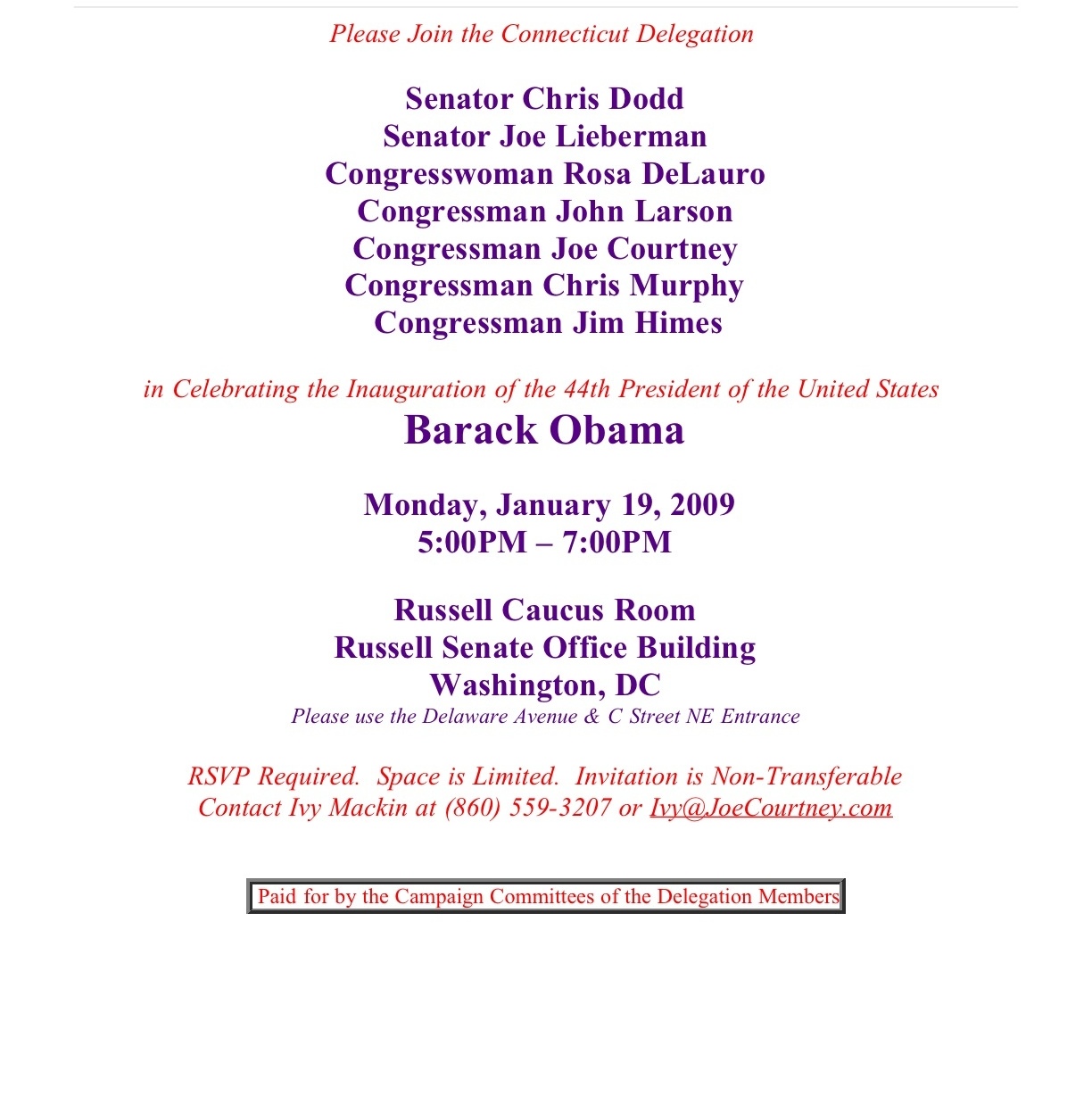
I’m not so stupid as I expect that Joe Courtney really expects me to make it to Washington to join him and the rest of the Connecticut delegation to celebrate the Obama inauguration, but must we yokels be insulted by having Joe Lieberman’s name on the list of people “celebrating” Obama’s inauguration. This merely adds insult to the injury we are suffering by Lieberman’s continued status in the Democratic caucus.


Curmudgeonly Etymology

I have been working lately on something that’s taking up a good deal of my time. Whether it will bear fruit or not, I don’t know, but I am left with little time to post, and less time to think. So I am going to mount a hobby horse that I have been riding for several years, about the debasement of the word “hero”. What set me off was this article (Our latest hero) from this morning’s Boston Globe. It seems Boston’s latest hero is a fireman who died when the firetruck in which he was a passenger went out of control because the brakes failed. It was a horrible event, and he died an awful death, but how does the fact that he died an accidental death make him a hero?

Here’s my dictionary’s definition of the word “hero”:

  1. In mythology and legend, a man, often of divine ancestry, who is endowed with great courage and strength, celebrated for his bold exploits, and favored by the gods.
  2. A person noted for feats of courage or nobility of purpose, especially one who has risked or sacrificed his or her life:soldiers and nurses who were heroes in an unpopular war.
  3. A person noted for special achievement in a particular field:the heroes of medicine. See Synonyms at celebrity.
  4. The principal male character in a novel, poem, or dramatic presentation.
  5. Chiefly New York City See submarine. See Regional Note at submarine.

I think we can all agree that definition five (which links in the dictionary to a long list of regionalisms for the entity that should here and everywhere go by the name of “grinder”) does not apply. We can exclude 1, 3 and 4 as well. That leaves definition two. It requires, if I read it right, some element of personal choice by the “hero”. That is, he or she must choose or at least knowingly risk death for a selfless end. What choice did this unfortunate fireman have? Why is he any more of a hero than his compatriots who survived the crash? If I were in a car crash, would I be a hero, or do I have to be a cop or a fireman in order to qualify?

This word has become increasingly degraded. The 9/11 victims (except for the passengers in the plane in Pennsylvania) were not heroes. They were victims. This fireman was a victim. Not every soldier that dies or is injured is a hero. Some, after all, take their wounds from behind, either metaphorically or in reality. Some are merely unlucky enough to be in the wrong place at the wrong time. Yet in our age, they are all heroes.

Of course, words change their meaning over time. Perhaps we need to redefine the word to mean something like: someone who has suffered an injury or death under circumstances that make us want to praise him or her to make ourselves feel good. Before we do that, or at least at the same time, we should come up with another word for those who are truly heroes (like the pilot of this plane), so we can set them apart somehow. They do deserve some recognition. According to my Thesaurus, the only synonym for the sense of the word hero at issue here is “paladin”, which somehow just doesn’t make it.


More on Wal-Mart

The Day has a follow up article on the Wal-Mart situation (Some Celebrate Wal-Mart’s Loss Of Interest). Indeed, more than some are celebrating. Unfortunately, not everyone:

Director of Planning and Development Michael Murphy said it was “unfortunate that the project didn’t move forward,” as staff believed the improvements being proposed would have protected the watershed.

From a town policy standpoint, he said, the developer had met, and even went beyond, the requirements to build on the site.

”It’s a matter of how development is done there, not that it shouldn’t be done,” Murphy said. “An opportunity was lost in an area designated for commercial development. Hopefully there will be more opportunities in the future.”

Mr. Murphy has a perfect right to his opinion. My question is whether the Planning Department has a right to an opinion. The Planning Department was instituted in the old Charter. Reference to it was removed in the new Charter, but it continues to exist under the old provision pursuant to a savings clause. Here’s what the old Charter had to say:

The department of planning shall be responsible for assisting the planning and zoning commissions in the development and maintenance of a comprehensive plan of development for the town. The department shall make studies and prepare recommendations and reports for orderly community development in the areas of zoning, subdivision regulations, land use and other phases of municipal development. The department shall have such other powers and duties as the council may prescribe.

So far as I can see it is not the province of the Planning Department to advocate for a developer, or to take a public position on the extent to which any particular proposal should or should not be approved. One of their functions is to act as a resource for the Planning Commission. They are not supposed to set themselves up in opposition to the Planning Commission, which is precisely what Murphy has done.

Town Planners must be closely watched. They can’t really have much fun unless they get to do a lot of planning, which means they have a bias toward development. Land preservation is boring. Not only is planning what they do, but additional commercial development means additional tax revenue, and town governments are, shall we say, biased toward expanding the commercial tax base. In addition, the system is structured in such a was as to get the planning office emotionally invested in a project before it ever gets to the Planning Commission. The developer goes to them, asks their opinion, consults closely, and acts on their recommendations before submitting a definite proposal. All of this makes a certain amount of sense, but the upshot is that the final proposal is the child of both the developer and the planner, and everyone wants their child to thrive.

In the Wal-Mart case the planner became such an advocate that the developer, at least at one point, took the position that the Planning Commission had to approve the project because the planner said that it had to do so. A planner should never give a developer an opening to make an argument like that, and once the Commission has made its decision, it should be the Planner’s role to support that decision, or keep respectfully silent.

Now that we’re entering a depression, the pressure to make a strip out of Route 184 may relent for a while. Who knows, maybe the Connecticut Legislature will take advantage of the crisis to finally reform our system of taxation so that towns don’t feel pressured to encourage the type of commercial development that has blighted so much of our landscape. It’s time we put an end to these big box stores, for both environmental and esthetic reasons. No uglier architectural style has ever evolved in the history of mankind.


One last encore for the Potemkin Presidency

Truly Pathetic:

The White House had high expectations for yesterday’s final, historic news conference. “ONE CORRESPONDENT PER ORGANIZATION,” proclaimed the bulletin sent to reporters. “STANDING ROOM ONLY FOR NON-SEAT HOLDERS.” But when the appointed hour of 9:15 a.m. arrived, the last two rows in the seven-row briefing room were empty, and a press aide told White House interns to fill those seats. (Emphasis in original)

Not with a bang but a whimper. (And let us be thankful for that)


We beat Wal-Mart!

This morning’s Day reported that Wal-Mart was “said to lose interest” in Groton. This evening, the story has been updated on the website, and we are now told that “Super Wal-Mart [is] definitely out in Groton“.

Konover Development vice president Michelle Carlson confirmed today that the company is dropping plans to build a Wal-Mart Supercenter on Route 184 in Groton.

“We are focusing our resources on projects we can bring to closure a lot quicker,” she said.

The company dropped its options to buy the Route 184 properties and dropped its appeal of the Inland Wetlands Agency’s application denial, Carlson said. It also asked the intervenors to drop their appeal of the welands board’s subsequent approval.

This is a great victory for the people of Groton. We owe a huge debt to the folks on the Planning Commission, who voted to block this project, and to the Groton Open Spaces Association. I suppose it didn’t hurt that we’re heading into a depression. Every cloud, no matter how massive, has a silver lining.

I want to add here that tomorrow I will enter my 21,388th consecutive day without entering a Wal-Mart.


Where is Obama going on torture and war crimes

Most commentators I’ve read interpret Obama’s statements yesterday regarding torture, in response to a question from George Stephanopoulos, pretty much put paid to any notion that an Obama government will go after the evildoers. That’s likely true, but we shouldn’t give up hope quite yet.

Here’s the exchange:

OBAMA: We’re still evaluating how we’re going to approach the whole issue of interrogations, detentions, and so forth. And obviously we’re going to be looking at past practices and I don’t believe that anybody is above the law. On the other hand I also have a belief that we need to look forward as opposed to looking backwards. And part of my job is to make sure that for example at the CIA, you’ve got extraordinarily talented people who are working very hard to keep Americans safe. I don’t want them to suddenly feel like they’ve got to spend all their time looking over their shoulders and lawyering (ph).

STEPHANOPOULOS: So, no 9/11 commission with Independence subpoena power?

OBAMA: We have not made final decisions, but my instinct is for us to focus on how do we make sure that moving forward we are doing the right thing. That doesn’t mean that if somebody has blatantly broken the law, that they are above the law. But my orientation’s going to be to move forward.

STEPHANOPOULOS: So, let me just press that one more time. You’re not ruling out prosecution, but will you tell your Justice Department to investigate these cases and follow the evidence wherever it leads?

OBAMA: What I — I think my general view when it comes to my attorney general is he is the people’s lawyer. Eric Holder’s been nominated. His job is to uphold the Constitution and look after the interests of the American people, not to be swayed by my day-to-day politics. So, ultimately, he’s going to be making some calls, but my general belief is that when it comes to national security, what we have to focus on is getting things right in the future, as opposed looking at what we got wrong in the past.

There’s a couple of things about this that give us hope. First, Holder has this to say about torture:

“Our government authorized the use of torture, approved of secret electronic surveillance against American citizens, secretly detained American citizens without due process of law, denied the writ of habeas corpus to hundreds of accused enemy combatants and authorized the use of procedures that violate both international law and the United States Constitution,…We owe the American people a reckoning.”

Obama did go out of his way to defer to Holder. But another consideration is this. If you were Obama, and you fully and absolutely intended to go after Bush and his cronies for each and every criminal act of the last eight years, how would you have answered that question? If you explicitly stated your intention, you would give Bush just the opening he needs to pardon each and every one of them to spare them from “politically motivated” persecution. Were I Obama, I’d keep my powder dry until I was safely in the White House, and Bush was safely out.

So there’s a glimmer of hope. All that being said, I must admit I’m not hopeful.

The idea that we should put these things behind us is, of course, absurd. The next Administration inclined to lawlessness will draw no other conclusion but that it can act without restraints because there will be no consequences. These people are not deterred by the threat of disapprobation. They wear it like a badge of honor. Only the threat of hard time is likely to stop them.


Drug companies and doctors

Check out this article at the New York Review of Books (Drug Companies and Doctors: A Story of Corruption). It’s a review of three books about the way that drug companies market their product, and of the corrupt relationships between doctors and drug companies. It’s difficult to summarize. Read it now, since I think you can only read current articles on the site. The review (written by a former Editor of the New England Journal of Medicine) documents the following points, among many others:

  • Doctors, particularly prestigious doctors, have been paid for advocating the use of prescription drugs for conditions (such as childhood bi-polar, a growth disease) for which the drugs have not been approved. They can do this because once a drug is approved for any use, doctors are free to prescribe it for any condition, though the drug companies cannot market it for any but the approved purpose. However, they can pay huge consulting fees to doctors who advocate for those uses.
  • Drug companies have created new diseases to fit the drugs they create (Shyness, for example, is now “social anxiety disorder”, for which you should be medicated.
  • The doctors who perform clinical tests are conflicted, and the tests are designed to achieve favorable results.

I’ve really only scratched the surface. Here’s an illustrative paragraph that interested me, since I have so many clients who take the medications mentioned.

Many drugs that are assumed to be effective are probably little better than placebos, but there is no way to know because negative results are hidden. One clue was provided six years ago by four researchers who, using the Freedom of Information Act, obtained FDA reviews of every placebo-controlled clinical trial submitted for initial approval of the six most widely used antidepressant drugs approved between 1987 and 1999—Prozac, Paxil, Zoloft, Celexa, Serzone, and Effexor. They found that on average, placebos were 80 percent as effective as the drugs. The difference between drug and placebo was so small that it was unlikely to be of any clinical significance. The results were much the same for all six drugs: all were equally ineffective. But because favorable results were published and unfavorable results buried (in this case, within the FDA), the public and the medical profession believed these drugs were potent antidepressants.

The review puts most of the blame on the doctors, on the theory that the corporate corrupters are just being corporations, and calls on doctors to reform themselves, because otherwise the government “will step in and impose regulations. No one in medicine wants that.”.

Maybe no one in medicine want that, but the rest of us should. Just as the capitalists are just being capitalists, so the doctors and researchers are just being human. Most, if not all of these abuses could be easily remedied with a little judicious governing. For example, it would have been a lot harder for GlaxoSmithKline to market its drug, Paxil, as a cure for a made up disease (Social anxiety disorder), if it hadn’t been legal for it to advertise (The article discusses a giant ad campaign designed to boost “awareness” of social anxiety disorder and Paxil). Remember the good old days when drug makers couldn’t advertise to the general public? I’ve seen ads telling people to ask their doctors about certain drugs without even telling the viewer what the drugs were for. If such ads were banned, like cigarette ads, then one giant abuse would be ended. Unscientific studies, at least in the approval process, could be stopped by requiring all such studies to be carried out by government labs or researchers with whom the government contracts directly. The companies could be required to fund the research, but not pick the researchers. Any outside study could not be considered in the approval process. Don’t want drug companies making payments to doctors? Ban it, or at least remove the tax deduction for any such payments. In fact, most of the problems appear to be rather easy to address on a theoretical level. Political will is another matter.

Parenthetically, there’s indirect evidence here that doctors don’t spend as much time worrying about lawsuits as they claim. I’m referring to the practice of prescribing drugs for conditions for which the drugs have not been approved or proven effective.

Consider the clinical trials by which drugs are tested in human subjects. Before a new drug can enter the market, its manufacturer must sponsor clinical trials to show the Food and Drug Administration that the drug is safe and effective, usually as compared with a placebo or dummy pill. The results of all the trials (there may be many) are submitted to the FDA, and if one or two trials are positive—that is, they show effectiveness without serious risk—the drug is usually approved, even if all the other trials are negative. Drugs are approved only for a specified use—for example, to treat lung cancer—and it is illegal for companies to promote them for any other use.

But physicians may prescribe approved drugs “off label”—i.e., without regard to the specified use—and perhaps as many as half of all prescriptions are written for off-label purposes. After drugs are on the market, companies continue to sponsor clinical trials, sometimes to get FDA approval for additional uses, sometimes to demonstrate an advantage over competitors, and often just as an excuse to get physicians to prescribe such drugs for patients. (Such trials are aptly called “seeding” studies.)

It’s hard to believe doctors would prescribe in that fashion if they were constantly worried about lawsuits.

Update: Today a sort of inverse proof that judicious government can solve these problems, as injudicious government has just attempted to exacerbate them. (Via Majikthise from Reuters)

U.S. health officials finalized guidelines that allow pharmaceutical companies to tell doctors about unapproved uses of their medicines, a practice opposed by critics of industry marketing.

The Food and Drug Administration (FDA) guidelines allow manufacturers such as Pfizer Inc (PFE.N) and Merck & Co (MRK.N) to distribute copies of medical journal articles that describe unapproved uses. The action could help companies expand the markets for medicines and medical devices.

The move, announced a week before Republican President George W. Bush leaves office, puts in place a policy that drew objections from congressional Democrats and drug-industry critics when it was proposed last year. Opponents say it will allow promotion of uses without adequate testing.


Another Connecticut Blog

My wife and I subscribe to the American Prospect, in which today I found an article by Sharon Butler, a professor of visual arts at Eastern Connecticut State University. The University is a bit north of here, but safely ensconced in our largely ignored Eastern part of the state. I enjoyed the article (subscription required to read the whole article), about the prospects for art in the age of Obama. I particularly enjoyed her take on the current exhibition at the Guggenheim, about which I expressed my own thoughts a few weeks ago. I said:

The other main attraction consisted of a collaboration of artists that, according to the museum’s website:

Working independently and in various collaborative constellations, they eschewed the discrete aesthetic object in favor of the exhibition environment as a dynamic arena, ever expanding in its physical and temporal parameters.

I have no reason to believe they did not succeed in their artistic endeavors, as I have no idea what the above means. Mostly the fruit of their efforts consisted of slogans written on the wall, or hanging from the ceiling, many of which made no sense whatsoever.

Ms. Butler says the exhibit in question was a perfect exemplar of art in the age of Bush:

Nowhere in the art world has this collective despondency and resignation been more starkly revealed than in a recent Guggenheim Museum exhibition lethargically titled “theanyspacewhatever.” Ten relational artists — that is, those focusing on how people and communities interact — who made it big over the past decade were commissioned to collaborate with curator Nancy Spector on installations that would occupy the museum’s five spirally arranged floors. Much of the show featured empty space, and Douglas Gordon’s faux-sage existential notions stenciled across the walls (“You’re closer than you know,” “Nothing will ever be the same”) seemed calculated to convey the profundity of banality and vice-versa — a Bushian notion if ever there were one. Perhaps the conceptual high point of the exhibition was Jorge Pardo’s maze of cardboard-screen partitions unevenly perforated with vaguely alien shapes, which made viewers yearn for it all to be over.

She’s right about the cardboard, but it beat the empty space by a mile:

I plead not guilty by reason of lack of notice to taking unauthorized pictures. We took the elevator up and worked our way down. The sign barring cameras was, so far as we noticed, only on the first floor as you enter the spiral. We only saw it as we exited.

But I digress (do I do anything else?). The main reason for writing this post is to let my readers know that Ms. Butler has a blog, and since she is from our neck of the woods, and since she appears to be a good leftie, i thought I would point you to it. It’s called Two Coats of Paint, and you can reach it at the link, or from the blogroll at the right. It’s about art, mostly, though she does hit on politics. Here’s her take on Bush’s official portrait.