Skip to content

Yet more bailout musings

A friend passed along this article from Counterpunch, which I am in turn passing along, because it is always good to know that there’s at least one other person out there, with more paper credentials, that agrees with something you’ve said. In this case, it is my recent post arguing that if we are going to borrow $700 million dollars, there are far better things to spend it on, even in the midst of this crisis, than a Wall Street bailout.

In this case the writer is Moshe Adler, the director of Public Interest Economics, who, like me, argues that the money would be better spent investing in our crumbling society:

What Keynes also pointed out during the Great Depression is that the government can increase employment by hiring workers itself. To press his argument Keynes suggested that the government could always hire half the unemployed to dig ditches and the other half to fill them up. But thanks to long years of neglect by the government, there are many government services that Main Street actually desperately needs: More teachers and better school lunches; more public transportation; more public universities with better facilities; more nurses and doctors and more medicinal drugs; more nursing homes for elderly people and more parks for the young; more housing for workers and more childcare for their children. And, Keynes explained, once the government starts using its power to stabilize employment and to increase its citizens? standard of living, there is no doubt that the economic horizon will clear and private lending and investment will rebound as well.

Normally, this would be the point at which the reader would ask: “But how do we pay for this all?” But not today. First, the government can use the money that the President and Congress want to give Wall Street. In addition, it is now clear that executive compensation is not a just reward. It can and should be taxed, heavily, and perhaps even retroactively.

The problem we have is that the terms of debate in this country are circumscribed. It is simply not allowed to argue that we should not have a bailout at all. The House Republicans are not taken seriously in their protestations; everyone knows they will vote for a bailout eventually, so long as it does not interfere with the ability of Wall Street to do this to us again. Were any politician to argue for what was, after all, the approach that ultimately ended the Depression, they would be dismissed as not serious persons, somewhat like Dennis Kucinich, who is almost always right, and always ignored.

Along with that article my friend (who contributed a comment here) steered me to another Counterpunch article that persuasively argues that the bailout won’t work. I was intrigued by this excerpt, dealing with the nature of the financial instruments that have caused this crisis:

The derivates—futures and forwards, caps and collars, options and swaps—were all derived from the performance of some ever more distant asset. Financiers invested and speculated in these instruments both in order to skim off the value of the assets and to protect themselves from risk. All of this trading was highly leveraged, which is to say that collateral in actual assets was far, far less than the supposed value of the derivates. A series of failures related to these derivative markets signaled a warning: the bankruptcy of Orange County in 1998 and of Long-Term Capital Management in 2000, the collapse of Amaranth Advisors in 2006, and the $7.2 billion dollar loss by Société Général in early 2008. Now the entire complex and fragile system of derivatives threatens to disintegrate.

If I understand it, basically we have billions and billions of dollars of financial instruments backed by assets worth far less than the instruments themselves. One suspects that even if the lending at the base, the subprimes, etc., had not been so reckless, the day of reckoning would have inevitably come to pass. It all seems very much like a sophisticated Ponzi scheme

In sum, I think the Democrats blew it. They should have just said “No”. Of course, the fact is that our Democratic representatives are only slightly less beholden to Wall Street than are the Republicans. They can’t imagine not attempting to preserve the rotten system we have. If the folks I’ve quoted are right, they won’t succeed in even doing that, and in the process they may cause vastly more harm to the rest of us.
Post debate

I can’t improve on what Digby has to say about the debate:

It’s very hard for me to gauge this debate because to me John McCain is quite obviously a crazy, intemperate, nasty old bastard. He was sarcastic, contemptuous and patronizing. I really, really loathe him. But then, I loathe Rush Limbaugh and Glen Beck too, who are also domineering, macho pricks. (On the other hand Barack said “I agree with John” about 832 times, so perhaps I’m misjudging him.)

My wife says Obama is winning in the early polls, so maybe people aren’t as stupid as the pundits.

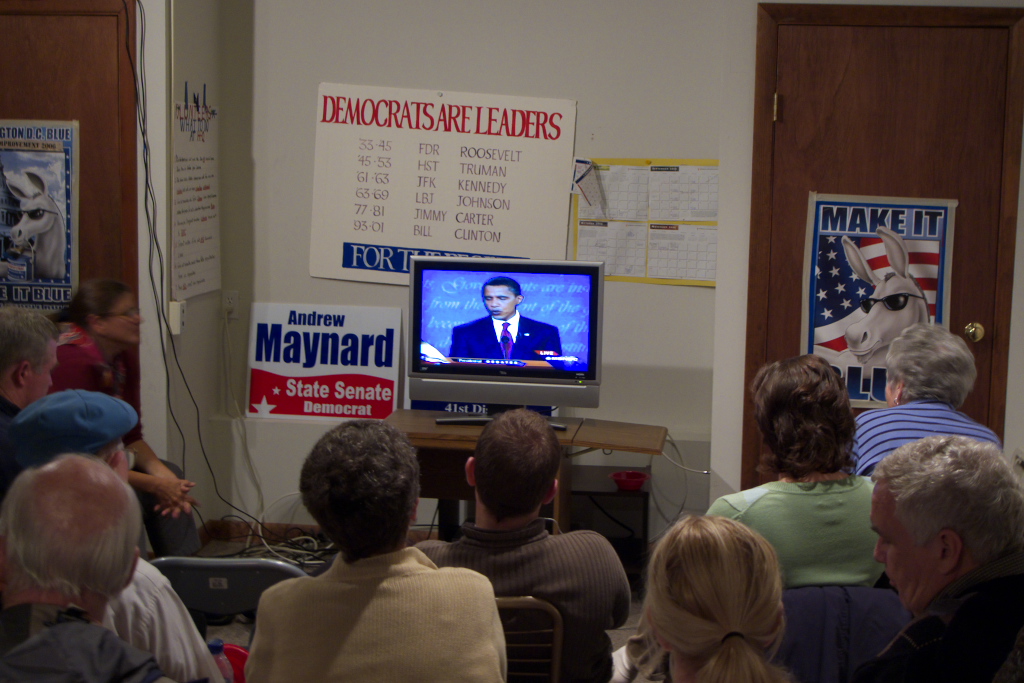
All I can add is this picture of the audience at Groton Democratic Headquarters, where 100% thought Obama won.

Next comes the comic relief, otherwise known as the Vice Presidential Debates, unless Palin becomes ill or her campaign plane mysteriously blows up in mid air. We’ll be adjourning to the Bulkeley House for that one, as it coincides with Drinking Liberally night. The whole country might want to drink liberally at the thought of Sarah Palin being president of the United States. Anyway, we will still start at 6:30, then adjourn to the bar to watch the debate.

The picture, by the way, was taken by my nifty new camera (no flash, 200 ISO, Image stabilized), of which I should be ashamed of myself for buying, but I am not, at least very much. If only our minds could evolve as fast as our technology. This camera, a Panasonic DMC-LX3, takes better pictures, within its limits, than my digital SLR, that I bought four years ago. Unfortunately, it’s so new that Apple hasn’t yet updated its operating system to read the camera’s RAW files, so instead of using Aperture I’m stuck for now with the clunky software that came with the camera. All things come to those who wait (except maybe a Democratic President) so that situation should resolve itself soon.

Brutal

McClatchy is the successor to the Knight Ridder papers, which was the only major news organization with an ounce of skepticism toward the Iraq War when it was being marketed. In fact, its skepticism could be measured in pounds, while the major papers were enabling the propaganda effort. Given that background, I’m not terribly surprised that they are not in the tank for McCain, but I must say this article, while 100% accurate, is just brutal, all but calling McCain a political con-man. Check out the second paragraph of this quote:

McCain’s announcement Wednesday that he wouldn’t debate until the bailout talks produced a deal was met with immediate accusations that he was trying to duck the debate to avoid questions about his recent comment that the U.S. economy was fundamentally sound, or about the global economic crisis occurring during a Republican administration.

Moreover, McCain has never been a leader in the Senate on financial policy, is not a member of the Senate Banking Committee that’s negotiating the bailout terms and had not been involved in those negotiations until Thursday, when they blew up. At McCain’s request, President Bush called McCain and Obama to the White House on Thursday to talk about the financial crisis along with congressional leaders.

This is no surprise coming from McClatchy, but journalism is breaking out all over. I haven’t watched the whole thing yet, but from the snippets I’ve seen, it looks like Katie Couric did an admirable job torpedoing Sarah Palin.

Sara Silverman on how to win in Florida

Before I posted this video I sent a link to a friend, to get his opinion as to whether I should post it. I thought it was funny, but I didn’t want to offend. I won’t mention my friend’s name, since I have a sort of policy about exposing anyone else to abuse, but he did authorize me to say:

My name is XXX XXXXX, and I am a Jew, and I approve this message:


The Great Schlep from The Great Schlep on Vimeo.

Interesting

I’m no big fan of Andrew Sullivan, though he does seem to have the intellectual honesty to be repelled by modern day Republicanism. But I was interested in this post from his blog, which my wife passed along to me. I’ve never been convinced that Sarah Palin is indeed the mother of that poor baby they are now using as a prop. I wrote about the rumours when she first got nominated, and the news that the daughter is now (allegedly) pregnant has not quieted all my doubts. Apparently Sullivan had questions too, but he has something I don’t have, the email addresses of people high up in the McCain campaign. So he asked them in private emails:

“I’m very sorry to say, it’s come to this: can you confirm on the record that Trig Palin is Sarah Palin’s biological son? . . . Since this is a crazy idea, it should be easy for you or someone to let me know, the most popular one-man political blog site in the world, what the truth is.”

Now they could have answered, or they could have ignored him, but they took the third way, the Republican way, and tried to smear him. You can read about it in the full post, to which I’ve linked above. His conclusion:

But since this is now all in the open, you deserve to know what your blogger has been trying to do in private for three weeks: just get a factual answer to a factual question on the record.

They won’t. They cannot take the time to confirm on the record that Trig is Sarah’s biological son, but they will try to smear the person asking. What does that tell you?

It tells me that they are typical Republicans and they are covering something up. But then again, maybe not. Smearing people who question them has become so reflexive with them that it is their all purpose answer to everything that comes their way. They even do it when they’d be better off just telling the truth, but the thought of doing that never crosses their minds.

Debate Party Tomorrow

Everyone’s invited to Groton Democratic Headquarters at 303 Route 12 (Geico Insurance Building) to watch Barack Obama either crush John McCain or debate an empty chair.

We had pretty good turnout for the acceptance speech, and we’re hoping for good turnout tomorrow. If you want to be an extra good Democrat, drop by at around 6:00 PM to make voter ID phone calls for Obama and Joe Courtney. If you just want to consume calories and watch the debate, be there by 8:00 PM.

Please sign my son’s petition

The following is adapted from an email I, along with others, received from my son today.

Please sign this petition.

There is a bill introduced by Ted Kennedy and co-sponsored by our buddy Obama which will allow Teaching Assistants like myself to organize a union. It’s really important to me and will only take a second of your time.

Thanks to George Bush, people like myself who serve as teaching assistants at private universities have no legal rights as workers. Even the UN thinks this is violation of our human rights. This is a matter of basic social justice- with a union we will be able to bargain better wages and health care. But it is also about democracy in the Academy. Having a union will give us a voice.

Teaching Assistants won this right some time ago, but lost it as soon as Bush had appointed enough members of the NLRB to form a majority. (If memory serves, there are five members, with one member’s term expiring each year).

Thinking about bailouts

One reason it’s not a good idea to pass a massive bailout without thinking is, tautologically speaking, because you don’t think about what you’re doing. That’s the essence of the Paulson plan, of course, to stop us from thinking-to make us react out of fear. And, as Matt Yglesias points out, another objective is to make sure we never re-think, since Paulson contemplates spending only (only?) $50 billion a month, so it would make far more sense to authorize only $50 billion in authority and then think carefully about further authority.

The Dodd plan is far better, but the more I think about it (I know that’s an unpatriotic thing to do), the more I am becoming convinced that no plan would be the best plan.

First, let’s look at what we’re being asked to do. We are being asked to borrow (god forbid we should tax ourselves to actually pay for anything) $700 billion from the Chinese (Why $700 Billion? Because “we just wanted a real big number”) to fund the purchase of assets worth far less than that amount, so that we can recapitalize entities that deserve to fail, from both a free market ideology perspective and a moral perspective. The argument is that if they fail, our economy goes down with them. But isn’t there more than one way to foster economic growth?

I’m not an economist, so maybe I’m missing something. Maybe someone out there can set me straight. Shouldn’t the first question be: is this the best use we can make of $700 billion dollars in borrowed money. If we’re going to borrow that much, wouldn’t it make more sense to invest it in something more worthwhile than worthless assets and Wall Street pigs. I think I’m right in saying that the Great Depression lasted as long as it did because Roosevelt was uncomfortable with the idea of deficit spending. He wasn’t willing to borrow his way out of the Depression. He had no choice but to change his mind during the war and the rest, shall we say, is history. It ultimately worked well back then, because the country had comparatively little debt to start out with. Whether it’s a good idea now is another story, but if we start from the premise that we are going to go out and borrow $700 billion dollars, why not put our chips on “trickle up” economics. Why not use that money to repair our infrastructure, increase our energy efficiency, provide reliable and cheap mass transit, etc. There are a host of things we could do that would yield a huge return to us. The money would be spent here, employing regular Americans who will turn around and spend it, creating economic activity. Spent wisely, it would decrease our dependence on oil and slow the advance of global warming. Who cares if we lose some big banks. Anything “too big to fail” shouldn’t exist in the first place. There are small banks that would grow big stepping in to fill the banking needs generated by the economic activity that the government would be fostering here at home. That would be an inevitable by-product of the economic activity created by such massive government spending. All to the good if the country’s banking needs are met by a host of small institutions rather than a few big ones. What, after all, have these investment banks really done for the rest of us?

Isn’t this the basic question: What is the best way to spend this money, if we’re going to spend it at all? Can this bailout possibly be the best way to spend $700 billion, whatever the consequences might be for Wall Street?

Vote Now!

A good friend and loyal reader just alerted me to the fact that PBS is conducting a poll on whether Sarah Palin is qualified to be Vice President. The right wing is trying to stuff the ballot box. We must rise up in righteous anger and do the same. Vote here.

Heads we lose, tails we lose

A consensus appears to be emerging among the reality based that Paulson’s plan is to pay top dollar for the junk he wants to buy, since that’s the only way the “plan” to save the banks will work. If he paid what the stuff is worth, many of them would still be underwater. In other words, the government is going to invest its money in these companies to keep them afloat, but the government, or at least the Secretary of the Treasury, isn’t interested in getting any return on that investment, should the infusion of money make the banks profitable. It’s a little like buying stock in a company, except that the company gets your money, and you don’t get any stock. There is no realistic scenario, given Paulson’s intention, for the taxpayers to recover anything close to their investment.