Skip to content

Charter Commission almost finished

I’ve avoided writing anything substantive about the Groton Charter Revision Commission, on which I’ve been serving for over a year, though I’ve mentioned the meetings in passing. I haven’t discussed it primarily because I think I would have been less effective as an advocate on the Commission if I had discussed our deliberations in this forum.

Now we’re finished, however, or nearly so. There will be a public hearing at 7:00 PM on Monday the 14th at the Town Hall Annex. If you’re a Groton resident consider attending.

The town of Groton website has information you can download, but I’m attaching the basic information to this post. I’ve attached a copy of the current charter, a copy of the proposed charter, a document prepared by Mick O’Beirne, the chairman, which lists the major substantive changes to the charter, and another document Mick just prepared consisting of a table that shows where various provisions from the old charter appear in the new charter.

We didn’t make any radical changes. For the most part we tried to modernize the Charter to bring it into line with current practice and current law. There are a number of anachronisms in the current charter. For instance, the town is required by the Charter to have a Fire Marshall. In fact, each of the Fire Districts has its own Fire Marshall, and there is no Town Fire Marshall. So we got rid of that requirement. The current charter has a very long list that grants various powers to the town. We have removed that and simply stated that the town has all the powers it can exercise pursuant to state law, etc.

There are only two proposed changes with which I’m not comfortable. The current charter provides that if neither the Town Council or the RTM passes a budget, then the town manager’s proposed budget is deemed adopted. We changed that to provide that, in such a case, the new budget would be identical to the old budget. I thought that was a bad idea because it seems unlikely this would happen except in a very difficult budgetary climate, and it seems unlikely that it would be responsible under those circumstances to go with a budget that is almost surely not going to be appropriate. Also, it’s not clear whether the specific line items would carry over from the previous budget, or only the bottom line figure.

The other problem I had was how we dealt with the library board. We deleted references to all boards and commissions in the charter. For the most part, that makes sense, because it leaves the Town Council free to create and abolish these entities (except those required by state law) without the necessity of a Charter Revision. At the moment we have commissions or boards required by the charter that have not functioned for decades. But I think the library board is a bit different, and I’m sorry we simply deleted all reference to it. The state statutes, and the current charter, envision a library board that manages its own budget and is largely independent of political interference. As a matter of fact, our library board has not functioned that way, because it has ceded its authority to the library director. That’s too bad, because a politically insulated library board could, in book burning times, serve as a bulwark against censorship more easily than a library board director who is ultimately answerable to the town council. I have a dim recollection of someone trying to ban a book at the library, and getting nowhere. We should maximize the chances that we will always have such an outcome.

But I can live with both of these changes. On balance, I think the proposed charter is a much needed modernization.

One thing we didn’t do was add a referendum to the budget process. Whether the charter is adopted or not, this will be our major gift to the town. This subject needs a post of its own, which I’ll probably write one of these days. I think it’s fair to say that, had we taken a vote at our first meeting, we would have voted to have one. The more any fair minded person looks at the structure of our town government, the more they realize that, even if a budget referendum were a good idea in the abstract, it doesn’t fit within our scheme of government. As time went on, and we discussed various proposals, the idea lost support, and when the time to vote came, the referendum garnered only two votes.

We are a disparate group, but we worked together well. This was my second commission. The first I was on literally dissolved around me, as a number of people quit due to their hostile feelings toward other commission members. (Mainly me, actually. And that’s yet another story) There was often disagreement on this commission, but it was always civil. I don’t think anyone ever came close to losing their temper and I think the quality of the debate was usually quite high.

We apparently finished just in time to get the measure on the November ballot, should all things go well from here. After the public hearing we will make whatever changes we feel appropriate based on the public comments. Then the council will make suggestions, and we will respond to those suggestions. After that, the council votes to accept or reject the proposed charter. If they vote to accept, it goes to a vote in November.

Click any link below to access a PDF of the described document.

Proposed Groton Charter

Current Groton Charter

Major changes in proposed Charter

Table of Cross References

Hagee running interference for Lieberman?

Via Think Progress we learn that John Hagee’s lawyers have demanded that youtube remove almost 120 videos featuring John McCain and Joe Lieberman’s favorite bigot.

The lawyers are claiming copyright infringement, but in fact they appear to be exploiting a loophole in youtube’s policies in order to dampen viewership about Hagee as we approach the Christian’s United for Israel annual “summit” that will feature the shame of Connecticut, Joe Lieberman.

Late last week, with no prior notification, lawyers for the controversial evangelist John Hagee had a series of videos concerning the pastor removed from YouTube. The clips spanned from the contentious to the mundane; some included footage lifted from sermons Hagee had already made public, others involved documentaries made by filmmakers inside Hagee’s conventions. All told more than 120 videos were taken down in the abrupt sweep.

Videos that were taken down include some filmed by independent film makers like Max Blumenthal (clearly not covered by any copyright controlled by Hagee) and some which make fair use of copyrighted material. But apparently youtube’s policies can be exploited by someone like Hagee to force a two week shutdown of any material they care to designate:

There is little Blumenthal, Wilson, People for the American Way or others whose videos were swiped can do in the meantime. A first amendment lawyer with knowledge of copyright law noted that the pastor’s lawyers can have YouTube take down relevant videos regardless of how little Hagee footage they include or how long they have been online. Indeed, YouTube’s policy is to remove any video that a third-party claims is a copyright infringement, even if it seems to clearly be “fair use.”

After a period of time — likely, more than two weeks — users can repost their clips and that third-party must then prove that the video violates copyright law. By then, however, Hagee’s Christian’s United for Israel, Washington-Israel Summit will likely have commenced.

There is probably a good reason for this policy, but it’s also clear that Hagee is exploiting it. In the process, Lieberman gets some protection. Prose can be powerful stuff, but as (former) Senator Allen can tell you, video packs a more powerful punch.

Fuzzy math, squared

John McCain has released his economic plan. Among other things, he promises to balance the budget by winning the wars in Iraq and Afghanistan and using the savings to pay down the deficit. No doubt the media will have tremendous difficulty seeing this fantasy for what it is. According to the McCain campaign:

“The McCain administration would reserve all savings from victory in the Iraq and Afghanistan operations in the fight against Islamic extremists for reducing the deficit. Since all their costs were financed with deficit spending, all their savings must go to deficit reduction.”

As a diarist at Kos points out, this statement is even stupider than it appears at first blush. She notes: “just because I stop charging on my credit card doesn’t mean I’m suddenly making income to pay off the debt I’ve run up, does it?”. Indeed it doesn’t.

If Obama said something one tenth this stupid we’d never hear the end of it. Here’s a non-risky prediction. It will never occur to the press to point out how ridiculous this is. As Paul Krugman has pointed out a number of times, during the 2000 campaign George Bush made demonstrably false statements about his economic plans, but the press couldn’t be bothered to check out the facts. Instead they pilloried Al Gore as a liar. Were that election rerun today, after everyone else recognizes Bush for the liar he is, they would do the same thing. This year we will have more of that type of coverage, made even more frustrating as we hear the term “straight talker” liberally utilized in describing McCain.

Book report

I marked a birthday recently (too old to celebrate) and my son gave me a copy of Takeover, The Return of the Imperial Presidency and the Subversion of American Democracy, by Charlie Savage. I just finished reading it.

I found this book to be a bit of a tough slog. It’s a little bit like being hit over the head by a baseball bat over and over. You really have to take a break every once in a while. Savage documents the Cheney (for it truly is Cheney’s administration, as Savage documents it) plan to subvert the constitution and install an elected dictatorship.

There’s nothing in this book that anyone addicted to the blogs has not read about before. It’s just that it comes at you in concentrated doses, alternately inducing rage and nausea. It’s a bit like Bush’s greatest Hits:

The Unitary Presidency

Torture

Subversion of independent agencies

Subversion of the civil service system

Faith based intelligence reports

Signing statements that declared, in effect, that Bush would not comply with provisions of the law of which he did not approve.

Suspension of habeas corpus

Secret legal opinions authorizing clearly illegal actions

Widespread wiretapping without warrants

Up-front announcements that the president is above the law, to which a supine Congress acquiesced.

Have I missed anything? Absolutely. Read the book.

The constitution depends on a lot of things to function. The founders expected that each of the three branches would be jealous if its constitutional function and resist any attempts by the other branches to transgress. The constitutional system also assumes that the various actors would, despite their tendency to push the envelope to enlarge their own power, acknowledge some limits on their own actions. Cheney and his minions acknowledged no limits, and the Republicans who controlled Congress were fixated on maintaining Republican hegemony to the exclusion of maintaining Congressional power. Moreover, the judiciary had, by Reagan and the first Bush, and more enthusiastically by this Bush, been salted with judges who advocated an expansive view of presidential power.

Savage does an excellent job of telling the entire story. As he points out, once a constitutional principle has been abandoned, it’s hard to recover it. It will be far more difficult for Congress to recover its constitutional prerogatives, than it would have been to protect them in the first place. One can’t read this book without coming to the conclusion that Congress’ failure to impeach Bush may well have spelled the end to the American Republic.

The only hope we have to recover, it seems to me, is if Obama is elected president. I don’t say that because I think Obama will restrain himself from Bush-like excess, though he may to a certain extent. I say it because, in the short run, only the courts can stop the presidential march toward absolute power. This will never happen while a Republican is in the White House. But it’s clear that the “unitary executive” theory is one adopted by conservatives to justify near dictatorial actions by one of their own. Savage points out, for instance that John Yoo, unitary executive proponent par excellence, felt differently when it was Bill Clinton who was doing the stretching. (page 67 in Savage’s book). My own reading is that these people are not process oriented, though they claim to be. They are results oriented. Presidential power should be enhanced, so long as it is exercised by a Republican. I am certain beyond a reasonable doubt that the unitary executive theory will die a quick death once these judges are faced with a Democratic president who uses even a mild version of the Bush tactics to advance his agenda. We can expect the Republican courts to put the brakes on Obama, should he be elected, at every turn. Despite the frustration that this may cause to progressives, it will be a good thing if those precedents remain in place to frustrate the next George Bush. But unless Obama can salt the judiciary, and especially the Supreme Court, with responsible jurists, that won’t happen. The judicial opinions that rein in Obama might as well end with “This opinion is only operative while a Democrat is President”, because if and when the Republicans return to power, the courts will again back off. That is one of the truly pernicious aspects of this “legal” theory. It is an unstated tenet of those that push it that it applies only when a Republican is president. Thus we will alternate between near dictatorial Republican presidents, propped up by both the courts and the corporate press, and weakened Democrats, who will face resistance from both those quarters.

Consider, for instance, the career arc of Judge John Bates, who made a living in the nineties litigating against Bill Clinton, who has now, since being put on the bench by George W. Bush, run interference against any and all attempts to call a judicial halt to the Bush-Cheney crime spree. He was, by the way, appointed to the FISA court by Republican president loving chief Justice John Roberts. Shortly after that appointment one of the FISA judges (don’t you wonder who) ruled that Bush could continue his illegal domestic spying program. There is no reason to believe that Bates would be similarly deferential to a President Obama. The same can be said for Alito, Roberts, and the rest of the unitary executive gang. They will suddenly discover the limits of presidential power should Obama be elected, as will the press, which has, with honorable exceptions like Savage, found nothing to complain about in Bush’s outrageous power grabs.

The Bush Farewell Tour

Bush Tours America To Survey Damage Caused By His Disastrous Presidency

Flower blogging

Totally slowed down for the holiday weekend. I spent a good part of the day watching the groundhog, chipmunks, and squirrels run wild over our yard. The Hav-a-hart is on the way for the groundhog, which has grown sleek and fat eating the fruits of my wife’s garden. At this point it considers us of only passing interest; it has long since consigned us to the “no threat” category, as it grazes at will, in broad daylight, on what passes for a lawn in the area by our barn. The chipmunks have experienced a population explosion since the last of our cats left this vale of tears. It’s odd how these little rodents don’t evoke the same feelings of revulsion as do their rat and mice cousins. The little guys scurry across the patio while we’re sitting on it, so while they retain a little respect for us (since they do scurry), it is rapidly fading. They too are growing sleek and fat, in their case from the seeds that drop from the bird feeder. It’s all endlessly amusing. However, the circle is rapidly closing around us. If we let this go on we’ll have hordes of them invading the basement in the winter.

All of which has nothing to do with this picture of a day lily, which is really all I have to offer.

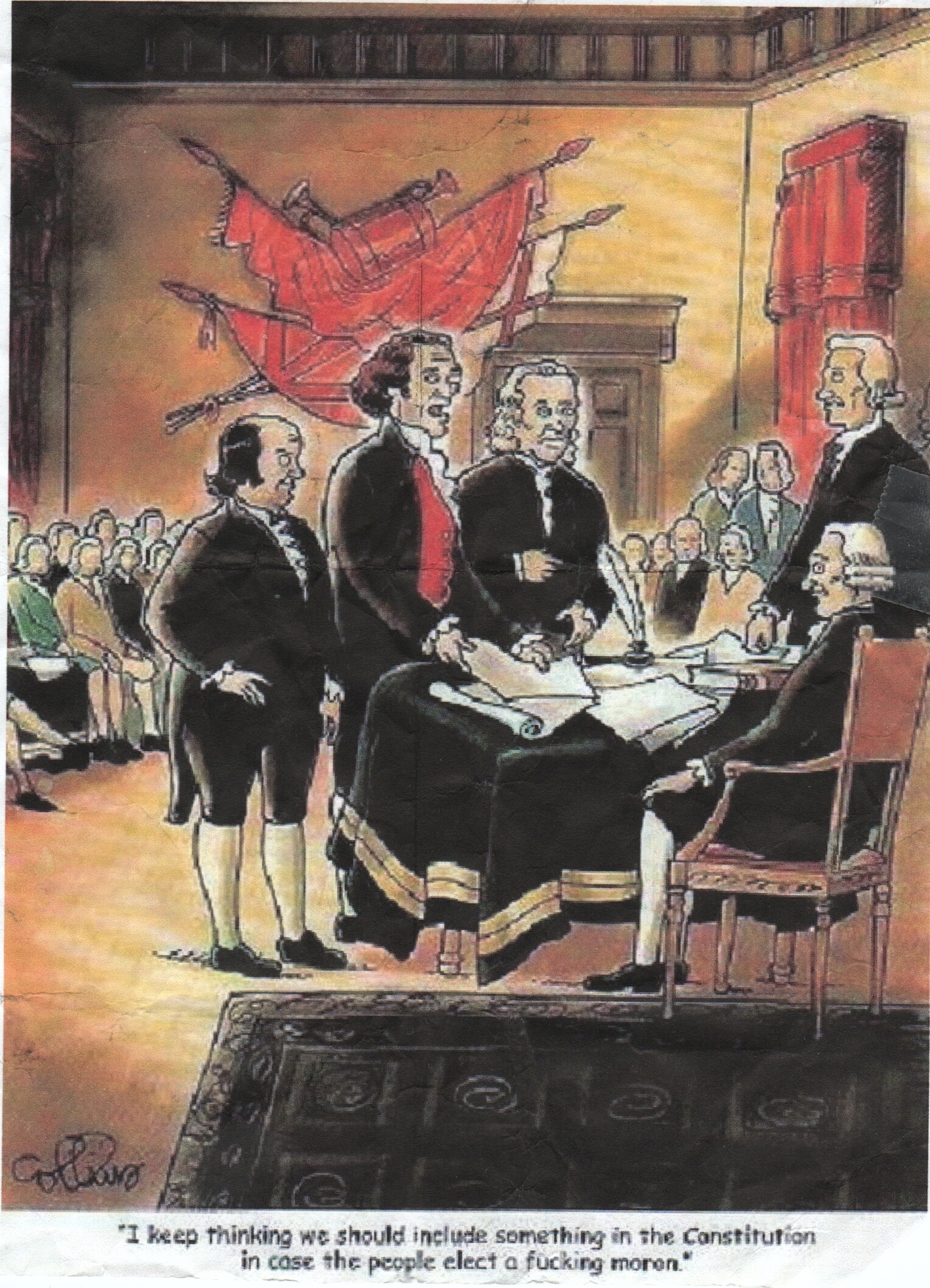
Second thoughts from a founding father

Another successful meeting of Drinking Liberally

I’ve been living in this area for many years, but this is the first time I’ve found myself strolling on Bank Street late on a summer night. It was with some trepidation that I stepped into the street to cross it, as there was a gang of motorcyclists, lined up and revving their engines looking for all the world like they were about to race down the street. However, they in fact behaved perfectly civilly, we made it across the street after leaving the latest edition of Drinking Liberally, walked past the bars and ended the night with some ice cream that couldn’t be beat, courtesy of Michael’s Dairy. Michael’s has been a New London institution since before I arrived in this area. If you make it down this way, and you’re a fellow ice cream fanatic, I highly recommend the pomegranate chip.

At the end of the night there were six of us remaining, four of whom are depicted here.

From left to write, former Lamont delegate Peter Roper and his wife Teri, State Representative Sandy Nafis and her husband, former Lamont delegate Alan Nafis, HPHS Class of ’68, greatest class in the history of the school.

Once again turnout exceeded our expectations. It seemed like the night before a long weekend might not be the best time for this type of event, but, not so.

In a totally unsurprising development, one of our stalwart members continues to insist that Joe Lieberman will be McCain’s running mate. He shudders at the thought, but remains insistent. Talk has begun of yet another Lieberman bet. I personally remain convinced that it’s an impossibility. I think McCain has to pick someone who will make the right happy. Could that someone be a certain California Florida governor of the male gender who just, to everyone’s surprise, announced that he was going to marry…a woman?

Update: I must have been drinking more liberally than I thought. I transplanted Charlie Crist to California.

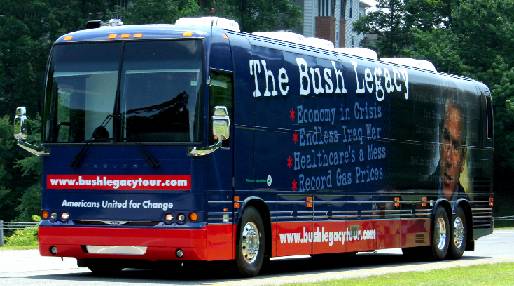
Bush Legacy Tour coming to a town near you.

I hadn’t heard of this before. The following announcement arrived in my email today:

Washington D.C. – In what supporters of the President have dubbed his “legacy year,” Americans United for Change, the progressive issue-advocacy group best known for leading the successful fight to beat back President Bush’s effort to privatize Social Security in 2005, has hit the road with its latest effort – The Bush Legacy Bus. The bus is a 45-foot long, 28-ton, clean bio-diesel-powered museum on wheels featuring several interactive exhibits on how two terms of failed conservative policies supported by Bush and his allies, including Sen. John McCain, have weakened America’s security abroad while neglecting and undermining important priorities here at home.

The latest stop on the national Bush Legacy Tour will be at the Silver Star Diner (210 Connecticut Ave, Norwalk, CT) on Monday, July 7th, 2008 at 3:30 p.m., EST where the people of Connecticut will be given a chance to reflect on how 8 years of failed Bush/conservative polices have left an economy in shambles, millions more without health insurance, an endless and mismanaged war in Iraq that has stretched our military to the breaking point, and thousands each day losing their jobs, their homes, and their dignity.

The Bush Legacy tour kicked off in Washington D.C. on June 24th and will travel coast-to-coast throughout the summer, making nearly 150 stops throughout the nation, both national political conventions and symbolic and historic locations like New Orleans and Crawford, TX. Click here to visit the Bush Legacy Tour homepage:

WHO: Americans United for Change

WHAT: 45-foot, 28-ton Bush Legacy Museum on Wheels Opened to the Public

WHEN: Monday, July 7th at 3:30p.m. EST

WHERE: Silver Star Diner (210 Connecticut Ave, Norwalk, CT)

Sounds like fun.

When corporations battle, we lose.

Verizon is currently suing Google/youtube, claiming that youtube has committed sundry acts of copyright infringement. Recently, a judge ruled that youtube’s source code was a trade secret, and youtube did not have to hand it over to Verizon in connection with the lawsuit. But the same judge ruled that youtube had to hand over 12 terrabytes of data, which will allow Verizon to paw through the viewing habits of each and every youtube user. When it comes to our secrets, the judge ruled that any invasion of our privacy interests would be purely speculative:

Google must divulge the viewing habits of every user who has ever watched any video on YouTube, a US court has ruled.

The ruling comes as part of Google’s legal battle with Viacom over allegations of copyright infringement.

Digital rights group the Electronic Frontier Foundation (EFF) called the ruling a “set-back to privacy rights”.

The viewing log, which will be handed to Viacom, contains the log-in ID of users, the computer IP address (online identifier) and video clip details.

While the legal battle between the two firms is being contested in the US, it is thought the ruling will apply to YouTube users and their viewing habits everywhere.

The US court declined Viacom’s request that Google be forced to hand over the source code of YouTube, saying it was a “trade secret” that should not be disclosed.

But it said privacy concerns expressed by Google about handing over the log were “speculative”.

The article goes on to report that privacy groups, such as the Electronic Freedom Foundation have been warning Google/youtube for years that it should anonymise (that word doesn’t pass muster with my spell checker, but if the BBC uses it, it must be real) IP addresses, but it has failed to do so on youtube, although it has on its search facilities.

Any corporation that had any concern for the privacy of its users would act proactively to protext them. We have not yet reached the point in our steady march toward becoming a security state that the government requires corporations to acquire this sort of information (at least I don’t think we have). If they never acquire it, it can never be demanded. It seems clear from the article that Verizon doesn’t need the IP addresses to prove its case. Google has now offered to anonymise (there it is again) the data, but so far Verizon isn’t having it.

There are lots of uses to which this data could be applied, some relatively benign (more direct marketing stuff). some not so nice. It is emblematic of our times that the court recognizes the trade secrets of a corporation, but can’t see a problem with needlessly divulging information on millions of people.