Skip to content

Filibuster-take three

My first few years as a lawyer were spent defending evictions, a fast moving process. In those days the trick was to delay cases until the client could move, because the Circuit Court judges were almost uniformly hostile to tenants. They would uphold an argument centered on some arcane procedural point, but when it came time for trial-forget it. So I quickly learned how to manipulate court procedures.

All this is by way of admitting that I don’t have a similar mastery of the procedures in the Senate, and it’s quite possible that I’m missing something here. I can’t help but think that Harry Reid has now painted himself into a corner. He has withdrawn the defense bill from consideration, until the Republicans mend their ways, except that he hasn’t:

“Because Republicans continue to block votes on important amendments to the Defense Authorization bill, we can make no further progress on Iraq and this bill at this time.

For these reasons, I have temporarily laid aside the Defense Authorization bill and have entered a motion to reconsider.

But let me be clear to my Republican colleagues — I emphasize the word “temporarily”. We will do everything in our power to change course in Iraq. We will do everything in our power to complete consideration of a Defense Authorization bill. We must do both.

What happens if the Republicans wait him out, and as October nears start accusing the Democrats of failing to support the troops? Will Harry have the cojones to keep the bill bottled up until they cave? It seems pretty clear to me that he’ll end up caving and they’ll end up winning.

The more I think about this, the more I think they decided to take their stand on the wrong bill. The bill is too important, so they will, at some point, feel duty bound to get something passed. It’s not simple enough, and therefore not easy to defend in a soundbite.

It would have been far better to make the Republicans actually debate the Webb Amendment, by putting it on the agenda and saying that we will get to the Defense Bill, and all the other important bills, as soon as we have finished protecting the troops. It shouldn’t be hard to soundbite that. Then, let the Republicans talk as long as they want, and just keep repeating that they’re punishing the troops to protect the president, and that they can have a vote on the Defense Bill anytime they want, as soon as they end the filibuster.

Then, when they cave (assuming they do), you blithely announce that you’ll make them do it again on the Defense Bill until there are up and down votes on the amendments. By that time, unless the Democrats are more incompetent than even I suspect, the American people will understand what the Republicans are doing, making it all the less likely that the Republicans will do it.

It seems that Reid has just punted this to October, at which point we’ll be hearing the same crap we heard in the Spring, with, most likely, the same results.

I devoutly hope that Reid has looked down the road, and has reason to think that things will play out differently than I suspect they will. No doubt he knows the rules better than me. I’d be ecstatic if I turn out to be wrong on this one.
Filibuster-take two

Okay, I’m beginning to see less and less point to the Reid filibuster, which truly does seem to put the onus on the Democrats to keep talking, for thirty hours, after which they stop and presumably move on to other business. Is there some way during that time period that they can move the matter to a vote? It looks like all the Republicans have to do is wait them out, which they will undoubtedly do.

Since the Republicans have basically announced that they will filibuster everything of substance, Reid should make them go the distance, which means, apparently, picking one issue and leaving it on the agenda until they cave:

A filibuster can be defeated by the governing party if they leave the debated issue on the agenda indefinitely, without adding anything else to the agenda. Strom Thurmond’s attempt to filibuster the Civil Rights Act was defeated when Senate Majority Leader Lyndon Johnson refused to refer any further business to the Senate, which required the filibuster to be kept up indefinitely. Instead, the opponents were all given a chance to speak and the matter eventually was forced to a vote.

Make them do it again and again. The alternative is surrender to the formerly filibuster hating Mitch McConnell, who has suggested this in response to Reid’s demands for up or down votes:

Minority Leader Mitch McConnell responded to Reid with a counteroffer: an automatic 60-vote threshold for all key Iraq amendments, eliminating the time-consuming process of clearing procedural hurdles. … [A]ll the controversial war-related votes held since Democrats took control of the Senate in January have required 60 “yeas” to pass.

McConnell has essentially proposed a Republican veto on all Iraq legislation, which he can convert to a veto on all legislation as soon as Reid caves. If and when they recover the majority, they won’t miss a beat in threatening the nuclear option. Tonight’s debate is just theatre, unless Reid follows up.

Rudy heading for a fall

Via Talking Points Memo, we learn that Giuliani’s trend lines look eerily like McCain’s, indicating that Rudy may be riding for a fall reminiscent of Mr. Straight Talk.

Since early March, Giuliani’s support has fallen by an estimated 8 percentage points. McCain’s fell by 10 points since January. And the rate of decline has been a bit steeper for Giuliani than for McCain. The saving grace for Giuliani has been that he started his decline from a higher point, around 33%, while McCain’s slump started down from 25%

As the frontrunners go down, we can expect other to go up, which is sort of what has happened. Thompson and Romney are both rising, but they’re apparently not sopping up all the folks abandoning McCain and Giuliani, as “None of the Above” has now taken a lead among Republicans.

It’s quite likely that as Thompson and/or Romney rises to the top, the increased attention to the reality behind the media masks each presents will lead to similar declines in their support. It just may be that even Republicans are not interested in nominating hollow men, and that’s all they’ve got. One of them has to end up on top, if only be default, since the party can’t nominate None, despite his/her superior qualifications. There’s a decent chance that the choice will be so uninspiring that his (no hers in the field) support in the party will be tepid at best. Imagine what that will mean for the candidate’s prospects of drawing support from the not undead.

The Democrats can still snatch defeat from the jaws of victory, particularly if the candidate runs a cautious, trying not to lose campaign. Whoever it is has to realize that people are looking for someone with a can do type of attitude, with the can-do geared toward doing things people want. First and most important rule: Ignore the beltway press, except when you’re attacking them.

Senators to lose sleep

Some time ago I suggested that the Democrats call the Republicans bluff and make them stand and deliver on their filibuster threats. It looks like Harry Reid has taken exactly that step.

Forcing his Republican colleagues to put up or shut up on the notion of an up-or-down vote, Senate Majority leader Harry Reid (D-NV) just moments ago announced that he will immediately file a cloture motion on the Reed-Levin troop redeployment bill and, if Republicans follow through with a filibuster, will place the Senate in a prolonged all-night session Tuesday to force a true continuation of debate.

This is a great first step. Just as important is that the Democrats speak with one voice on this issue.

Reid has chosen to draw the line on the Reid-Levin troop redeployment measure. Personally, I think Reid should have made them filibuster the Webb amendment, which would have required mandatory troop down time of two years for every year in combat. It’s something that would have been easier to frame, and it’s something many of them would have felt it necessary to vote for if they were forced to vote.

No matter. It’s good that the Democrats are trying to break the cycle whereby filibusters have been effective tools for the Republicans, who have used them without consequence, while the Democrats have retreated at the first mention of “obstructionism” or the argument that something “deserves an up or down vote”. The Democrats have failed to play tit for tat and have paid for it.

Now, they have to stick to this and make the Republicans talk for as long as it takes to get them to back down. If this is merely a symbolic gesture, it will only encourage further misbehavior.

Getting to No

There are times when one wonders why we have come to the point where we are sometimes unable to just say no.

Here in Groton a developer has been building yet another tacky looking hotel, scheduled for completion in 2008. Halfway through construction he asks the town for a tax break.

Kiran Parekh, managing partner of Groton Hospitality, who also owns the Hampton Inn on Long Hill Road, said in a letter to the town that the company needs time to “ramp up and stabilize” the hotel operation, as meetings and conferences are planned in advance.

It’s patently clear that Mr. Parekh found out too late that the Town handed out a tax break to the Marriot as an incentive to get it to do what it was going to do anyway, so he figured it was worth asking that he be given an incentive to do what he’d already done.

I assume that ultimately the answer will be “no”, but should there be any doubt? Parenthetically, as the article points out, a similar need to “ramp up” justification was made in support of the Marriot project, which made the “argument that it takes time to build up business for a full-blown conference facility”. Has anyone ever seen the numbers to verify that the claim was true? And isn’t the problem far worse for a non mega-corporation entepeneur, e.g., the long a-building nursery on Flanders Road that is struggling through its initial years without, I’m sure, any tax break at all. Only the bigger pigs can make their way to the trough.

Double parenthetically, if we’re going to give tax breaks, why give them to people in the business of creating low pay dead end jobs? Have we no Wal-Marts?

Newport Kite Festival

Yesterday, (July 14th) my wife, sister and I headed to Newport for a mini-family reunion at Brenton Point State Park.

As it happens, the same winds that make Narragansett Bay an ideal yachting destination also make it an ideal destination for the humbler pastime of kiting, and, by a happy coincidence, our family picnic coincided with the 2007 Newport Kite Festival. We picnicked in the midst of the festival. The downside was that all the good (shady) locations were taken, the upside was that we got to see all manner of kites.

I know nothing of the finer points. I gather from some things said on the PA system that for reasons unclear box kites are out of fashion at the moment. I am not really quite sure how some of these contraptions, which often look like balloons, qualify as kites, but no matter, they lent an air of color and magic to the scene, which really enhanced our pleasure.

I’ve posted a few pictures, that you can view by clicking here or at the link at the upper left hand corner of the home page. Here’s one I especially liked, a kite boat that looks quite dramatic against the sky.

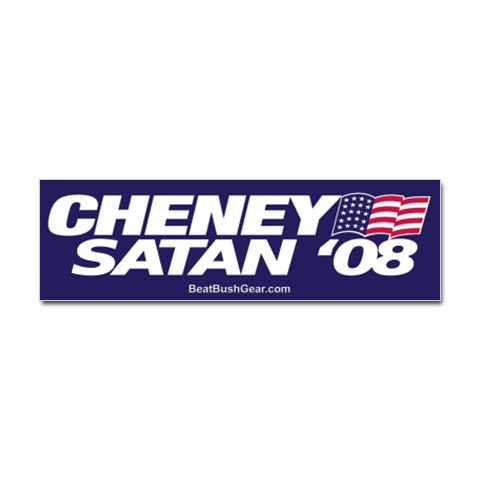
The Devil defers to a better man

Seen on a bumper on our way to Newport yesterday:

jitcrunchaspx.jpg

Friday night music

Neil Young makes a suggestion:

[youtube]http://www.youtube.com/watch?v=k4kTnP5VJ1k[/youtube]

The video is more than a year old, so many of Bush’s impeachable offenses still lay before him.

All we need is Common Sense

A few days I argued that the Democrats could appeal to the visceral emotions of voters, as Drew Westen advocates and still make reasoned arguments. The two aren’t mutually exclusive, for there’s nothing that says you can’t make an impassioned argument that is consistent with reason.

I’m listening to a biography of Tom Paine these days, and it came to mind that Paine is a perfect example of someone who was able to appeal to both reason and emotion. Common Sense was brilliantly argued, and part of its effectiveness lay in the difficulty Paine’s opponents had in answering his arguments. But the pamphlet was brilliantly effective for another reason: Paine spoke to the common man in his own language, giving voice to inchoate resentments that seethed below the surface but had not been articulated so effectively before. He said very little that was new, but he said it in a way that was the opposite of the dispassionate, convoluted mode in which his contemporaries had been taught to write and argue. Before his pamphlet came out, anyone advocating Independence was a wild eyed radical; within weeks of its publication Independence was an unstoppable idea. Like master politicians and manipulators today, Paine knew how to frame an issue, but he stayed faithful to reason and intellectual honesty.

Reading it now, in the age of content free sound bites, we might easily miss the appeal to emotion that is embedded in Paine’s prose. But his audience didn’t. Maybe Michael Moore is our Tom Paine (he does strike fear in the hearts of the Tories), but things are bad. These days, one Tom Paine is not enough.

Outrage fatigue closing in on the tax front-what else is new

Life is tough for pundits like Paul Krugman. Yesterday’s outrage seems mild by comparison with today’s. If you write your column a day or two ahead of deadline you risk writing about yesterday’s scandal.

Case in point, today Krugman takes the Democrats to task for slowly walking away from mandating fair taxation of hedge fund managers. The hedge fund crowd has taken the position that their earned income is capital gains, and they have, so far, gotten away with it:

The effect of this redefinition is that income that should be considered by normal standards to be ordinary income taxed at a 35 percent rate is treated as capital gains, taxed at only 15 percent instead. So fund managers get to pay a low tax rate that is supposed to provide incentives to risk-taking investors, even though they aren’t investors and they aren’t taking risks.

For example, the typical hedge-fund manager has a 2-and-20 contract — that is, he gets a fee equal to 2 percent of the funds under management, plus 20 percent of whatever his fund earns. It’s not exactly straight salary, but none of this income comes from putting his own wealth at risk. Except for the fact that he might make a billion dollars a year, he resembles a waitress whose income depends on a mix of wages and tips, or a salesman who lives on a mix of salary and commissions, more than he resembles an entrepreneur who sinks his life savings into a new business.

Outrageous? Yes, but mild compared to this from the front page of the very paper in which Krugman’s column appeared:

The Blackstone Group, the big buyout firm, has devised a way for its partners to effectively avoid paying taxes on $3.7 billion, the bulk of what it raised last month from selling shares to the public.

Although they will initially pay $553 million in taxes, the partners will get that back, and about $200 million more, from the government over the long term.

That’s right. These hedge fund guys just can’t get motivated to pull down billions a year if they have to pay a whopping 15% in income tax. Without us yokels subsidizing them, they might not invest other people’s money at all, and then where would we be? As Abu Gonzalez might say, this new scam renders outrage at the capital gains dodge somewhat “quaint”.

ADDENDUM: There is some good news. No less a corporate coddler than Hillary Clinton has grabbed the hedge fund tax issue to burnish her credentials with us little people:

Senator Clinton, speaking at a rally in New Hampshire, called for ending a “glaring inequity” that allows investment managers in certain partnerships to take large amounts of their compensation in the form of performance fees or “carried interest,” which is taxed at the 15 percent capital gains rate rather than at income tax rates as high as 35 percent.