Skip to content

A little Holiday Excursion

My family has established yet another Holiday tradition-a trip to New York City between Christmas and New Years. In years past we have taken in a Broadway play, but times are tough and belt tightening is in order, so this year we decided to go to the Guggenheim. Herewith a few pictures of the Big Apple.

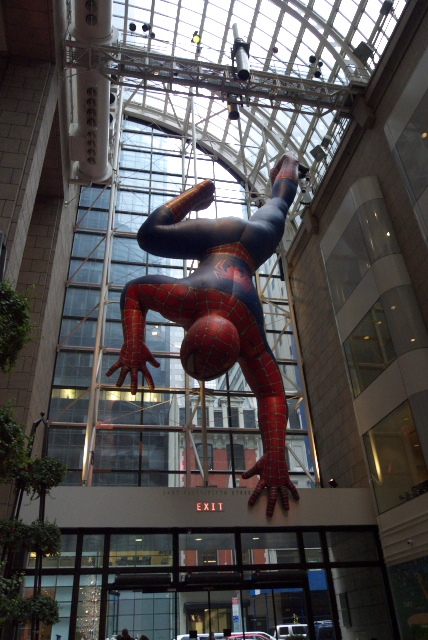
It wouldn’t be New York, of course, if you didn’t run into a superhero. Based on the movies I’ve viewed, the place is crawling with them, and sure enough, when we stopped along the way to the museum for a coffee, who should we see but Spiderman? The fact that we were at the atrium at the Sony Store was, I’m sure, purely coincidental.
The Guggenheim is a beautiful building, though I must say the current featured exhibition, photographs by Catherine Opie, left me a bit cold. The other main attraction consisted of a collaboration of artists that, according to the museum’s website:

Working independently and in various collaborative constellations, they eschewed the discrete aesthetic object in favor of the exhibition environment as a dynamic arena, ever expanding in its physical and temporal parameters.

I have no reason to believe they did not succeed in their artistic endeavors, as I have no idea what the above means. Mostly the fruit of their efforts consisted of slogans written on the wall, or hanging from the ceiling, many of which made no sense whatsoever. However, this one, despite all our troubles, seemed to ring true as we usher in the age of Obama:

But alas, not everyone shares that optimistic viewpoint. This is the Holiday season, a time, as we all know, when depression runs deep for many. At least one person must have concluded that everything was not going to turn out alright, so, apparently, he threw himself off the upper level, landing in a pool of water in the lobby. You can just make out his body in this photo:

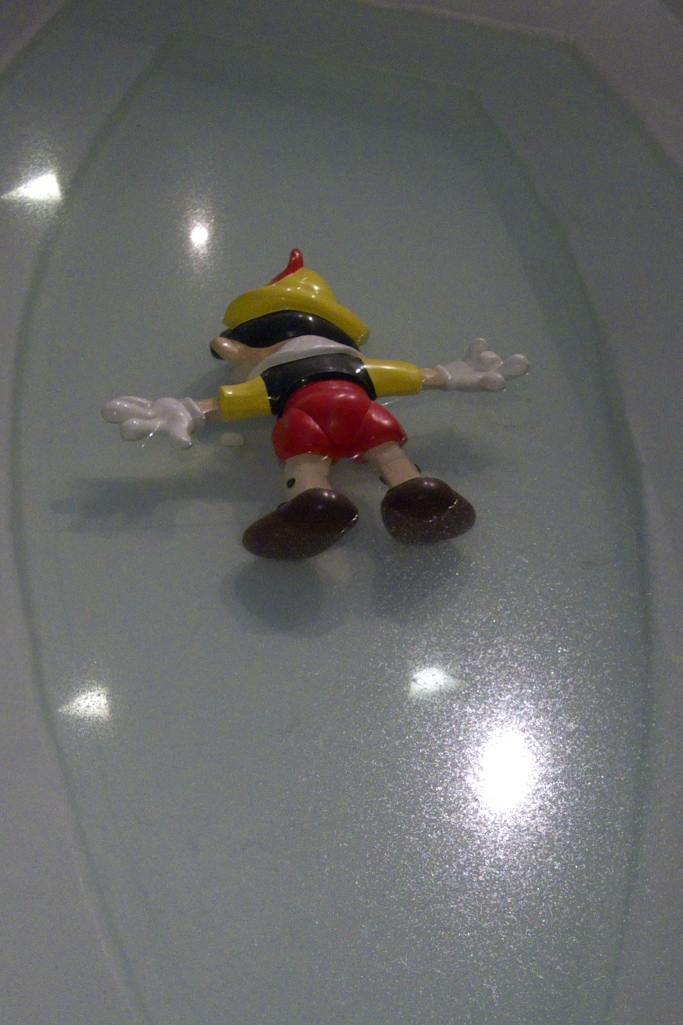
This being New York, and as you can see, he was totally ignored. Some time after I took the foregoing shocking photo I was able to get closer. It’s my understanding that they are still trying to identify the poor fellow:
I leave you with this photo that my son took, which depicts the fog enshrouded buildings on the West Side of Central Park, with the pond in the foreground. I thought it was a great picture.

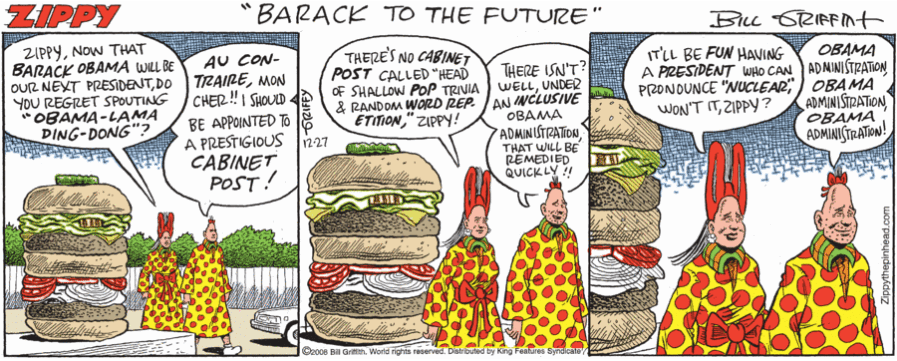

Everyone wants a job with Obama


Friday Night Music-The White Stripes

Both of my sons are here for the Holidays, and I asked the younger, a former college radio music director, to recommend a music video for tonight. My thinking was that he could recommend something of which I was unaware, and which might broaden my horizons and those of the folks who read this blog.

I have, in fact, heard of the White Stripes. They were the first and possibly only band to perform on the Daily Show.

This video has a bit of a Holiday connection too, at least for me. Our youngest was an almost fanatical Lego fan, so for several years there were lots of Legos under the tree. Needless to say, I’ve bent my no-lip synching rule in this case. So, without further ado, the White Stripes:


George Bush and the pardon power

Might I direct the reader’s attention to the discussion over at Talking Points, particularly this post, about Bush’s attempt to “revoke” a pardon that he granted to a scam artist from Long Island.

First let me confess that if not for my own laziness I would have written about this before. As soon as I heard about Bush’s pardon “revocation” it struck me as odd. How can a President revoke a pardon. If it could be done, what would stop a President’s successor from revoking one of his (or her) pardons?

As Josh Marshall points out, the press has not gone out of its way to delve into this question. Marshall did, and his findings are interesting:

First is the argument put forward by the White House itself, that the president had sent requests for pardons to the Pardon Attorney but that the Pardon Attorney had yet to “execute and deliver grants of clemency to the named individuals.” According to the White House press release from Wednesday, the president got to him before he’d done that and “directed the Pardon Attorney not to execute and deliver a Grant of Clemency to Mr. Toussie.”

But from what I can tell, the Pardon Attorney doesn’t ‘execute’ anything. The current system of having the Pardon Attorney create certificates of pardon only goes back to the Eisenhower administration, and was then apparently only done to relieve the president of the chore of signing so many pardons and commutations. I spoke to former Pardon Attorney Margaret Colgate Love (1990-1997) who told me that “receiving the president’s warrant and sending notifications to the petitioners is purely ‘a ministerial act of notification.'” In layman’s terms, at this end of the transaction, the Pardon Attorney’s role is really just a matter of paperwork. “When we received the Master Warrant from the president,” said Love, “what our job was was to notify them, by telephone, and eventually by written notification. The document evidenced the president’s action. We never assumed that that document had any necessary legal significance.”

So just as a factual matter, the idea that the Pardon Attorney needs to ‘execute’ the pardons seems to be bogus. End of story.

The second argument has to do with notification. The idea here is that even though the president is the actor, his pardon only takes effect when the petitioner is notified. This reasoning depends on the Du Puy case from 1869, in which the Court ruled that President Grant could take back two pardons earlier issued by President Johnson because the petitioners had not yet been notified of their pardons. But the Du Puy case comes from a technological universe in which the US Marshal’s notification would have been the first the petitioner heard about it. But clearly that’s not the case anymore. There’s little doubt that Toussie heard about his pardon in the news prior to the president’s decision to rescind it.

More to the point, from talking to people familiar with the process, I understand that it is standard procedure for the petitioners or their counsel to be notified of their pardon either before or simultaneous with the public announcement. So there’s every reason to be believe that Toussie or his attorneys were specifically notified of his pardon, despite not getting the framable document that does not appear to have any legal significance.

If Mr. Toussie decides to litigate this question, it seems to me his case will hinge on whether the White House did, in fact, notify him or his attorney prior to making the pardon public. Secondarily, as Josh says, he can argue that notice to the world is notice to him. Thirdly, of course, it will hinge on whether a judiciary solidly in the Republican camp will care to embarrass a former Republican president.

It seems to me that this is just another instance of Bush believing that he has unlimited power. In this case, he is claiming to have unlimited power to revoke an exercise of what is a virtually unlimited power to begin with. No one argues (and I’m not sure why) that the Congress has any ability to regulate or restrain the pardon power, by, for instance, requiring that the president follow any particular process. It is hard to see, given that assumption, how any president can impose any procedural constraints on himself or his successors.


Tragic News from Up North


Happy Holidays

I’m shutting down for a few days. Before I go I’d like to wish everyone Happy Holidays. I’d also like to thank two of my long time readers (who are also great Democrats) for sending those eCards to my wife and me. We’ve enjoyed them immensely.

I’ve been feeling a bit under the weather lately, so even when I’ve had the time to cruise the net, I’ve been only semi-conscious, thus only dimly aware of what’s going on. Al Franken seems to be ahead, a bit of a Hanukkah miracle there. Rather than bore you further, might I suggest you read Tom Tomorrow’s Year In Review, first part here, second part here. It’s like a trip down memory lane, made all the better because you know it’s all (or mostly all) going to turn out just fine. (Except for the coming Depression of course. But seriously, what else could we expect after eight years of Republican mismanagement?)


Failing Upwards

Folks of my generation will no doubt remember the Peter Principle, first propounded by Dr. Laurence J. Peter and Raymond Hull in their book of the same name. Peter and Hull proposed that in any hierarchical organization, a person tends to rise to his or her level of incompetence. This principle has long since been disproved, since one of its tenets was that once a person rose to their level of incompetence, they remained there. Consider George W. Bush, who rose several levels past his level of competence. Indeed, it is not at all clear that he ever held a position in which he displayed the slightest competence.

But, one could argue that he is a special case.

This is all by way of introducing yet another proof that the principle is dead in our modern era, and I’m not talking about Bill Kristol, for whom there is also no discernible record of competence at any level. No, this one strikes a little closer to home, in that it involves the lawyer business, in which I have the misfortune to be engaged. It seems that a long lived Wall Street Law Firm, Thacher, Profitt & Wood, is about to go under. It tried to sell itself, but couldn’t. But have no fear, some of the partners, at least, have found a new home:

Thacher’s partners had been in talks to sell the firm. But [Sonnenschein, Nath & Rosenthal], based in Chicago, is not acquiring Thacher, choosing instead to take on the lawyers who formed the core of its real estate, finance and corporate practices.

Thacher was founded in 1848, and its clients included many of the biggest banks and investment banks, including Citigroup and UBS. It has been one of the leading firms behind the creation of the sort of mortgage-backed securities that fueled the lending spree that has since backfired on the banks.

So the guys who helped create the mess that has led to the destruction of the national economy are getting a soft landing while the rest of the firm is still faced with uncertainty. It gets even better. Guess who will be getting the benefit of legal advice from these folks who helped create the mess in which we find ourselves:

… [T]he Treasury Department recently awarded Thacher a $500,000 contract to advise on investments as part of the federal bailout, the Troubled Asset Relief Program. Mr. McCarthy said that the lawyers involved with that assignment would be joining Sonnenschein and expected to retain the Treasury as a client.

Who better to advise us on these investments than the very guys who helped create them?

Now, my heart’s not really bleeding for the folks left behind at the rump Thachers. During the good times they, at least the partners, no doubt shared in the fees generated by the creation of these toxic instruments, and most of them will probably find work elsewhere. Still, it is emblematic of our times that the lawyers considered the cream of the firm were those who created “the sort of mortgage-backed securities that fueled the lending spree that has since backfired on the banks”.


Sock and Awe

Try your hand at hitting the dirty dog with your shoe. My wife’s definitely not a video gamer, so it took her a while, but she got a kick when she finally got him.

The first time I went I had to refresh before the game appeared. I got him twice on my first go round.

UPDATE: Speaking of shoes and Bush,it looks like Bush has finally brought some economic growth somewhere:

When a pair of black leather oxfords hurled at President Bush in Baghdad produced a gasp heard around the world, a Turkish cobbler had a different reaction: They were his shoes.

Although his assertion has been impossible to verify — cobblers from Lebanon, China and Iraq have also staked claims to what is quickly becoming some of the most famous footwear in the world — orders for Mr. Baydan’s shoes, formerly known as Ducati Model 271 and since renamed “The Bush Shoe,” have poured in from around the world.

A new run of 15,000 pairs, destined for Iraq, went into production on Thursday, he said. A British distributor has asked to become the Baydan Shoe Company’s European sales representative, with a first order of 95,000 pairs, and an American company has placed an order for 18,000 pairs. Four distributors are competing to represent the company in Iraq, where Baydan sold 19,000 pairs of this model for about $40 each last year.


Still fun to beat this dying horse

This morning’s Times has a post mortem on one of George Bush’s many failures: the housing crisis. The Times credits Bush with genuinely wanting to increase home ownership. I refuse to do that, since I don’t think he’s ever actually wanted to improve the lives of ordinary people. He has done what needed to be done in order to enrich the members of his class.

The article establishes anew what we already knew: that the primary reason the situation got so out of hand was Bush and his gang’s adherence to Republican anti-regulation orthodoxy. It doesn’t matter whether they actually believed that unregulated markets always work optimally, or only said so because it was in the interests of their base. The effect was the same.

Publicly, Bush blames everyone but himself. Privately? I never believe the second hand Bush quotes passed on by Bush flacks, but let’s assume for the sake of argument that this is true:

But in private moments, aides say, the president is looking inward. During a recent ride aboard Marine One, the presidential helicopter, Mr. Bush sounded a reflective note.

“We absolutely wanted to increase homeownership,” Tony Fratto, his deputy press secretary, recalled him saying. “But we never wanted lenders to make bad decisions.”

Here is a guy who exploited every loophole, and created a bunch from whole cloth, to expand and abuse his own power. When the law did not allow him to do something, he argued that it did. When it was clear as day that something he did was illegal, he did it anyway, because he knew one thing. He was subject to absolutely no oversight. As a result he made a lot of bad decisions. In fact, it would be the work of a day to try to come up with one good decision he made.

So we must wonder. What made him think his banker friends would act any differently, after he abolished effective oversight of them? Those bankers did not make bad decisions. Things worked out great for them. They all got spectacularly rich, and they’re still spectacularly rich. Thanks to Bush, they’re still in line for big bonuses, on our dime. Their decisions were bad only if looked at from the point of view of the general interest. But Republican dogma tells us that business people are not supposed to consider any interests but their own. That’s what regulators are for-to make sure that the pursuit of private gain does not destroy the public good. So, if Bush didn’t want lenders to make bad decisions, he himself made all the wrong decisions to prevent them from doing so. But then, what else is new?

Update. Paul Krugman, on his blog, comments on Bush’s commitment to home ownership and the root of our present problem:

I’m also with Barry Ritholtz that Bush’s emphasis on homeownership was not the problem. Bush favored homeownership; I’m sure he also favored marital fidelity; his influence on homeownership and his influence on adultery were probably comparable. It’s Bush’s opposition to financial regulation that did the evil deed.


Friday Night Christmas Music

Well, what else could you expect the Friday before Christmas? The following song is on my Ipod Christmas playlist. It seemed like a good choice. Unfortunately, I had a choice between a video with poor quality audio that wasn’t so obviously lip synced, or one with better audio but bad lip syncing. I decided to go with the good sound. In each case the video was terrible.

The Kinks, Father Christmas:

And, as a Christmas bonus, the Boss singing Santa Claus is Coming to Town: