Skip to content

Great David Brooks takedown

I don't read David Brooks. I let other people do that for me. He's just another Edmund Burke wannabe, without the brains to pull it off. But I did read him once or twice in the past, and my distant memories are enough to know that this parody of his recent marijuana column is spot on. Read and enjoy.

A bit of sanity, in Utah of all places

A state legislator in Utah is proposing a state constitutional amendment “that that would exempt religious institutions from performing same-sex marriages even if the state is required to issue marriage licenses to gay couples”. Now, your first reaction might be to roll your eyes, but the guy's rationale, to my mind, makes sense, and even though he's a Republican, it sounds like he's sincere:

“The truth is, the main reason I'm proposing this is that I just want people to relax,” Rep. Jacob Anderegg told the Tribune in an interview published Monday. “If they know they have their federal religious guarantees in writing, I hope they will just relax.”

I doubt that the amendment will do much good. Most of the strident opposition to gay marriage is, at bottom, about raising money off of gullible fools. They don't want to relax. But it certainly can't hurt, and who knows, despite my reservations, it might cause some relaxation. It is, of course, totally unnecessary. I can't imagine there's a lawyer on any side of the political spectrum that would argue that you can constitutionally force a religious institution to carry out any marriage to which it has some sort of bigoted objection. You couldn't, for instance, force the Pope to marry two Jews, whatever their gender might be. The whole idea is almost as ludicrous as imagining that it's consitutional for the government to spy on everyone's email all of the time. Oh…wait.

What's truly surprising about this is that it comes from the land of the Mormons, a state in which it is absolutely shocking that there is a single state legislator, not to mention a Republican state legislator, who wants people to relax about gay marriage. That in itself is huge progress.

Something we can all agree on

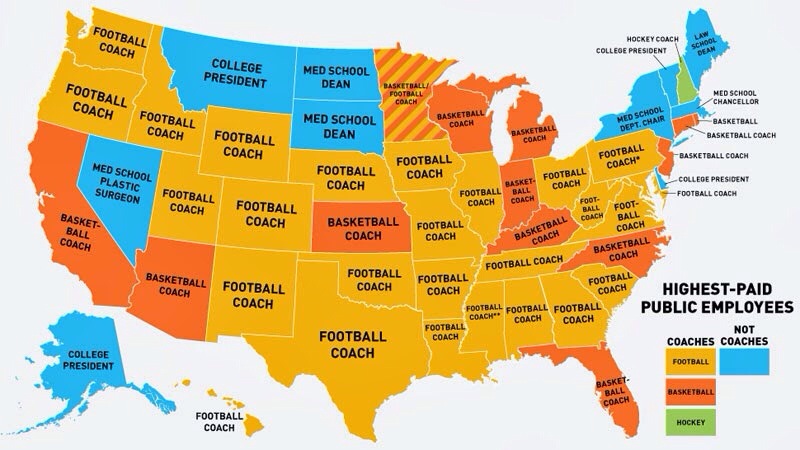
If you’re like me (and you should be) you’ve seen lots of maps of the U.S. showing differences among the states in graphic fashion. Typically, they show the Southern States coming off as one might expect: worst. For instance, divorce rates are higher in the Bible Belt, as are rates of teen pregnancy. The disparity is pretty much a constant. On whatever measure, we in the sane states come off better.

So, does it come as a refreshing surprise, or a profound downer, that by one measure, we are almost universally stupid. It’s not surprising really, but when you see it in a graph it is downright depressing. Herewith, the highest paid “public servant” in each of the 50 states.

20140102-174152.jpg

via Hullabaloo

Well, actually, New England comes off only half bad, though Connecticut should hang its head in shame.

No Mystery Here

This morning the Times ran one of those year in review stories, this one about house prices. The story notes that, in what should not be a suprise to any sentient being, the increase in house prices of recent days appears to be a passing phase, and it's more than likely that the rate of increase will slow further. We are to believe this is a bad thing, although we are not told why, but we can let that pass. The article also notes that house prices have still not reached there previous highs, which, so far as I can tell, we are also supposed to think is a bad thing.

You would never know from reading the article that the previous highs resulted from a housing bubble, meaning they never would have gone that high if someone unlike Alan Greenspan had been in control, and that they were by definition (it was* a “bubble”, remember) unsustainable at those levels.

This amnesia is not terribly surprising, but what always surprises me (well, not really) is the fact that the role of rising inequality in the housing market is rarely mentioned, and then only obliquely. If we were talking about yachts, we might expect rapidly rising prices. But we are talking about homes. Everyone needs one, but usually only one. Some people have two, three, or, like John McCain, can't remember how many they have. But there is simply not enough demand for excess housing generated by the 1% to have a significant impact on national home prices, particuarly since the rich tend to segregate themselves. If wages are stagnant or declining in real terms, it stands to reason that home prices cannot, absent a bubble, increase very much in the long term. People can't buy what they can't afford. Basic laws of economics (of the common sense variety) would dictate that housing prices should remain relatively stable. The quality of our housing stock might decline, since the cost of improvements, to the extent any individual homeowner can afford them, will be harder to recover. The solution, of course, it to reverse the flow of money to the top. Until that happens, housing prices will only rise if the banks are allowed to create another bubble, which, I admit, they are likely to do as soon as the government agrees to look the other way.

Where are the Obama haters when we need them?

A few days ago, I noted my utter lack of surprise at the fact that Eric Holder has refused to enforce a subpoena sought by some government officials investigating JP Morgan's role in aiding Bernie Madoff. It seems there is some doubt that the financial geniuses at the bank really didn't know Madoff was scamming his clients, and that the bank may actually have knowing enabled the con. What a surprise.

Anyway, one thing I didn't note, was the fact that there has been very little coverage of this in the national press. Pam Martens noted this fact today:

Since December 16, major business media have failed to dig deeper into a potentially blockbuster story involving the Justice Department’s refusal to honor a Wall Street regulator’s request for a subpoena against JPMorgan Chase to obtain Madoff related documents the firm was refusing to turn over. JPMorgan Chase was Madoff’s banker for the last 22 years of his fraud. The Trustee in charge of recovering funds for Madoff’s victims, Irving Picard, said in a filing to the U.S. Supreme Court this Fall that JPMorgan stood “at the very center of Madoff’s fraud for over 20 years.”

It’s a big story when a serial miscreant like JPMorgan – which has promised its regulators to change its jaded ways in exchange for settlements – risks obstruction of justice charges by denying one of its key regulators internal documents. It becomes an explosive story when the Justice Department, the highest law enforcement agency in the land and the regulator’s only source of help in enforcing a subpoena for the documents, sides with the serial miscreant instead of the regulator.

via Wall Street on Parade

I think I can clear this up. When push comes to shove, even in this terribly partisan age, the parties tend to silently come together when it comes to covering for the big banks. We first saw that in January of 2009, when Little Timmy Geithner, Wall Street's candidate for Treasury Secretary, breezed through his confirmation hearings despite tax problems that would have sunk better nominees. They would certainly have derailed any of Obama's other nominees, none of whom were anywhere near as terrible as Geithner.

In order for an issue like this to get coverage in the national press, someone must raise a hue and cry. There happens to be a party in this country that is not much good at governing, but is awfully good at raising hues and crys, yet, as in the Geithner situation, it has been strangely silent about what by any measure is a profoundly acrid smell being emitted by the Department of Justice. If such a hue and cry was raised, the folks at the New York Times and Washington Post would dutifully follow up, printing reams of stories about incompetence or corruption at the Department of Justice, as they have dutifully done about the roll out of Obamacare (while, in many cases, ignoring the fact that the glitches are being cleared up). Matter of fact, only a Republican hue and cry gets much press; we Dems can hue and cry till the cows come home, but nobody seems to notice. Anyway, you don't have to be a news junkie to know that the Republicans attack virtually everything Obama or his administration does, so what gives here, when they have an actual legitimate issue? Silly question, of course. As Randy Newman sang, “it's money that matters”, and the banks have a lot of it, and tend, as Hamlet said, “to spread the compost on the weeds, to make them ranker”.

An artist with local roots

If you have a copy of this morning's Times, take a gander at the front page, where you'll see a picture of a picture of outgoing (finally) Mayor Bloomberg., the depicted picture painted by one Jon R. Friedman. The name struck a chord with my wife and me, and a little googling led us to confirm our recollections.

When I first started working as a legal services lawyer I was paid with a CETA grant, at the princely sum of $9,500.00 a year. I worked in New London, but we had a Norwich office as well, where I went quite often. Jon R. Friedman was also working under a CETA grant (proof here), painting murals in Norwich. One of the murals adorned the walls of the legal services waiting room in Norwich, and we got to know Jon fairly well as he worked on it. It was good, but his Norwich masterpiece was the mural that briefly adorned the walls to the entry hall at the Norwich City Hall. Back in those days the Superior Court was in City Hall, with courtrooms scattered throughout the building. Most folks entering to go to court would pass through that hall, and thanks to John, for a while they got a valuable lesson in politics.

I don't remember the precise pictorial subject of the mural, though I do know it suited the Frederick Douglass quote emblazoned thereon:

Power concedes nothing without a demand. It never did and it never will.

The mural had a fairly brief shelf life, but I got a kick out of it every time I walked those halls. It is now gathering dust somewhere. Who knows, but Friedman's newfound (to me at least) prominence might retrieve it from oblivion. I wonder if he ever imagined that someday he'd be painting the portraits of arrogant billionairres (besides Bloomberg, he's got Bill Gates on his resume) who are living proof of the truth of Douglass's statement.

Krugman wrong again

I hate to disagree with Krugman, but disagree I must. In a recent post on his blog he made the outrageous claim that the right can't take (or make?) a joke, and that we on the left can. The proximate cause of his post was the reaction to a humorous attack on Bitcoin, which provoked an angry response from the suckers who will, blessedly, soon lose all their money.

And it’s not just BitCoin. When I think about the various debates I’ve been engaged in over the past five years, what’s striking is how furious and huffy the other side gets when people like me use picturesque language to get a point across — “confidence fairy”, “zombie idea”, and so on. As in other matters, this is not symmetric. I get called a lot of names, but so what? The argument’s the thing.

Or maybe not, for some people. As the old lawyer’s line says, if the facts are on your side, pound the facts; if the law is on your side, pound the law; if neither are on your side, pound the table. I’d add: and demand “civility.”

In other words, I think that when one side in a debate lacks all sense of humor, and gets deeply offended when the other side cracks a joke, it’s an indicator of intellectual insecurity.

via The Conscience of a Liberal

How wrong he is, and how soon he forgets. Right wingers are always making jokes that we lefties don't get. For instance, just recently, Meghan Kelly joked about Santa Claus being white. We know it was a joke because she told us so herself, the day after she made it. Or consider Anne Coulter, one of the greatest right wing comedians of all time. (Actually I've chosen her because it's just so easy to find examples) Liberals can never see the humor in her remarks about, for example, Arabs, gays, or murdering political opponents despite the fact that she patiently explains that her comments were jokes.

Now in our defense, there are some differences between lefty jokes and right wing jokes. Our jokes are generally “funny” and we usually know we are joking as the words leave our mouths or pens. Right wing jokes have a sort of ex post facto quality; they tend to become jokes a day or two after they are emitted, generally at about the time the jokester starts to take some heat, or, when they themselves (poor Meghan again) become the butt of real time jokes of the funny variety.

Nonetheless, and in the interests of maintaining the “both sides do it” journalistic meme, I must again state that Krugman is dead wrong about the humorlessness of the right and about the ability of the left to take a joke. I plead guilty myself. I've always believed that I can understand a good joke, but try as I might I haven't summoned up so much of a chuckle as a result of Meghan's joke, though I'm sure it must be funny.

Back from the Shadows Again

Well, our holiday guests have come and gone, and it is time for me to return to blogging. Don't ask me why. I do pay a modest yearly fee to my web hosting service, so I guess one answer would be that I have to get my money's worth, but I could solve that problem by pulling the plug on this exercise in self delusion.

As it's been a while since I posted, this post will involve a few of the week's events, all built around a common theme. So, off we go.

Those of you who regularly read this blog probably know that I am somewhat cynical. Not as cynical as one near and dear to me seems to think, but somewhat cynical. Yet even I was astounded to realize the extent to which Wall Street has gamed the bankruptcy system in its favor. While pensioners in Detroit may be taking a huge hit, despite a state constitution saying their pensions are sacrosanct, several banks that conned Detroit into a disastrous investment vehicle are well protected:

As Detroit struggles to come up with money to improve services for its residents, two large banks are poised to receive hundreds of millions of dollars to cancel a deal that helped push the city into bankruptcy in the first place.

The two banks, UBS and Bank of America, were the only creditors that managed to reach a settlement with Detroit before the city declared bankruptcy last July. They agreed to let Detroit out of financial contracts called interest-rate swaps for 75 percent of what the city owed, or about $230 million. They also agreed to give up some casino tax proceeds that Detroit had pledged to them as collateral for the swaps.

The 75 cents on the dollar is a far better deal than the city’s other creditors will probably get. And because of an unusual provision in the federal bankruptcy code, these two banks actually have a legal right to 100 cents on the dollar. The provision gives traders in swaps, options and other derivatives a so-called safe harbor, exempting them from the usual stay that blocks creditors’ efforts to collect debts.

The provision has turned on its head the meaning of safe harbor in bankruptcy. Bankruptcy proceedings are supposed to give debtors like Detroit a safe place to negotiate a way out their problems under the protective eye of a federal judge.

Bankruptcy law rests on the bedrock principle that the best outcome can be achieved if everybody shares equitably in the pain and losses. But in the brave new world of municipal bankruptcy, the law gives derivatives traders an even safer harbor than Detroit’s.

via The New York Times

As the article says, the bankruptcy act was “reformed” several times over the course of the years to declare more and more Wall Street debt protected.

This may be hard to believe, but there was a time when the Bankruptcy system actually looked out for the little guy. 1978 was not really that long ago. It was in that year that the Bankruptcy Act of 1978 was passed (you can tell by the title of the Act). That act actually reformed the system in a way that was friendly toward regular people. The only onerous provision (and it may have been added later) was the provision excepting student loans from discharge, which has, of course, led to student loan abuse, particularly by for-profit institutions, of massive proportions. But, other than that, the law was quite solicitous of normal people. For instance, it expanded the scope of exemptions available to debtors. Prior to its enactment, a debtor declaring bankruptcy could keep only so much as state laws allowed. A debtor in Connecticut would lose pretty much everything, while a Florida debtor could keep his or her home. The 1978 law allowed a debtor to chose the more generous of state law exemptions or a new package of federal exemptions. The Act actually put the debtor into a position where he or she had some leverage over creditors.

Wall Street and the creditor class, could not, of course, allow this situation to persist. “Reform” was needed, and “reform” is what we got. It is entirely okay for creditors to lure debtors into borrowing money on onerous terms that would have been considered usurious in any other day or age. The bankruptcy system is now punitive and expensive for individuals, but it remains quite business friendly. Just ask any worker who has had his union contract set aside by a bankruptcy court, or his pension eviscerated. Now we see that under our very noses the banks have “reformed” the bankruptcy code so that they can drive our cities into bankruptcy and then shove themselves into first place in line to get paid for their services.

Even a cynic has a hard time believing this sort of thing. However, my cynicism is strong enough to be absolutely sure that nothing will be done to rectify this abuse, no matter how much publicity it may get. (I should add that the banks settled for 43% of their money; still more than the other creditors will get, and you can rest assured they've come out winners overall)

Speaking of cynicism and Wall Street, is there any surprise here:

Providing additional evidence that the Obama Administration's Department of Justice (DOJ) is protecting “banks too big to fail,” Pulitzer Prize winning financial reporter David Cay Johnston has revealed that the DOJ has refused to force JPMorgan Chase to comply with an ongoing investigation into the bank's possible knowledge of Bernard Madoff's fraud scheme of a few years ago.

via Buzzflash

Perhaps the worst appointment Obama ever made was Little Timmy Geithner, who ran interference for Wall Street from his post at the Treasury Department for four years, though we can give Obama points for consistency as he may have matched Timmy with Jack Lew. Not to be outdone, however, Eric Holder has run a strong second or third, depending on how you rate Lew. Is there anything he's done as Attorney General that Obama can truly point to with pride? Maybe that's a bad way to phrase the question. Is there anything Holder has done as Attorney General that the rest of us Democrats can point to with pride? If so, it pales in comparison to the harm he's done as Wall Street's legal enabler.

Still speaking of cynicism and Wall Street, is there any surprise here:

Signs of the energy business are inescapable in and around Houston — the pipelines, refineries and tankers that crowd the harbor, and the gleaming office towers where oil companies and energy traders have transformed the skyline.

And in a squat glass building on the University of Houston campus, a measure of the industry’s pre-eminence can also be found in the person of Craig Pirrong, a professor of finance, who sits at the nexus of commerce and academia.

As energy companies and traders have reaped fortunes by buying and selling oil and other commodities during the recent boom in the commodity markets, Mr. Pirrong has positioned himself as the hard-nosed defender of financial speculators — the combative, occasionally acerbic academic authority to call upon when difficult questions arise in Congress and elsewhere about the multitrillion-dollar global commodities trade.

Do financial speculators and commodity index funds drive up prices of oil and other essentials, ultimately costing consumers? Since 2006, Mr. Pirrong has written a flurry of influential letters to federal agencies arguing that the answer to that question is an emphatic no. He has testified before Congress to that effect, hosted seminars with traders and government regulators, and given countless interviews for financial publications absolving Wall Street speculation of any appreciable role in the price spikes.

What Mr. Pirrong has routinely left out of most of his public pronouncements in favor of speculation is that he has reaped financial benefits from speculators and some of the largest players in the commodities business, The New York Times has found.

via The New York Times

There is nothing new about academics acting as whores for various industries. Lots of scientists do it as well, but it works particularly well for economics professors, as they can never be proven wrong, at least not the way the game is currently being played. Sooner or later a scientist that shills for industry will be found out. But in this day and age there is absolutely no penalty for being wrong in the economics profession. In fact, nothing enhances your reputation more. Just ask Alan Greenspan, the man who has never been right. Still it takes a special kind of guy to brazenly deny the truth of something that is so obviously true.

What I always find interesting is how cheaply people like Pirrong can be bought. I remember when our three term governor got caught with his hand in the cookie jar it turned out that he really didn't get many cookies considering the goodies he was handing out. Pirrong won't say what he's been paid, and his employer isn't curious in the least about it, possibly because the school itself is being handsomely bribed, but another academic discussed in the article rented his soul for a mere $50,000. Admittedly, he can keep renting it so the money may pile up, but that kind of money is merely the crumbs off the crumbs from the table of the folks for whom he shills. In defense of Pirrong and his ilk, the price of a college professor really should pale next to the cost of the governor of a state, even a state as small as Connecticut. Every governor has a monopoly for the length of his or her term, but there are undoubtedly scores of professors who'd be only too happy to step up and take Pirrong's place if he upped his price. As economics professors other than Pirrong would undoubtedly point out, it's a simple question of supply and demand.

By the way, if you guessed that the common theme of this post was cynicism, you were right.

Having gotten all that off my chest, I hereby acknowledge that I am in arrears on my good news post, but only because I haven't been posting. I'll find something by tomorrow.
Stopped clocks and Obama haters

Yesterday a lot of us on the left were pleasantly surprised that a federal judge in Washington had ruled the NSA surveillance program not just merely unconstitional, but really quite sincerely unconstitutional. I know I was pleasantly surprised, though when I read the judge's name, something tugged at my not so mystic chords of memory. The good folks at Consortium News brought it all back:

U.S. District Judge Richard Leon is winning kudos across the political spectrum for a ruling that rejects the constitutionality of the National Security Agency vacuuming up the metadata on virtually every phone call made in America. Leon clearly possesses a libertarian streak, but he earned his place on the bench by running a partisan cover-up of a historic crime.

Leon was appointed to his lifetime judicial post by George W. Bush in 2002 after Leon won the gratitude of the Bush Family by protecting its interests as an aggressive and reliable Republican legal apparatchik on Capitol Hill. There, the heavy-set Leon gained a reputation as a partisan bully who made sure politically charged investigations reached a desired outcome, whatever the facts.

In the 1990s, Leon served as special counsel to the House Banking Committee as it transformed President Bill Clinton’s minor Whitewater real estate deal into a major scandal that eventually led to the House vote to impeach Clinton in 1998 and thus set the stage for Bush’s disputed election victory in 2000.

But Leon’s most important work for the Bushes may have come in the 1980s and early 1990s when he helped construct legal justifications for Republican law-breaking and sought to intimidate Iran-Contra-related witnesses who came forward to expose GOP wrongdoing.

via Consortium News

Read the whole article. This paragraph, which sums things up, is particularly interesting:

So, one could say that Richard Leon was there at the birth of what became George W. Bush’s imperial presidency, which gave birth to the NSA’s massive spying operation which Leon declared unconstitutional on Monday (although Leon stayed his ruling to give the government time to appeal).

It is impossible to believe that Leon would not, prior to his appointment, have avidly and wholeheartedly defended the NSA program were it being run under a Republican president. We must, therefore, conclude that one of two things is happening here.

One, which Robert Parry of Consortium News mentions, is the possibility that Leon, safely ensconced on the bench with a lifetime appointment, is now exercising “intellectual independence”. In other words, he would rule as he had even were George Bush still president. To give Parry his due, he mentions this possibility, but he doesn't endorse it.

The other possibility is that Leon ruled as he did because he is a partisan Obama hater. Nothing seems more likely. Were I a believer, at this point I'd say something about God working in mysterious ways. In any event, while this reflexive Obama hating on the part of Republicans has done this country a world of hurt, every once in a while it works to our collective advantage. When Obama wanted to destroy Social Security, the Republicans would have none of it; not because they didn't want the same thing, but that they simply could not bring themselves to agree with him. We may find that Obama hatred may get us a few votes on the Supreme Court to uphold good Judge Leon's decision. You never know.

I would like to believe that in this instance Obama has been playing the Republicans, manipulating them into demanding the end of a program he doesn't like, but could not get rid of unless it appeared that he was being forced to do so against his will. I'd like to believe that, but I don't.

Fighting inequality in the passive voice

I understand that Obama gave a speech about inequality recently. Some say it marks a departure from his middle of the road course, while others…well, they have their doubts.

It certainly is frustrating that Obama is able to recognize and give voice to the problem, and yet also give the distinct impression of being a man with no intention of actually doing anything about it.

The best reaction I've seen is a column I read recently in the Boston Globe, though I know it appeared elsewhere. One Anat Shenker-Osorio, examines Obama's language and finds it wanting in a way that is all too common among those who manage our national discourse.

In summarizing highlights of America’s economic past, Obama used declarative sentences that made clear what various leaders accomplished. “It was Abraham Lincoln, a self-described ‘poor man’s son,’ who started a system of land grant colleges all over this country….A rich man’s son named Teddy Roosevelt fought for an eight-hour workday….FDR fought for Social Security….LBJ fought for Medicare and Medicaid.”

But as he turned to characterize the Great Recession, Obama’s speech pattern changed: He shifted to a sentence structure that excludes human actors from the subject position. “The deck is stacked” against the working class, Obama said. Why? Because “taxes were slashed,” he said, and “growth has flowed to a fortunate few.” His language gave no indication of who brought about these disparities.

Instead, his words suggested abstract ideas were capable of independent action. “Because of upward mobility,” Obama said, “the guy on the factory floor could picture his kid running the company.” And, he went on, “jobs automated or headed offshore.” In a nearly hourlong speech, only rarely did we get any glimpse of who-did-what-to-whom: “Businesses lobbied Washington to weaken unions and the value of the minimum wage.”

It’s no surprise that Obama’s not naming names—throughout the economic collapse and its aftermath, that kind of avoidance has been commonplace among politicians. What makes this speech stand out is that even as it attempts to put forth deliberate remedies to inequality, its language undermines the notion that we are confronting a problem humans made, not a hurricane or nasty flu, and suggests that the problem is out of human hands. It’s a perfect example of why English teachers admonish us to avoid passive constructions.

via The Boston Globe

It's an irony of amazing proportions. Obama's political opponents are quick to blame him for all manner of things, yet he is reluctant to assign blame to anyone. It's important because we cannot deal with a problem unless we recognize its causes. If we talk as if inequality is caused by impersonal forces that are simply working in accordance with some natural law, then we will seek out solutions that attempt to deal with those forces, or, more likely, ameliorate the effects of those forces (leading to rightwing claims that amelioration is welfare, and the ameliorated are “takers”). If we recognize, instead, that we are dealing with deliberate policy choices made by human beings with names, faces, agendas and party affiliations, then different, usually simpler and more effective, solutions present themselves. Those solutions may not be within our reach at present, but they will never be attempted if they are not properly articulated in a fashion every bit as aggressive as that currently employed by the right to stir up resentment against the powerless. Unfortunately, the obvious solutions are perceived as contrary to the interests of the people who control the purse strings of both parties. It does no good to argue that extreme inequality is not in the long term interest of the affluent. As Keynes said, in the long term we'll all be dead, and in the short term they are getting very rich.

Sooner or later, someone will come along who will see the political advantage of appealing to the frustrations of the lower 99 and who will, in fact, point fingers and name names. Unfortunately, it is far more likely that it will be a fascist than a leftist, and that fingers will be pointed at all the wrong people.

I do disagree with Shenker-Osorio about one thing, however. We now live in an age when we can no longer assume that even hurricanes are the result of forces over which we have no control. They too, are now, as often as not, the result of deliberate policy choices.