Skip to content

Easy for you to say

As least several times a week I get spam comments, which I must consign to perdition. I don’t know how they are generated, whether by live person or by computer. I normally just delete them, but this one I have to promote, since it appears, to the best of my ability to understand it, to be promoting an essay writing service. One can easily see why whoever wrote this comment might need a ghost writer:

Various spheres of people’s life take a lot of time and money, thence why have we to expend life time for expository essay composing? This is greater to use really professional http://quality-papers.com” rel=”nofollow”>essay writing service to purchase the expository essay at, I guess.

It is quite possible that there is a grammatically correct phrase in there, but I can’t find it.


The Times legitimizes idiocy

The New York Time has a lot to answer for. Back in 2002 and 2003, it helped legitimize the Bush Administration’s push to war, running a series of poorly sourced and mendacious articles. The sources for the articles were mainly Bush administration creatures, who then used the Times articles as proof that the lies they were spewing elsewhere were true. Years later, the Times rid itself of the reporter who inflicted most of those articles on us, and even issued a half mea culpa, but of course the damage was done. Bush got his war.

What can the Times do for an encore? How about legitimizing climate change denial? The consequences of an unnecessary war pale into insignificance beside the consequences of neglecting climate change.

Well the Times is on the case. Yesterday it legitimized attacks on Rajendra K. Pachauri, a leading climate change scientist, quoting a variety of people with one thing in common: no credentials in the field. (Thanks to Wiz at WCubed for the link-I guess related minds think alike). Today the Times gives credence to the absurd argument that snow in February disproves the fact of global warming. The Times would no doubt argue that it is just presenting both sides, but there comes a point when there are no longer two sides, and covering it that way just gives aid and comfort to crazies. There are actually people who believe the earth is flat, and no doubt some that believe the sun goes around the earth, but we are long past the time when there is any reason to accord those views any respect. So it should be with global warming, and even if it weren’t, giving credence to the idea that a winter storm in the winter disproves the theory is absurd in the extreme. That kind of argument deserves only mockery.

What’s particularly infuriating, to anyone with an ounce of knowledge on the subject, is this: not only is the evidence cited inadmissible to disprove global warming, but it is entirely consistent with the theory. Anyone who has taken the trouble to read up on the science knows that.

There are already Democrats who are using this storm as an excuse to fold on cap and trade. The Times is giving them cover. As with Iraq, so with global warming.

By the way, here in Groton, the storm proved the existence of global warming. It’s February after all. When we have precipitation, here in New England, in February, it’s supposed to be snow. And yet—yesterday the snow turned to rain!!!! A data point! This proves nothing everything!

Once again, by the way, the most responsible coverage of this issue was on the Daily Show and Colbert respectively (okay, Rachel Maddow too).


Is that the sound of an ox being gored?

Truly as a public service, I’m sure, the New London Day printed a full page ad today, warning us that our right to know is being jeopardized because legal notices may move from the newspapers to the internet. This, we are shrilly informed, represents a direct threat to our democracy, since only 10% of the people go to government websites while 83% “of adults read a community newspaper every week”. My, oh my, that old saw about statistics certainly remains true. Not to take away from the other statistical stretchers, but how many of those adults, one would like to know, actually read the legal notices? And who knew that the newspapers have been playing a watchdog role in the public discourse when they have printed all those overpriced legal notices all these years?

Meanwhile, the Day, which in its day job is a crusader against all forms of corruption and hypocrisy, fails to identify the owner of that bellowing ox.


Democrats consider, maybe, possibly, fighting back, just a little, provided Republicans don’t mind

What planet do Democrats live on?

Apparently, Harry Reid is considering growing some balls, and Obama is thinking of following suit, by giving recess appointments to the nominees that have been held up by the limitless holds to which Obama’s nominees have been subjected. But the Democrats are fearful that they will be perceived as-well-as not playing fair, by the American people:

“When a senator highlights obstructive procedures — as Southerners did in the 1950s and 1960s with the filibuster, committee obstruction and more — it gives Democrats some political space to fight back, either by reform or finding ways around the normal process,” said Julian Zelizer, a historian at Princeton University.

But Republicans say the public is already alarmed by Democratic overreach and will view recess appointments as more of the same. They dismiss the idea that Shelby’s holds give Democrats any additional political cover.

“If anyone thinks this has political significance, they need to put down the federal pages and take a trip outside the 202 as soon as the weather permits,” one senior GOP aide said. “Turns out people are more concerned with their own jobs than the appointments of a bunch of federal bureaucrats.”

In addition to [NLRB nominee] Becker, there are a number of controversial appointments whose recess appointments could inflame Republican passions — including Dawn Johnsen, Obama’s nominee to head the Justice Department’s Office of Legal Counsel. Democrats said Obama could be on safer political ground if he uses early recess appointments to install national security nominees, including four to senior positions in the Pentagon.

The article goes on to discuss the fear and trepidation that the Democrats exhibit when talking about the possibility of doing the same things that Republicans did on a routine basis.
It truly boggles the mind that Democrats would still be concerned about inflaming Republicans, who cannot behave any more badly than they already are, or about the reaction of voters, who don’t give a [insert your favorite profanity here] about the arcana of Senate procedure. The Republicans lost big over the last two years, but it wasn’t because they made recess appointments, or because they ran roughshod over the Democrats alleged right to filibuster. It was because they [guess the profanity]ed everything up. Voters are going to take out their resentments on the Democrats this year because the Democrats have done nothing, which is the equivalent of [same profanity]ing things up. They will no doubt resent the fact that they have no alternative to the Democrats but the Republicans, and that may well put them in a more forgiving mood, but they will not be voting against Democrats because they made recess appointments, or curtailed absurd Senatorial courtesies, or because they passed bills through reconciliation, just like the Republicans used to do. It’s far more likely that they’ll be driving down their own base’s turnout be failing to take any steps to limit the Republican abuses, than that they’ll lose votes by fighting back.

When I read stuff like the above I begin to think that Democrats just might not be interested in actually accomplishing anything; that they are so enthralled to their corporate masters that they’d just as soon lose a few of their colleagues (who will end up as highly paid lobbyists anyway) than actually accomplish any of the things they keep promising. It is beginning to look more and more that the Party of No is providing coverage for the Party That Would Really Rather Not. Maybe Tom Tomorrow is right.

No discussion of this issue would be complete without a link to Paul Krugman’s excellent column in this morning’s Times.


More on Bysiewicz’s woes

At the risk of beating a decomposing horse, I want to reply to a comment I received on my post about Susan Bysiwicz’s legal problems. Here it is, the first paragraph being a quote from my post:

Blumenthal responds that the amendment that made the AG a constitutional officer was enacted against the backdrop of the very statute that Susan would like to invalidate. We assume that a legislature acts with knowledge of pre-existing law, and there is no reason to believe that the legislature intended to repeal the quite reasonable requirement that the Attorney General be an attorney.

But the Legislature did not write the relevant provision (Art. 6, Sec. 10):

Every elector shall be eligible to any office in the state, except in cases provided for in this constitution.

That wasn’t written by the Legislature, but by the Constitutional Convention. The amendment that established the AG as a Constitutional Officer (Amendment I, 1969) was written by the Legislature, but they did not see fit to provide additional qualifications in their amendment. (The offices of Governor, Lt. Governor, State Rep, and State Senator all have additional qualifications.)

This is really just a restatement of the argument that the statute is unconstitutional because it imposes a requirement that the constitution does not. I actually dealt with this in my original post, but some additional discussion might be appropriate.

First, I don’t disagree with the commenter’s factual statements. This is just another way of saying that the legislative enactment (the 10 year active practice requirement) preceded the creation of the constitutional office. One could argue that the constitutional change implicitly repealed every statute on the books regarding the attorney general. It is not an irrational argument, but it would be irrational to argue that the legislature intended to do that. No one could argue with a straight face that the legislature intended to open up the AG’s job to a high school graduate with no legal training. Parenthetically, the fact that the statute came first probably weakens Bysiewicz’s case. Had the legislature tried to add qualifications by statute after the enactment of the constitutional provision, her argument would be much stronger.

It is not impossible that a judge would rule that, while the legislature clearly intended for the experience requirement to stay in place, that it blew it, and created a situation that permits any 18 year old elector to be attorney general. That is not impossible. And given that our legislature is not the United States Senate, it’s probably an oversight that the legislature would swiftly correct. A judge might reasonably anticipate just that response, and feel that s/he could safely rule the statute unconstitutional on the theory that the problem would be fixed before any harm could be done. After all, right now the only person affected is Susan, and at least all of us on this side of the political fence can probably agree that she is actually, as opposed to legally, qualified for the job. That is the argument that will have to prevail in court, and it is the argument the commenter is implicitly making.

Count me unconvinced. I wouldn’t bet my life savings, but if I had to put a dollar on either side, I’d bet that Blumenthal’s argument wins. Which gets us back to my final conclusion, which I’ll reiterate. As a person who wants to see a Democrat win, I’ll be backing one of the other candidates. Why buy into trouble?

By the way, it is possible that any group or individual voter, even a group of Democrats, could bring suit once Susan certifies herself as a candidate. I don’t know if individual voters would have standing, but it seems possible that anyone could bring an action seeking a declaratory judgment that Susan was ineligible. In that case, Blumenthal’s office would presumably come in to represent the state, which might be awkward, but Susan would need to get counsel of her own. Or, she could represent herself, and get in some active practice.


Bysewicz in trouble

Susan Bysiewicz is in a bit of trouble. She withdrew from her exploratory gubernatorial campaign, and announced her candidacy for attorney general. Turns out, however, that there is a more than reasonable legal argument that she is not qualified for the job.

Here are the facts: Susan practiced law for about six years before entering politics. She may or may not have checked a box on her occupational tax form to the effect that she was not practicing law during her political period, but I’ve become somewhat convinced that, while that might prove politically embarrassing, should she continue in her quest, it is probably not a total legal impediment, though it may be evidence against her. After she announced, a Connecticut blogger (and I’m not sure who) brought up the provisions of Section 3-124 of the Connecticut General Statutes, which reads, in part:

The Attorney General shall be an elector of this state and an attorney at law of at least ten years’ active practice at the bar of this state.

After the issue was raised, Susan (I’m going to use her first name, since I can consistently spell it right) asked Dick Blumenthal for his opinion. She had a colorable reason to ask him for the ruling, because as secretary of state she is required to certify candidates. Blumenthal sort of refused to bite, ultimately kicking the can to the courts. At least that’s the way it’s been played in the media, but my own reading of his decision leads me to believe that Susan is in serious trouble.

First, a little history. At the present time the Attorney General is a constitutional officer. It has not always been thus. Prior to 1970 the AG’s office was a creature of statute. The Constitution was amended in 1970, merely adding the AG to the list of officers elected every four years, but the statutory system that had created the job remained on the books. Among those statutes was the statute that includes the 10 year active practice provision.

There is a separate provision in the Constitution that provides that:

Every elector who has attained the age of eighteen years shall be eligible to any office in the state.

So Susan has two arguments. First, she argues that the provisions of the Constitution, conferring eligibility on anyone over 18, trump the statutory provisions and render them unconstitutional. In other words, if the Constitution says anyone can hold any office, the legislature can’t arbitrarily, or even non-arbitrarily, restrict eligibility for any office beyond the age requirement in the Constitution. Her second argument is that the active practice of law consists of basically being a licensed lawyer, and that therefore any lawyer with 10 years of bar membership is eligible. Her third argument is that the Secretary of State is engaged in the active practice of law.

It was only as to the third argument that Blumenthal kicked the can to the courts. He ruled against Susan on the other two.

To a very concrete thinker, the first argument should have a certain superficial appeal. The argument goes like this. The constitution is the supreme law. The Constitution does not require active bar membership, and its language is rather emphatic (Every elector…shall be eligible to any office”). The statute in question adds an additional requirement that, as a practical matter, no 18 years old can ever meet. So in addition to imposing an experience requirement, it abolishes the age requirement.

Blumenthal responds that the amendment that made the AG a constitutional officer was enacted against the backdrop of the very statute that Susan would like to invalidate. We assume that a legislature acts with knowledge of pre-existing law, and there is no reason to believe that the legislature intended to repeal the quite reasonable requirement that the Attorney General be an attorney. Not only does that seem unreasonable, but if the legislators had so intended, they would have repealed the statute explicitly. He concludes, I think correctly, that a court would hold the statutory requirement constitutional.

It goes downhill from there for Susan. Blumenthal demolishes the argument that merely being an attorney is the same as actively being an attorney. To state it that way pretty much refutes it. If the legislature intended to make any attorney whose license was more than 10 year old eligible for the office, it could have done so quite easily. A cardinal rule of statutory construction is that each word in a statute is presumed to have meaning, and there’s every reason to believe that the legislature intended this word to have meaning. The legislature obviously wanted the chief civil attorney in the state to have some experience. That’s totally rational, and unlikely to raise judicial hackles.

So, at least in my opinion, Susan must argue that, as Secretary of State, she is engaged in the active practice of law. The fact, if fact it is, that she ticked off the “not actively practicing” box on her occupational tax form may cause her PR problems down the road. I don’t think that dooms her case in the abstract. She could have been wrong when she ticked that box, so she may be responsible for back taxes and maybe for making a false statement, though I think the latter is a stretch. In any event, it would certainly be admissible as evidence of her own understanding of the duties of her office. (I should state again that I am not 100% sure how she completed this form; I am relying on double and triple hearsay).

My own opinion is that had she so stated on that form, it would have been a true statement. While legal training might be very helpful for a secretary of state, it is neither a prerequisite for the job, nor does the job involve the practice of law. If it did, then most of our secretaries of state have been engaged in the unauthorized practice of law, which is illegal. On the other hand, the case law cited by the attorney general, at least some of it, implies or states that a law professor who merely teaches the law is engaged in active practice. One does not even need to be admitted to the bar to teach in a law school. Heck, you don’t even, strictly speaking, need a law degree. So I suppose Susan could argue that engaging in a line of work in which one is regularly called on to use one’s legal training is sufficient to satisfy the statute. My own opinion is that the argument proves too much; anyone with a law degree could argue that their training comes in handy in almost any professional or business related job. The result would be to render the “active” in “active practice” somewhat meaningless.

All that being said, lets be generous and give Susan a 50% chance of winning in court. What does the potential delegate to the convention, or Democratic primary voter who wants to win, make of all this? Susan would probably be a perfectly good attorney general. This issue aside, she is probably the most electable of the three announced candidates. For myself, based on what I know at the moment, and if I were a judge, I would rule her ineligible for the office. Nominating her, and/or electing her, is, in my opinion, asking for trouble. I don’t know what the courts do when they declare an elected candidate ineligible for the office to which they were elected. I seem to recall Joe Biden was actually a few days short of 30 when he was first elected to the Senate, but somehow the problem went away. It’s a problem in which I, personally, would prefer not to invest, nor do I want to find out that the answer is that the runner up gets the office. Right now Susan is taking the position that she’ll forge ahead, until someone sues her. That means the Republicans can bide their time, and sue at the most opportune time for them, unless one of the Democrats sues her first, which might be off the table, for political reasons. Personally, until this is cleared up, I’m supporting anyone but Bysiewicz. It’s more important that we win, than that she wins.

Lamont visit Redux

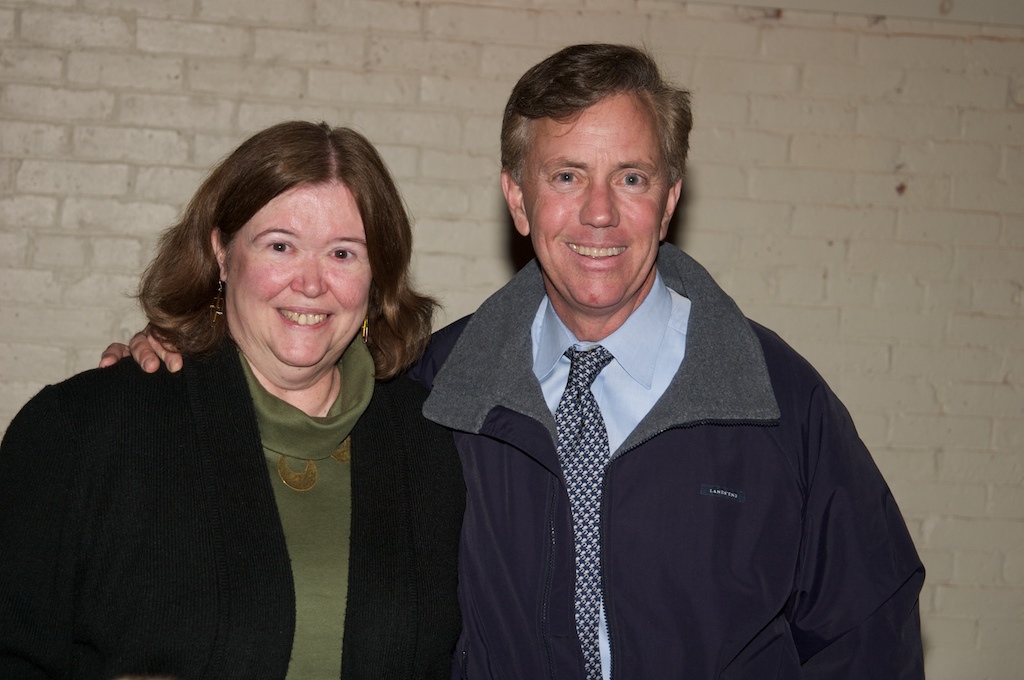
I’ve finally gotten around to editing the still pictures that I took at Thursday’s Drinking Liberally. There aren’t that many. Below, Liz Duarte and Ned. Liz was primarily responsible for getting Ned to come.

You can see the lot, and download any one you like, here.


Friday Night Music-Bed Sidran

I freely admit to being an amateur so far as jazz is concerned. It’s a big musical world out there, and I’ve really only explored the capital cities of jazz. (Charlie Parker, Miles Davis, Dave Brubeck, etc.) This is by way of saying that I have no idea where Sidran stands among jazz aficionados. I stumbled on Sidran through my Iphone, courtesy of WunderRadio, on which I subscribed to an all jazz radio station in New Jersey. They played a cut from an album he recorded called Dylan Different, which I proceeded to buy myself for Christmas. There tends to be a certain sameness about his Dylan takes, but they still make enjoyable listening, at least in my opinion. I could only find two live videos from the album, Highway 61 Revisited and Tangled up in Blue, both of which follow. A couple of other cuts are better than these, but alas, are not available on youtube.


Shameful

One wonders how much of this the supine Democratic Senate leaders expect those of us who pony up the campaign money to take:

Sen. Richard Shelby (R-AL) has put an extraordinary “blanket hold” on at least 70 nominations President Obama has sent to the Senate, according to multiple reports this evening. The hold means no nominations can move forward unless Senate Democrats can secure a 60-member cloture vote to break it, or until Shelby lifts the hold.

Shelby is trying to extort Obama into throwing money at his state for the earmarks Republicans are supposed to hate.

What I find mystifying (no, I really don’t find it mystifying) is that these Republican holds seem to have a vise like grip, while Reid never seems to have a problem giving the back of his hand to a hold from his own caucus. What I actually do find mystifying is the idea that there could possibly be an actual rule allowing such a hold, and if it’s only a custom, why on earth Reid and the rest would put up with this constant abuse.


Ned Lamont at Drinking Liberally

As I’ve mentioned (repeatedly, actually) Ned was a guest at our Drinking Liberally meeting last night. Here’s video of his appearance. Due to youtube’s time limits, I’ve cut the video into two, splitting it at a rather arbitrary point. I got home late last night, so I really didn’t have the time for anything too sophisticated, not that I know much about video editing anyway. The lighting was not great, by the way, which accounts for the rather muddy video.

So, without further ado, part 1:

Part 2:

Ned was a big draw. My wife counted about 35 people while he was there, and some more drifted in after he left. That’s not to imply that he just spoke and left; he hung around quite a while, chatting with just about everyone there. Some folks just got there extremely late.

I took some still pictures, but haven’t had the time to deal with them. I told some folks there that I would post them, which I’ll do later, as an update to this post.